
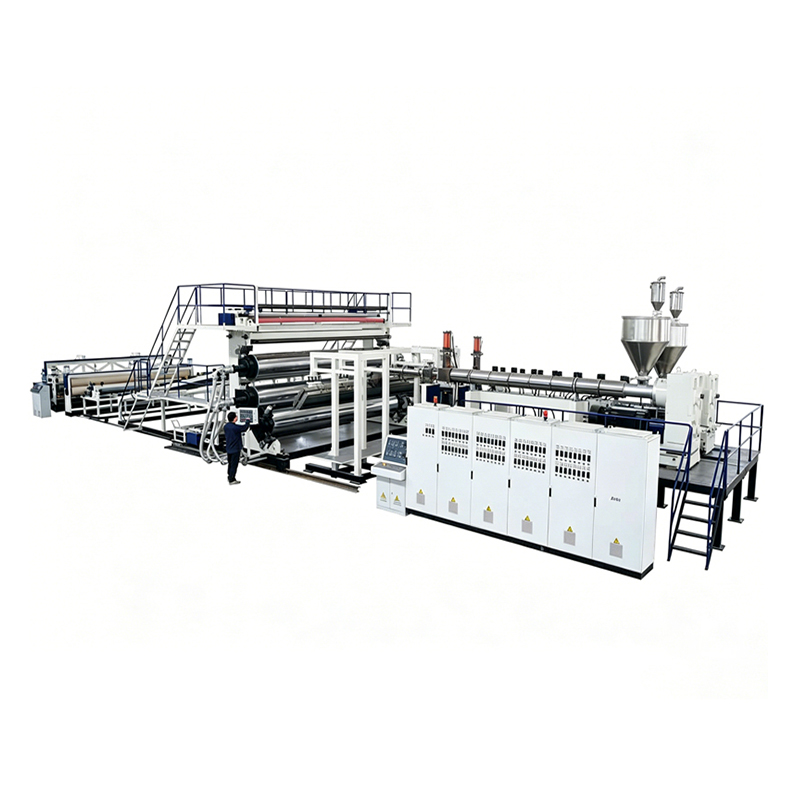
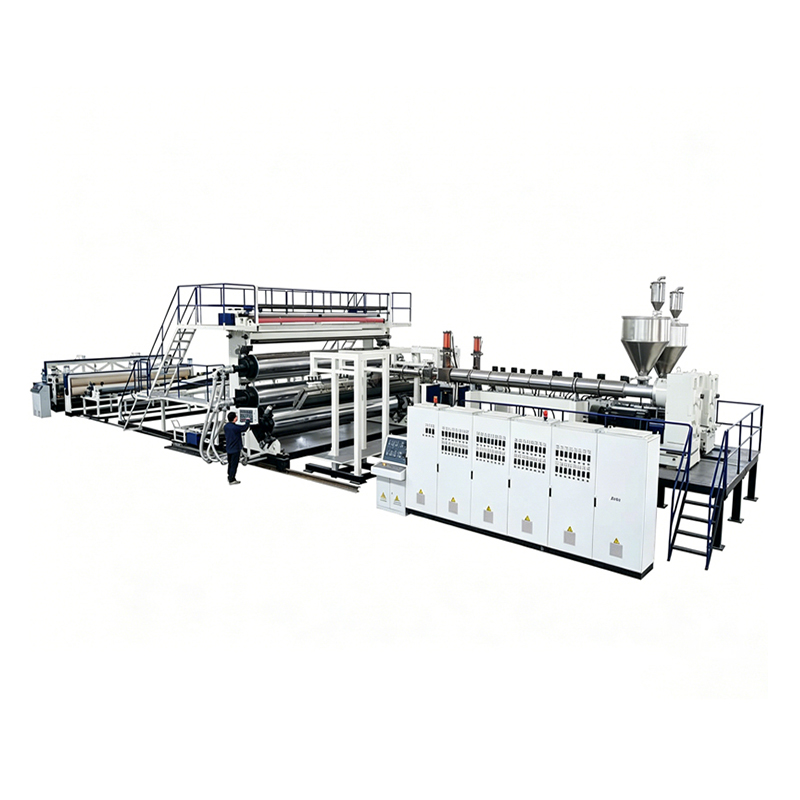
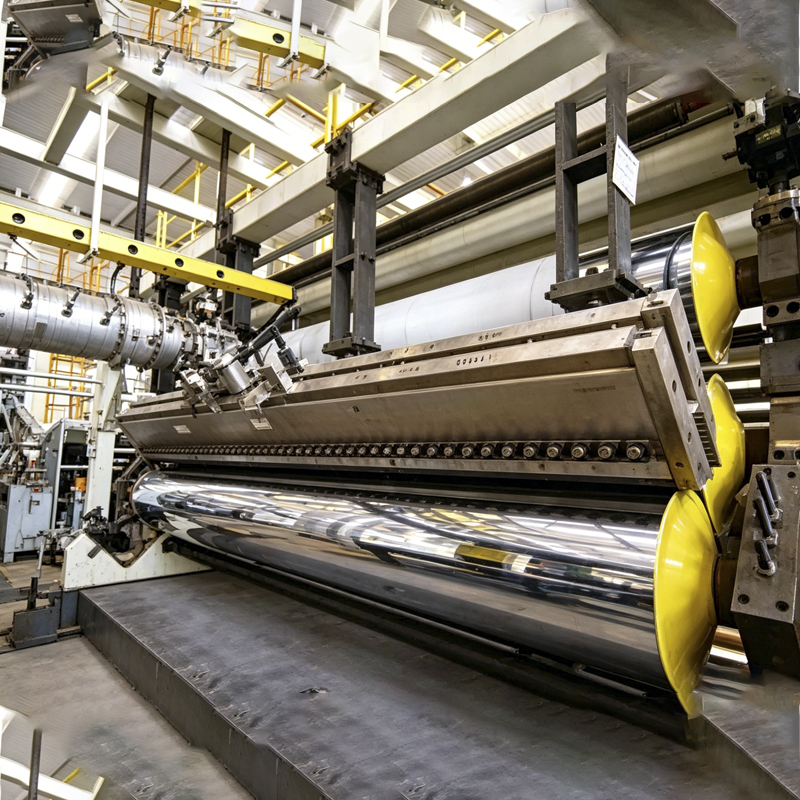

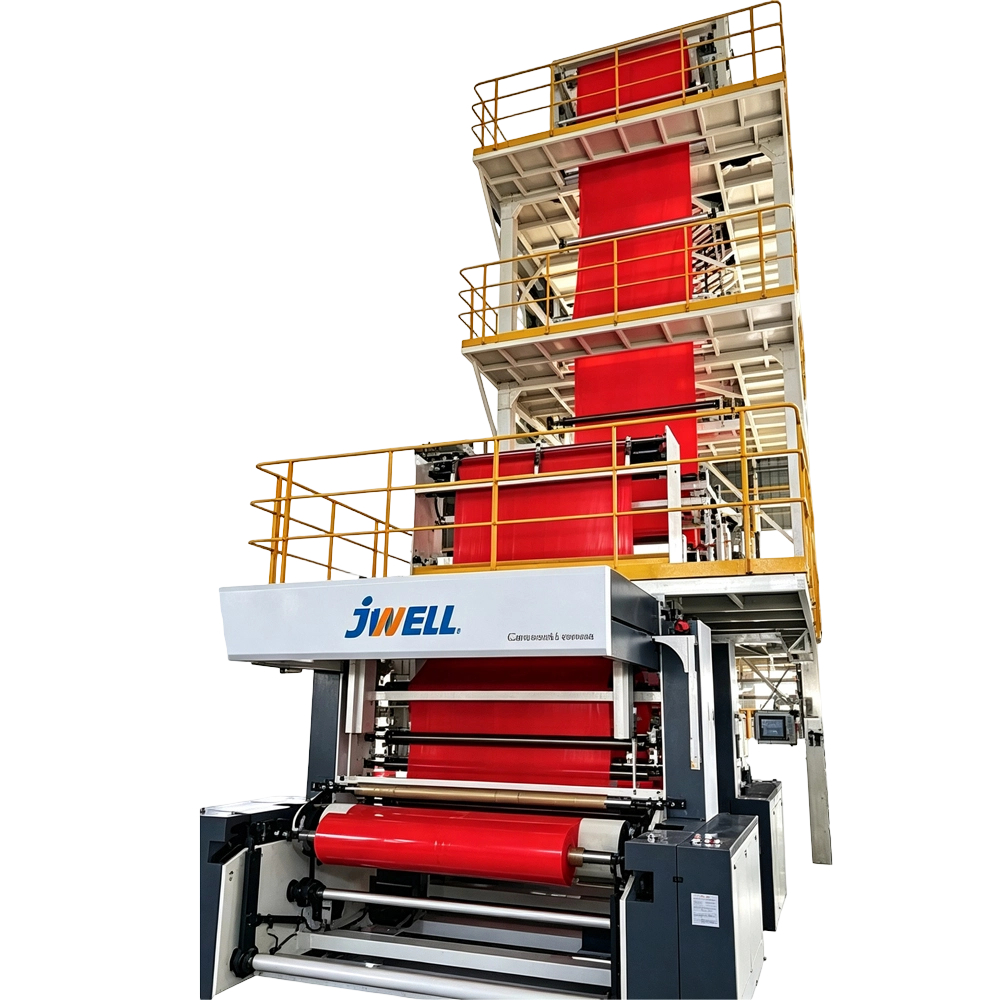
The 8m Geomembrane, Waterproof Sheet Extrusion Line is a high-output co-extrusion line specifically designed for producing non-woven – PE – non-woven composite geomembranes and waterproof sheets. With a maximum finished product width of 8000 mm (8 meters) and a designed output of 3000 kg/h, this line is intended for large-scale civil engineering and environmental projects where efficiency, durability, and impermeability are critical.
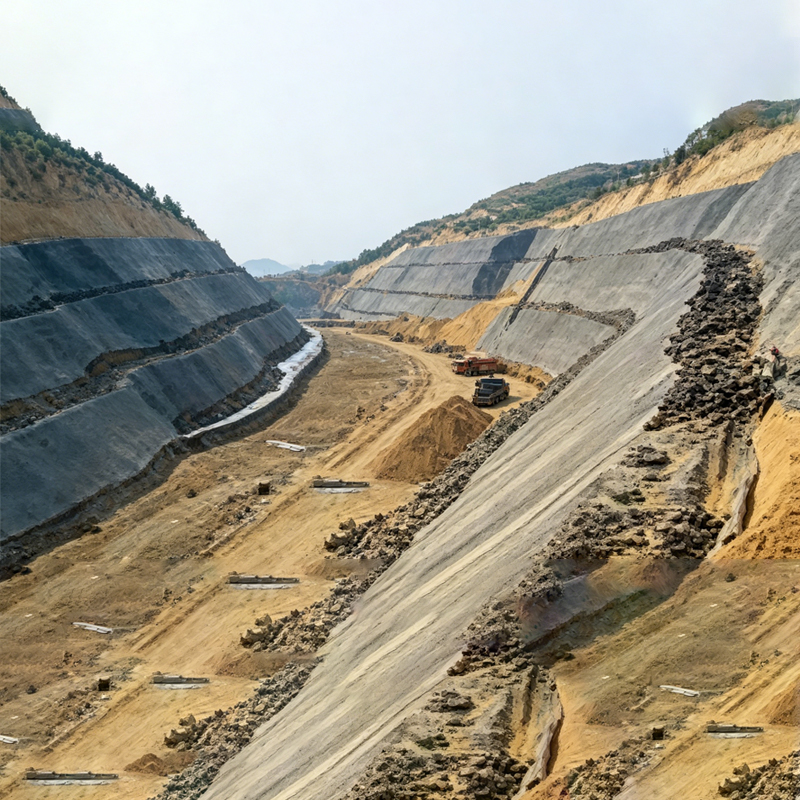
The 8-meter wide geomembranes produced by the JW200-8000 line are widely used in:
·Landfill Liner & Cover Systems – Prevents leachate from contaminating groundwater. A recent project in Southeast Asia used 8-m wide geomembranes to cover a 200,000 m² landfill, reducing field seams by 35% compared to standard 4-m wide rolls.
·Mining Heap Leach Pads – Resists acidic or alkaline solutions. The three-layer structure (non-woven + PE + non-woven) provides chemical resistance and mechanical protection.
·Hydraulic Works (Canals, Reservoirs, Dams) – The 1–3 mm thickness range allows customization according to water pressure requirements. For example, a dam rehabilitation project in Chile used 2.5 mm thick, 8-m wide geomembranes to speed up installation on steep slopes.
·Floating Covers for Drinking Water Reservoirs – The non-woven outer layers inhibit algae growth and protect the PE core from UV degradation.
·Tunnel Waterproofing – The fabric layers improve adhesion to shotcrete or concrete linings.
The JW150-4000 (4 m width, 0.8–3 mm thickness, 1500 kg/h) is suitable for smaller projects or where transportation/installation constraints exist, such as roof waterproofing or small farm ponds.
|
Parameter |
Value |
Benefit |
|
Product width |
8000 mm |
Fewer longitudinal seams → reduced leakage risk, 30–40% faster installation |
|
Extruder model |
Dual JWS200/35 |
Each extruder independently controlled, achieving symmetric melt flow and ensuring thickness uniformity across 8 m width |
|
Design output |
3000 kg/h |
High output lowers production cost per square meter; enables just-in-time delivery for large orders |
|
Thickness range |
1–3 mm |
Versatility: thinner for liners, thicker for high-stress applications such as tailings ponds |
|
Structure |
Non-woven – PE – Non-woven |
Excellent puncture resistance (non-woven acts as cushion) + high tear strength + dimensional stability |
Specific engineering benefits:
·Lower welding costs – With 8-m wide rolls, a 10,000 m² site requires only about 1,250 m of field seams, compared to about 2,500 m with 4-m wide rolls.
·Excellent stress distribution – Dual JWS200/35 extruders (L/D ratio 35:1) ensure complete homogenisation of additives (carbon black, antioxidants) even at 3000 kg/h.
·Lower specific energy consumption – Optimised screw design reduces specific energy consumption to ≤0.28 kWh/kg (typical for JWS series).
The JW line integrates both online and offline quality controls, complying with GRI GM13 (for geomembranes) or ASTM D7466 standards.
3.1 Online (continuous) monitoring
Automatic thickness gauge – Ultrasonic or laser sensors traverse the 8 m width, measuring more than 20 points per meter. Tolerance: ±3% of nominal thickness (e.g., ±0.06 mm for a 2 mm sheet).
Width control system – Edge trimming device with feedback loop maintains ±10 mm precision.
Melt pressure and temperature sensors – Installed on each extruder die; alarms are triggered if deviation exceeds ±2°C or ±5 bar.
3.2 Offline (laboratory) tests – per roll
|
Test |
Standard |
Acceptance criteria (for 2 mm PE geomembrane) |
|
Tensile strength (MD/TD) |
ASTM D6693 |
≥30 kN/m (MD), ≥27 kN/m (TD) |
|
Elongation at break |
ASTM D6693 |
≥600% |
|
Puncture resistance |
ASTM D4833 |
≥400 N |
|
Tear resistance |
ASTM D1004 |
≥150 N |
|
Hydrostatic pressure resistance |
ASTM D751 |
No leakage for 1 hour at 0.7 MPa |
|
Carbon black content |
ASTM D1603 |
2.0 – 3.0% (uniformly dispersed) |
|
Oxidative Induction Time (OIT) |
ASTM D3895 |
≥100 min (standard) or ≥400 min (HDOIT) |
3.3 Real-life case
A customer in Indonesia required 1.5 mm thick geomembranes for shrimp pond liners. During QC, the laboratory found that after 72 hours of continuous operation, local thickness deviations exceeded 5% due to die lip build-up. The operator cleaned the die and recalibrated the automatic thickness gauge; subsequent rolls passed the ±2.5% tolerance. The line’s data logging system provided full traceability.
| Model | JW150-4000 non-woven fabric-PE-non-woven fabnic | JM200-8000(non-woven fabric-PE-non-woven fabric) |
| Products width | 4000mm | 8000mm |
| Products thickness | 0.8-3mm | 1-3mm |
| Extruder model | JWS150/35+JWS150/35 | JWS200/35+JWS200/35 |
| Capacity | 1500kg/h | 3000kg/h |
Q1: Can the JW200-8000 produce smooth or textured geomembranes?
A: Yes. The standard configuration produces smooth sheets. For textured (embossed) surfaces, we offer an optional embossing roll unit installed after the calender. The non-woven lamination process is unaffected.
Q2: How is thickness uniformity maintained across the 8-m width at 3000 kg/h?
A: Dual JWS200/35 extruders feed a wide-slot die with automatic flexible lip adjustment (thermal or mechanical control). The die’s coat-hanger flow channel geometry is optimised by CFD simulations for our specific melt index range (MFI 0.3–2.0 g/10min). In addition, the thickness gauge’s feedback loop adjusts the die bolts in real time.
Q3: What are typical roll dimensions and weight?
A: For an 8-m wide × 2 mm thick × 100 m long roll, the weight is approximately 2500 kg (PE density 0.95 g/cm³). Our line includes a heavy-duty winder capable of handling 3000 kg rolls. Non-woven rolls are loaded on independent unwind stands with tension control.
Q4: How often should the extruder screws be inspected?
A: For JWS200/35 screws (chrome-plated or bimetallic), when processing virgin PE + carbon black, we recommend a visual inspection every 2000 operating hours. If using regrind, reduce to 1000 hours. The line’s maintenance reminder system logs running time.
Q5: What is the lead time for an 8-m extrusion line?
A: Standard lead time is 120–150 days after order confirmation (including factory acceptance testing). We can expedite to 90 days. The JW150-4000 typically takes 90–120 days.
Q6: Can different core materials (LLDPE, HDPE, PVC) be used on the same line?
A: The JW series is optimised for HDPE/LLDPE (MFI ≤1.0 for geomembrane applications). Switching to PVC requires a different screw geometry (barrier-type) and a different die temperature profile. We can offer multi-purpose barrel/screw sets as an option. Please contact our engineers for specific material trials.
Q7: How is oxidation prevented during high-speed production?
A: The extruder is equipped with a nitrogen purging system for the hopper throat and sealed melt pipes. Additionally, the barrel has 5 precisely controlled temperature zones to avoid degradation hot spots. Typical residual OIT retention after processing is >85%.




Pipe Extrusion Production Line
Plastic Shredder Crusher Machine

Tel: +86-19057068112

E-mail: [email protected]

Company Address
No. 128 Qingfeng Road, Xieqiao Town, Haining City, Jiaxing City, Zhejiang Province

19057068112

 English
 русский