
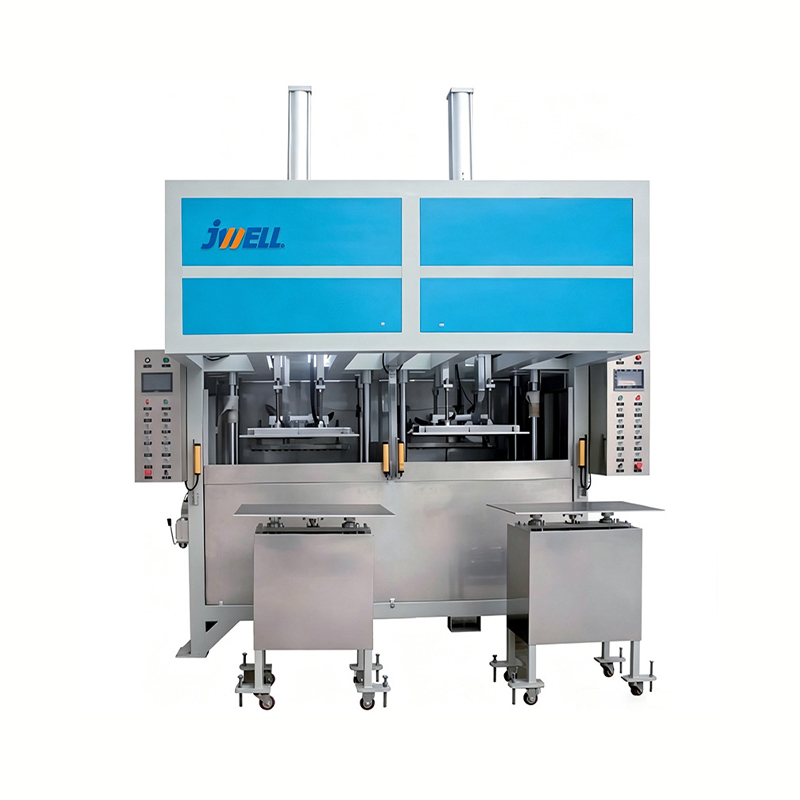
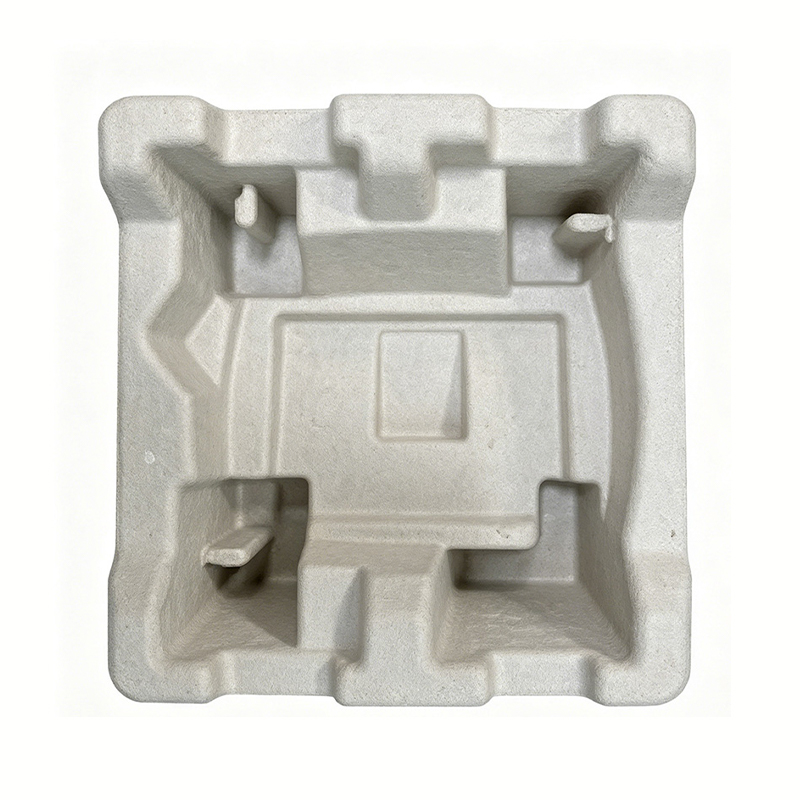
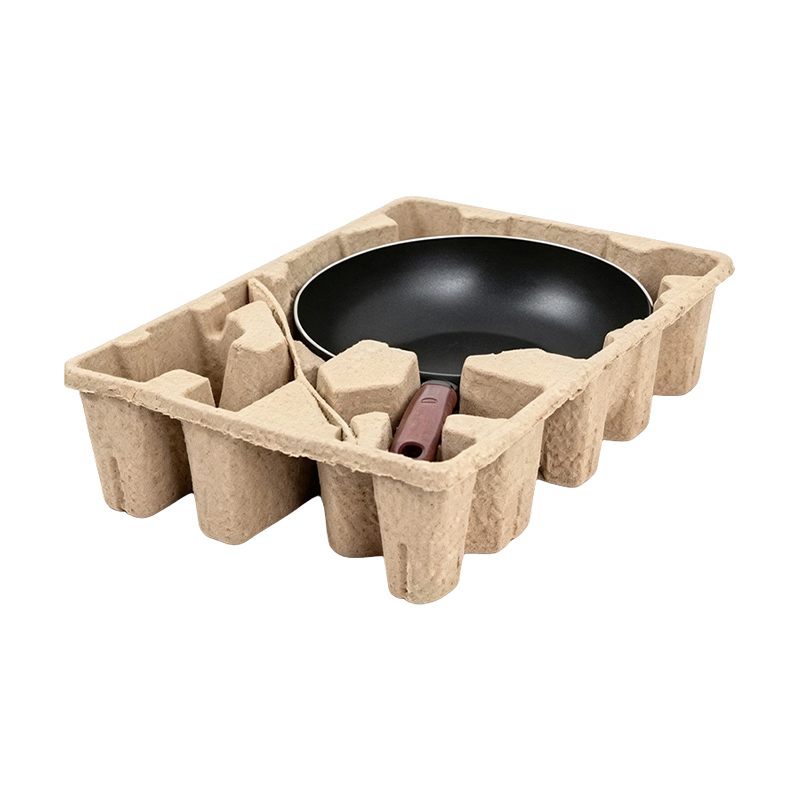
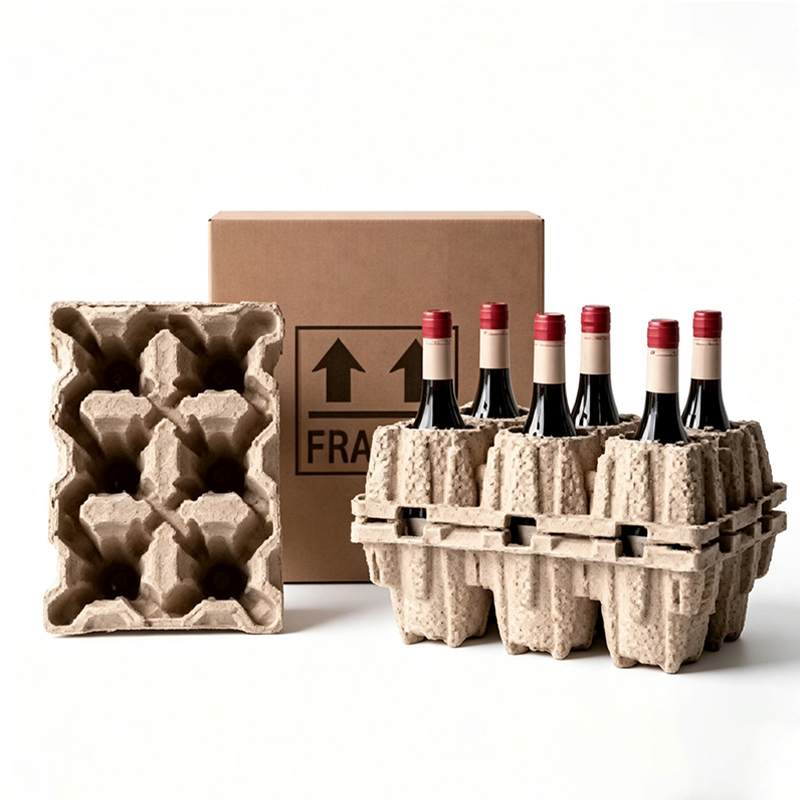
The semi-automatic paper-plastic industrial packaging forming system is specifically designed for the production of industrial-grade molded pulp packaging (commonly referred to as "dry-pressed" or "transfer-molded" packaging). Unlike egg-tray machines, this equipment focuses on thick-walled, high-cushioning structural components.
Typical finished products include:
Electronic cushioning pads: Corner protectors and base trays for servers, televisions, and washing machines (the 800×600 mm table size accommodates large appliance bases).
Automotive component liners: Pulp inserts for brake disc transport and dashboard assembly protection.
Industrial tool inserts: Customized pulp housings for heavy wrenches, power tools, or bearing seats.
Custom fragile-article carriers: Specialty packaging for glassware or ceramic sanitary ware, requiring cavity depths >80 mm.
Real-world example: A Southeast Asian home appliance manufacturer uses this model to produce washing machine base pads. Each mold cycle takes 12 seconds, with 2 stations, yielding approximately 600 pieces per hour (depending on manual screen placement). This replaces EPS foam, reducing packaging material costs by 18% while improving impact resistance in drop tests.
The machine's mechanical design delivers significant operational and economic benefits.
1. Space-Saving Rigid Structure
Dimensions: L3100 × W2160 × H3800 mm – the compact footprint allows the machine to fit in standard workshops (clear height under 4 m), eliminating the need for dedicated high-bay storage and reducing facility modification costs.
Machine weight: 2.0 tons – sufficient dead weight minimizes vibration during high-speed reciprocating motion, ensuring uniform wet-fiber distribution and avoiding "fiber drift" (uneven wall thickness).
2. Pneumatic-Hydraulic Hybrid Power
Power source: Pneumatic cylinders – unlike pure hydraulic systems that are prone to oil leakage contaminating the pulp slurry, pneumatic cylinders provide clean ISO-standard actuation. This ensures that the maximum product height of 80–100 mm is formed under stable compression, preventing edge cracking in deep cavities.
3. Critical "External Drying" Process
Drying method: Off-mold drying – this is a key maintenance advantage. The mold remains at room temperature during forming. Unlike hot-pressing systems where thermal expansion causes mold wear, this significantly extends the service life of expensive electroformed nickel or copper mesh molds.
4. Efficient Transfer Logic
Transfer method: In-mold transfer – the product remains on the male/female mold until pneumatically blown onto a pneumatic lift platform. This avoids deformation commonly caused by free-fall dropping, ensuring finished-part tolerances remain within ±0.5 mm, meeting precision industrial nesting requirements.
To ensure the 8–16-second cycle time does not compromise quality, we implement a three-stage inspection process:
Stage 1: Raw Slurry Concentration Test (Pre-Production)
Frequency: Every 2 hours.
Method: Use a Brecht-Fetzer consistency meter. The slurry concentration must be maintained at 1.5% – 2.0%. If deviation occurs, the continuous feeding system automatically adjusts the dilution water valve. The operator manually checks the beating degree (Schopper-Riegler value) to ensure fiber length is sufficient for forming 80-mm-deep cavities.
Stage 2: In-Mold Wet-Green Strength Spot Check (During Production)
Frequency: 1 piece per station every 30 minutes.
Method: The operator removes the wet blank from the pneumatic platform and inspects corners for "mesh tearing". With two stations alternating, the operator uses the alternating gap (approx. 4–6 seconds) to visually check for screen clogging, which directly affects the maximum 16-second cycle time.
Stage 3: Final Dry Product Physical Testing (At Shift Change)
Drop test: Finished products (simulating the actual weight of a TV or power tool) are dropped from 1.2 m onto a concrete floor to verify the dynamic cushioning curve.
Dimensional check: Vernier calipers are used to measure the 800×600 mm outer edges and internal reinforcing ribs. Our in-mold transfer method ensures shrinkage during external drying remains stable at 0.8% – 1.2%.
Moisture content: A handheld moisture meter is used; the acceptable range is 8% – 12%. If exceeded, an alarm triggers, reminding the operator to extend external drying time (adjust the drying tunnel conveyor speed).
| Outer dimension | L3100*W2160*H3800mm |
| Platen size | 800*600mm or customize |
| Equipment weight | 2.0T |
| Forming method | Reciprocating |
| Max. product height | 80-100mm |
| Pulp feeding style | Continuous supply of slurry |
| Drying method | Drying outside the mold |
| Product transfer method | Wet embryo transfer method |
| Power mode | Cylinder |
| Material receiving method | Pneumatic lifting platform |
| Number of work stations | 2 positions |
| Capacity | Related to product shape and labor efficiency |
| Cycle time | 8-16 seconds/drop |
Q1: The parameters state "production capacity depends on product shape and manual efficiency." How is actual daily output calculated?
A1: The machine is semi-automatic. Two stations produce one set every 8–16 seconds (theoretically 450–1125 molds/hour). However, for complex shapes close to 100 mm in height, forming time is longer (near 16 seconds). Additionally, the operator must place the upper mold screen and remove wet products from the pneumatic platform. We recommend calculating at 70% efficiency: 2 stations × 3600 s / 12 s (average) × 70% = about 420 effective mold cycles/hour. For flat, shallow trays (e.g., 30 mm height), production can approach the 8-second limit.
Q2: How does the "pneumatic lift platform" used for receiving affect quality?
A2: This platform gradually descends as product stacks accumulate. It ensures that wet, fragile blanks experience a vertical drop of less than 50 mm each time, preventing impact marks and internal fiber breakage. Without this platform, products >80 mm in height would collapse under their own weight if dropped from 300 mm.
Q3: Can non-standard mold sizes be customized?
A3: Yes. The standard table size is 800×600 mm, but the specification clearly states "or customized." We can adjust the mold base to accommodate your specific product dimensions. However, the maximum product height remains limited to 80–100 mm. If your product depth is 150 mm, we recommend our "dual-suction" model (custom development required).
Q4: What are the daily maintenance requirements for the "continuous feeding system"?
A4: Due to reciprocating forming, the slurry tank vibrates. Daily checks of the flexible rubber joints connecting the slurry pump and the forming tank are mandatory to avoid leaks. Weekly cleaning of the "strainer" (typically 40-mesh) is required to prevent pinhole defects on product surfaces.
Q5: Why choose "external drying" over "internal hot-press drying"?
A5: Internal drying (hot pressing) requires heating elements within the mold, causing thermal expansion that deforms the mesh and leads to dimensional inaccuracies. Our external drying method allows you to use a separate drying line (e.g., a tunnel oven) while maintaining constant temperature. Your mold service life increases by 2–3 times (saving approximately $1,500/year in mold repair costs), and you can process thicker, heavier industrial products without the risk of "baking cracks."




Pipe Extrusion Production Line
Plastic Shredder Crusher Machine

Tel: +86-19057068112

E-mail: [email protected]

Company Address
No. 128 Qingfeng Road, Xieqiao Town, Haining City, Jiaxing City, Zhejiang Province

19057068112

 English
 русский