
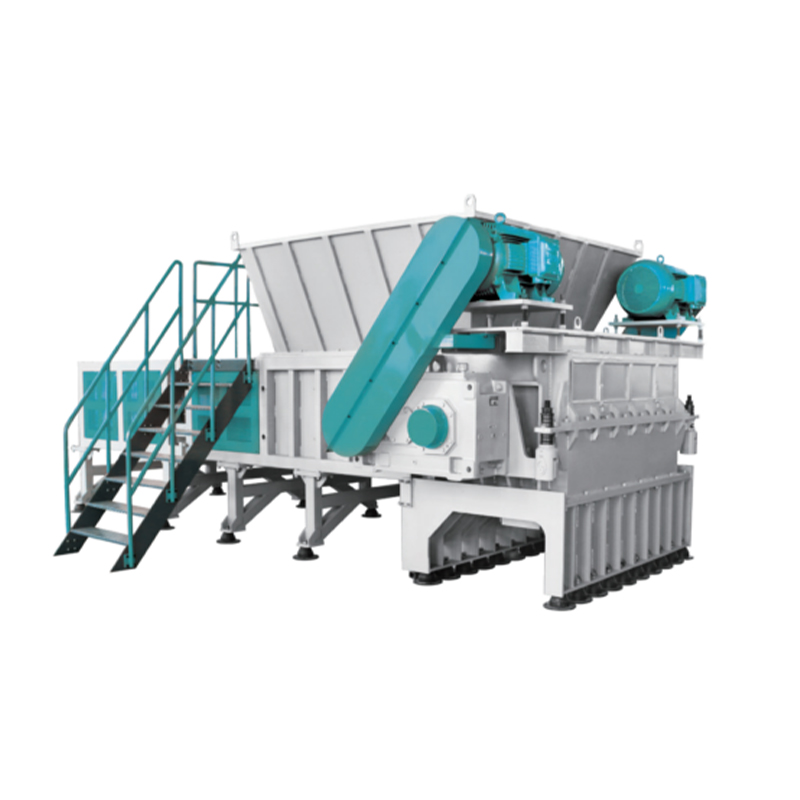
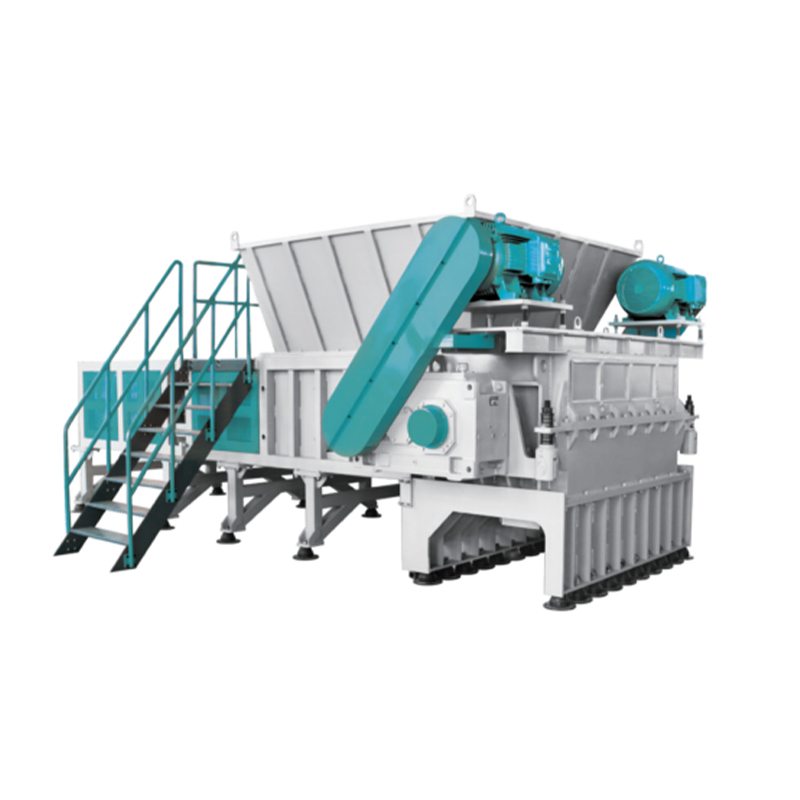
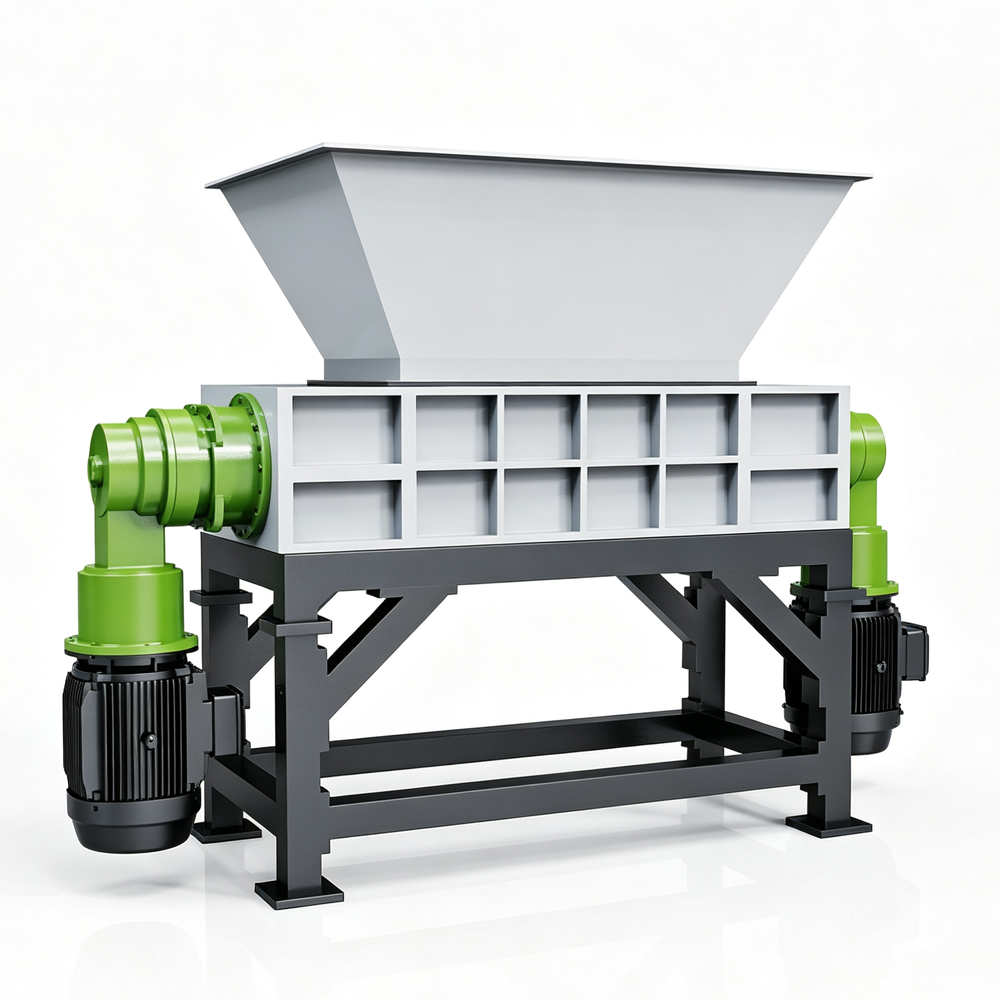
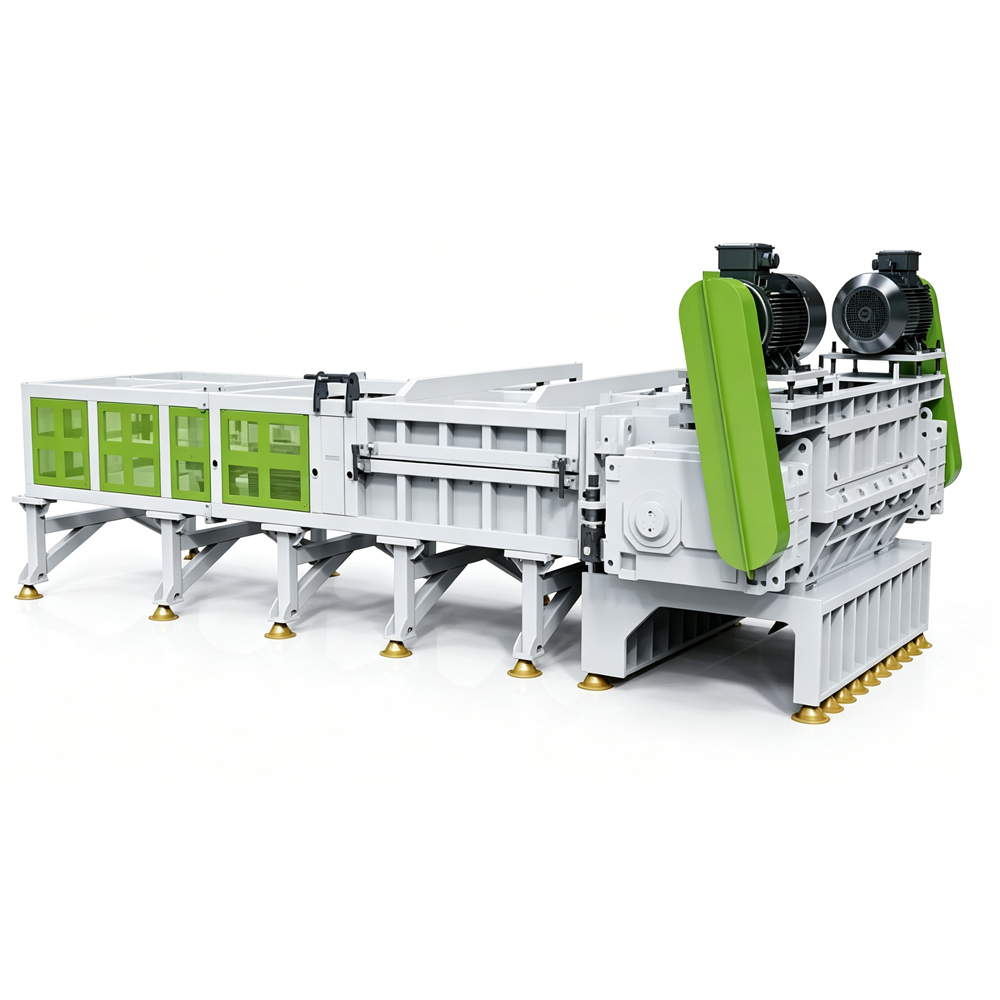
The JWsSZ Series Heavy Single-shaft Shredder is specifically designed for continuous, high-torque shredding of bulky and hard materials. This series features a large-diameter rotor of Φ750 mm and dual-drive power options ranging from 2×55 kW to 2×132 kW, converting troublesome waste streams into uniformly sized shredded material.
Thanks to its large crushing chamber (up to 1800×2800 mm) and high number of rotor blades, the JWSSZ series is trusted in heavy-duty recycling lines worldwide.
Case – Plastic Recycling (Mexico)
A recycler processing post-consumer HDPE drums and industrial plastic lumps (up to 50 mm thick) installed one JWSSZ-2500 (2×90 kW, 177 moving blades). Previous shredders often jammed on lumps. The JWSSZ’s stepped rotor and more stationary blades (12 pcs) reduced feed blockage downtime by 70%, producing uniform 40-60 mm flakes directly into the washing line.
Case – Wood & Biomass Preparation (Canada)
A pallet recycling plant switched to a JWSSZ-2000 (2×75 kW, 147 moving blades) to shred whole hardwood pallets and construction offcuts. The Φ750 mm rotor diameter provides high rotational inertia, allowing it to crush nails and metal contaminants without stopping. Output size ≤80 mm feeds directly into a hammer mill, increasing overall line efficiency by 35%.
Other common applications:
E-waste (TV housings, ABS plastic shells)
Cable scrap (pre-shredding before separation)
Aluminum profiles and light metal scrap (optional wear-resistant coating available)
Textile waste and carpet rolls
A. Large Rotor Inertia – Φ750 mm Diameter
Unlike smaller rotors (typically Φ400–600 mm), the 750 mm diameter stores more kinetic energy. This means fewer power spikes, less belt slippage, and the ability to shred thick, elastic materials (e.g., rubber, industrial film) without frequent reversal.
B. Dual Drive & Smarter Power Distribution
|
Model |
Power |
Moving Blades |
Stationary Blades |
Best for… |
|
JWSSZ-1600 |
2×55 kW |
117 |
8 |
Medium-output plastics, wood, paper rolls |
|
JWSSZ-2000 |
2×75 kW |
147 |
10 |
Pallets, e-waste, cable drums |
|
JWSSZ-2500 |
2×90 kW |
177 |
12 |
Lumps, thick-wall pipes, carpet rolls |
|
JWSSZ-3000 |
2×132 kW |
218 |
14 |
Whole car bumpers, baled textiles, large aluminum profiles |
The dual motors drive through heavy-duty gearboxes, ensuring torque balance even at low speeds – ideal for high-torque, low-speed shredding that reduces dust and noise.
C. Blade Configuration – More Cuts Per Revolution
Each JWSSZ series has 117–218 moving blades and 8–14 stationary blades, giving a much higher cutting density than standard single-shaft shredders. One pass produces more uniform particle size, often eliminating the need for a secondary screen change.
D. Large Crushing Chamber – From 1500×1400 mm to 1800×2800 mm
The JWSSZ-3000 has a feed opening of 1800×2800 mm, allowing complete industrial bales or bulky mixed waste to be shredded without pre-cutting. A hydraulic ram feeder (optional but recommended) automatically pushes material into the cutting zone.
We follow a documented 6-step QA/QC protocol that simulates real-world harsh conditions. Every JWSSZ shredder is tested individually, not batch-sampled.
Step 1 – Raw Material Certification
Steel plates for the rotor and main frame come from certified mills. Blade steel (CrMo or D2 equivalent) is tested for carbon and chromium content using a spectrometer.
Step 2 – Weld Inspection
Main frame welds are 100% ultrasonic tested (UT) per ASTM E114. No porosity or undercut is allowed.
Step 3 – Rotor Dynamic Balancing
Each Φ750 mm rotor (weighing up to 3.2 tons) is dynamically balanced to ISO 1940 G6.3 at 150% of operating speed. Vibration threshold is kept below 2.5 mm/s.
Step 4 – Hydraulic & Electrical Safety Testing
We simulate emergency stops, overload reversal cycles, and door interlock faults. The PLC logic is validated per EN 60204-1.
Step 5 – Full-Load Test with Real Materials
Your model is fed with actual waste samples (if provided) or our standard test mix: 40% hardwood blocks, 30% PP lumps (40 mm thick), 20% aluminum profiles, 10% mixed cables. The shredder runs continuously for 8 hours. Recorded metrics:
Current draw of each motor
Output particle size distribution (by sieve analysis)
Bearing temperature rise (must stay within ambient +35°C)
Step 6 – Final Documentation
Each machine ships with a signed test report including vibration readings, thermal images of bearings, and a video of the on-site shredding test.
Real Quality Case:
A German customer ordered a JWSSZ-2000 for medical waste. During our internal testing, the rotor bearing temperature rose 2°C above our limit. We disassembled, found a minor raceway defect, replaced the bearing, and re-ran the 8-hour test. The machine arrived with zero issues – that customer subsequently ordered three more.
|
Model
|
Rotor Dia. (mm)
|
Drive Power (kW)
|
Rotor Blade (pcs.)
|
Fixed Blade (pcs.)
|
|
JWSSZ-1600
|
Φ750
|
2 × 55
|
117
|
8
|
|
JWSSZ-2000
|
Φ750
|
2 × 75
|
147
|
10
|
|
JWSSZ-2500
|
Φ750
|
2 × 90
|
177
|
12
|
|
JWSSZ-3000
|
Φ750
|
2 × 132
|
218
|
14
|
Q1: Can the JWSSZ shred hard materials like solid steel or heavy cast iron?
No – this is a single-shaft shredder for medium-hard to tough materials (plastics, wood, aluminum, copper cables, rubber, textiles). For scrap steel, please consider our dual-shear shredder series. However, the JWSSZ can handle occasional small bolts or nails embedded in wood/plastics without damage – the rotor and stationary blades have hardened edges (HRC 52-55).
Q2: How often do blades need replacement or resharpening?
It depends on material abrasiveness. Typical intervals:
Clean plastics/wood: 400–600 hours between resharpening
Highly filled plastics (e.g., talc-filled PP): 150–250 hours
Copper cables or aluminum: 300–450 hours
All blades are reversible (4 cutting edges). The cost of a full set of rotor blades is about 15-20% of a new gearbox – we keep stock for all models.
Q3: What is the smallest output particle size I can achieve?
Using the supplied screens:
20 mm screen → output 20–40 mm (suitable for further granulation)
50 mm screen → output 40–70 mm (for washing lines or melting)
100 mm screen → output 80–120 mm (only for pre-shredding)
For extra-fine <10 mm output, a secondary grinder is recommended.
Q4: Does the machine automatically reverse when overloaded?
Yes – the Siemens/PLC-based control detects a current spike exceeding 110% of rated load, reverses the rotor for 3 seconds, then resumes normal direction. If overload occurs three times within 2 minutes, the machine alarms and stops (prevents thermal damage).
Q5: What is the actual power consumption compared to rated power?
At typical 70-80% load factor (recommended for continuous operation):
JWSSZ-1600: consumes approx. 80–90 kW (2×55 kW motors)
JWSSZ-3000: consumes approx. 190–210 kW (2×132 kW motors)
No-load power (rotor spinning empty without feed): about 12-15% of total rated power.
Q6: Can I add a hydraulic ram feeder later?
Yes – all JWSSZ shredders come with pre-drilled mounting plates for a hydraulic ram feeder. Retrofit on-site takes about 6-8 man-hours. For fluffy materials (film, carpet, foam), we strongly recommend the ram feeder to force-feed material into the rotor.




Pipe Extrusion Production Line
Plastic Shredder Crusher Machine

Tel: +86-19057068112

E-mail: [email protected]

Company Address
No. 128 Qingfeng Road, Xieqiao Town, Haining City, Jiaxing City, Zhejiang Province

19057068112

 English
 русский