
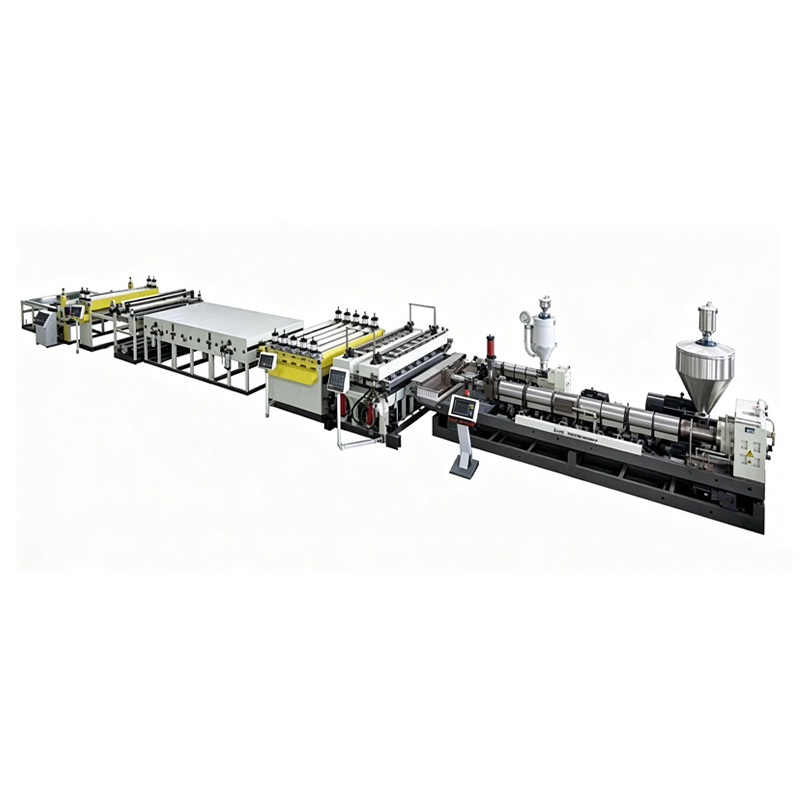
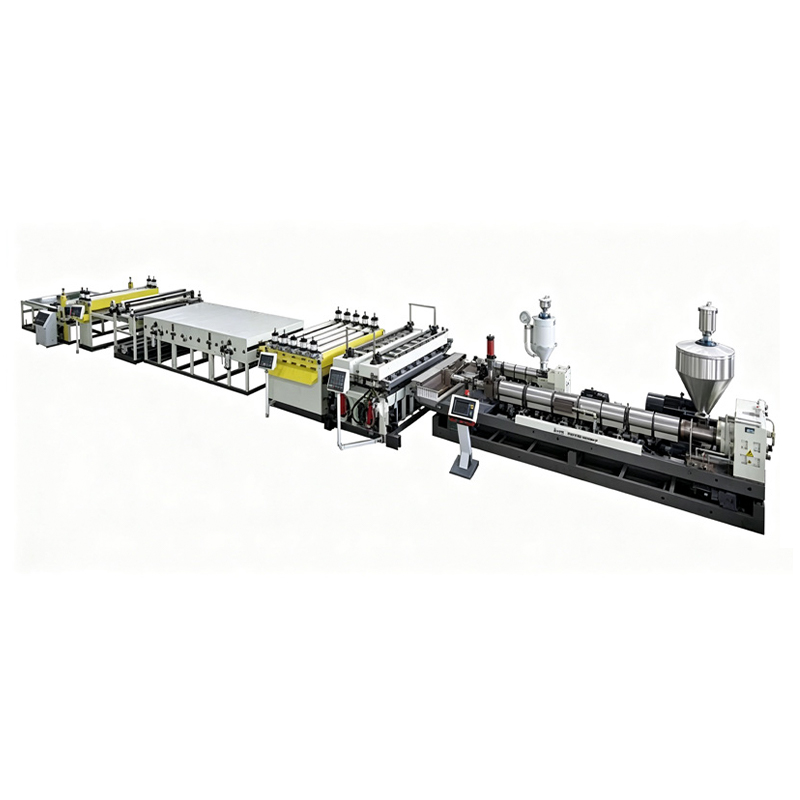
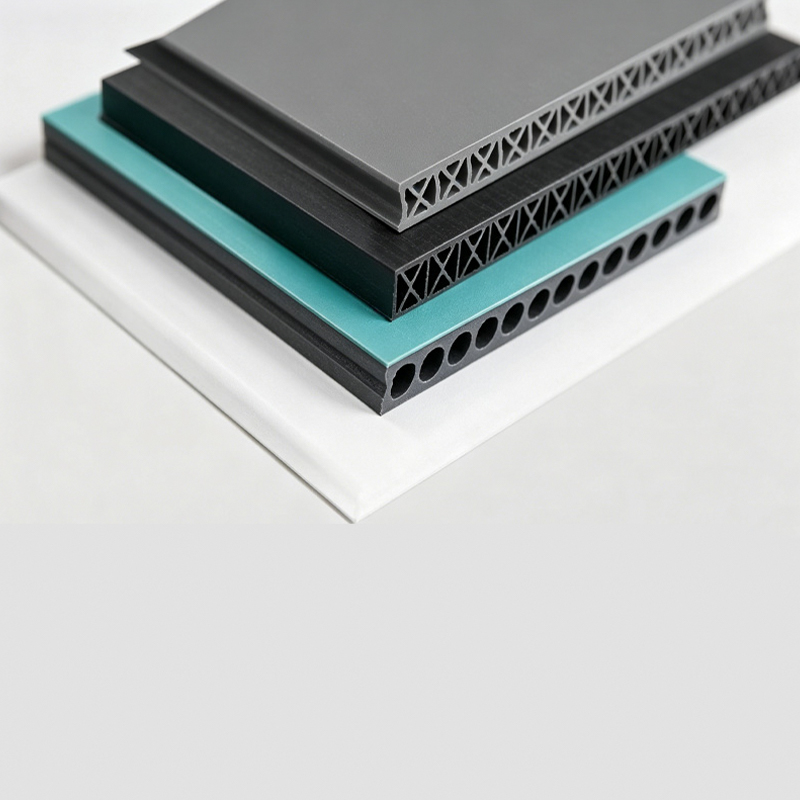
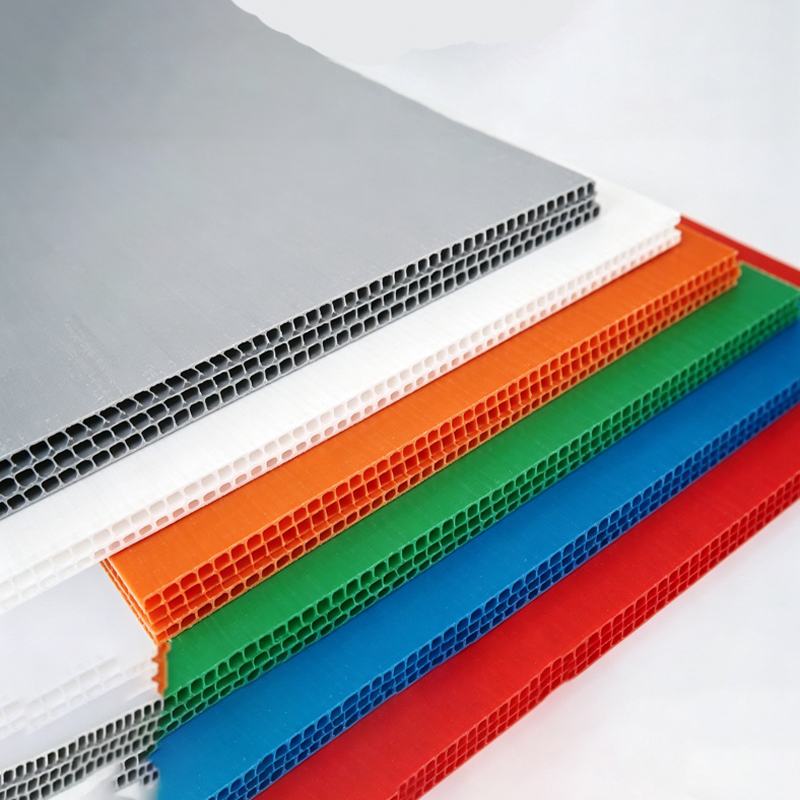
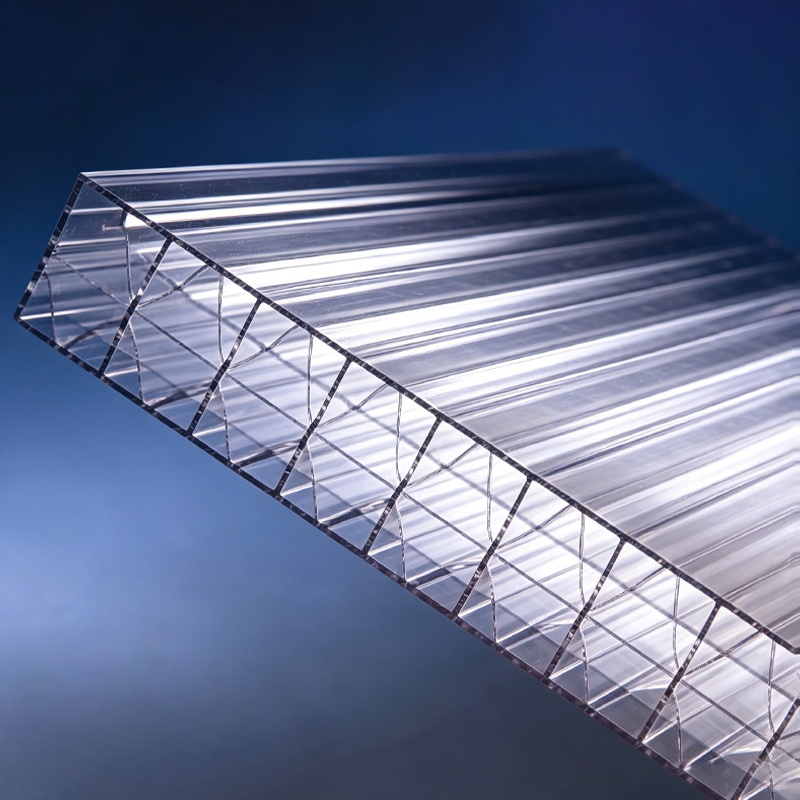
The PC / PP / PE hollow core sheet extrusion line is a high-performance production system specifically designed for manufacturing lightweight, high-rigidity, and impact-resistant hollow core sheets. This equipment line comprises three model configurations: JW130/35+JW45/30, JW120/38+JW45/30, and JW120/30. These models are tailored for different raw materials (PC, PP, PE) and can produce sheets with a width from 1300mm to 2100mm and a thickness from 2mm to 40mm, with a maximum extrusion output of 350–600 kg/h.
Thanks to its wide material compatibility and dimensional range, this extrusion line serves multiple industries:
A. Polycarbonate (PC) Hollow Core Sheets – Models JW130/35+JW45/30 and JW120/38+JW45/30
Thickness range: 2–40mm (first model) / 2–10mm (second model)
Width: up to 2100mm or 1300mm
Output: 400–600 kg/h
Typical uses:
Greenhouse glazing sheets (4–10mm thick, UV co-extruded PC sheets) – A customer in the Netherlands uses the JW130/35 line with 2100mm width to produce 8mm twin-wall sheets, reducing greenhouse construction time by 30% due to fewer sheet joints.
Highway sound barriers (10–20mm thick) – PC's high impact strength (over 200 times stronger than glass at the same thickness) makes it ideal for noise reduction panels.
Industrial machine guards – Combines light transmission with durability, replacing metal mesh.
Digital printing billboards – Flat, rigid surface (2–5mm thick).
B. PP / PE Hollow Core Sheets – Model JW120/30
Thickness range: 2–8mm
Width: 1300mm
Output: 350 kg/h
Typical uses:
Returnable transport packaging (corrugated PP sheets) – A German logistics company replaced wooden boxes with 4mm PP hollow core sheets, reducing weight by 60% and achieving over 100 stacking cycles.
Pallet divider sheets – Anti-slip, moisture-proof.
Temporary ground protection on construction sites – Lightweight and recyclable.
Stationery folders and binders – Customizable colors, low cost.
|
Feature |
Advantage |
Practical Impact |
|
Wide thickness range (2–40mm) |
One line can produce both thin signage sheets and thick structural panels |
SMEs avoid purchasing multiple machines; ROI increases by approx. 40% |
|
Max output 600 kg/h (PC) |
High productivity for large orders |
8-hour shift can output up to 4.8 tons – enough 9- for 1200m² of 10mm twin-wall PC sheet |
|
Co-extrusion capability (models JW130/35 and JW120/38) |
Twin extruders (main 280kW/185kW + co-extruder 22kW) |
Enables UV-resistant cap layers, colored surface layers, or recycled material core – reduces material cost by 15–20% |
|
Max width 2100mm |
Less edge trimming, lower scrap rate |
For 2100mm sheet, material utilization reaches 96%, vs. 88% for 1300mm line |
|
Energy-efficient motors |
Main motor power 132–280kW (optimized for each output) |
Energy consumption only 0.33–0.47 kWh per kg – below industry average of 0.55 kWh |
|
Specialized screw design |
Barrier screw for PC models; general-purpose screw for PP/PE |
Prevents degradation of PC (sensitive to moisture and heat) – ensures stable melt quality |
Other practical advantages:
·Fast thickness change: Adjustable die lip gap (optional electric adjustment); typical changeover time < 30 minutes.
·Low scrap rate: With closed-loop thickness measurement and control system, scrap rate during stable production is below 3% (industry standard approx. 5–8%).
·Corrosion-resistant components for PC: PC can release acidic gases when overheated; corrosion-resistant design extends die and screw life.
To ensure every meter of hollow core sheet meets international standards (e.g., ASTM D635 for flame resistance, ISO 527 for tensile strength), the extrusion line incorporates strict in-process control and final inspection protocols.
A. Online real-time monitoring
Ultrasonic thickness gauge – Installed after the calibration table; scans sheet width every 2 seconds. Tolerance: ±0.05mm.
Extruder melt pressure and temperature sensors – Triggers alarm if PC melt temperature exceeds 280°C (burning risk).
Laser width gauge – Ensures sheet width is within ±3mm of setpoint.
B. Offline laboratory tests (per shift or per batch change)
Light transmittance test (for PC greenhouse sheets) – Using haze meter; target >85% for 4mm twin-wall sheet.
Dart drop impact test (ISO 6603-2) – For 10mm PC sheet, 20kg dart dropped from 1.5m height: no rupture.
Flat crush test – Compress hollow core sheet to 50% of original thickness; must recover to >95% of original shape (PP/PE).
UV aging test (accelerated QUV) – After 1000 hours exposure, co-extruded UV cap layer retains >90% impact strength.
C. Real-world case – QC troubleshooting
A customer producing 6mm PP sheets for packaging experienced intermittent surface waviness. Our QC team traced the issue to unstable cooling water temperature in the calibration table (fluctuating between 15°C and 25°C). After installing a constant-temperature water tank (±1°C), flatness met ASTM D4802 standards. This case is now included in our commissioning checklist.
D. Final inspection before shipment
Visual inspection under polarized light for residual stress.
Dimensional check (width, thickness, length).
Certificate of analysis provided with shipment.
| Model | JW130/35、JW45/30 | JW120/38、JW45/30 | JW120/30 |
| Suitable material | PC | PC | PP、PE |
| Products width | 2100mm | 1300mm | 1300mm |
| Products thickness | 2-40mm | 2-10mm | 2-8mm |
| Main motor power | 280kw/22kw | 185kw/22kw | 132kw |
| Designed capacity | 600kg/h | 400kg/h | 350kg/h |
Q1: Can the same line produce both PC and PP/PE?
A: No – screw geometry and barrel cooling methods differ. PC requires a barrier screw with mixing and vacuum venting (to remove moisture), while PP/PE use a standard single-stage screw. The JW120/30 is dedicated to PP/PE; JW130/35 and JW120/38 are dedicated to PC. Cross-contamination degrades sheet quality.
Q2: How much start-up scrap is typical?
A: For an experienced operator, about 50–80kg of scrap is generated during die start-up and calibration (15–20 minutes). After stabilization, scrap drops to below 5kg per hour. Using an automatic screen changer and pre-heated die can reduce start-up scrap by 40%.
Q3: How is 40mm thick PC sheet achieved?
A: The JW130/35 line uses a specially designed sheet die with flexible lip and a multi-stage vacuum calibration table. Because PC is an amorphous material, slow cooling is required to avoid internal stress. Production speed for 40mm sheet is about 0.6–0.8 m/min – slower than for thin sheets, but the 600 kg/h output still ensures profitable production for construction panels.
Q4: What maintenance does the co-extruder (22kW) require?
A: The auxiliary extruder (JW45/30) processes UV masterbatch or recycled material. Due to additives, its wear is typically higher. Inspect the screw and barrel every 2000 operating hours. One customer extended service life to 8000 hours by opting for a 316L stainless steel lining (optional feature).
Q5: How to resolve warpage in PC sheet production?
A: Warpage is usually caused by uneven cooling or improper melt temperature. First, ensure uniform water temperature in the calibration table (use cross-flow piping). Second, set melt temperature to 260–270°C (do not exceed 280°C). Third, adjust pull-roller pressure: too high causes permanent deformation. Our control software includes a "warpage reduction algorithm" that automatically adjusts cooling zones based on thickness feedback.
Q6: Can colored sheets be produced without changing material?
A: Yes – install a masterbatch dosing feeder before the extruder hopper. For co-extrusion lines, add color only to the auxiliary extruder (cap layer) – this is more cost-effective. For solid color throughout, use a small volumetric dosing feeder. Color change cleaning takes about 1 hour.




Pipe Extrusion Production Line
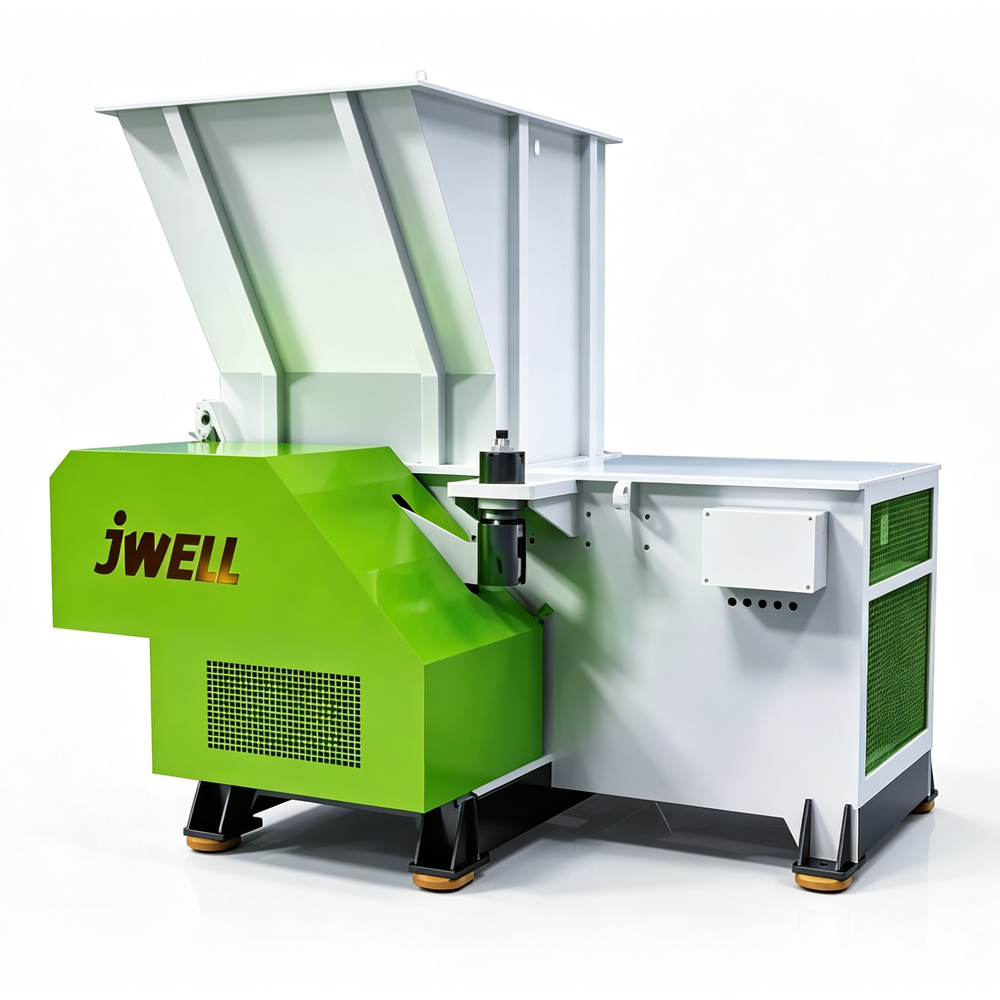
Plastic Shredder Crusher Machine

Tel: +86-19057068112

E-mail: [email protected]

Company Address
No. 128 Qingfeng Road, Xieqiao Town, Haining City, Jiaxing City, Zhejiang Province

19057068112

 English
 русский