
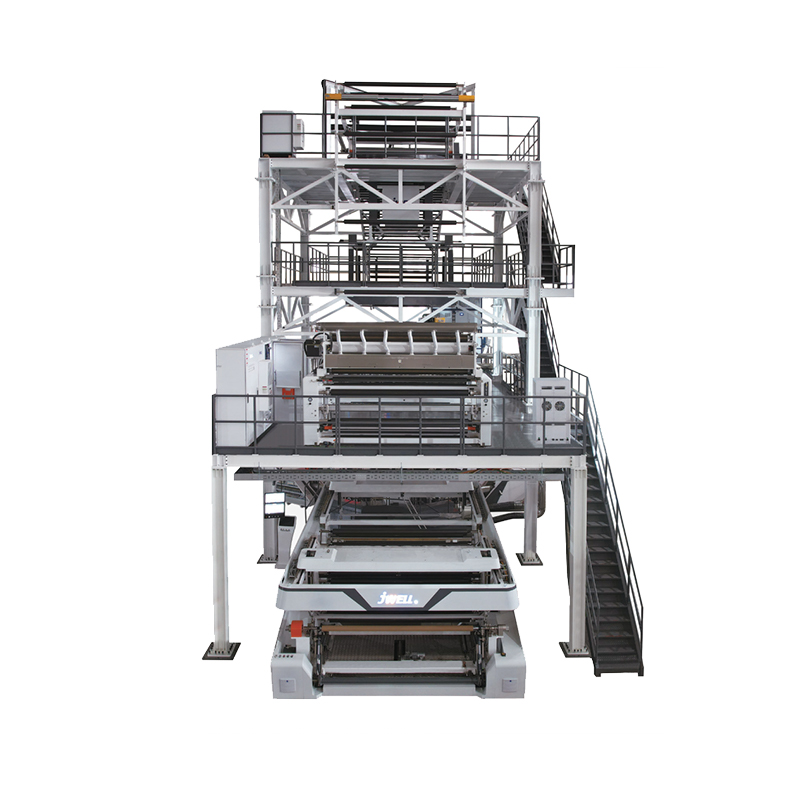
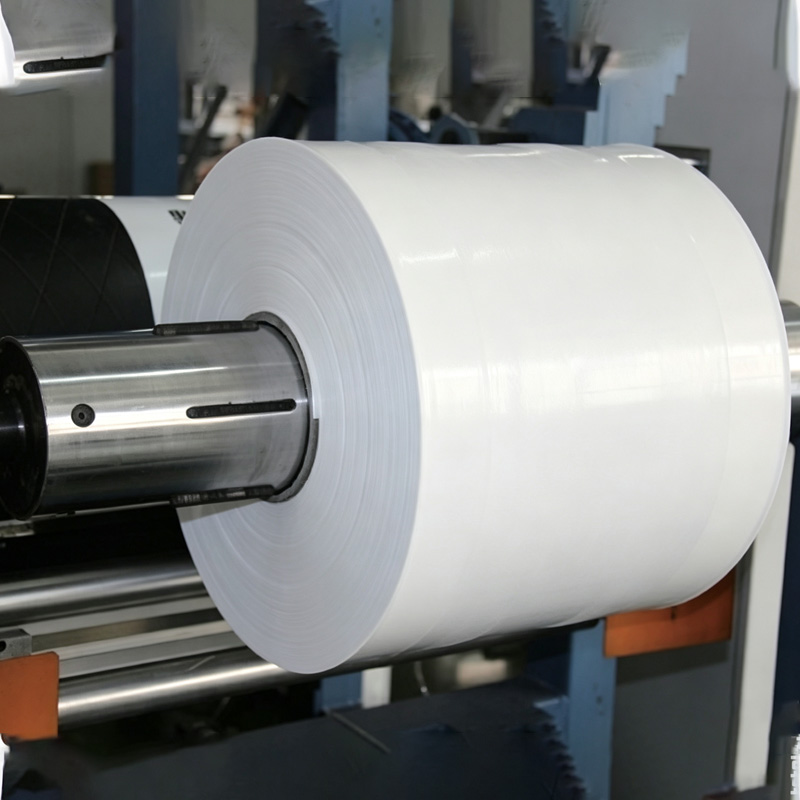
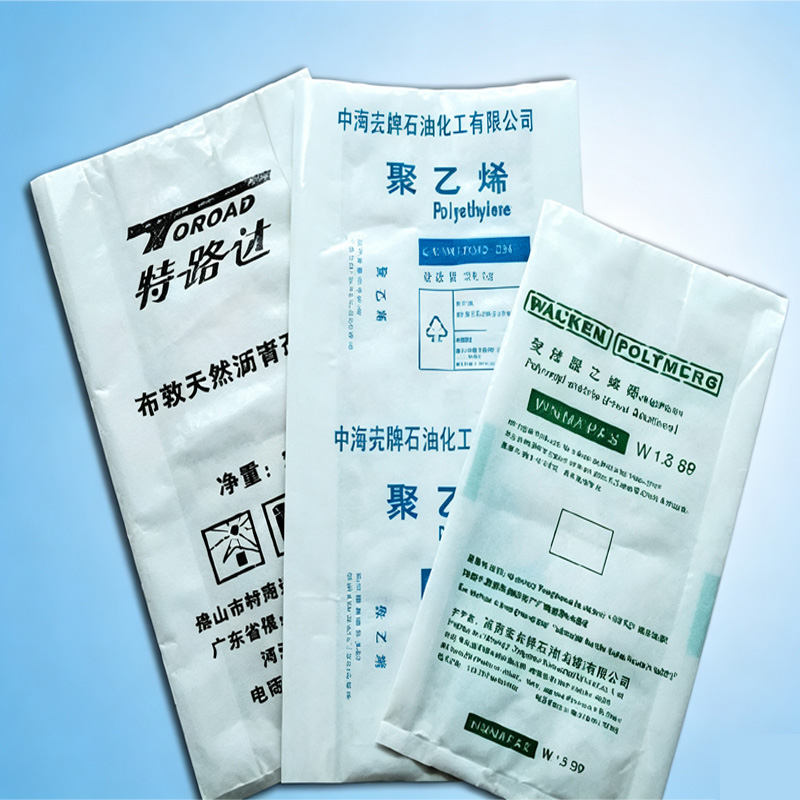
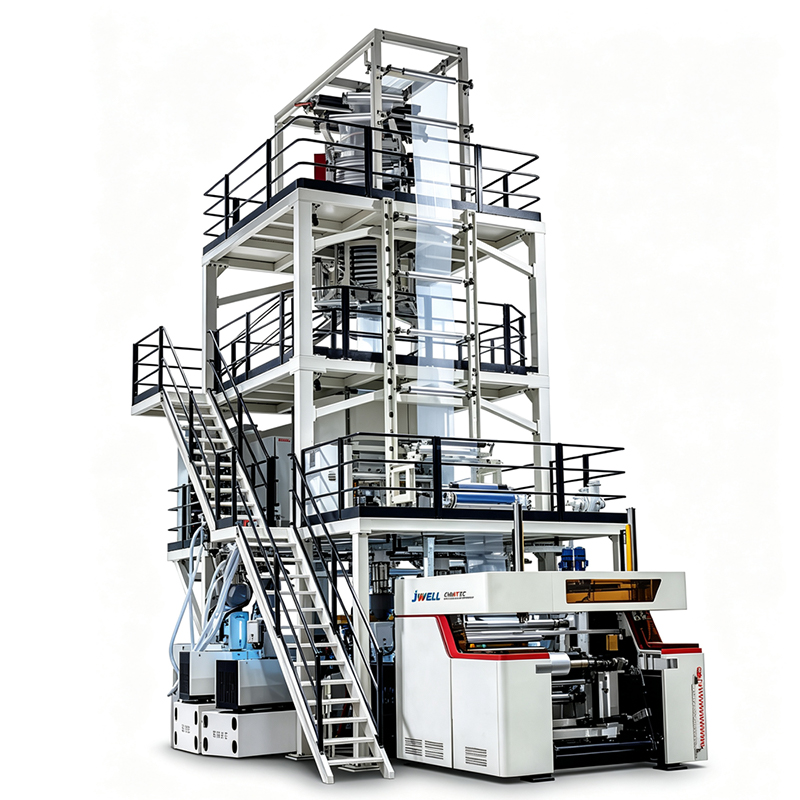
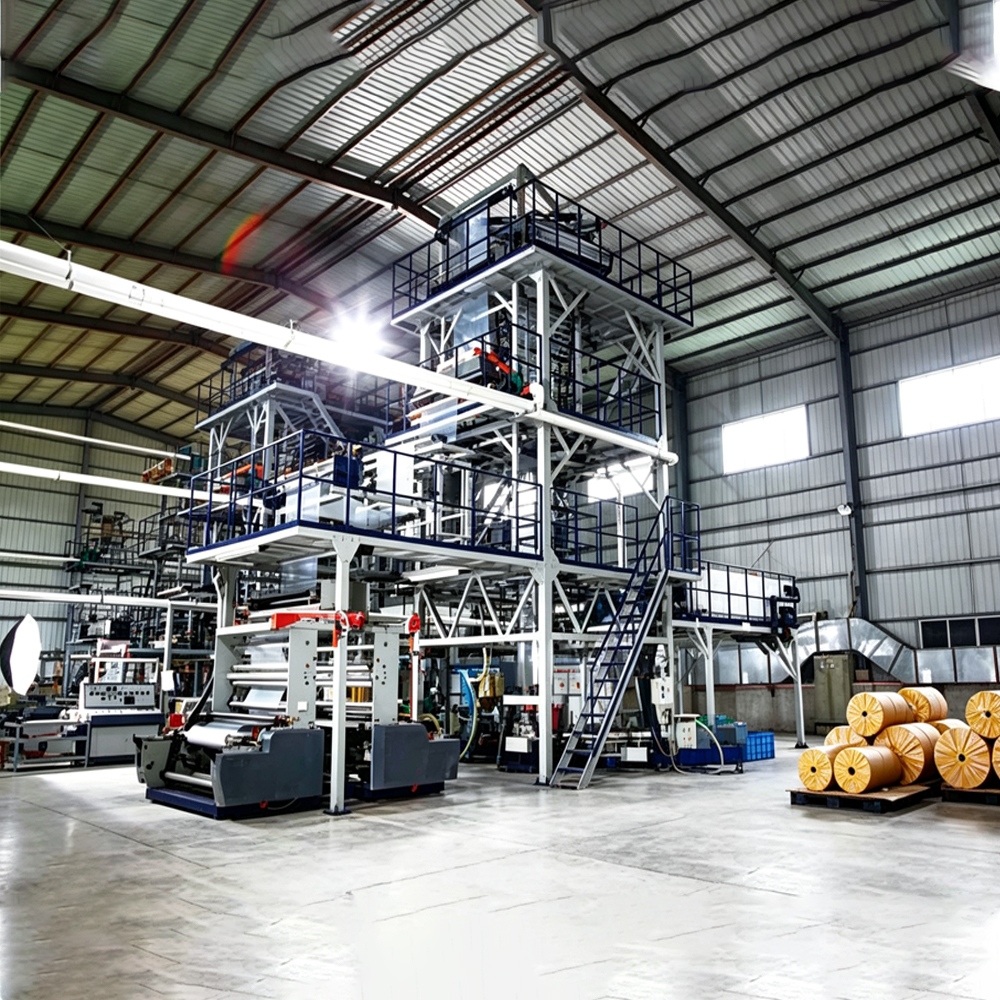
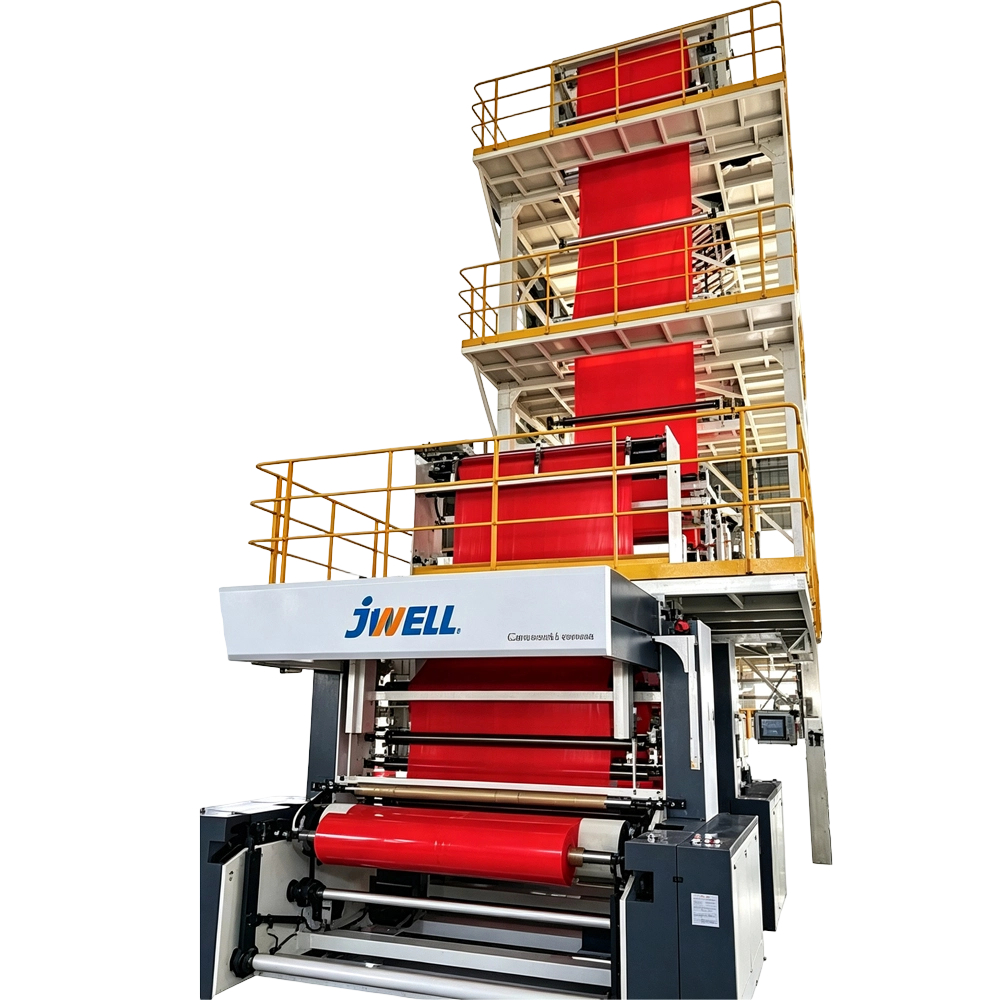
FFS Heavy-duty Film Blown Film Line, suitable for industrial continuous production using LDPE, LLDPE, mLLDPE, and HDPE as raw materials. equipment operates on 380V, 3-phase, 50Hz industrial power, with a maximum flat-fold width (with folding) of 600mm, film thickness range of 0.05–0.18mm, a designed maximum line speed of 80 m/min, and an actual output of 420–460 kg/h (depending on raw material formulation and layer requirements).
The FFS heavy-duty film blown film line is specifically designed for FFS heavy-duty packaging, enabling continuous forming, filling, and sealing of the film.
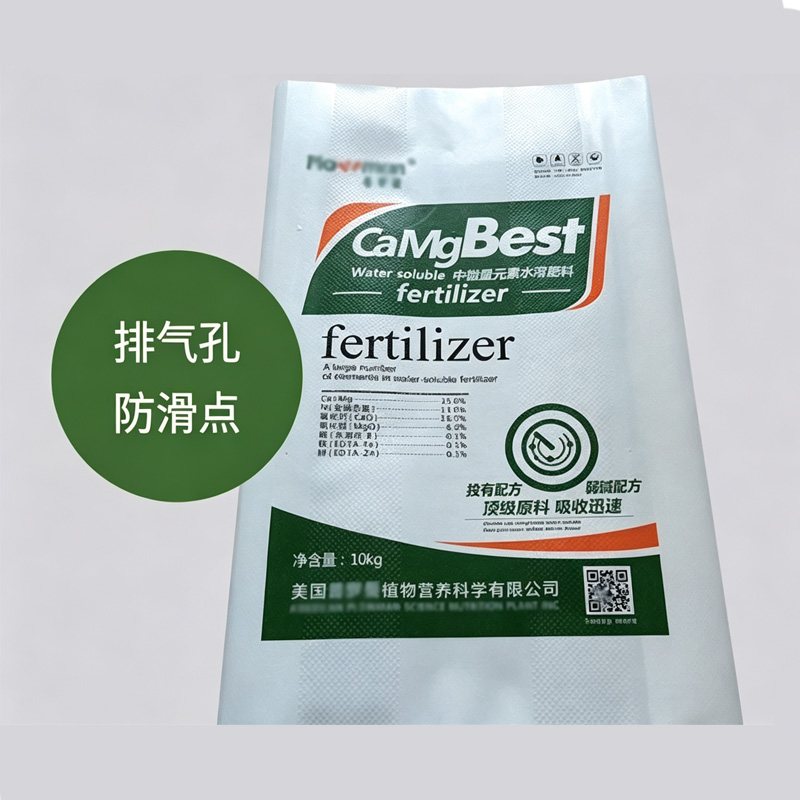
Typical end products include:
Industrial bulk bags for chemicals, fertilizers, and plastic resins
Pet food and animal feed packaging (15–50 kg bags)
Building materials (cement, sand, dry mortar)
Agricultural inputs (seeds, crop protection products)
Real case: A fertilizer plant in Southeast Asia uses this production line to produce 600mm flat-fold width, 0.12mm thickness film at a running speed of 75 m/min. Using an LLDPE formulation, the actual output reached 440 kg/h, and the bag breakage rate during filling was reduced by over 30%.
High output efficiency
420–460 kg/h actual output (depending on raw materials and layer structure), supporting medium to large-scale production. Faster than ordinary production lines of the same class (300–350 kg/h).
Wide thickness range and material flexibility
Supports 0.05–0.18mm thickness, applicable to LDPE, LLDPE, mLLDPE, HDPE. This means you can switch from light-duty transport film to heavy-duty industrial film on one machine.
FFS-optimized flat-fold design
Maximum 600mm flat-fold width (with folding), matching standard FFS bag sizes used in automated packaging lines. No secondary slitting or rework required.
Stable mechanical design
Power and temperature control follow Jwell’s proven scheme, ensuring stable melt pressure and uniform film thickness. The ≤25°C air temperature condition helps maintain cooling consistency.
Industrial structural design
Uses 380V, 3-phase, 50Hz power supply – common in Europe, Asia, Africa, and South America. Designed for continuous 24/7 operation.
Real case: A packaging processor in Kenya replaced two old production lines with one unit of this equipment, saving 40% floor space while increasing monthly output of heavy-duty bags from 180 tons to 260 tons.
To ensure consistent film performance in FFS applications, the following quality control procedures are implemented during and after production:
During extrusion:
|
Parameter |
Control method |
Tolerance |
|
Film thickness |
Automatic thickness control (average curve) |
±3–5% |
|
Melt temperature |
Thermocouple feedback + PID control |
±2°C |
|
Air ring cooling |
Manual/automatic adjustment based on ambient temperature ≤25°C |
Frost line stable |
Post-production tests (per batch):
|
Test item |
Standard / method |
Acceptance criteria |
|
Tensile strength (MD/TD) |
ASTM D882 |
≥25 MPa |
|
Elongation at break |
ASTM D882 |
≥300% (LLDPE) |
|
Dart drop impact |
ASTM D1709 |
≥150g (at 0.10mm thickness) |
|
Heat seal strength |
Internal FFS simulation |
≥40 N/50mm |
|
Coefficient of friction |
ASTM D1894 |
0.2–0.4 (ensures smooth feeding) |
|
Thickness deviation |
30-point scan |
Total average ≤6% |
Real case: A customer in Poland reported that after adding online thickness monitoring, their poor seal rate dropped from 2.1% to 0.6% within two months.
Q1: Can this production line use 100% recycled LLDPE?
A: Yes, but the expected output will drop to around 350–380 kg/h. Recycled material affects the melt index and requires finer screen packs. It is recommended to use 70% virgin + 30% crushed in-house scrap to ensure stable FFS sealing.
Q2: What is the minimum thickness for a 25kg fertilizer bag?
A: For 25kg cement/fertilizer, typical thickness is 0.10mm. For 50kg, use 0.12–0.14mm. At 0.08mm, there is a risk of bag breakage during drop tests.
Q3: How can the line speed be increased above 80 m/min?
A: The designed maximum speed is 80 m/min. To go higher, you need:
High-output extrusion screw (optional)
Dual air ring + IBC (internal bubble cooling)
But note: above 85 m/min, film orientation increases, which may reduce heat seal strength.
Q4: Does ambient temperature above 30°C affect production?
A: Yes. The specification requires cooling air temperature ≤25°C. Above this, the frost line rises, film haze increases, and output may drop by 5–8%. An air chiller is recommended in hot regions.
Q5: What is the typical payback period?
A: Based on 22 hours/day operation, 430 kg/h output, producing 25kg bags, and a gross profit of $0.12 per kg → monthly gross profit ≈ $34,000. The payback period is typically 8–14 months, depending on local electricity and labor costs.
Q6: When producing ultra-thin film of 0.05mm, how to ensure thickness uniformity?
A: At 0.05mm thickness, uniformity is mainly affected by three factors: die gap precision, air ring cooling stability, and tension control. Recommendations:
Use a high-precision automatic thickness control system (this line supports ±3–5% tolerance).
Ensure stable cooling air temperature ≤25°C and uniform air speed distribution.
Reduce line speed appropriately to 60–70 m/min, and use an mLLDPE-based formulation (higher melt strength).
Real case: A packaging plant in Thailand used this line to produce 0.05mm lightweight fertilizer inner bags. With the above adjustments, thickness deviation was controlled within 4.2%, meeting FFS heat sealing requirements.
Q7: When switching from LLDPE film production to HDPE film, what adjustments are needed?
A: LLDPE and HDPE have different crystallization behavior, melting temperatures, and shrinkage rates. When switching, follow these steps:
Purge the screw: Use a dedicated purging compound or linear low-density polyethylene transition material, extrude at 180–200°C for 20–30 minutes.
Adjust temperature profile: HDPE has a higher melting temperature (approx. 200–220°C); raise each zone of the extruder by 15–20°C.
Change blow-up ratio: Recommended blow-up ratio for HDPE is 2.5:1–3:1, while for LLDPE it is typically 2:1–2.5:1.
Reduce output: Initially run at 350–380 kg/h, then gradually increase after stabilization.




Pipe Extrusion Production Line
Plastic Shredder Crusher Machine

Tel: +86-19057068112

E-mail: [email protected]

Company Address
No. 128 Qingfeng Road, Xieqiao Town, Haining City, Jiaxing City, Zhejiang Province

19057068112

 English
 русский