
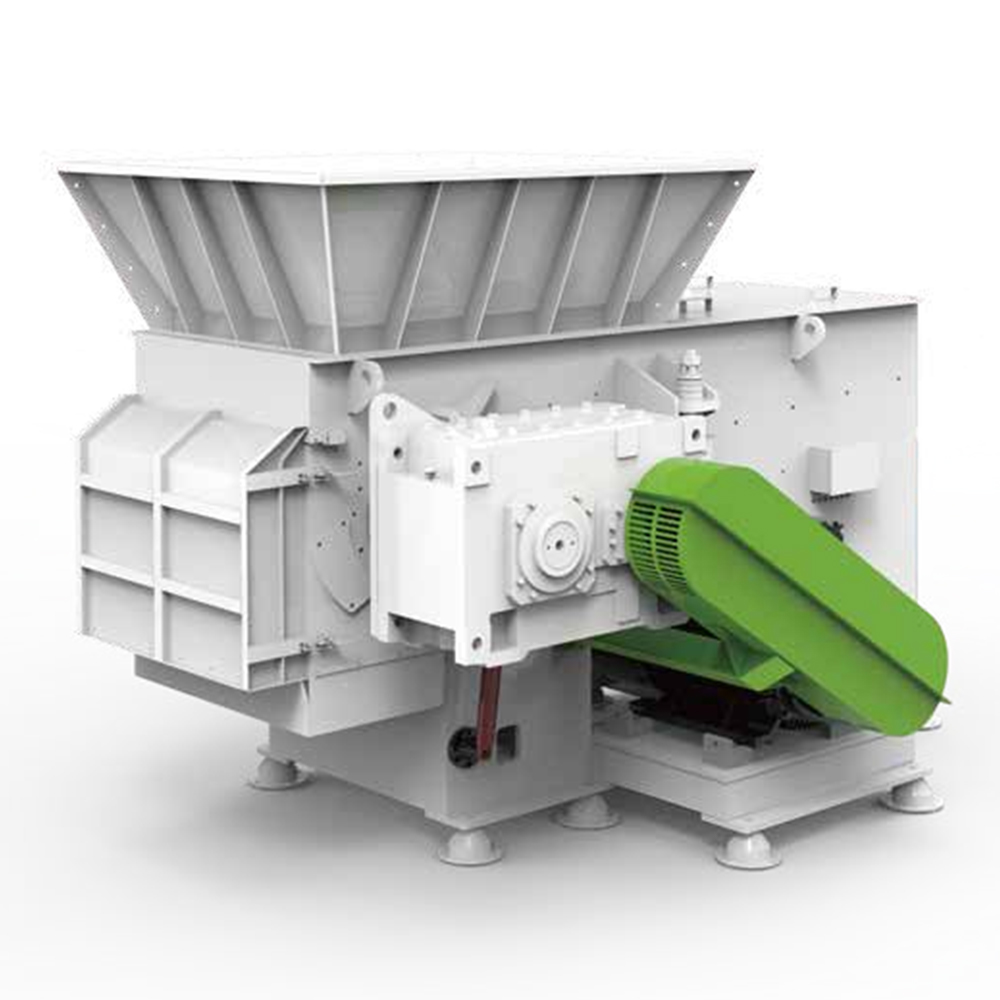
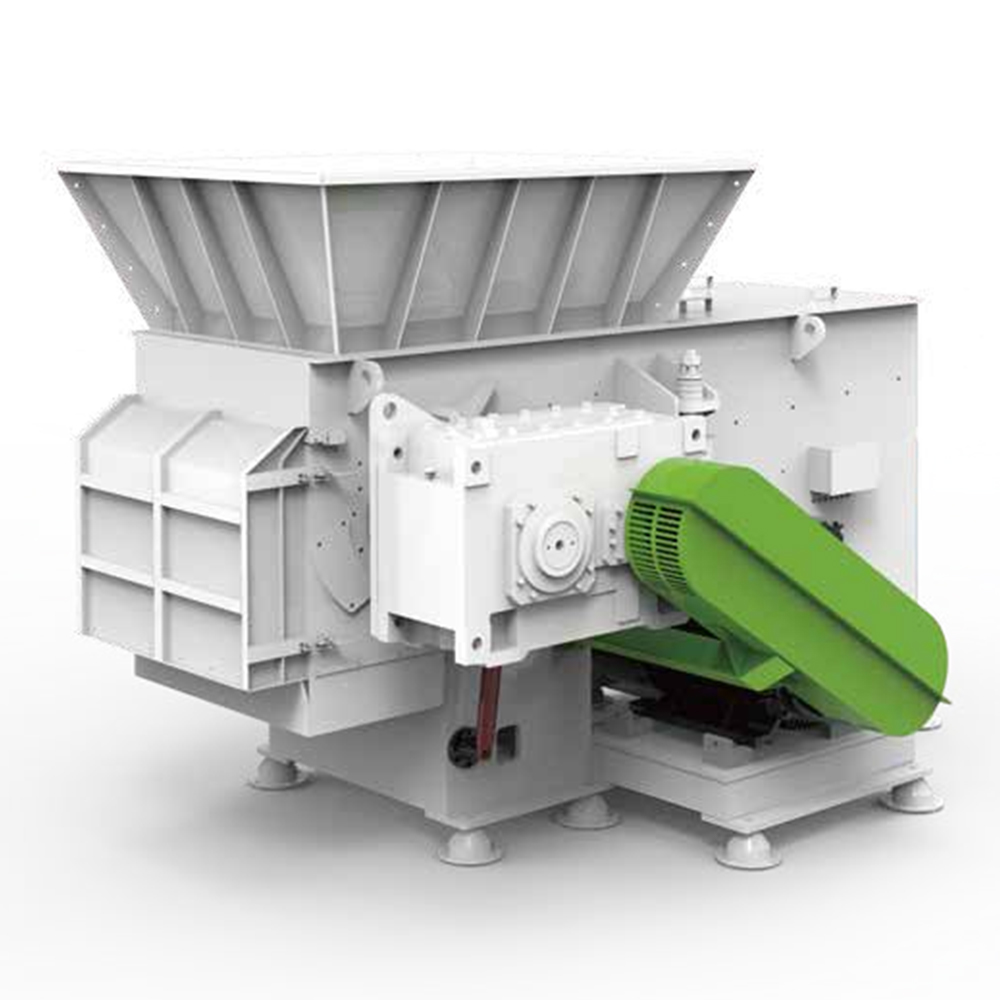
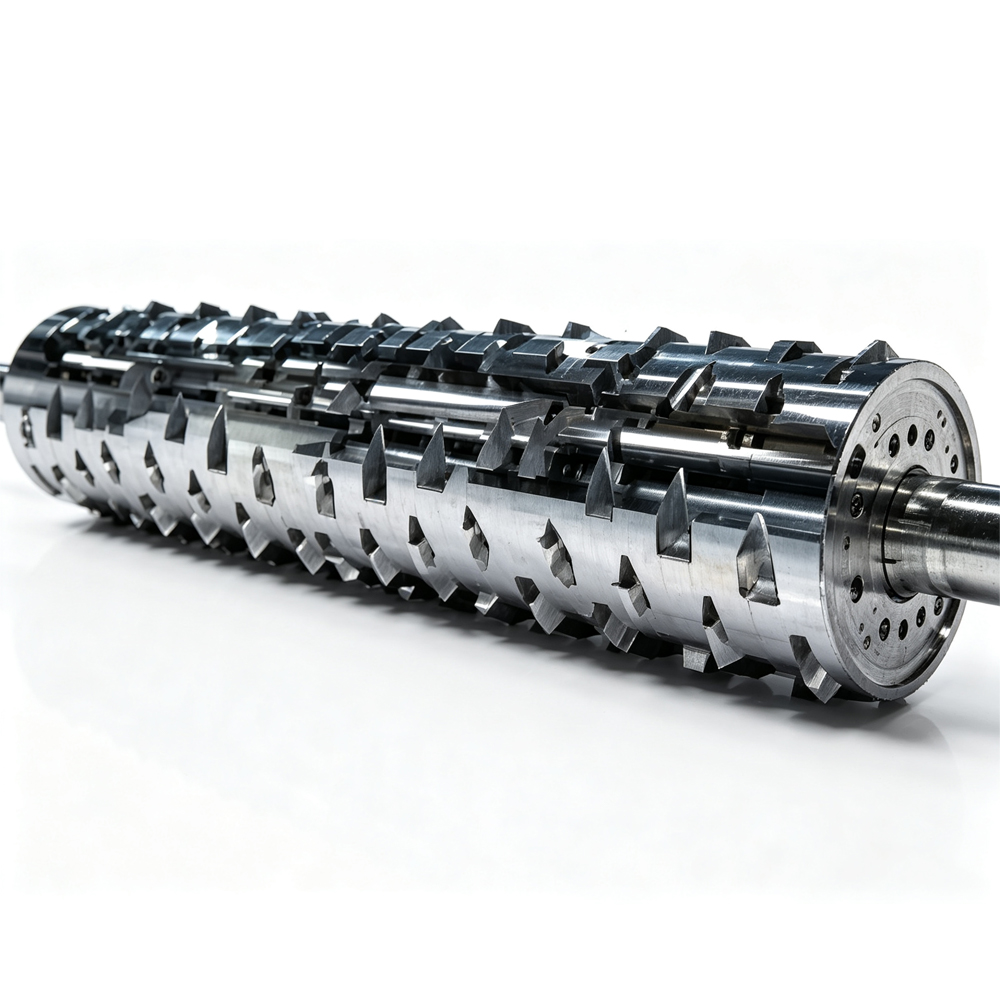
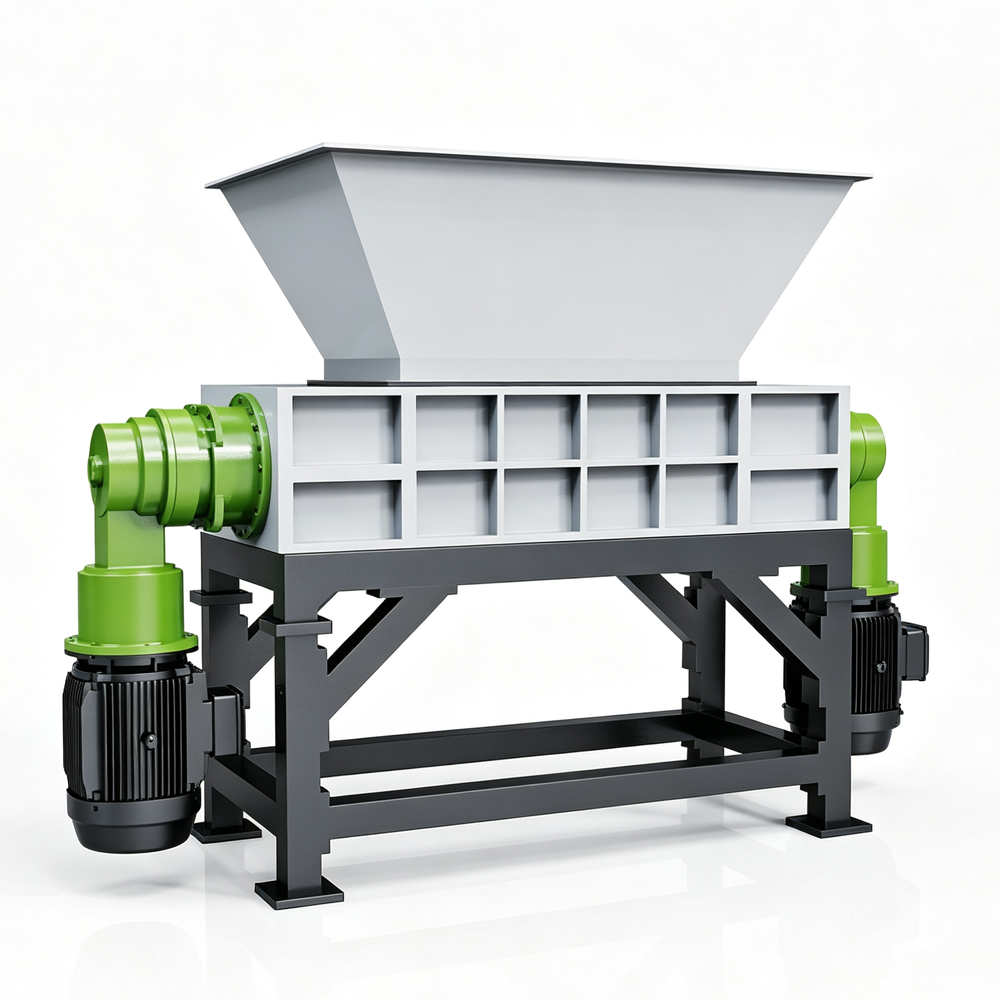
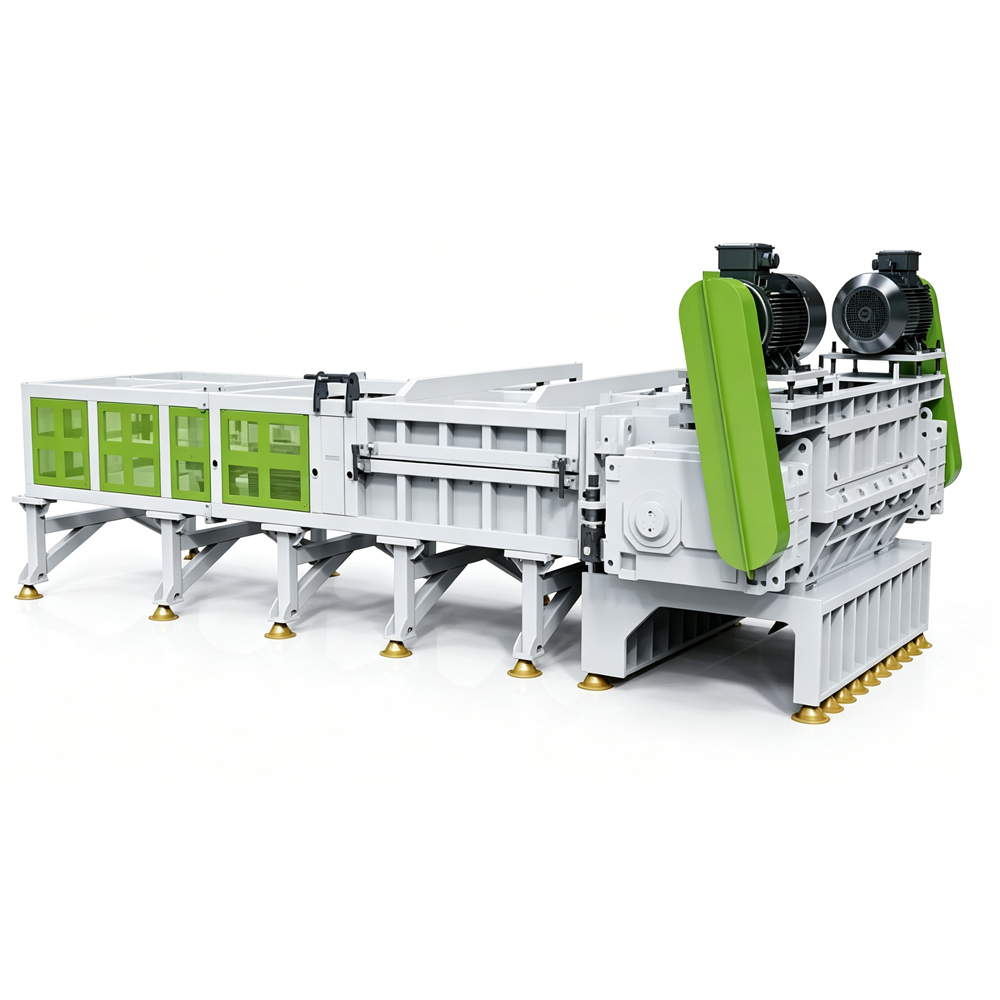
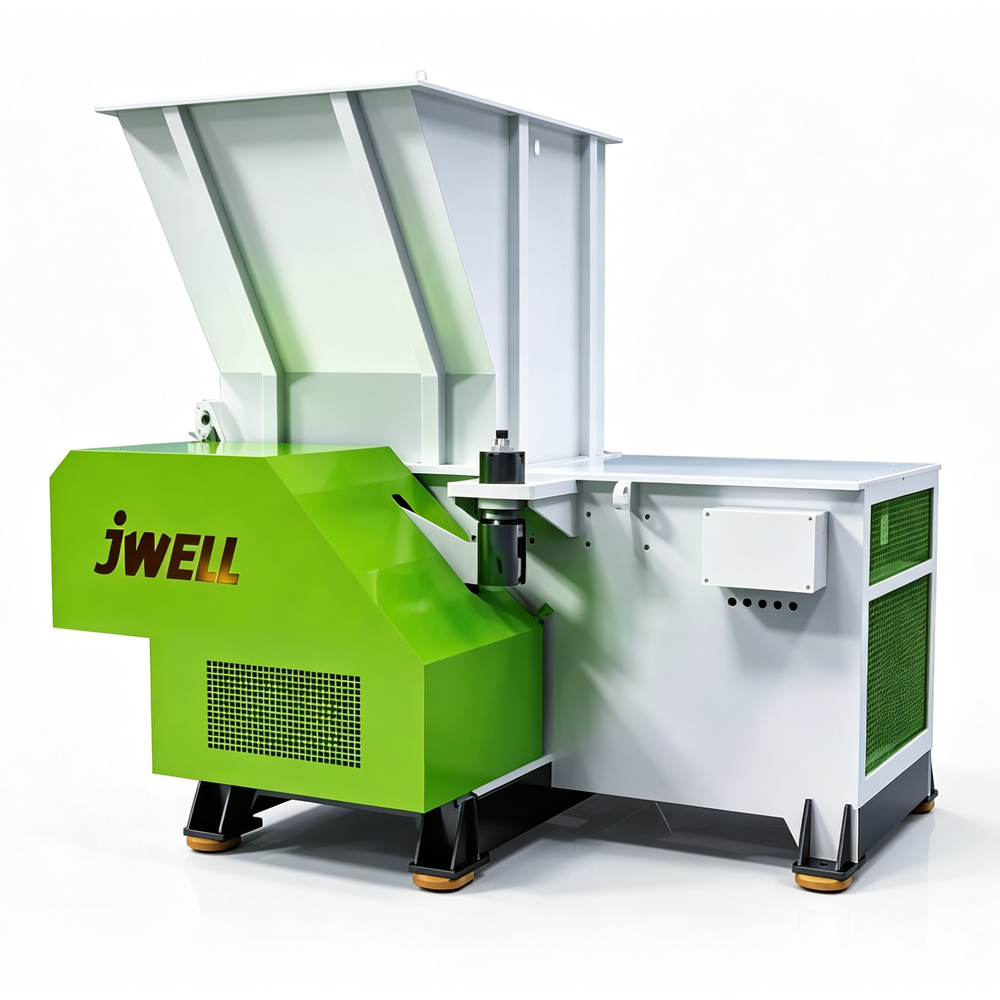
The DYSSJ series universal single shaft shredder is designed for low-to-medium speed, high-torque shredding applications. With a rotor diameter of Φ456mm and equipped with different numbers of rotating and fixed knives, it can efficiently process a variety of hard, tough, and mixed waste materials. Three models (850/1500/2000) cover applications from small-scale trials to large-scale continuous production.
Plastics Recycling Industry
Processing objects: Large plastic drums (IBC drums), injection molding scrap, PE/PET bottle bales, plastic pallets.
Real case: A recycled plastic factory in Jiangsu Province uses the DYSSJ-1500 to shred waste HDPE plastic pallets. Rotor speed approx. 80 rpm, with a Φ40 mm screen, output size uniform (<40 mm), throughput 1.2–1.5 tons per hour, material directly fed into a pelletizing line.
Advantages: 102 rotating knives (with 5×2 fixed knives) provide uniform cutting and are not prone to wrapping.
E-waste (WEEE)
Processing objects: Waste circuit boards, computer housings, mixed small appliance waste.
Real case: An e-waste dismantling company in Guangdong uses the DYSSJ-850 (37 kW) to pre-shred waste computer chassis (containing small amounts of metal). The 770×800 mm shredding chamber easily accommodates whole chassis; the 3×2 arrangement of fixed knives effectively prevents material slippage. After output, metal is separated by magnetic separation; capacity approx. 0.6–0.8 tons/hour.
Wood & Biomass
Processing objects: Wooden pallets, construction formwork, branches, straw.
Real case: A biomass fuel plant in Shandong Province chooses the DYSSJ-2000 (75kW×2 dual motors) to shred waste construction timber. The shredding chamber measures 1890×800×600 mm, allowing 1.8m long timber to be fed side by side. 144 rotating knives with 7×2 fixed knives reduce material to below 30mm in one pass, providing high-quality feedstock for a subsequent pellet mill, with throughput exceeding 3 tons per hour.
Rubber & Tires
Processing objects: Truck tire rings (after cutting), rubber seals.
Note: Not recommended for shredding whole off-the-road (OTR) tires directly (pre-cutting required), but suitable for tire rubber blocks ≤600 mm.
Waste Paper / Textiles / Film
Although the number of rotating knives is high, the single-shaft structure with screen is also effective for light materials. With an optional hydraulic ram, it can process baled waste paper, scrap fabric offcuts.
|
Parameter |
DYSSJ-850 |
DYSSJ-1500 |
DYSSJ-2000 |
Advantage |
|
Rotor diameter |
Φ456mm (all series) |
Same as left |
Same as left |
Large diameter rotor provides higher cutting inertia, avoiding jamming; low rotor linear speed (~2 m/s) results in less dust and lower noise. |
|
Drive power |
37 kW |
75 kW |
75kW×2 (dual motor) |
Dual-motor models achieve torque superposition, especially suitable for shredding thick-walled solid materials or high simultaneous feed rates. |
|
Number of rotating knives |
60 pcs |
102 pcs |
144 pcs |
High rotating knife density gives finer cutting surfaces, improving output uniformity by >30% and reducing screen wear. |
|
Number of fixed knives |
3×2 (6 pcs) |
5×2 (10 pcs) |
7×2 (14 pcs) |
Double-row fixed knife design doubles the number of shearing actions on the material, more efficient than single-row fixed knife models. |
|
Shredding chamber dimensions (L×W×H) |
770×800×600 |
1330×800×600 |
1890×800×600 |
Uniform width 800mm and height 600mm facilitates shared infeed conveyors; increasing length accommodates different batch feed rates. |
Other design advantages
Screen-controlled output: All models have interchangeable bottom screens (20–80 mm apertures) for precise output size control.
Hydraulic ram (optional): Increases feed density for fluffy materials (films, fibers).
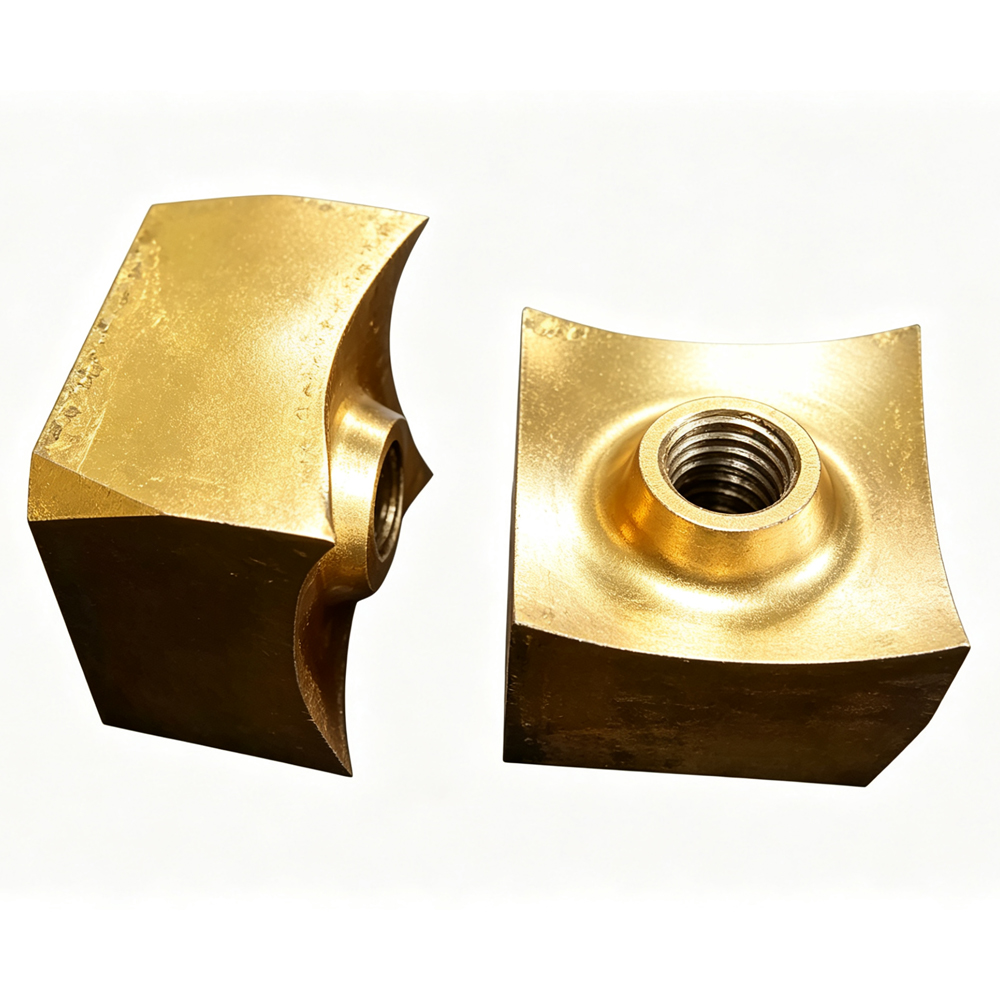
Knife material: Made of Cr12MoV or SKD-11 heat-treated steel, hardness HRC55–58, can be reversed for two uses, long service life.
Safety interlocks: Door power cut-off, spindle speed monitoring, overload protection, CE compliant.
We implement a 6-level quality control from raw materials to complete machine load testing, ensuring the DYSSJ series meets continuous heavy-duty operation requirements.
1.Material & Component Inspection
Knife plates: Spectrometer analysis of alloy composition, spot-checked hardness (±1 HRC).
Main shaft: Ultrasonic testing (UT) for internal cracks, static balance test (G2.5 grade).
Bearings: Selected SKF/FAG genuine, with certificate of origin verified.
2.Machining Precision Control
Rotor shaft concentricity ≤0.02 mm to avoid vibration at high speed.
Shredding chamber steel plate thickness ≥20 mm (Q345B), stress-relieved by annealing after welding.
3.Pre-assembly & Dynamic Balance
Rotor assembly undergoes dynamic balance test (ISO 1940 G6.3 standard), residual unbalance ≤5 g·mm/kg.
4.No-load Test Run (2 hours)
Check bearing temperature rise ≤35°C, noise ≤85 dB(A), all fasteners tight.
5.Load Test (real material)
Case-based testing: 30% of each production batch is sampled for material testing using typical customer waste (e.g., HDPE drums, wooden pallets).
Test criteria: Throughput ≥90% of design value, output合格率 (within screen aperture ±5 mm) ≥98%.
After 1 hour continuous operation, motor current fluctuation ≤10%.
6.Factory Inspection Report
Provide complete machine dimensions, electrical safety, lubrication status, and knife gap record (adjustable 0.5–1 mm between rotating and fixed knives).
| Model | Rotor Dia. (mm) | Drive Power (kW) | Rotor Blade (pcs.) | Fixed Blade (pcs.) | Crushing Chamber Size Max. (mm) |
|---|---|---|---|---|---|
| DYSSJ-850 | Φ456 | 37 | 60 | 3×2 | 770×800×600 |
| DYSSJ-1500 | Φ456 | 75 | 102 | 5×2 | 1330×800×600 |
| DYSSJ-2000 | Φ456 | 75×2 | 144 | 7×2 | 1890×800×600 |
Q1: Can this series shred metal?
A: No, not for pure metal (e.g., aluminum profiles, copper blocks). However, it can process composite waste containing small amounts of non-ferrous metal (e.g., circuit boards, plastic housings with metal inserts), relying on the overload protection system to automatically reverse and reject material. Magnetic separation or manual sorting is recommended beforehand.
Q2: The DYSSJ-2000 has dual motors of 75kW×2 – is the actual total power 150kW? Does it consume more electricity?
A: The dual motors use synchronous drive control, total input power up to 150kW, but actual operating power adjusts automatically with load. Compared to a single-motor model, the dual-motor configuration provides smoother torque output under heavy load, and the specific energy consumption (kWh/ton) is actually about 15% lower because it avoids frequent overload shutdowns.
Q3: How often do the knives need replacement? How to replace them?
A: Depends on material. For general plastic/wood shredding: reverse every 200–300 hours (knives have 4 edges), replace with new knives every 800–1000 hours.
Replacement steps: Stop and lock machine → open side panels of shredding chamber → remove knife clamp screws → take out old knives and clean knife seats → install with reversed edge or new knives. A knife setting jig provided by our company is recommended to ensure consistent gap.
Q4: The maximum shredding chamber dimension is 770×800×600 (for DYSSJ-850), but what if the material length exceeds 770mm?
A: That dimension indicates the three-dimensional size limit (L×W×H) for a single piece that can be fed at once. For long materials (e.g., 1.5m soft film), continuous feeding via a conveyor is possible, relying on rotor rotation to pull them in. Hard materials exceeding the length limit require pre-cutting; otherwise, bridging may occur.
Q5: How to choose the model?
A: Quick selection guide:
Throughput <1 ton/hour, material size <800mm → DYSSJ-850
Throughput 1–2.5 tons/hour, needs to process whole plastic drum bales → DYSSJ-1500
Throughput >2.5 tons/hour, or requires dual-motor redundancy → DYSSJ-2000
Q6: What is the maintenance schedule for the equipment?
A:
Daily: Check grease (main spindle bearings greased every 8 hours), bolt tightness, screen wear.
Weekly: Clean electrical cabinet cooling fan, check belt tension (if belt drive).
Monthly: Measure knife gap, clean material buildup inside shredding chamber walls.
Every six months: Replace gearbox oil, check main shaft seals.




Pipe Extrusion Production Line
Plastic Shredder Crusher Machine

Tel: +86-19057068112

E-mail: [email protected]

Company Address
No. 128 Qingfeng Road, Xieqiao Town, Haining City, Jiaxing City, Zhejiang Province

19057068112

 English
 русский