
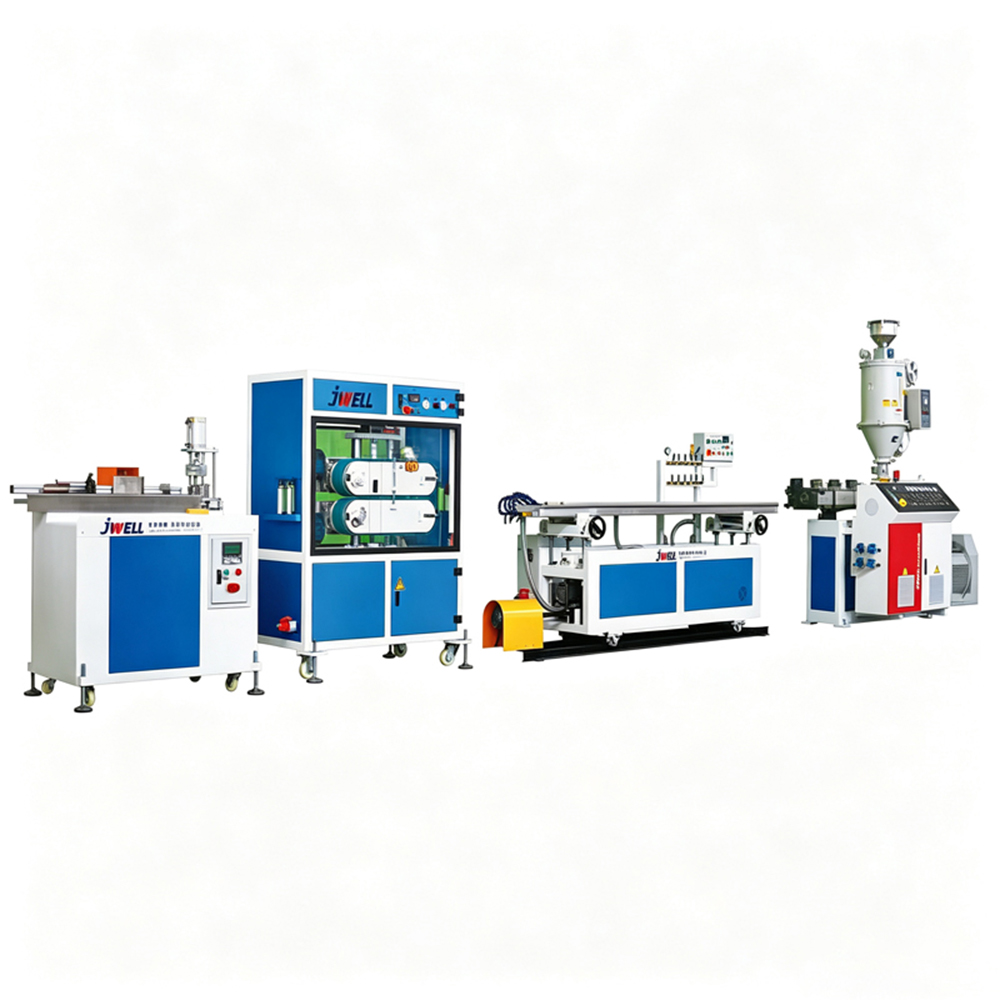
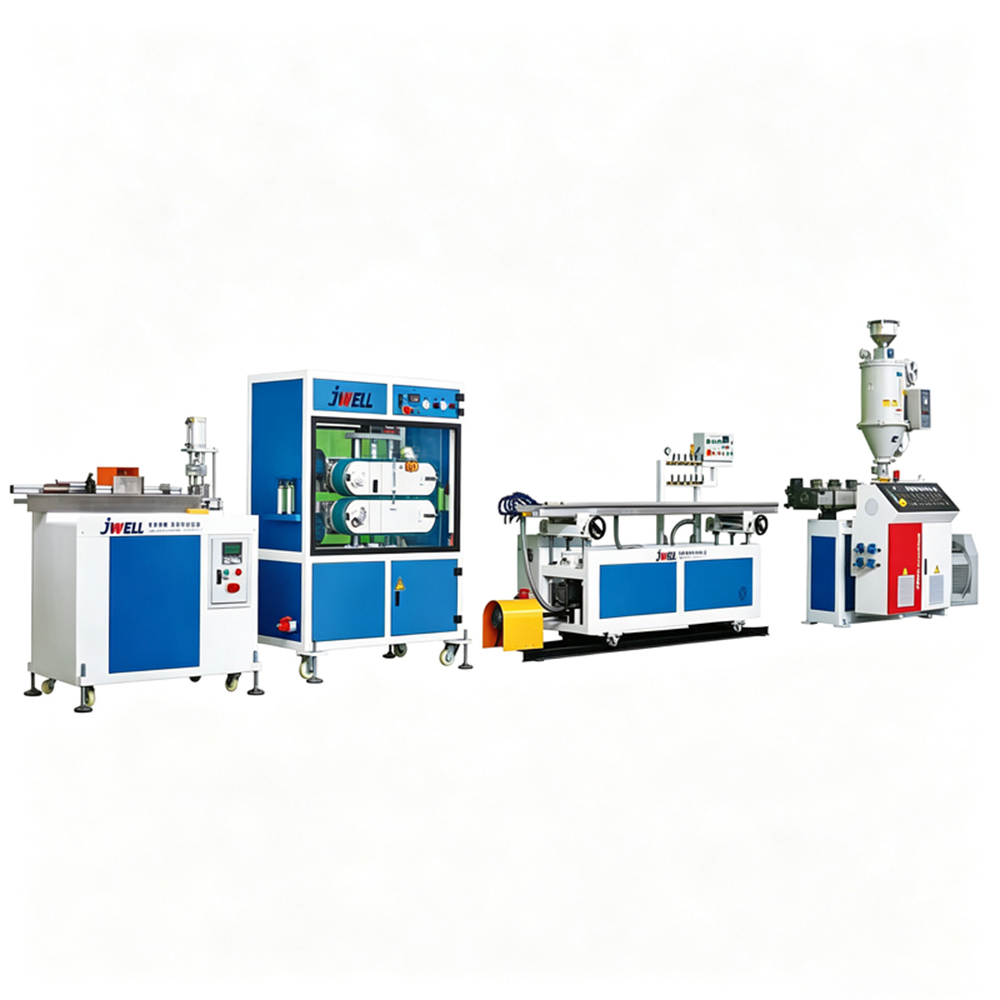
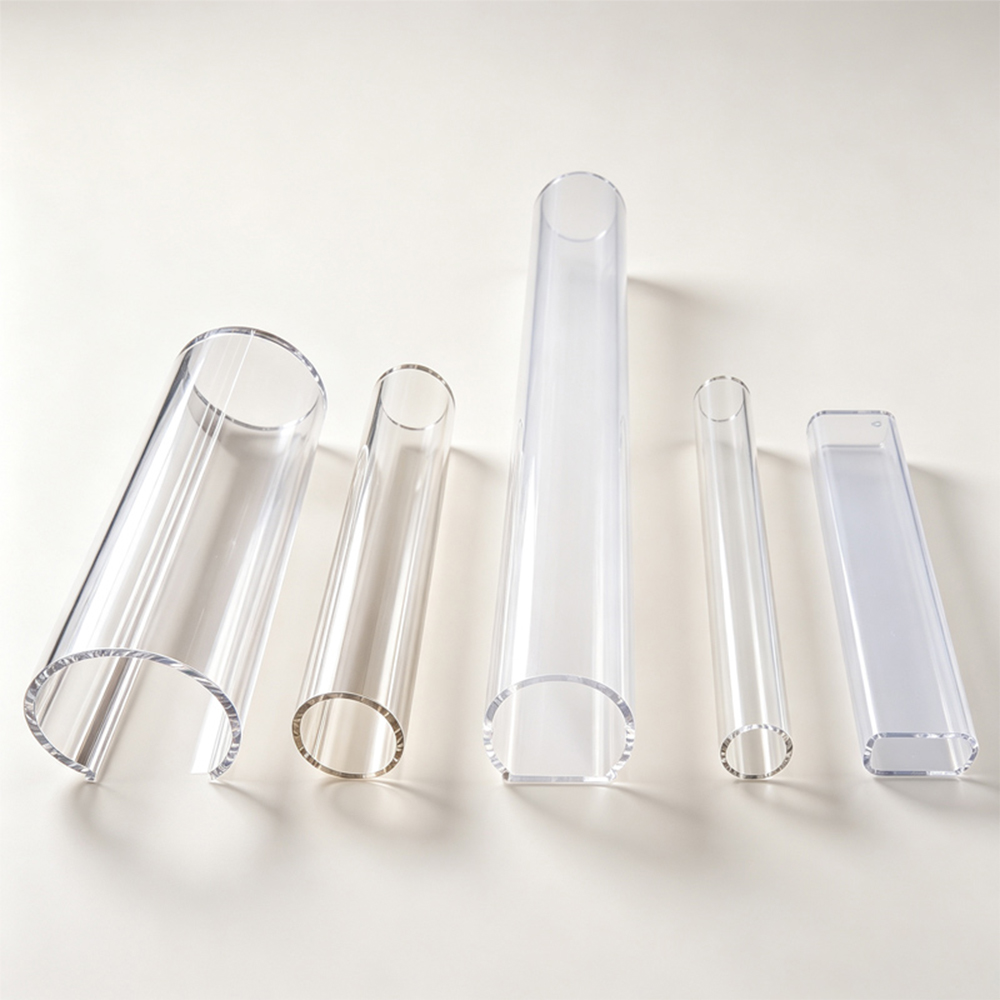
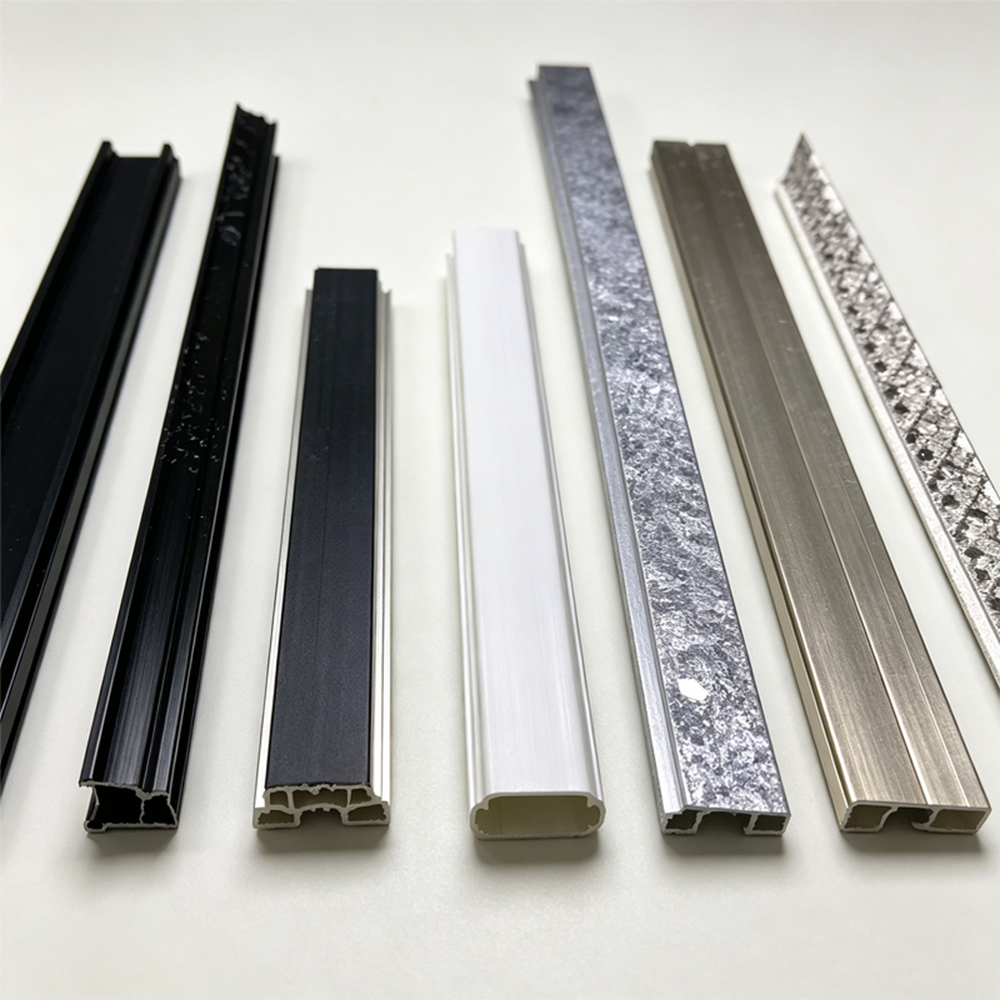
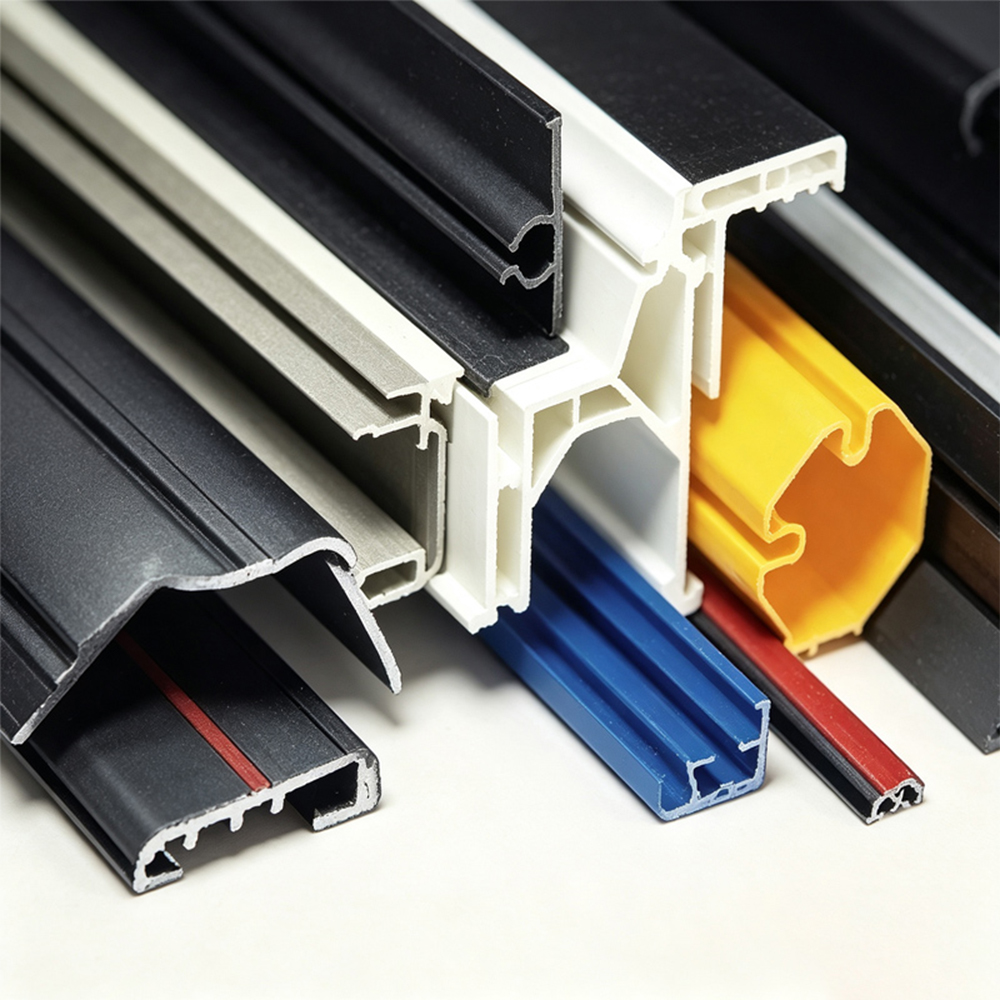
This extrusion line is suitable for the production of plastic profiles made of PVC/PP/PE/PC/ABS and other plastics, covering models from YF50 to YF300 with product widths of 50–300 mm. It adopts the JWS series energy-saving drive (e.g., 15/11 kW dual-power mode), water consumption of only 4–7 m³/h, and air consumption of 0.5–0.6 m³/min. Widely used in doors & windows, automotive trims, cable ducts, etc., it offers advantages such as fast material changeover, low energy consumption, and stable dimensions.
This extrusion line is suitable for the production of plastic profiles made of PVC/PP/PE/PC/ABS and other plastics, covering models from YF50 to YF300 with product widths of 50–300 mm. It adopts the JWS series energy-saving drive (e.g., 15/11 kW dual-power mode), water consumption of only 4–7 m³/h, and air consumption of 0.5–0.6 m³/min. Widely used in doors & windows, automotive trims, cable ducts, etc., it offers advantages such as fast material changeover, low energy consumption, and stable dimensions.
|
Advantage |
How parameters support this advantage |
|
Energy-saving drive system |
Dual power ratings (e.g., 15/11 kW on YF50) allow switching between high-torque and economy modes, saving up to 25% energy for thin-wall profiles. |
|
Low utility consumption |
Cooling water 4–7 m³/h (30–50% lower than industry average for same output); compressed air only 0.5–0.6 m³/min – can be supplied by a small 7.5 kW compressor. |
|
Broad material flexibility |
Screw design (JWS series) specifically optimized for PVC/PP/PE/PC/ABS – no need to change screws; only fine-tuning of temperature settings required. |
|
Compact footprint for small width models |
YF50 (max 50 mm) occupies only 6m x 1.8m, ideal for workshops or labs. |
|
Scalable production capacity |
From 50 mm to 300 mm width using the same control system – reduces training and spare parts inventory. |
Practical advantage case study:
A British recycler processed post-industrial PP waste (MFI 3–8) on YF180. The 90/75 kW drive system could handle fluctuating viscosity without stoppages, while the 5 m³/h cooling water kept melt temperature below 200°C – preventing degradation. Output: 180 kg/h of recycled pallet profiles.
We implement a 5-stage QC protocol to ensure each extrusion line meets CE and ISO 9001 standards.
Stage 1 – Incoming Components
Screw & barrel: 100% inspection of hardness (HRC 55–60) and chrome layer thickness (0.05–0.10 mm).
Heating bands: Resistance and insulation test (≥10 MΩ at 500V DC).
Gearbox: Noise check at full load (<78 dB) and vacuum test for oil leakage.
Stage 2 – Sub-assembly Testing
Extruder idle run: Run at 50% of max screw speed for 4 hours – measure vibration (≤2.5 mm/s).
Cooling system: Flow verification (4 m³/h ±5% for YF50/YF108) and pressure drop (≤0.3 bar across die head).
Stage 3 – Full Line Integration
Material trial run: Use standard rigid PVC (K value 65–68) to run 200 kg at rated speed. Record:
Output stability (±3% over 1 hour)
Profile dimensions (Cpk ≥1.33 per 10 samples)
Material changeover test: Switch from PVC to PP (using purging compound) – record time (<40 minutes on YF180).
Stage 4 – Final Factory Acceptance Test (FAT)
48-hour continuous run using customer-selected material (simulated).
Safety checks: Emergency stop distance (<50 mm), thermal circuit breakers, CE-certified guards.
Stage 5 – On-site Re-commissioning
Our engineers repeat FAT at customer's factory and train operators. Signed test report including actual profile samples.
QC outcome example:
A Vietnamese pipe producer purchased YF240. During FAT, we detected uneven cooling on the 240mm die – adjusted the water channel design, resulting in final product straightness improvement from 1.2 mm/m to 0.3 mm/m.
| Model | YF50 | YF108 | YF180 | YF240 | YF300 |
| Max product width (mm) | 50 | 108 | 180 | 240 | 300 |
| Extruder model | JWS45 | JWS50 | JWS65 | JWS90 | JWS120 |
| Drive power (kw) | 15/11 | 22/18.5 | 30/22 | 55/45 | 90/75 |
| Cooling water consumption (m³/h) | 4 | 4 | 5 | 7 | 7 |
| Compressed air consumption (m³/min) | 0.5 | 0.6 | 0.6 | 0.6 | 0.6 |
Q1: Why does the YF180 list two drive power values (90/75 kW)?
A: The 75 kW setting is for high-torque, low-speed extrusion of heat-sensitive materials (e.g., rigid PVC). The 90 kW setting provides higher throughput for PP/PE. Switch via the VFD panel – never switch while running.
Q2: My compressed air supply is only 0.5 m³/min. Can I run YF108?
A: Yes, YF108 requires 0.6 m³/min, but most customers oversize their compressor. If your supply is only 0.5 m³/min, you can still run at up to 85% of max line speed. For full speed, add a 200L air receiver tank or upgrade the compressor. We recommend a safety margin – use 0.8–1.0 m³/min.
Q3: Can I produce 300mm wide profiles on YF240?
A: No – the maximum width per model is hardware-limited by die width and calibration table size. YF240 max = 240 mm. To produce 300 mm, choose YF300, or run dual-strand extrusion (two 150 mm profiles side-by-side) on YF240 with a custom die.
Q4: How often should the cooling water be replaced?
A: Closed-loop system: check conductivity monthly – replace if >500 µS/cm. Open-loop (tap water): use a 200-mesh filter and descale every 3 months. The required flow rate (4–7 m³/h) is moderate; many customers use a small cooling tower.
Q5: Can the same screw extrude both ABS and PC?
A: Yes, but with limitations. The JWS series has a compression ratio of 2.5:1 – suitable for ABS (easy) and PC (requires higher temperature, 260–280°C). For frequent PC/ABS blend changeovers, we recommend a nitrided screw (standard on JWS90/120). Avoid running glass-filled PC – use a special wear-resistant screw.
Q6: My YF50 output is very low (only 8 kg/h). What's wrong?
A: Check:
Material feeding: Is pellet bridging in the hopper?
Screen pack: Clogged? Replace with 40/60/40 mesh.
Back pressure: Too high? Open die restrictor valve 1/4 turn.
Drive power setting: You may be in 11 kW economy mode – switch to 15 kW.
Screw speed: Target 40–70 rpm for PVC, 80–120 rpm for PE.
Case study: A Kenyan customer had the same problem – it turned out they were running high-viscosity PE material in 11 kW mode. After switching to 15 kW and raising screw speed from 45 rpm to 95 rpm, output jumped to 19 kg/h.


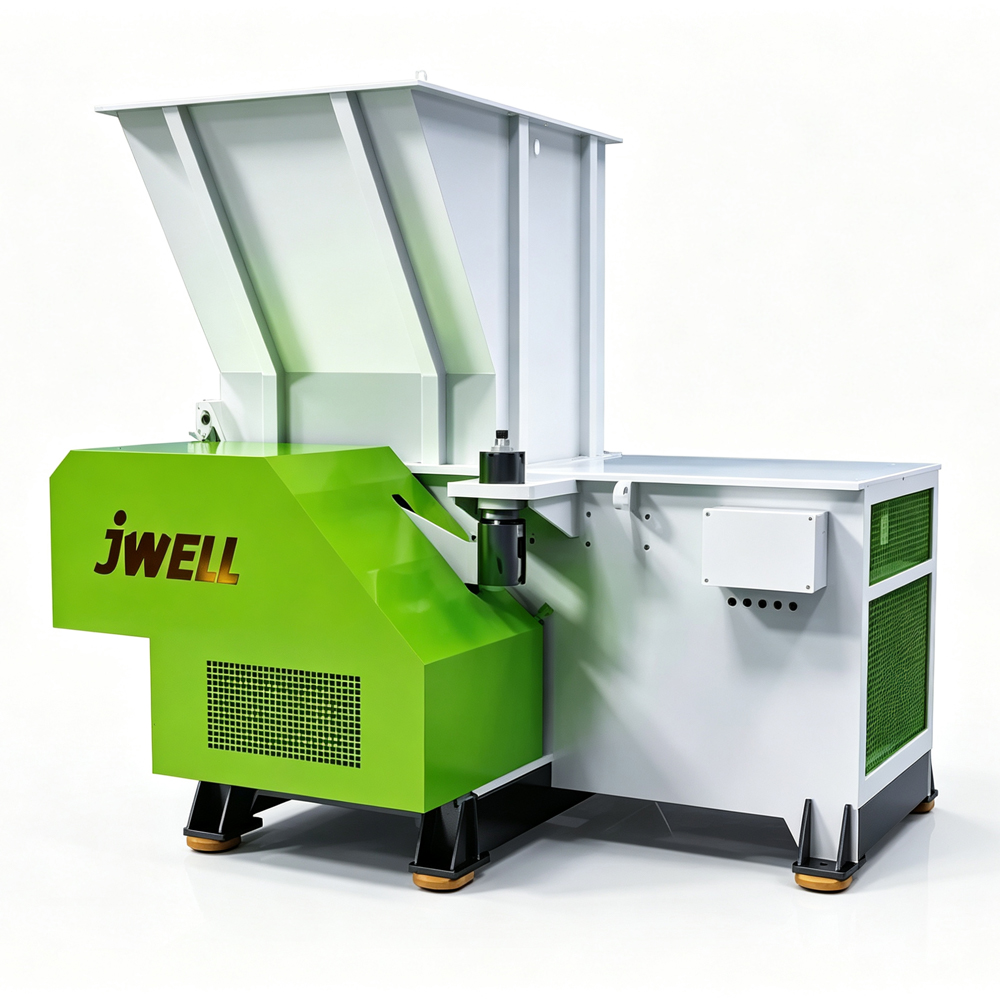


Pipe Extrusion Production Line
Plastic Shredder Crusher Machine

Tel: +86-19057068112

E-mail: [email protected]

Company Address
No. 128 Qingfeng Road, Xieqiao Town, Haining City, Jiaxing City, Zhejiang Province

19057068112

 English
 русский