
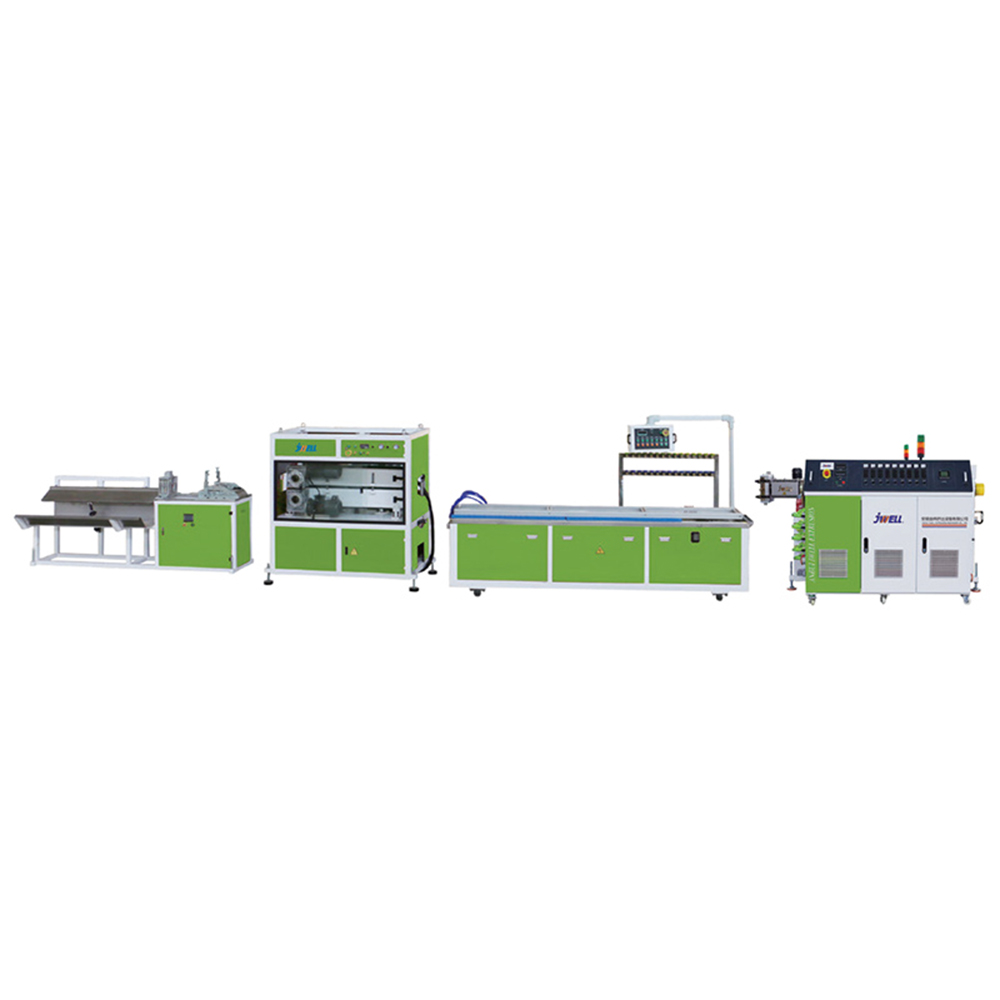
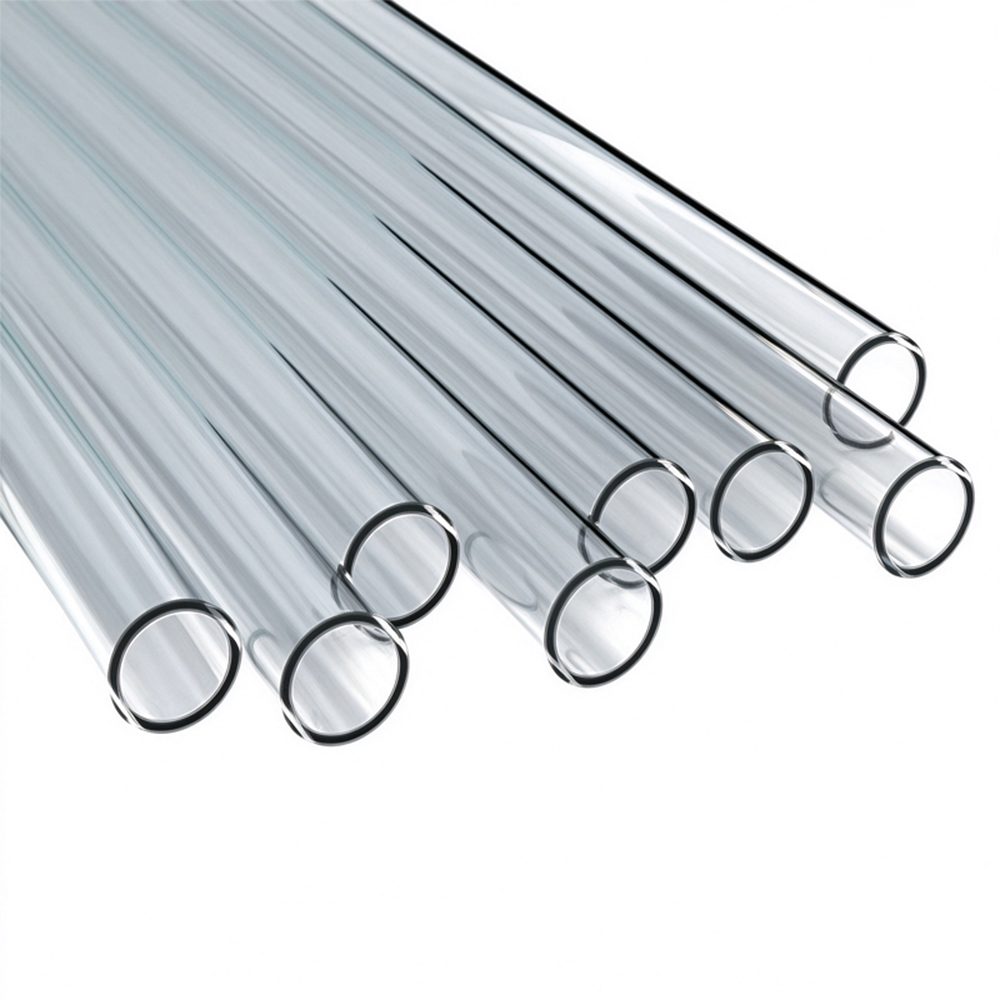
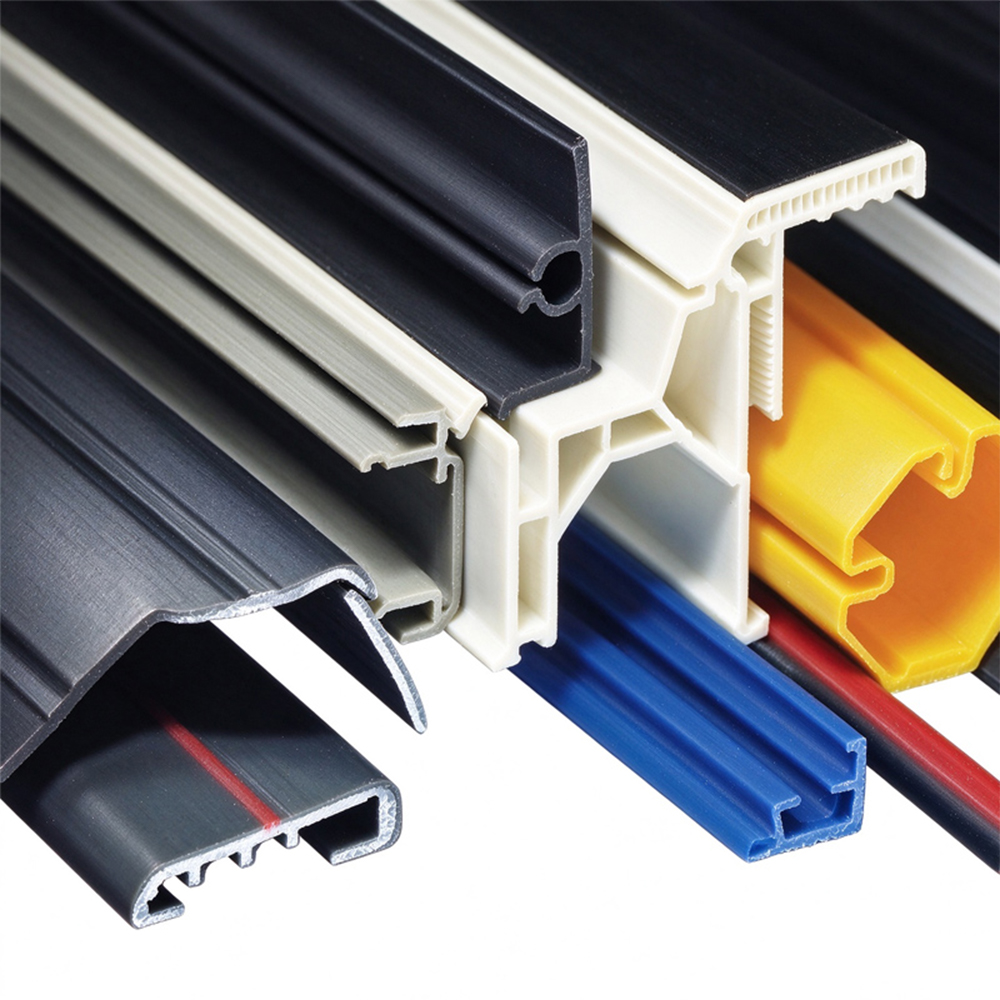
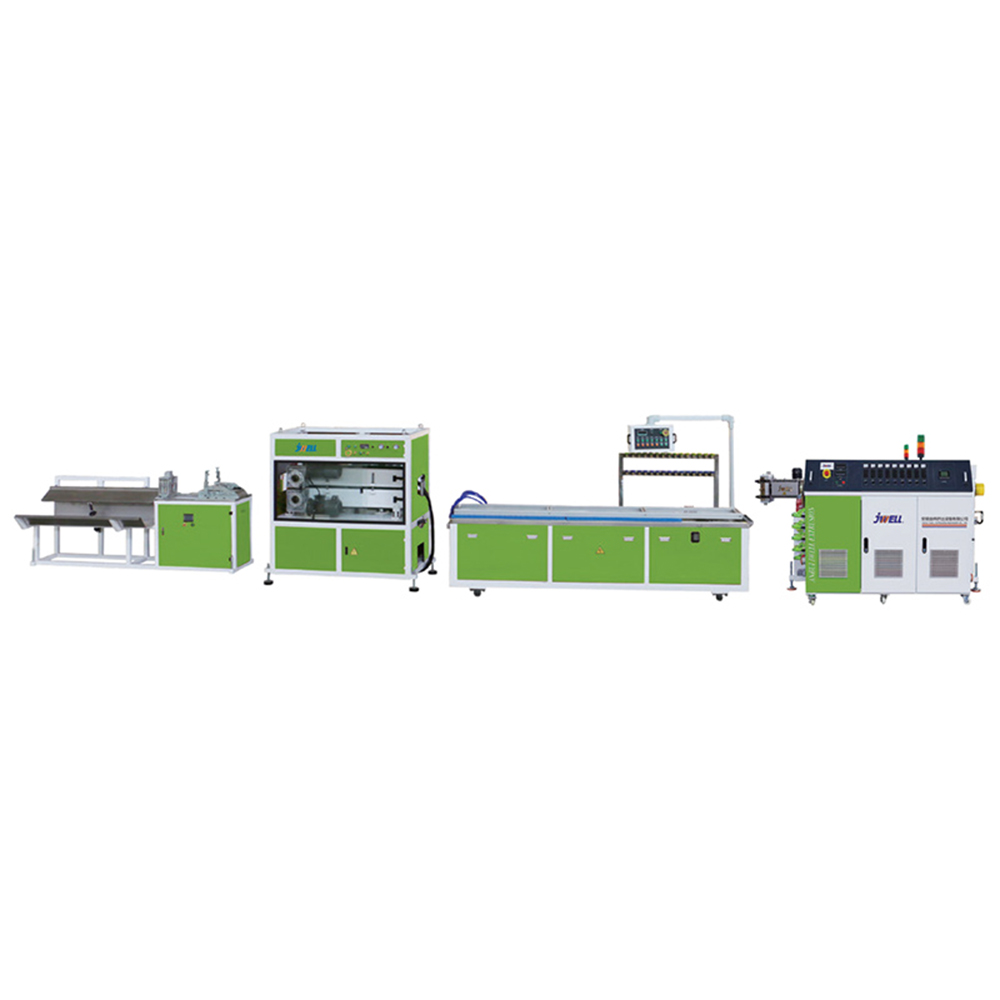
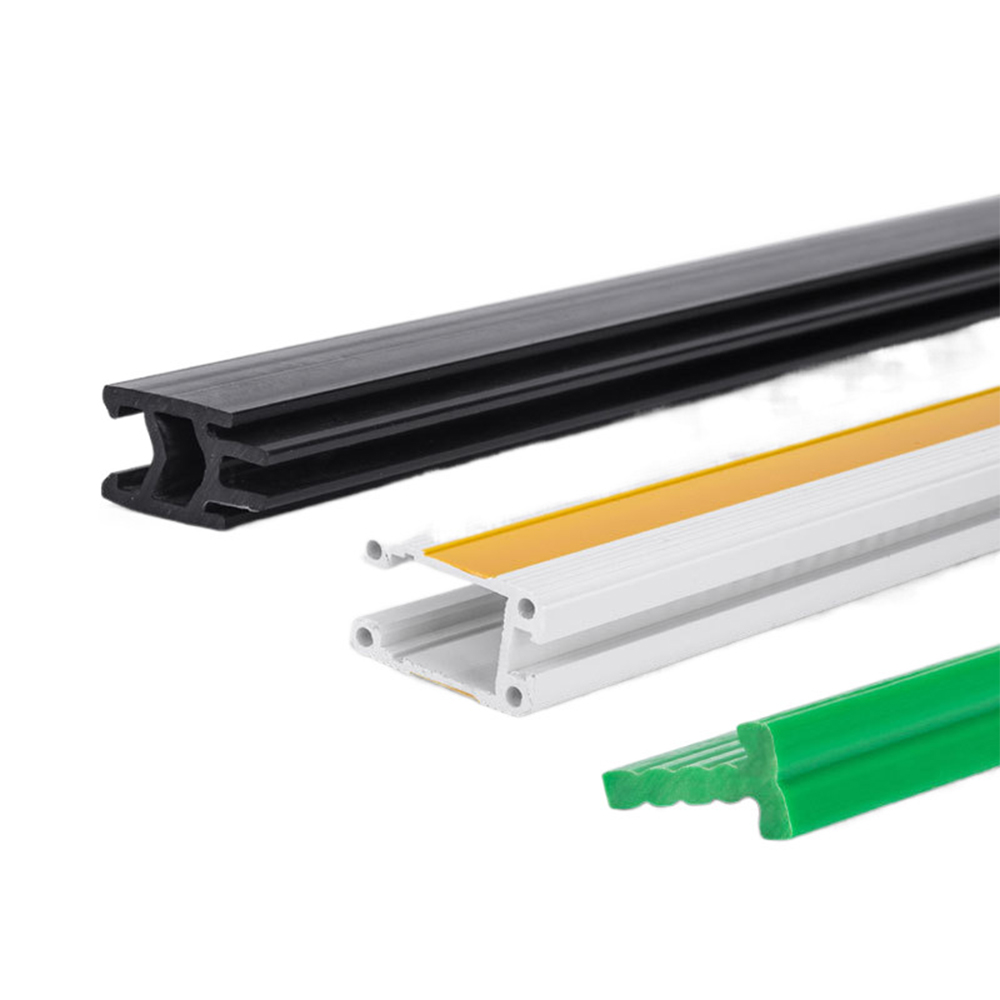
This PVC/PP/PE/PC/ABS profile extrusion line is suitable for the production of profiles made from PVC, PP, PE, PC, ABS, etc. The YF108 to YF300 models cover a product width range of 108–300 mm. It is matched with JWS series extruders (45–120), with drive power ranging from 15 to 90 kW, cooling water consumption of only 4–7 m³/h, and compressed air demand of 0.5–0.6 m³/min. Featuring low energy consumption, strong versatility, and stable operation, it is widely used in doors and windows, cable ducts, decorative strips, and other fields.
Our extrusion line is specifically designed for PVC, PP, PE, PC, and ABS materials, covering a wide variety of profile shapes and sizes. The maximum production width ranges from 108 mm to 300 mm, serving multiple industries:
Building & Construction – Window frames, door seals, cable trays, skirting boards, and drainage channel profiles (typical models: YF240 / YF300 equipped with JWS90 or JWS120 extruders).
Automotive – Edge trim, weather strips, and interior decorative profiles (YF108 compact line with JWS45 or JWS50).
Furniture & Decoration – Edge banding, baseboards, and light diffuser panels (YF180 with JWS65).
Electrical – PVC/ABS cable conduits and wire ducts (YF108 for small precision profiles).
Real-world case: A Turkish window profile manufacturer uses two YF240 lines (JWS90 extruders, 55/45 kW motors), running 22 hours per day, producing 120 mm x 60 mm PVC casement window frames. The cooling water consumption of 7 m³/h and compressed air demand of 0.6 m³/min perfectly match their central utility system, achieving an output of 280 kg/h per line.
|
Feature |
Advantage |
Supporting parameters |
|
Dual motor power options |
Energy flexibility – choose lower power for energy saving, higher power for difficult-to-melt materials |
e.g. YF108: 15/11 kW or 22/18.5 kW |
|
Optimized screw geometry |
High plasticizing capacity for PP/PC without degradation |
JWS series (45 to 120) with tailored L/D ratios |
|
Low cooling water demand |
Reduces plant utility costs; enables closed-loop cooling |
Only 4–7 m³/h (competitors typically require 8–12 m³/h) |
|
Stable compressed air consumption |
No oversized air compressor needed; ensures consistent pneumatic calibration |
0.5–0.6 m³/min for all models |
|
Wide width capability |
One line can produce multiple profile sizes |
From 108 mm (small trims) to 300 mm (large panels) |
Real-world case: A Polish PE cable duct producer replaced an old line with a YF180 line (JWS65, 30/22 kW, 5 m³/h cooling water). Energy consumption per ton dropped by 18%, and they achieved dimensional tolerance of 0.3% on 150 mm wide ducts – thanks to precise screw temperature control integrated with the JWS65 extruder.
We implement a 5-stage quality control protocol to ensure consistent output for PVC/PP/PE/PC/ABS materials.
Stage 1 – Incoming material & component inspection
Hardness test of extruder barrel and screw (HRC ≥ 62)
Check thermal response uniformity of heating/cooling rings
Stage 2 – Sub-assembly testing
No-load run: JWS extruder runs at 50% and 100% rated motor power (e.g., 15 kW and 11 kW for YF108 low power option) for 2 hours, monitoring vibration (<1.5 mm/s) and bearing temperature rise (<40°C).
Stage 3 – In-line process validation (simulated production)
Using customer's actual material (e.g., rigid PVC or ABS pellets)
Continuous 4-hour run at maximum production width (e.g., 240 mm for YF240)
Key parameters monitored:
Cooling water outlet temperature (must remain ≤35°C at 7 m³/h flow)
Compressed air pressure stability (0.6 m³/min @ 6 bar, fluctuation ≤0.05 bar)
Screw torque vs. motor current (JWS120 90/75 kW maintains torque variation <5%)
Stage 4 – Profile quality measurement
Dimensional accuracy: laser measurement every 500 mm – width tolerance ±0.1 mm (e.g., 108 ±0.1 mm on YF108)
Surface finish: no shark skin or melt fracture (visual inspection and 60° gloss meter)
Mechanical property sampling: tensile strength (ASTM D638) and impact resistance (Izod) – tested per shift
Stage 5 – Final assembly & burn-in test
Whole line (extruder + calibration table + puller + cutter) runs for 8 hours
All electrical safety checks (ground continuity, insulation resistance >1 MΩ)
Real-world case: Before shipping a YF300 line to a Brazilian PC sheet profile manufacturer, our QC team detected a 0.2 mm eccentricity in the puller rollers during Stage 4. The rollers were replaced, and subsequent testing achieved ≤0.05 mm runout – ensuring the customer's 300 mm wide PC profiles met automotive glazing standards.
| Model | YF108 | YF108 | YF108 | YF240 | YF300 |
| Production width (mm) | 108 | 108 | 180 | 240 | 300 |
| Extruder model | JWS 45 | JWS 50 | JWS 65 | JWS 90 | JWS 120 |
| Motor power (kw) | 15/11 | 22/18.5 | 30/22 | 55/45 | 90/75 |
| Cooling water (m³/h) | 4 | 4 | 5 | 7 | 7 |
| Compressor air (m³/min) | 0.5 | 0.6 | 0.6 | 0.6 | 0.6 |
Q1: Which extruder model should I choose for rigid PVC vs. flexible PVC?
A: For rigid PVC (e.g., window frames), use the higher power option (e.g., 22/18.5 kW on YF108 with JWS50) to maintain high back pressure. For flexible PVC (seal strips), the lower power option (15/11 kW) is sufficient and saves energy. Our YF180 and YF240 with JWS65/JWS90 – both handle rigid PVC well; choose based on output target (65 kg/h vs. 120 kg/h).
Q2: Can I process PP and ABS on the same line without changing screws?
A: Yes – the JWS series extruders use a universal barrier screw design. For PP (higher melt flow) and ABS (lower melt flow), you only need to adjust the temperature profile and screw speed. However, for PC (high viscosity), we recommend a dedicated screw to maximize output. One Vietnamese customer switches between PP and ABS twice a week on their YF180 line – cleaning takes 45 minutes.
Q3: My cooling water supply is only 5 m³/h. Which model can I use?
A: YF108 (4 m³/h) or YF180 (5 m³/h) are suitable. YF240 and YF300 require 7 m³/h. If your cooling capacity is limited, you can add a buffer tank or chiller – but we recommend matching the specification. A German customer installed a YF240 with only 5 m³/h of cooling water and experienced temperature fluctuations; after adding a 200 L buffer tank, the problem was solved.
Q4: For abrasive materials like glass fiber-filled PP, how often should I replace the screw and barrel?
A: With our bimetal barrel (HRC 62-64) and nitrided screw (case depth 0.5 mm), expect 8,000–10,000 hours of life for 30% glass fiber-filled PP. For unfilled PVC or PE, life exceeds 15,000 hours. We provide wear measuring gauges and recommend annual inspection.
Q5: What is the actual energy consumption per kg of output?
A: Based on customer data:
YF108 (JWS45, 15 kW) producing PVC decorative strips: 0.28 kWh/kg
YF240 (JWS90, 55 kW) producing PP window profiles: 0.31 kWh/kg
YF300 (JWS120, 90 kW) producing large PE ducts: 0.33 kWh/kg
These figures include extruder motor, barrel heating, and vacuum calibration pump – but not auxiliary chillers.
Q6: Can you provide turnkey solutions including downstream equipment?
A: Yes – we supply complete lines: extruder, calibration table (vacuum or pressure type), puller (caterpillar or belt type), automatic cutter, and tipping stacker. For a YF180 line, we recently delivered a complete PVC fence profile line to a UK customer, including a 4 m long vacuum calibration tank and a servo-driven cutter with ±1 mm accuracy.




Pipe Extrusion Production Line
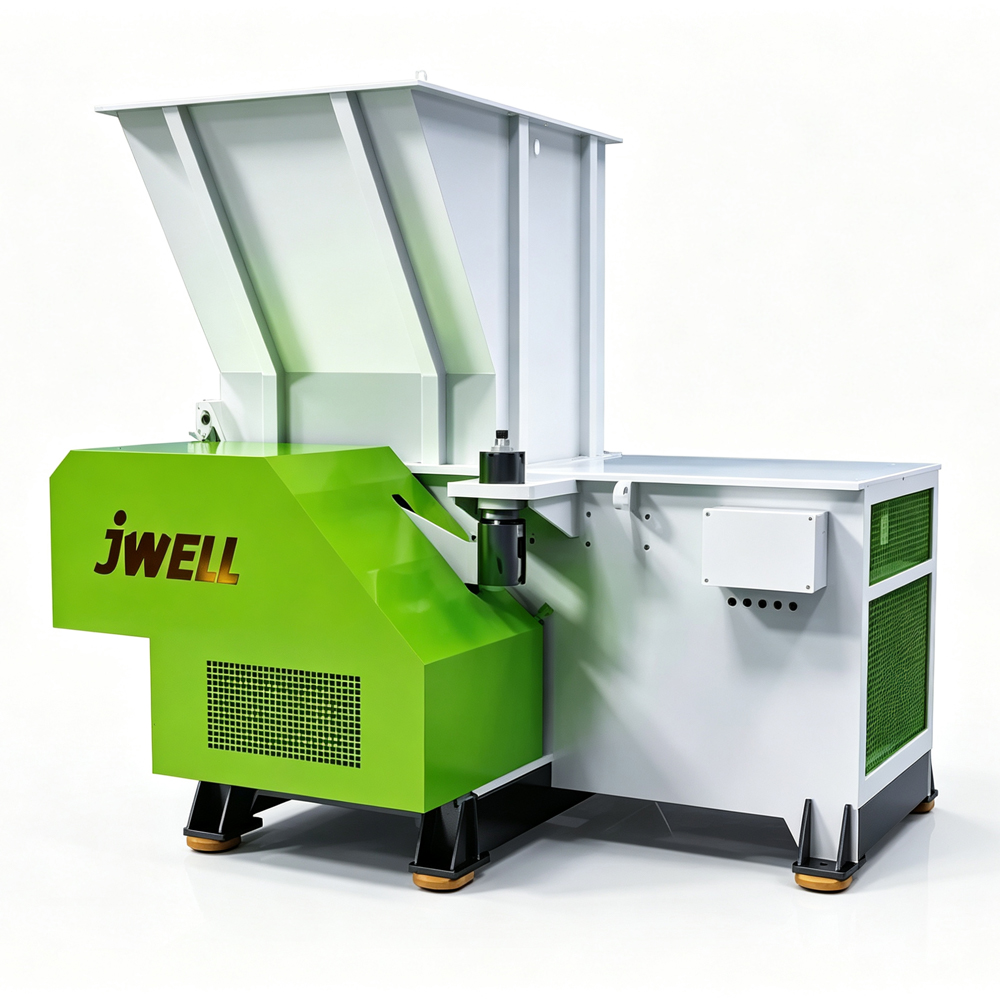
Plastic Shredder Crusher Machine

Tel: +86-19057068112

E-mail: [email protected]

Company Address
No. 128 Qingfeng Road, Xieqiao Town, Haining City, Jiaxing City, Zhejiang Province

19057068112

 English
 русский