
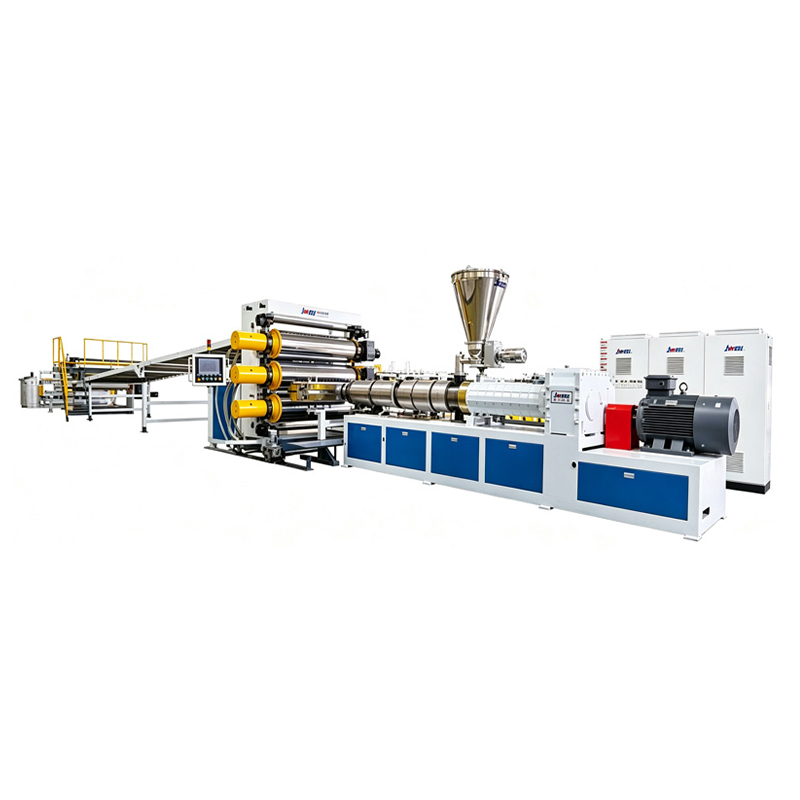
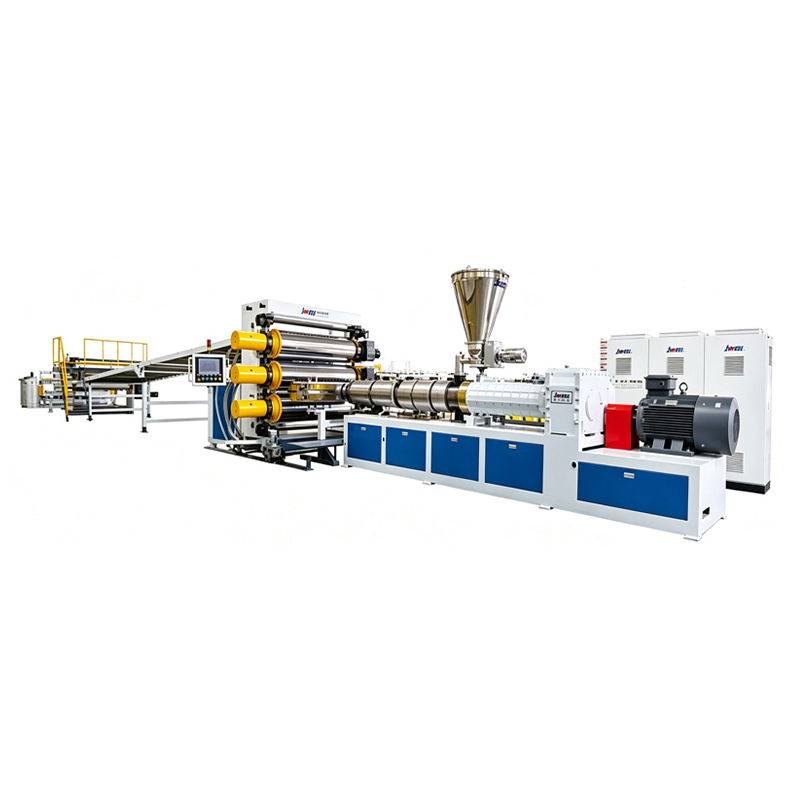

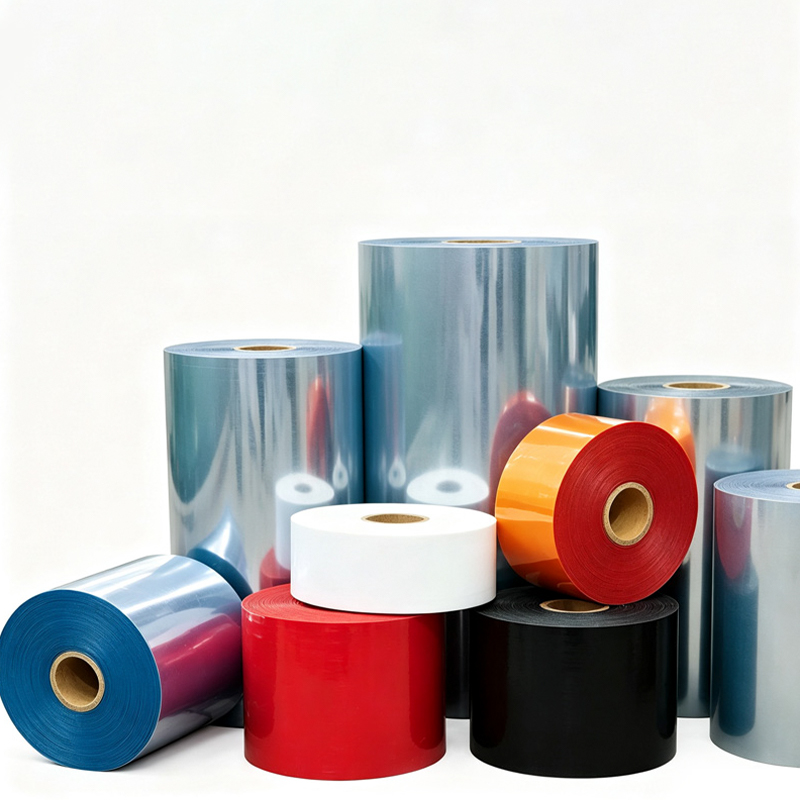
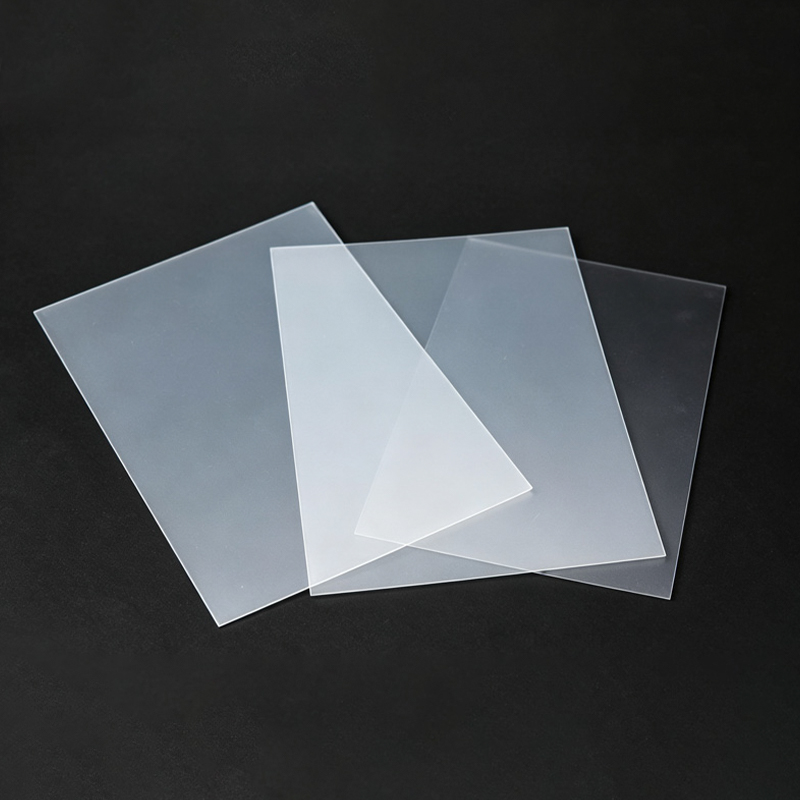
This production line is specifically designed for manufacturing PVC transparent rigid sheets and decorative sheets. It offers two models: SJZ80/156-1500 and SJZ92/188-2300, with product widths up to 1220mm and 2000mm respectively, and thickness ranging from 0.2 to 3.0mm. The designed extrusion output reaches as high as 350-550 kg/h, featuring low energy consumption, uniform plasticization, and suitability for wide, thin-walled products. It is widely used in packaging, furniture, and advertising decoration.
Packaging Industry: Transparent rigid films for blister packaging, clamshell packaging, and food trays (e.g., fruit, candy, electronics packaging). The SJZ80/156-1500 model offers a thickness starting from 0.2mm, making it an ideal choice for lightweight, high-transparency packaging.
Decorative Sheets: PVC decorative sheets for indoor wall panels, ceiling panels, furniture laminates, and advertising signs. The SJZ92/188-2300 model can provide a width of 2000mm, making it ideal for large-size decorative panels used in commercial spaces and residential renovations.
Stationery and Office Supplies: Transparent rigid films for folders, file covers, and ID card lamination.
Medical and Pharmaceutical: Blister packaging for tablets and medical device trays (requiring high transparency and chemical resistance).
Real-world Case: A European packaging company adopted the SJZ80/156-1500 production line to produce 0.5mm transparent rigid film at a stable output of 320–340 kg/h. The 1220mm width matched their existing slitting and printing lines, reducing material waste by 12%. Another Southeast Asian decorative panel manufacturer used the SJZ92/188-2300 production line to produce 1.8mm wood-grain PVC sheets at an output of 530 kg/h, supplying the hotel furniture industry.
High Output, Low Energy Consumption: The SJZ80/156-1500 achieves 350 kg/h with only 75 kW, while the SJZ92/188-2300 reaches 550 kg/h with 110 kW. This corresponds to an energy efficiency of approximately 4.7–5.0 kg/kWh, which is 15–20% higher than many traditional single-screw extruders.
Wide Thickness Adaptability: The SJZ80/156-1500 handles 0.2–3.0 mm, covering both ultra-thin and medium-thick applications. The SJZ92/188-2300 focuses on 1.0–3.0 mm, meeting rigid decoration requirements.
Large Width Capability: The 2000mm width on the SJZ92/188-2300 minimizes splicing, reducing downstream processing costs for wide decorative sheets.
Stable Conical Twin-Screw Design: The SJZ80/156 and SJZ92/188 conical twin screws provide excellent mixing, uniform plasticization, and lower melt temperature, which is critical for transparent films (reducing yellowing and gels).
Easy Maintenance: High-wear components (screws and barrels) are nitrided and repairable, with a service life extended to 8–10 years under normal operating conditions.
To ensure consistent film quality that meets international standards (e.g., ASTM, ISO), we implement the following multi-stage control and testing process:
1. Online Monitoring
Thickness Gauge: Automated ultrasonic or beta-ray thickness gauge scanning at the haul-off unit. Full-width tolerance is maintained within ±3%.
Visual Inspection System: High-resolution cameras detect surface defects (gels, black spots, fish eyes, scratches) in real time.
2. Offline Laboratory Tests (per shift)
·Tensile Strength and Elongation at Break: According to ASTM D882 – Typical value ≥45 MPa for transparent rigid PVC.
·Impact Resistance: Dart drop impact test (ASTM D1709) – ensures no brittle failure for thin films.
·Heat Shrinkage: 15 minutes at 100°C – ≤2% shrinkage for packaging grade.
·Optical Properties: Haze meter (ASTM D1003) – Haze <3%, transparency >95% for transparent films.
·Dimensional Stability: Measure width and thickness after conditioning at 23±2°C, 50% RH for 24 hours.
3. Practical Quality Control Practice
One customer producing 0.3mm transparent film for electronics blister packaging encountered occasional gel spots. By adjusting the vacuum venting zone on the SJZ80/156 extruder and changing screen packs daily, gel spots were reduced from 15 per m² to fewer than 3 per m², meeting stringent export requirements.
| Model | SJZ80/156-1500 | SJZ92/188-2300 |
| Extruder Specification | SJZ80/156 | SJZ92/188 |
| Products Width(mm) | 1220 | 2000 |
| Products Thickness(mm) | 0.2-3.0 | 1.0-3.0 |
| Main Motor Power(kw) | 75 | 110 |
| Designed Extrusion Output(kg/h) | 350 | 550 |
Q1: Can the SJZ80/156-1500 continuously produce 0.2mm film without breaking?
A: Yes. With appropriate die lip gap setting (0.18–0.22 mm), chill roll temperature (25–30°C), and stable melt pressure (12–15 MPa), we have validated production at 280–300 kg/h for 0.2mm thickness. It is recommended to start at 0.3mm thickness and gradually reduce.
Q2: What raw materials are compatible?
A: Standard rigid PVC resin (K value 65–68), impact modifiers (CPE or acrylic type), processing aids, stabilizers (calcium-zinc or organotin for transparent products), lubricants, and optional color masterbatch for decorative sheets. Avoid recycled material containing impurities for transparent grades.
Q3: How can the width be changed on the same production line?
A: The die lip opening can be adjusted from 1000mm to 2000mm (on the SJZ92/188-2300). For reducing width below the die width, edge trimming devices with automatic waste recycling systems can be used. The optimal fixed width for the SJZ80/156-1500 is 1220mm – smaller widths require slitting.
Q4: What is the typical energy consumption per ton?
A: For SJZ80/156-1500: approx. 214 kWh/ton (75 kW ÷ 350 kg/h). For SJZ92/188-2300: approx. 200 kWh/ton (110 kW ÷ 550 kg/h). Actual values vary with production speed and cooling load.
Q5: How often should screws and barrels be inspected?
A: First inspection after 6 months, then every 12 months. For PVC containing calcium carbonate filler (decorative sheets), wear is faster – inspect screw flight clearance every 3000 operating hours.
Q6: Does the production line support in-line recycling of edge trim?
A: Yes. Both models can be equipped with granulators and forced-feed edge trim recycling systems. For decorative sheets, regrind can be blended with virgin pellets up to 30%; but for transparent films, we recommend ≤10%, using only same-quality edge trim.
Q7: What is the delivery time for spare parts (screws, die head, chill rolls)?
A: Standard parts (heating bands, thermocouples, gears) – 7 days. Major components such as screws (nitrided) – 30 working days. We recommend keeping a spare set of screws to ensure uninterrupted production.




Pipe Extrusion Production Line
Plastic Shredder Crusher Machine

Tel: +86-19057068112

E-mail: [email protected]

Company Address
No. 128 Qingfeng Road, Xieqiao Town, Haining City, Jiaxing City, Zhejiang Province

19057068112

 English
 русский