
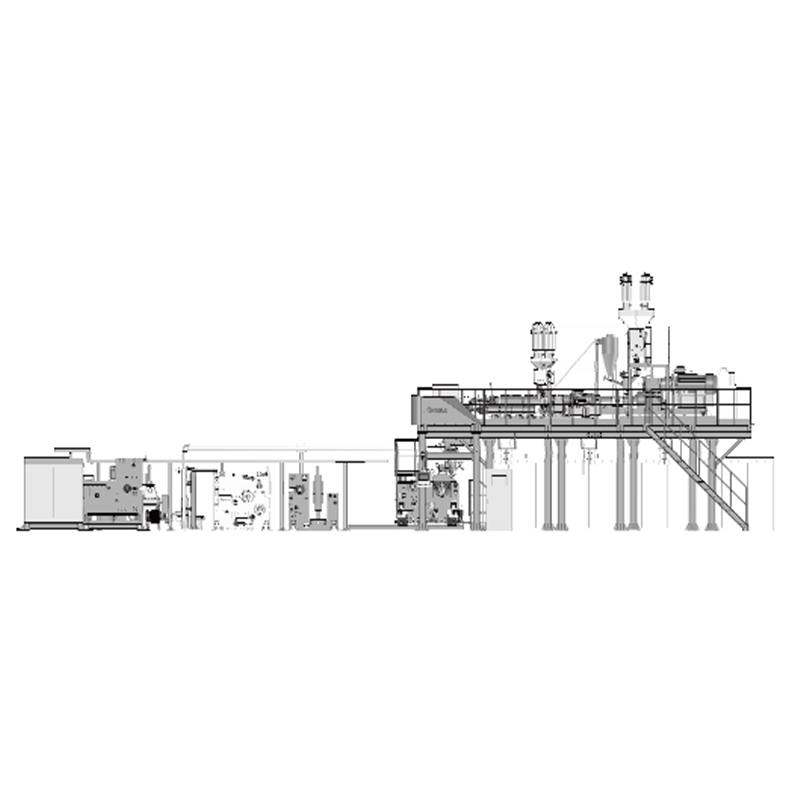
A decorative film covers a cabinet, a wall panel, a furniture edge. The pattern, wood grain, marble, brushed metal, sits inside the film, not printed on top. A CPP cast decorative film extrusion line produces this by melting polypropylene, casting it into a thin sheet, and embossing the pattern while the film is still hot. The line runs continuously. Pellets go in one end. Finished decorative film rolls off the other. For flooring, furniture, and interior surfacing manufacturers, this line is the source of the surface.
Polypropylene pellets, blended with color and additives, enter the extruder hopper. The screw rotates inside a heated barrel, melting and mixing the material. A CPP cast decorative film extrusion line uses a barrier screw that melts uniformly without overheating. Degraded polymer changes color and weakens the film. Melt temperature control is tight.
The melt passes through a screen changer that catches contaminants before they reach the die. A CPP cast decorative film extrusion line with an automatic screen changer runs continuously. Manual screen changers force a line stop.
The flat die spreads the melt into a thin sheet. Die lip adjustment bolts control the thickness profile across the web. A CPP cast decorative film extrusion line with automatic die control uses thickness gauge feedback to adjust the die lips in real time.
The molten sheet drops onto a polished chill roll. The roll cools and solidifies the film. The surface finish of the chill roll transfers to the back side of the film. A CPP cast decorative film extrusion line with a mirror-polished chill roll produces a glossy back surface.
From the chill roll, the film passes to the embossing station. The film is still hot enough to take a permanent impression. An engraved steel roller presses the pattern into the film surface. Wood grain, leather texture, geometric lines. The pattern depth and sharpness depend on the film temperature and the nip pressure. A CPP cast decorative film extrusion line manufacturer positions the embossing roller at the precise point in the cooling curve where this balance holds.
The embossing roller is precision-engraved with a chrome finish. Quick-change roller systems let the operator switch patterns without disassembling the line. One shift runs wood grain. The next runs matte solid.
After embossing, the film passes through additional cooling rollers under controlled tension. Too much tension stretches the film. Too little lets it sag. A CPP cast decorative film extrusion line with automatic tension control maintains dimensions through the cooling section.
A thickness gauge monitors the film before winding. The data feeds back to the die control for automatic correction. A CPP cast decorative film extrusion line that holds thickness within a few microns produces film with consistent pattern depth and visual appearance.
The winder builds finished rolls. Surface winders and center-surface winders handle different film thicknesses. A CPP cast decorative film extrusion line with proper winding tension produces rolls that unwind smoothly at the laminating or converting stage.
Here is what the line needs to produce consistent decorative film:
The pattern comes from the embossing roller, not from printing. A wood grain roller has the negative of the grain etched into the surface. As the hot film passes under pressure, the pattern transfers into the plastic. It becomes part of the film. It does not wear off or scratch away.
Colored film with a registered embossed pattern looks like the real material. A CPP cast decorative film extrusion line with precise roller speed control registers the texture to the color swirls in the film. The wood grain lines up with the color variation. Registered embossing is what makes a vinyl plank look like real wood instead of a photograph of wood.
The pattern depth changes because the film temperature at the embossing station drifted. A CPP cast decorative film extrusion line with controlled cooling keeps the film at the right temperature. The embossing roller wears and the pattern loses sharpness. A chrome-plated roller with proper hardness maintains pattern definition through millions of linear meters. The film thickness varies and the pattern distorts. Automatic gauge control holds thickness on target.
A CPP cast decorative film extrusion line turns polypropylene pellets into surfaces that look like wood, stone, and metal. The melt is cast, the pattern is pressed, the film is wound. Choose a manufacturer that controls the melt, engraves the roller precisely, and maintains tension through the line. The film will look like the material it imitates. That is the point.




Pipe Extrusion Production Line
Plastic Shredder Crusher Machine

Tel: +86-19057068112

E-mail: [email protected]

Company Address
No. 128 Qingfeng Road, Xieqiao Town, Haining City, Jiaxing City, Zhejiang Province

19057068112

 English
 русский