
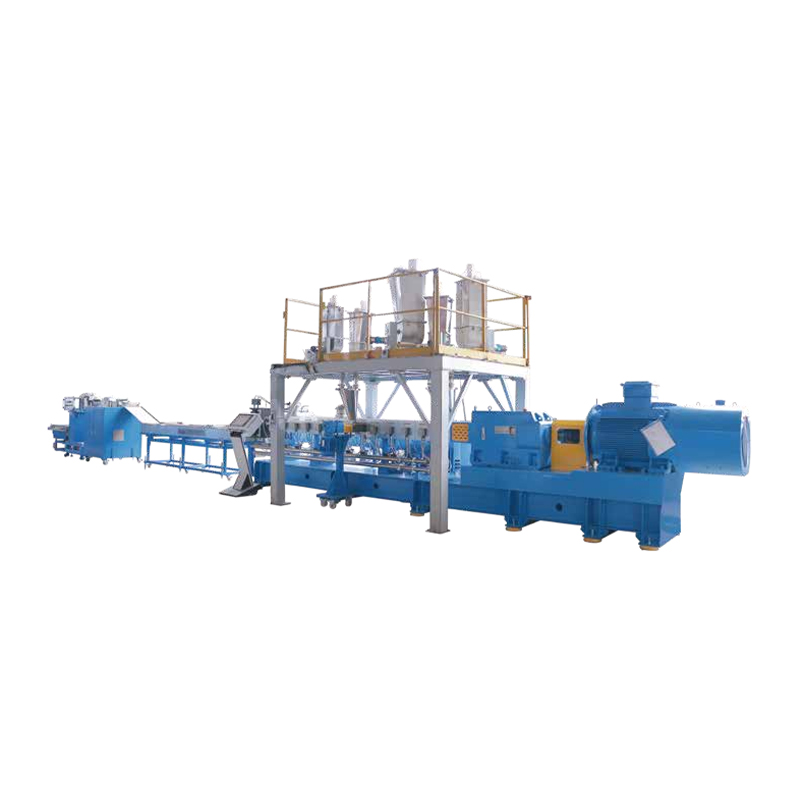
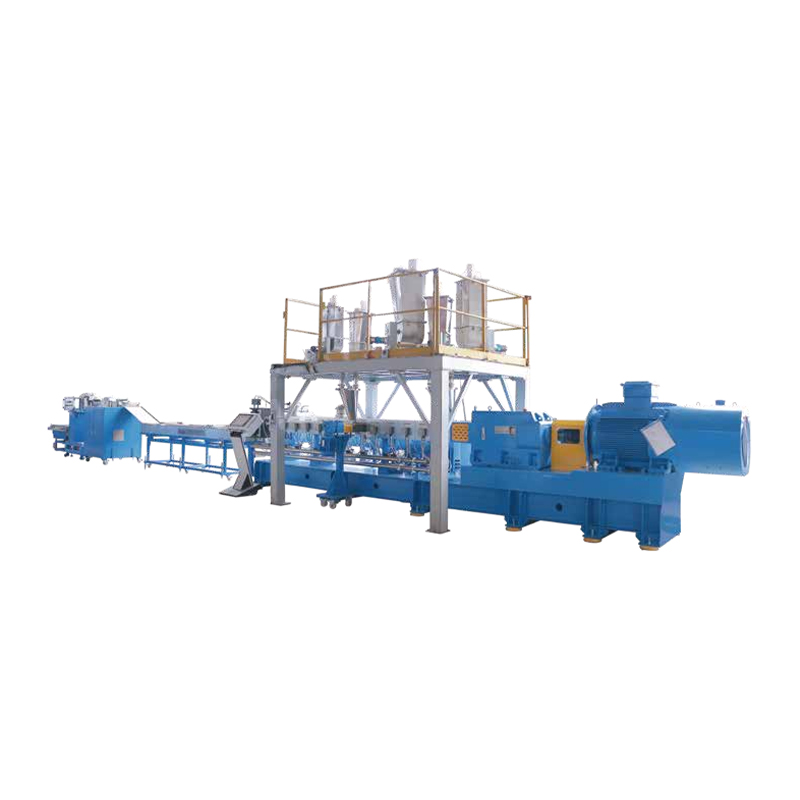
The CJWS series (models 65, 75, 95) is a dedicated production line for twin-screw extruders designed specifically for engineering plastics compounding and pelletizing. It features high length-to-diameter (L/D) ratios, wide speed ranges, and scalable throughputs, suitable for high-performance materials such as PA6, PA66, PC, POM, PBT, PET, ABS and their glass fiber/mineral filled modified grades.
The three models cover different production scales while sharing the same core technology:
|
Model |
Typical Output (kg/h) |
Common Applications |
|
CJWS65 |
400–800 |
R&D pilot line, small-batch specialty compounds (e.g., halogen-free flame-retardant PA), masterbatch production |
|
CJWS75 |
650–1100 |
Medium-scale production of glass fiber reinforced PBT for automotive connectors, carbon fiber reinforced PC |
|
CJWS95 |
1000–1700 |
High-volume extrusion of POM for gears, PC/ABS blends for e-scooter battery housings, and post-industrial recycling of engineering waste |
Real case: A German automotive supplier uses the CJWS75 to produce 30% GF-PA6 at an output of 950 kg/h. The high L/D ratio (44:1) achieves optimal glass fiber incorporation and devolatilization, resulting in a tensile strength >160 MPa and moisture content <0.3% after pelletizing.
Based on actual technical data sheets, the CJWS series offers clear engineering advantages:
·High L/D ratio (36–48)
Better dispersion and mixing – longer residence time ensures uniform distribution of additives (flame retardants, toughening agents, fibers).
Excellent devolatilization – multiple vent ports remove moisture, volatiles and reaction by-products, critical for hygroscopic resins such as PA and PC.
·Wide screw speed range (400–900 rpm)
Process flexibility – low speed (400–500 rpm) for heat-sensitive materials (e.g., POM); high speed (800–900 rpm) for high-shear mixing of nano-fillers.
Scalable output – operators can fine-tune speed to match downstream cooling and pelletizing systems.
·Validated reference throughput
"Reference throughput" is based on standard engineering plastics (e.g., PA6, unfilled). Actual output can be increased by 15–20% through optimized screw configuration and higher bulk density feeding.
·Robust construction for engineering resins
Wear-resistant bimetallic barrels and nitrided screws – tested with 50% GF-PA66, showing no significant wear after 6000 hours.
Every CJWS pelletizing line undergoes rigorous quality assurance – from component manufacturing to final pellet evaluation.
A. In-process quality monitoring (during extrusion)
|
Parameter |
Method |
Acceptance Standard |
|
Melt temperature |
IR or immersion pyrometer |
Setpoint ±5°C |
|
Melt pressure |
Pressure transducer (barrel zone) |
<250 bar (safe limit for engineering plastics) |
|
Torque & motor load |
Real-time SCADA monitoring |
≤95% of rated torque at target speed |
|
Screw speed stability |
Encoder feedback |
±2 rpm at steady state |
B. Finished pellet inspection (per batch)
Samples are taken each production shift for testing:
Pellet size uniformity (length 2.5–3.5 mm, diameter 2–3 mm) – sieve analysis.
Bulk density (e.g., 0.60–0.75 g/cm³ for glass-filled PA).
Moisture content – Karl Fischer method (<0.1% for most engineering plastics before further processing).
Mechanical properties – injection molded test specimens per ISO 527 / ISO 180 (tensile strength, notched Izod impact strength, heat deflection temperature).
C. Factory Acceptance Test (FAT) example
Before shipping a CJWS95 to a Mexican compounder, the manufacturer conducted a 4-hour trial using 20% talc-filled PP (as a substitute for engineering plastics).
Actual output: 1680 kg/h (above the 1800 upper reference value) at 850 rpm.
Melt temperature fluctuation: <3°C across 8 zones.
Pellet length consistency: 98% within 2.8–3.2 mm.
| Model | L/D | Speed rpm |
Capacity for reference kg/hr |
| CJWS65 | 36~48 | 400~900 | 400~1000 |
| CJWS75 | 36~48 | 400~900 | 650~1300 |
| CJWS95 | 36~48 | 400~900 | 1000~1800 |
Q1: How to choose between CJWS65, 75 and 95?
A: Based on desired hourly output and available floor space.
Up to 800 kg/h → CJWS65
650–1300 kg/h → CJWS75
Above 1300 kg/h → CJWS95
Also note that larger models offer higher torque, which benefits highly filled compounds (>40% glass fiber).
Q2: Can heat-sensitive engineering plastics like POM or PVC be processed on these machines?
A: Yes. The wide speed range (down to 400 rpm) and gentle screw design (optional reduction of kneading blocks) allow safe processing. For POM, we recommend L/D 36–40 with enhanced venting to remove formaldehyde gas.
Q3: How does L/D ratio affect pellet quality?
A: Higher L/D (48 vs. 36) provides more kneading blocks and reverse elements, improving melting and mixing, but also increases residence time. For glass fiber reinforced grades, L/D 44–48 ensures better fiber distribution without excessive breakage. For unfilled materials, L/D 36 is sufficient and more energy-efficient.
Q4: What is the actual energy consumption?
A: Measured on a CJWS75 running 30% GF-PA6 at 850 kg/h:
Specific energy: 0.22 kWh/kg (including heating and drive).
This is about 12% lower than older European twin-screw designs.
Q5: What maintenance is required to maintain reference throughput?
A:
Every 500 hours – check screw tip clearance (replace if wear >0.3 mm).
Every 2000 hours – inspect barrel liners and gearbox oil condition.
Annually – fully pull screws, clean and measure all kneading elements.
Users following this schedule report stable output for 8–10 years.
Q6: Can the same machine produce both rigid and elastomeric engineering plastics (e.g., TPU)?
A: Yes, with a screw configuration change. For TPU (thermoplastic polyurethane), use fewer shear elements and a lower compression ratio. Many CJWS users have two screw sets – one for glass-filled PA/PC, another for TPU/PMMA.




Pipe Extrusion Production Line
Plastic Shredder Crusher Machine

Tel: +86-19057068112

E-mail: [email protected]

Company Address
No. 128 Qingfeng Road, Xieqiao Town, Haining City, Jiaxing City, Zhejiang Province

19057068112

 English
 русский