
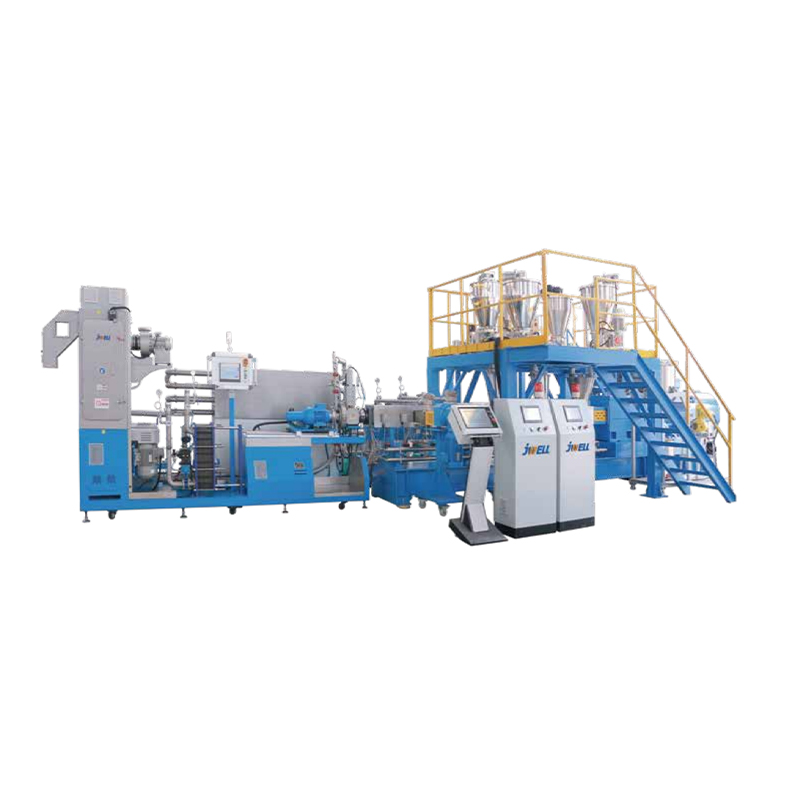
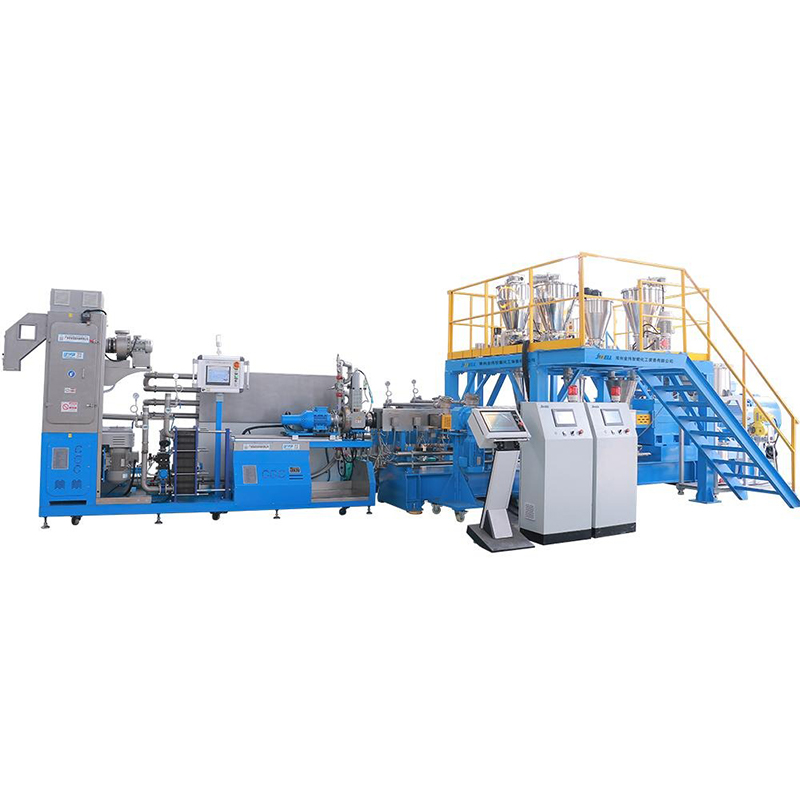
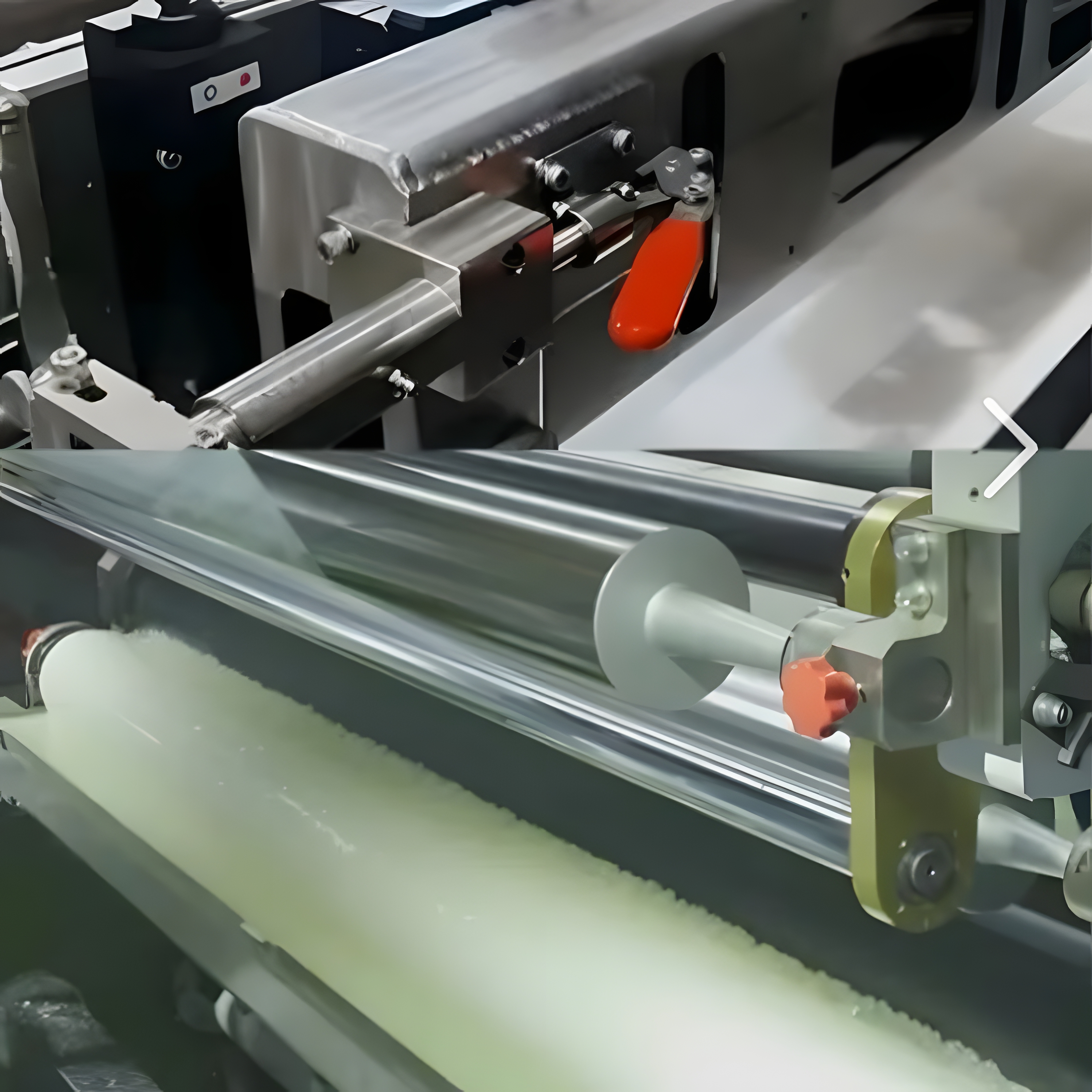
Jwell's HC Series Co-rotating Twin-Screw Extrusion Lines for Thermoplastic Elastomers (TPE) (HC65, HC75, HC95) are high-efficiency solutions specifically designed for the compounding and modification of high-value elastomers such as TPE, TPV, TPU, and TPO. These models feature a modular barrel structure, length-to-diameter (L/D) ratios ranging from 48 to 64, maximum screw speeds of up to 600 rpm, and reference output ranges from 300 kg/h (HC65) to 1500 kg/h (HC95), flexibly covering all scenarios from small-scale R&D scale-up to large-scale continuous industrial production.
The HC series is widely used to produce various thermoplastic elastomers, including TPE-S (SEBS-based), TPV (dynamic vulcanization), TPU, and TPO.
HC65 (300–500 kg/h) – Suitable for small to medium batch production.
Real-world case: A medical tubing manufacturer uses the HC65 to produce SEBS-based TPE for syringe piston seals. With an L/D=48 configuration, it ensures uniform chemical resistance and low compression set.
HC75 (500–1000 kg/h) – Best suited for the automotive and consumer goods industries.
Real-world case: An automotive parts supplier produces TPV automotive weather seals on an HC75 at 600 rpm, L/D=56. Stable output reaches 780 kg/h, with consistent crosslinking degree and surface finish.
HC95 (1000–1500 kg/h) – Designed for high-volume industrial profiles and wire & cable jackets.
Real-world case: A cable manufacturer uses the HC95 to produce halogen-free flame-retardant TPU for EV charging station cables. At 600 rpm, L/D=64, it achieves an output of 1350 kg/h with a gel count below 0.5%.
High L/D ratio (48–64)– Better compounding and devolatilization
Longer screw length allows more kneading blocks, improving dispersion of fillers (e.g., carbon black, flame retardants) and enabling efficient devolatilization. For TPV production, the extended L/D ensures complete vulcanization without scorch.
Maximum screw speed 600 rpm – High shear and output flexibility
Unlike low-speed lines (300–400 rpm), 600 rpm enables both high-output bulk compounding and gentle mixing for heat-sensitive materials (e.g., low-odor TPE for indoor use). Torque remains stable even at maximum speed.
Scalable output – Matches your needs
HC65: 300–500 kg/h → Ideal for R&D to production scale-up.
HC75: 500–1000 kg/h → Workhorse for mid-sized factories.
HC95: 1000–1500 kg/h → Reduces per-kg cost for large-volume orders.
Energy-efficient gearbox & modular design
All models feature a high-torque, oil-cooled gearbox designed for over 100,000 hours of service life. Modular barrel sections (4D/6D) can be reconfigured for different TPE formulations (e.g., adding side feeders for fillers or liquid injection units for plasticizers).
Each TPE extrusion line undergoes rigorous quality control – both during manufacturing and after installation. Our standard procedures include:
A. In-process quality control (during extrusion)
Melt pressure & temperature monitoring (each barrel zone) – ensures viscosity stability.
Screw speed vs. torque correlation – detected by real-time PLC. Deviations >2% trigger an alarm.
Devolatilization vacuum level – maintained at -0.08 to -0.09 MPa to remove moisture/odor.
B. Final product testing (per batch)
Melt flow index (MFI) – tested at 190°C/2.16 kg or 230°C/5 kg per ASTM D1238.
Mechanical properties – tensile strength (ASTM D412), elongation at break, tear strength.
Compression set (23°C/72h, 70°C/24h) – critical for automotive weather seals.
Abrasion resistance & hardness (Shore A/D) – per DIN 53516 and ASTM D2240.
Gel/fish-eye count – optical inspection for film-grade TPE.
C. Factory acceptance test (before shipment)
We use your actual TPE formulation and run continuously for 4 hours at 600 rpm. The line passes acceptance if:
Output fluctuation ≤ ±3%
No melt temperature spikes (exceeding setpoint by >10°C)
Uniform pellet size (2–3 mm), no discoloration
Real-world case: During a factory acceptance test for an HC75 line destined for Poland, we used 30% talc-filled TPV. The customer witnessed a stable output of 820 kg/h, with 6.2% lower specific energy consumption compared to their existing line.
|
Model
|
L/D
|
Max. screw speed (rpm)
|
Capacity for reference (kg/hr)
|
|
HC65
|
48–64
|
600
|
300–500
|
|
HC75
|
48–64
|
600
|
500–1000
|
|
HC95
|
48–64
|
600
|
1000–1500
|
Q1: For my TPE product, should I choose L/D=48 or L/D=64?
L/D=48 – Suitable for most TPE-S and TPU without fillers or with ≤20% filler. Faster cleaning, shorter residence time.
L/D=64 – Recommended for TPV (requires dynamic vulcanization), highly filled TPE (>40% mineral/flame retardant), or when you need two vent ports for deep devolatilization.
Q2: Can the HC65 reach 500 kg/h at 600 rpm?
Yes, but only for very free-flowing TPE (MFI >30 g/10min) combined with optimized screw design. For standard SEBS compounds (MFI 5–15), actual output is 350–420 kg/h. The data in the table are reference ranges – we will provide screw element simulations before purchase.
Q3: How to purge the line when switching from black TPE to white TPE?
The modular barrel allows easy opening. For L/D=48–64, we recommend a two-step purging method:
Run PP or HDPE at 600 rpm for 15 minutes → removes most residue.
Run commercial purging compound (e.g., Dynapurge) at 400 rpm for 10 minutes.
Typical color change time: 45–60 minutes on an HC75.
Q4: What is the energy consumption per kg of product?
Real data from an HC95 producing TPE-S (1100 kg/h, 600 rpm):
Total installed power ≈ 315 kW (main motor + heaters + vacuum). Energy consumption ≈ 0.28–0.32 kWh/kg. This is 12–15% lower than traditional 400 rpm lines due to better torque utilization.
Q5: Do you provide smaller lines for pilot trials?
While the HC65 is our smallest production model, we can offer lab-scale lines (e.g., HC35, output ~20 kg/h). However, for direct scale-up to production, the HC65 is an ideal "small production" line – many R&D centers use it to prepare market samples.
Q6: For L/D=64, how do you avoid thermal degradation of TPE due to long residence time?
You are correct to observe this. Longer L/D means longer residence time, but in actual design we control thermal degradation risk through three aspects:
Screw configuration optimization – In L/D=64 configurations, we reduce the proportion of pure kneading blocks and increase conveying elements, so the actual residence time in high-temperature zones is only 8–12 seconds longer than L/D=48 (measured on HC75 at 600 rpm).
Zoned temperature control – A decreasing or isothermal profile from feed zone to die, rather than continuous heating. For example, in TPV production, a cooling zone is set immediately after the vulcanization zone (15–20°C lower than the preceding zone).
High-speed dilution effect – At 600 rpm, the thin material layer renews rapidly, resulting in lower actual thermal exposure than low-speed, long-residence-time configurations.
Real-world case: A US customer uses an HC95 (L/D=64) to produce aging-resistant TPE-S, requiring tensile retention >90% after 190°C/72h heat aging. We tested at 600 rpm, and the final retention reached 94% with no visible degradation.
Q7: Your output ranges (e.g., 500–1000 kg/h for HC75) have a wide span. If I want to run long-term at the low end (500 kg/h), will it affect product quality or equipment life?
Not at all. Our reference output ranges represent a safe operating window based on different formulations and processing difficulty – they are not mandatory full-load requirements.
Effect on quality: At 500 kg/h, the fill ratio decreases (about 50–60% instead of 70–80%), but by adjusting screw speed (e.g., from 600 rpm down to 350–400 rpm) you can maintain the same specific shear work and melt temperature. In practice, many compounders use HC75 lines to produce high-viscosity TPU (poor flow) with actual outputs of only 450–550 kg/h, and the product tensile strength and extrusion appearance are still acceptable.
Effect on equipment life: Low-load operation actually reduces wear on the gearbox, bearings, and barrels. Our gearbox design life of 100,000 hours is calculated at 80% of rated torque. Running long-term at 50% torque can extend actual life to over 150,000 hours.
Recommendation: If you are certain to run long-term at 500 kg/h, we can configure the line with a finer screw spline and a smaller main motor (reduced from 250 kW to 185 kW) before shipment, further saving initial investment and energy consumption.





Tel: +86-19579950928

E-mail: [email protected]

Company Address
No. 128 Qingfeng Road, Xieqiao Town, Haining City, Jiaxing City, Zhejiang Province

19579950928

 English