
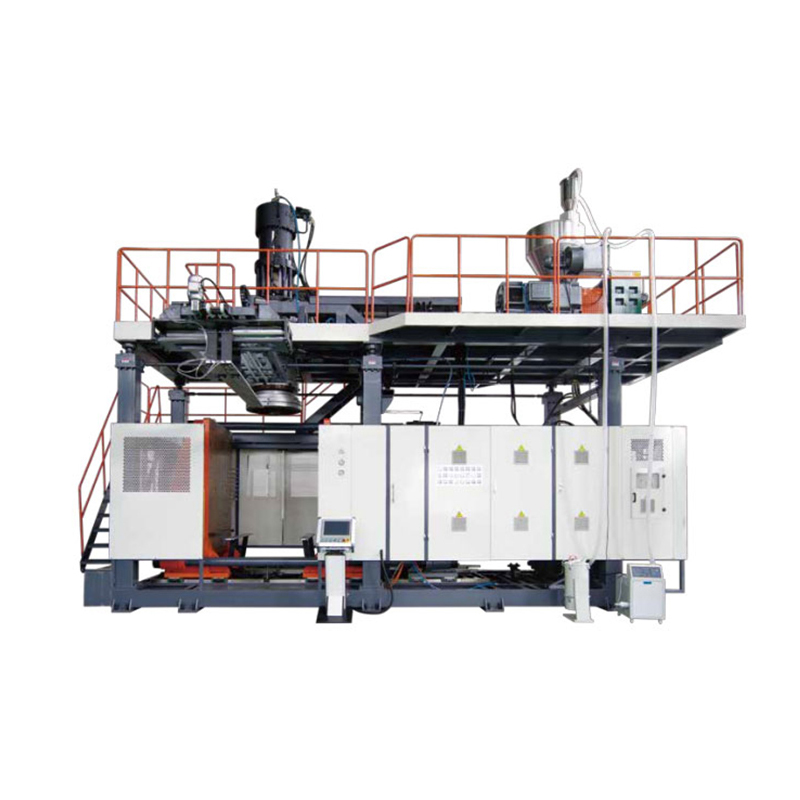
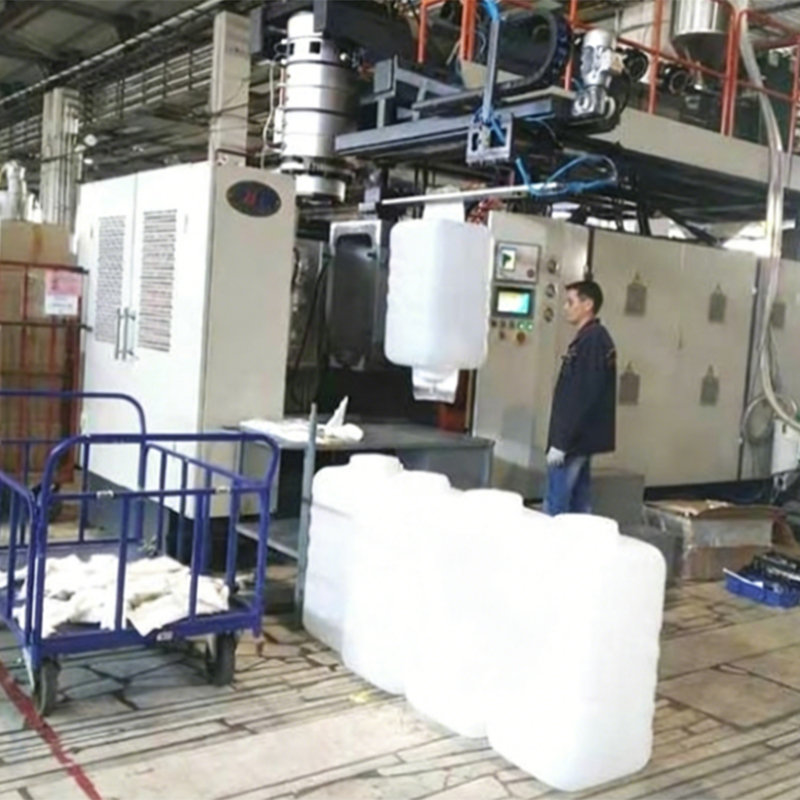
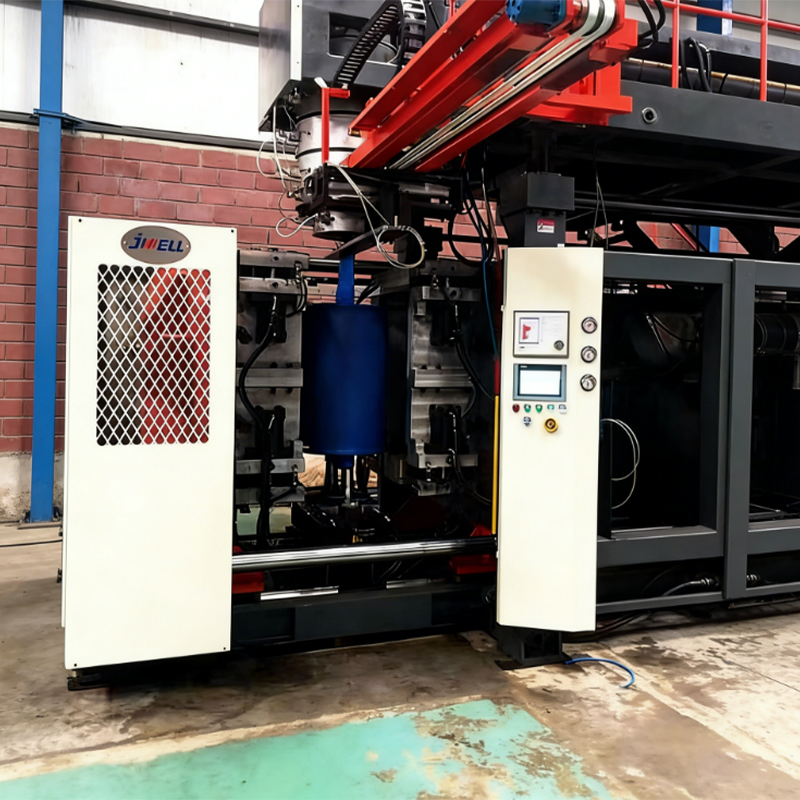
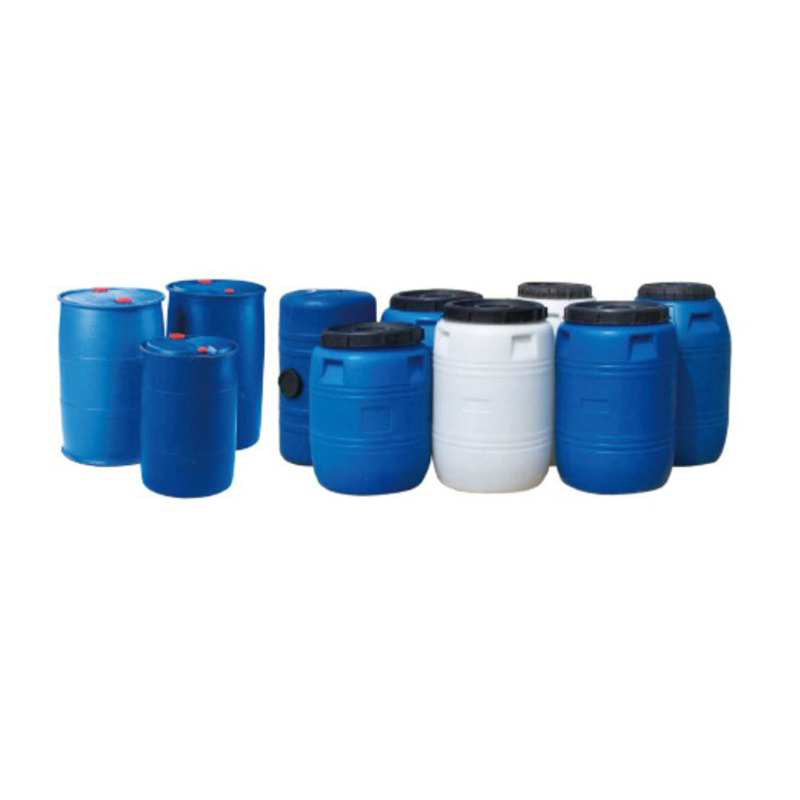
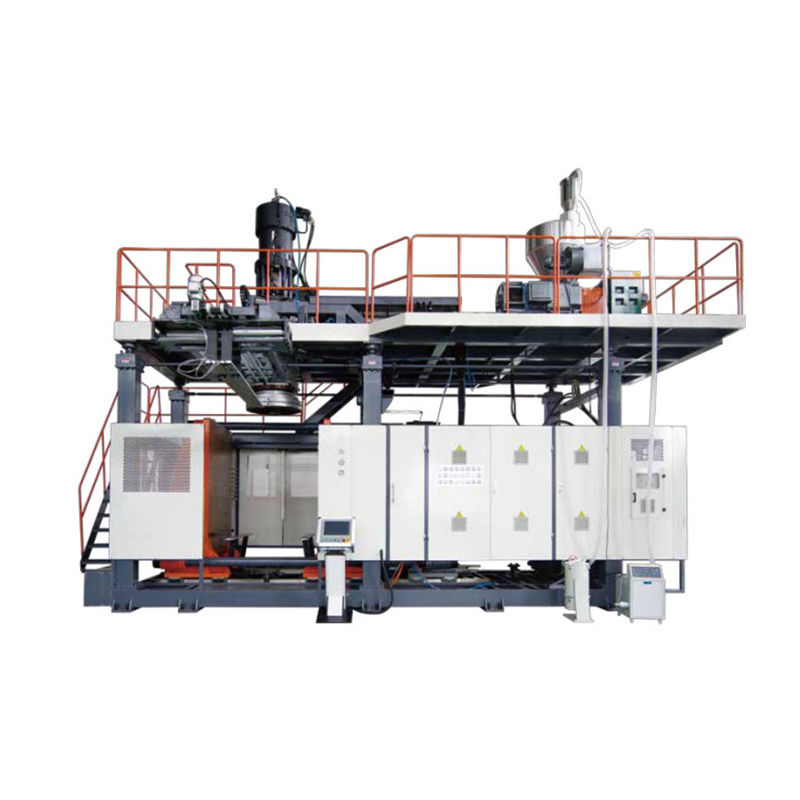
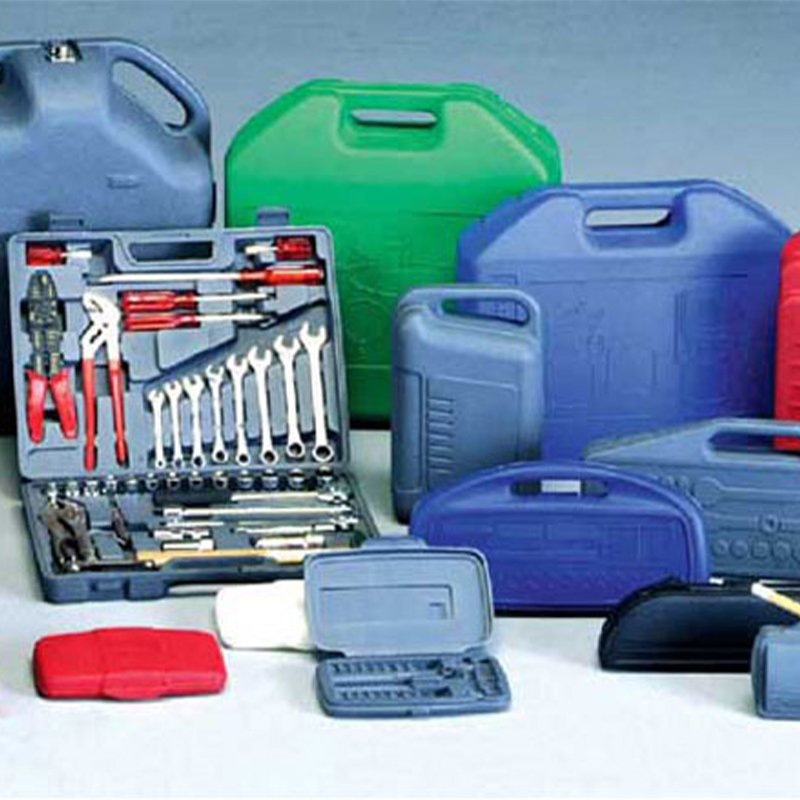
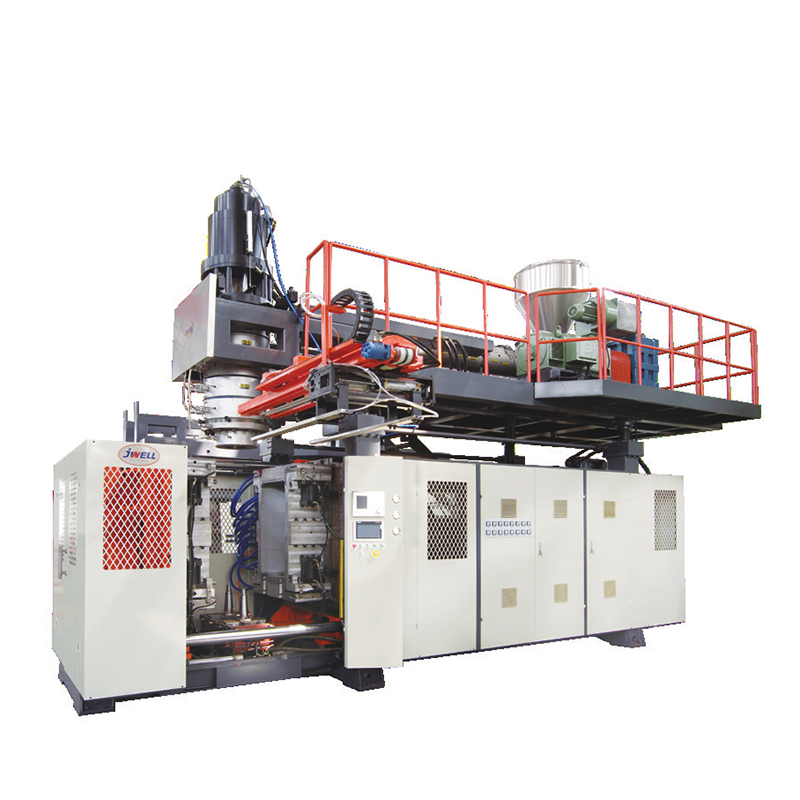
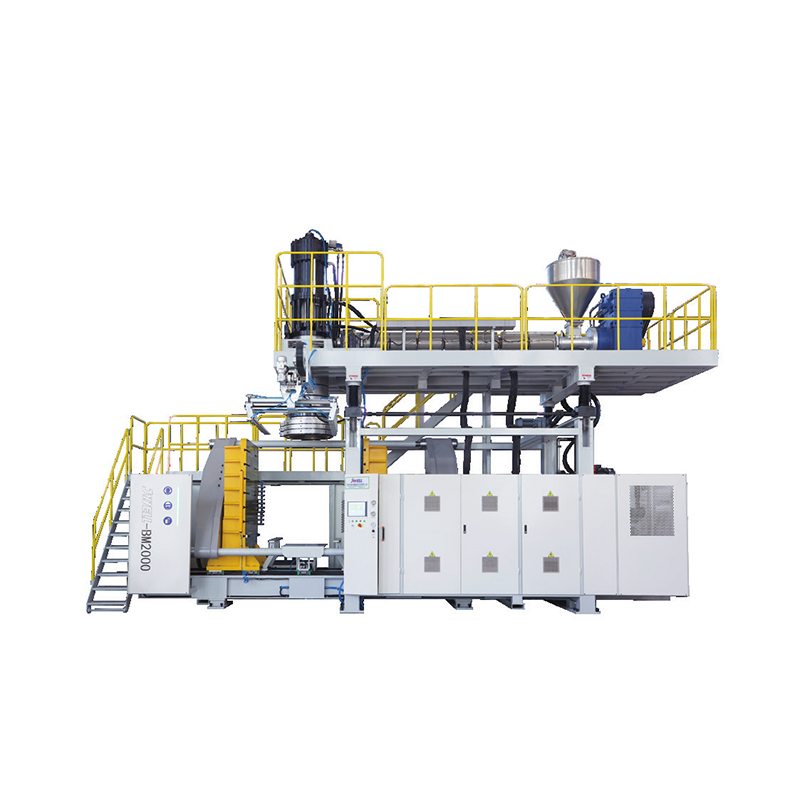
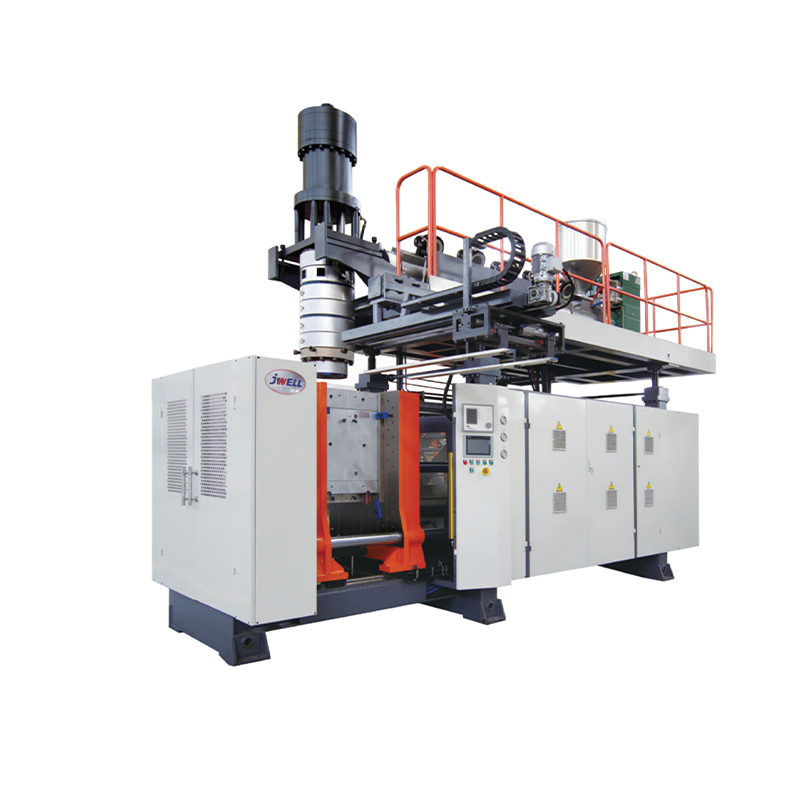
The BM Series HDPE Blow Molding Machines (BM30, BM50, BMI100) are heavy-duty industrial solutions designed for the production of large hollow plastic parts. Maximum product volume ranges from 30L to 100L. Engineered for high output and continuous operation, they are suitable for packaging, automotive, and industrial container manufacturing.
Thanks to high clamping force, generous platen dimensions, and accumulator head design, these machines excel at producing HDPE parts with uniform wall thickness.
BM30 (max. product 30L, dry cycle 600 cycles/hour)
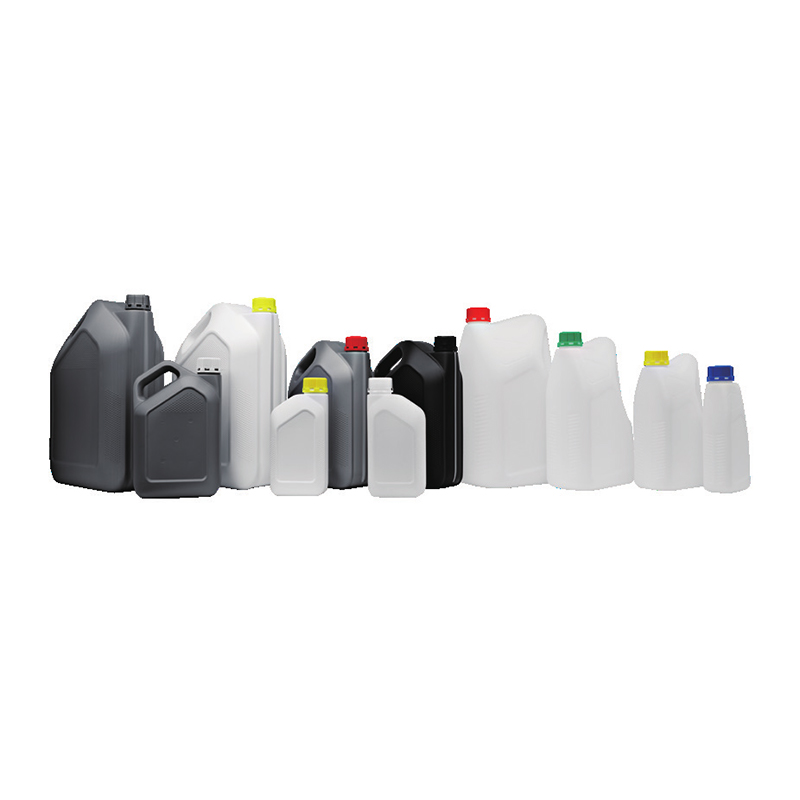
Typical products: 20L–30L square pails, small industrial drums, automotive air ducts, tool boxes.
Real-world case: A chemical lubricant producer uses the BM30 to manufacture 25L HDPE pails. With a plasticizing capacity of 120 kg/h (PE) and clamping force of 280 kN, they achieve 540–600 pieces/hour at 2.5mm wall thickness. The 400–900 mm mold platen stroke allows quick mold changes for pails of different heights.
BM50 (max. product 50L, dry cycle 450 cycles/hour)
Typical products: 50L open-head drums, large water tanks, automotive fuel tanks, waste bins.
Real-world case: An automotive parts supplier uses the BM50 to produce 45L HDPE fuel tanks. The 400 kN clamping force and 880×880 mm platen dimensions ensure flash-free parting lines. The 18.5 kW hydraulic pump motor and 6.2L accumulator volume (per spec sheet) enable precise parison programming to accommodate wall thickness variations at internal baffles of the fuel tank.
BMI100 (max. product 100L, dry cycle 360 cycles/hour)
Typical products: 100L chemical drums, 80–100L municipal waste bins, large marine buoys, agricultural spray tanks.
Real-world case: A waste management company uses the BMI100 to produce 95L municipal waste bins. The 600 kN clamping force, combined with a 100mm main screw diameter and plasticizing rate of 190 kg/h, ensures consistent melt uniformity. The 500–1300 mm mold platen stroke accommodates tall bins with undercuts. After optimizing cooling time, output stabilizes at 340–360 pieces/hour.
2.1 Accumulator Head – For Large and Thick-Walled Parts
Unlike continuous extrusion, the accumulator head stores molten HDPE and then rapidly injects it into the mold. This reduces melt sag and provides uniform wall thickness – critical for parts like 100L drums that require consistent strength.
2.2 High Dry Cycle Output (vs. Competitors)
BM30: 600 pieces/hour (30L parts) – 20–30% faster than many domestic models of similar tonnage.
BM50: 450 pieces/hour – suitable for medium output, multi-cavity production.
BMI100: 360 pieces/hour – excels on heavy-duty 100L parts, where cycle time is mainly limited by cooling rather than plasticizing.
2.3 Robust Plasticizing & Drive System
|
Model |
Screw Diameter (mm) |
Plasticizing Capacity (PE kg/h) |
Drive Motor (kW) |
|
BM30 |
80 |
120 |
37 |
|
BM50 |
90 |
180 |
45 |
|
BMI100 |
100 |
190 |
55 |
These oversized screw/drive combinations prevent "starve feeding" during rapid cycles. The 45–55 kW main motors can handle high backpressure when processing regrind or masterbatch.
2.4 Powerful Clamping & Large Mold Accommodation
Clamping force: 280–600 kN – ensures flash-free parts even for 100L drum molds.
Platen dimensions: up to 1020×1000 mm (BMI100) – suitable for family molds or multi-cavity molds for small parts.
Maximum mold size: 800×1200 mm (BMI100) – accommodates irregular shapes like automotive air ducts.
2.5 Energy Efficiency
Total installed power is 95–135 kW, but actual energy consumption is 50–70% thanks to optional servo-driven hydraulic pumps and PID temperature control for die heating (20–30 kW). For a 24/7 plant producing 50L drums, the BM50 saves approximately 15–20 kWh per ton of HDPE processed compared to older hydraulic machines.
We implement a 4-stage quality control plan to ensure every machine delivers consistent part quality.
Stage 1 – Incoming Material & Pre-molding Inspection
Melt flow index test (per batch of HDPE): target 0.2–0.8 g/10min for large drums.
Moisture content below 0.02% (using desiccant dryer) – HDPE is hygroscopic; moisture causes silver streaks or bubbles on part surfaces.
Screw/barrel wear check: every 2000 operating hours (caliper measurement).
Stage 2 – In-Process Monitoring (Real-Time)
|
Parameter |
Acceptable Range (BM50 example) |
Action if out of range |
|
Melt temperature |
190–210°C (HDPE) |
Adjust barrel zone temperatures |
|
Accumulator shot volume |
4.5–6.2 L (full stroke) |
Recalibrate limit switches |
|
Clamping force |
380–420 kN (target 400) |
Check tie rod nuts |
|
Parison wall thickness program |
Deviation ≤ ±0.15mm from design |
Re-teach servo positions |
Stage 3 – Post-Mold Part Testing (per batch)
Drop test (UN certification for dangerous goods): 30L drum filled with water, dropped from 1.2m – no cracking.
Top load test: 100L drum must withstand 400 kg force for 1 minute (ASTM D2659).
Leak test (underwater air check): 0.5 bar internal pressure, no bubbles for 30 seconds.
Wall thickness profile: Ultrasonic thickness gauge measures 12 points – max/min ratio ≤ 1.3:1.
Stage 4 – Machine Factory Acceptance Test (FAT)
Before shipment, each machine runs a 72-hour continuous test:
8-hour shift at maximum dry cycle rate
16-hour shift at 80% load
Then measure: plasticizing uniformity (deviation ≤2%), hydraulic oil temperature rise (≤ ambient +15°C), noise level (≤85 dBA).
Real-world case: A BM30 destined for a lubricant plant in Kenya failed FAT due to uneven parison thickness (0.4mm deviation on a 2mm wall). We replaced accumulator piston seals and reprogrammed the parison servo curve – the second test passed with 0.1mm deviation.
Product Specifications:
|
Item
|
Description
|
|
Place of origin
|
China
|
|
Brand name
|
JWELL
|
|
Model number
|
HDPE Material
|
|
Minimum order quantity
|
5L
|
|
Packaging details
|
Wooden pallet packing
|
|
Delivery time
|
90days
|
|
Payment terms
|
TT. LC
|
Technical Parameters:
|
Model
|
Unit
|
BM30
|
BM50
|
BM100
|
|
Max product volume
|
L
|
30
|
50
|
100
|
|
Dry cycle
|
Pc/h
|
600
|
450
|
360
|
|
Die head structure
|
Accumulating type
|
Accumulating type
|
Accumulating type
|
Accumulating type
|
|
Main screw diameter
|
mm
|
80
|
90
|
100
|
|
Max plasticizing capacity (PE)
|
kg/h
|
120
|
180
|
190
|
|
Driving motor
|
Kw
|
37
|
45
|
55
|
|
Accumulating volume
|
L
|
5.2
|
6.2
|
12.8
|
|
Oil pump motor power
|
Kw
|
15
|
18.5
|
22
|
|
Clamping force
|
KN
|
280
|
400
|
600
|
|
Space between platen
|
mm
|
400-900
|
450-1200
|
500-1300
|
|
Platen size W*H
|
mm
|
740*740
|
880*880
|
1020*1000
|
|
Max. mould size
|
mm
|
550*650
|
700*850
|
800*1200
|
|
Heating power of die head
|
Kw
|
20
|
28
|
30
|
|
Machine dimension LWH
|
m
|
4.32.23.5
|
5.62.43.8
|
5.52.54.0
|
|
Machine weight
|
T
|
12
|
13.5
|
16
|
|
Total power
|
Kw
|
95
|
110
|
135
|
Q1: What is the actual energy consumption per part?
A: Take the BM50 producing a 5kg, 50L drum as an example:
Measured power (with servo pump): average 38–42 kW
Cycle time: 35 seconds → 103 pieces/hour
Energy per part = 0.37–0.41 kWh/piece
Energy per kg HDPE = 0.074–0.082 kWh/kg
Compared to conventional fixed pump machines at 0.11–0.13 kWh/kg – a 28% saving.
Q2: Can I use recycled HDPE?
A: Yes, 30–40% post-consumer recyclate can be used without parameter modification. Use a screen changer (optional) to remove contaminants. The BM50's 90mm screw has a compression ratio of 3.0:1 – very suitable for mildly degraded PCR. For higher PCR ratios (50%+), we recommend adding a venting section and reducing the plasticizing rate by 15–20%.
Q3: How long does a mold change take?
A: With optional hydraulic mold clamping and quick-change water manifolds:
BM30: 12–15 minutes
BM50: 18–22 minutes
BMI100: 25–30 minutes
Manual mold change (without quick clamps) adds 10–15 minutes. This is standard for domestic machines – we provide a mold change cart for BM50/100 at no extra charge.
Q4: What is the maintenance interval for the accumulator head?
A: - Replace piston seals every 6,000 operating hours (or annually).
Inspect accumulator cylinder bore for scratches every 3,000 hours.
Real-world case: A BM50 at a Turkish drum plant ran continuously for 18 months without seal replacement – started showing melt leakage into hydraulic oil (cross-contamination). We now enforce a 5,000-hour seal replacement schedule.
Q5: Can I produce multi-layer (co-extruded) products?
A: The standard accumulator head is single-layer. For co-extrusion (e.g., HDPE + EVOH barrier layer for fuel tanks), we offer a 3-layer co-extrusion kit that fits between the accumulator and the die. Two additional extruders (30–45 kW each) are required. Available for BM50 and BMI100 – lead time extends by 8 weeks.
Q6: How do I accommodate different part heights (e.g., 40cm vs 80cm)?
A: Use the mold platen stroke adjustment (manual or electric):
BM30: 400–900 mm stroke
BM50: 450–1200 mm
BMI100: 500–1300 mm
For very tall parts (e.g., 1.2m), we recommend the BMI100 with extended tie rods – optional +200 mm stroke (additional cost).
Q7: What safety certifications are available?
A: Standard CE (LVD, MD, EMC) for the EU market. Optional UL508A electrical panel (North America). A customer in Chile once requested CSA – available through third-party on-site certification (additional cost).





Tel: +86-19579950928

E-mail: [email protected]

Company Address
No. 128 Qingfeng Road, Xieqiao Town, Haining City, Jiaxing City, Zhejiang Province

19579950928

 English