
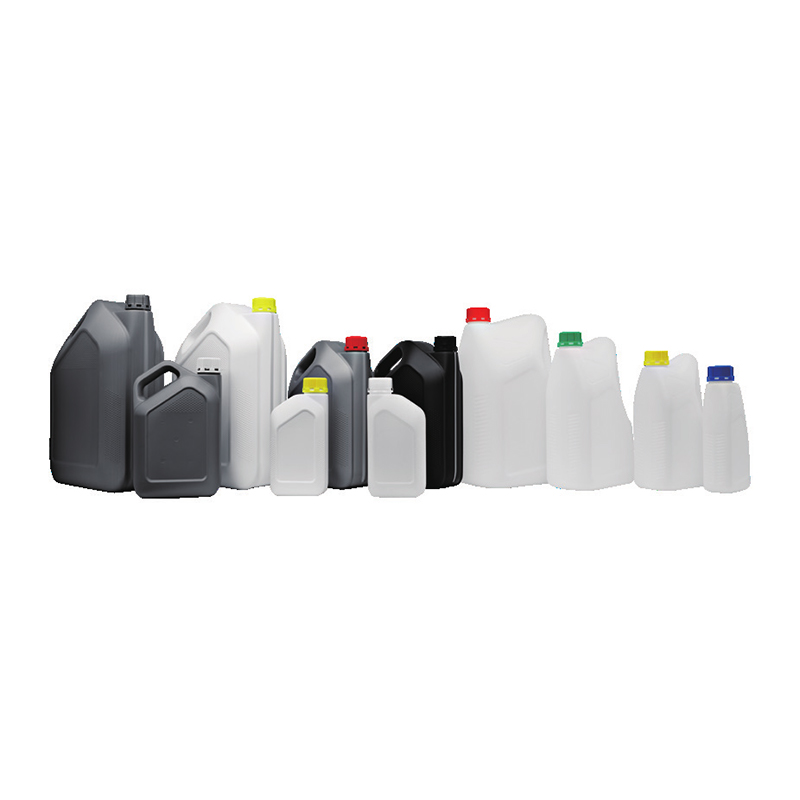
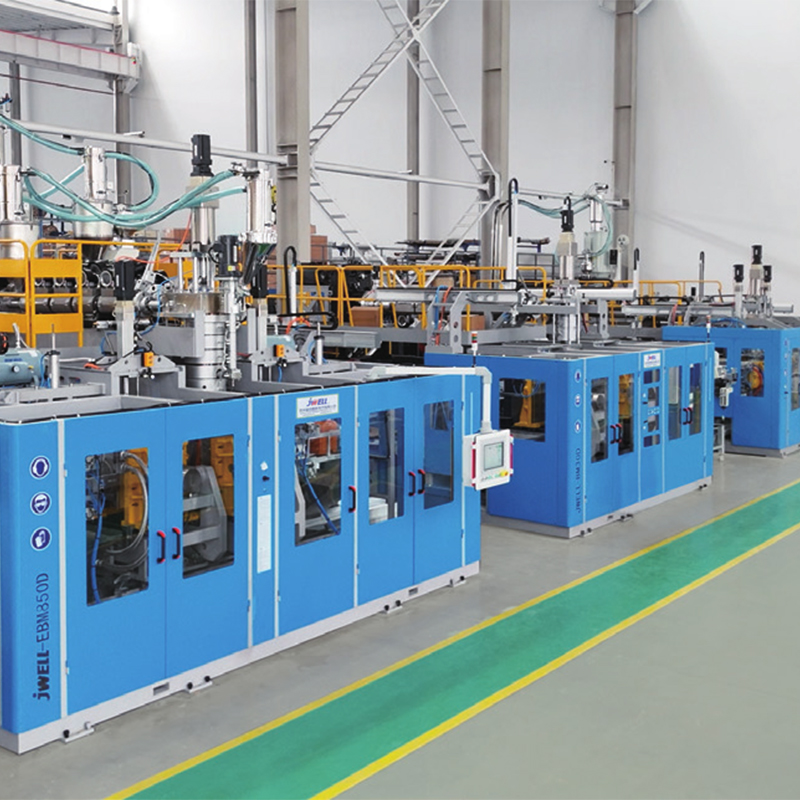
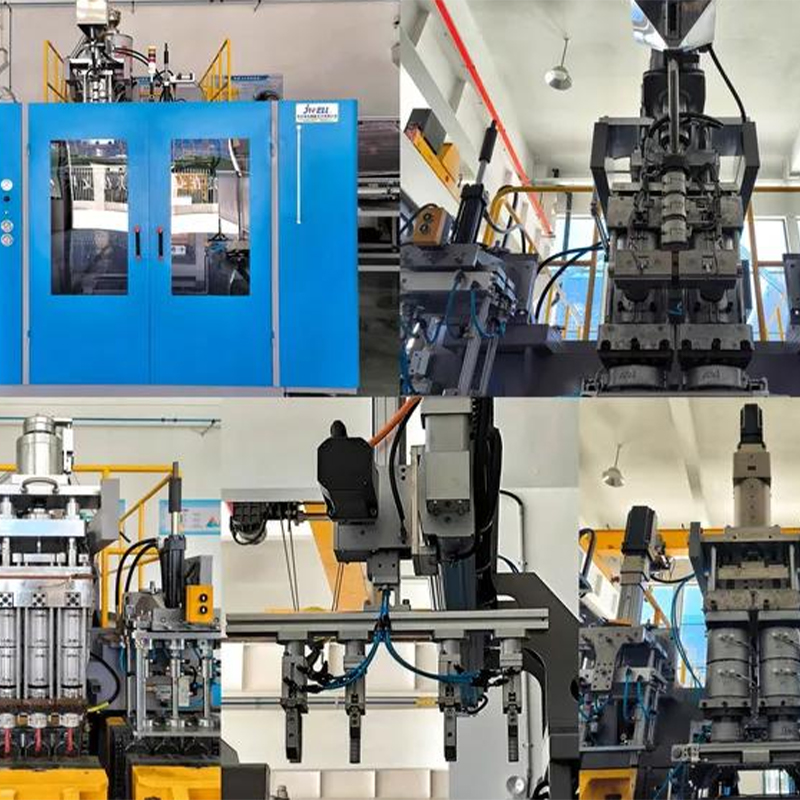
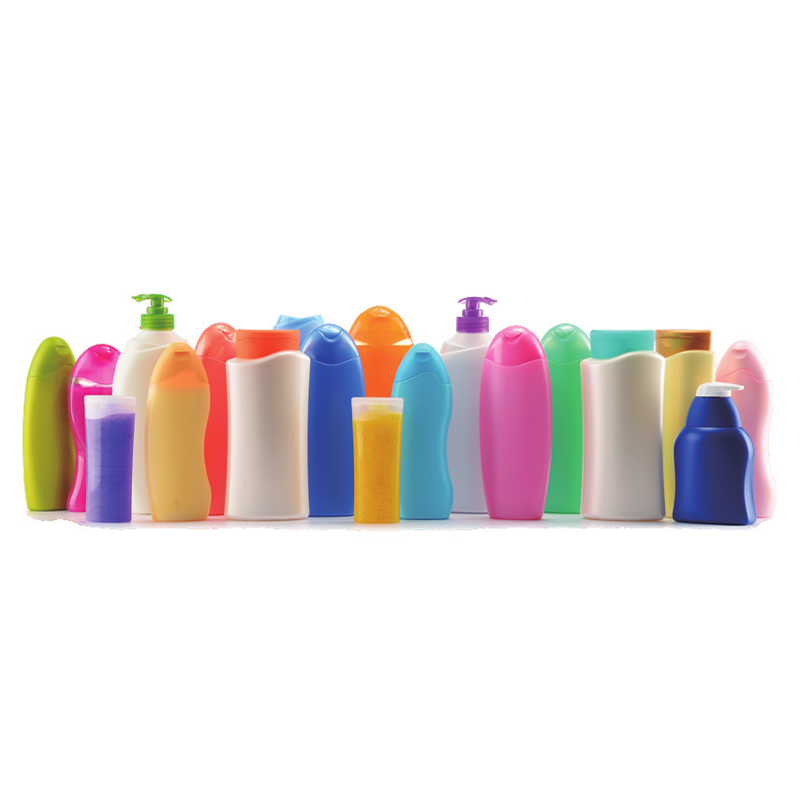
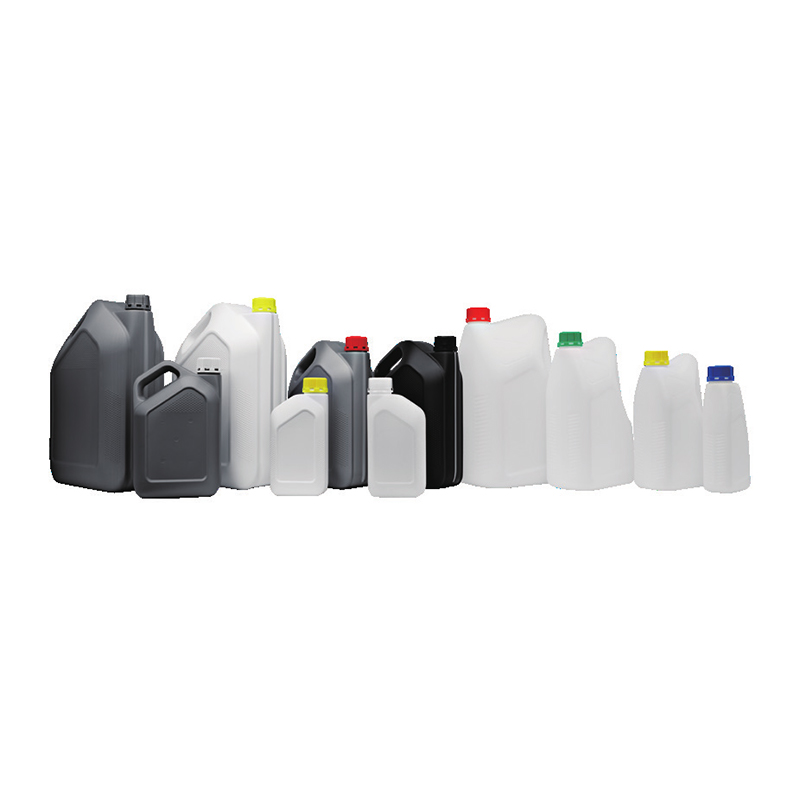
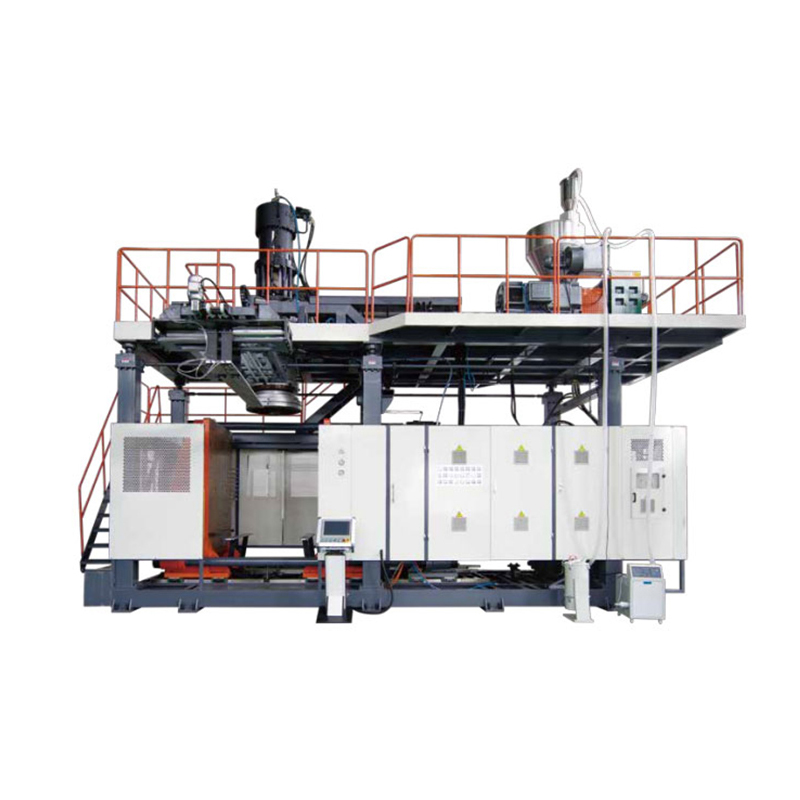
The EBM-D series fully automatic electric blow molding machines (including five models: EBM420D, EBM520D, EBM650D, EBM850D, EBM1100D) are designed for efficient production of small to medium-sized hollow containers. This series adopts servo-driven electric clamping and extrusion systems, completely eliminating hydraulic oil, achieving clean, low-noise, and low-energy operation.
|
Model |
Typical Products |
Real-World Cases |
|
EBM420D (screw diameter 65mm, output 70–90 kg/h, clamping force 50 kN) |
50–200ml cosmetic bottles, small medicine bottles |
A Polish skincare brand produces 150ml lotion bottles, weight accuracy ±0.2g, operating 22 hours per day. |
|
EBM520D (screw diameter 80mm, output 100–110 kg/h, clamping force 80 kN) |
300ml – 1L oil bottles, shampoo bottles |
An Italian lubricant company replaced hydraulic machines with the EBM520D, reducing energy consumption by 40% while maintaining 1200 bottles/hour output. |
|
EBM650D (screw diameter 75/90mm, output 120–140 kg/h, clamping force 180 kN) |
2L – 5L chemical containers, glass water jugs |
A German car care products manufacturer uses this model to produce 4L HDPE containers, mold thickness 2*130mm, mold opening stroke 320mm, suitable for deep-cavity shapes. |
|
EBM850D (screw diameter 90/100mm, output 150–170 kg/h, clamping force 240 kN) |
5L – 10L industrial pails, food-grade buckets |
A French food packaging plant produces 8L honey buckets, platen size 760*400mm, mold opening stroke 340mm for easy part removal. |
|
EBM1100D (screw diameter 100mm, output 210–230 kg/h, clamping force 500 kN) |
10L – 20L large containers, automotive air ducts |
A UK building chemicals supplier produces 15L HDPE pails, mold travel stroke 1100mm, fully automatic operation, dry cycle time 6 seconds. |
Platen size and mold travel stroke directly determine the maximum container size. For example, the 1050*400mm platen of the EBM1100D can produce two 10L pails side by side.
All EBM-D series machines use servo-driven electric clamping and extrusion systems. The following are real-world performance metrics in daily production:
2.1 Energy Efficiency (verified by power monitoring)
EBM520D average power consumption is only 8.5 kWh, while a comparable hydraulic machine uses about 14 kWh – 39% energy savings.
EBM850D operates at 12 kWh; based on 6000 hours/year and €0.20/kWh, annual electricity savings of approximately €2500.
2.2 Precision and Repeatability
Electric toggle clamping achieves ±1% clamping force stability, critical for thin-walled containers (e.g., 0.4mm PP cups).
Dry cycle time (e.g., 2.9 seconds for EBM420D) is 30% faster than hydraulic machines, directly increasing hourly output.
2.3 Clean Operation and Lower Maintenance Costs
No hydraulic oil means zero leakage risk – ideal for food/medical packaging (BRCGS or ISO 15378 certified environments).
Oil-free operation reduces annual maintenance costs by approximately €800–€1200 per machine (seal replacement, oil filtration, waste oil disposal, etc.).
2.4 Mold Protection and Low Noise Operation
Electric clamping supports digital mold protection (sensitivity adjustable to 0.1mm increments). Real case: when a foreign object fell into the platen area, the EBM650D stopped within 50ms, avoiding €6000 in mold damage.
Full-cycle noise level below 72 dB(A), compared to about 82 dB(A) for hydraulic machines.
The following standard QC processes are based on actual production specifications from a blow molding plant certified to ISO 9001:2025, applicable to the EBM-D series:
3.1 Incoming Material Inspection and Melt Flow Index Test
Test item: MFR (melt flow index) of HDPE/PP raw material – allowable tolerance ±5% of specified value.
Tool: Davenport or ZwickRoell melt flow indexer.
Key parameter: Screw L/D ratio (25/1 to 30/1 for EBM650D/850D) requires raw material MI between 0.3–1.2 for optimal mixing.
3.2 Process Stability Monitoring (every 2 hours)
Screw speed and extrusion load: For EBM1100D at 220 kg/h output, allowable load range is 75–85% of motor rated torque.
Clamping force verification: using tie-bar strain gauges. EBM850D must maintain 240 kN ±3% across four tie bars – imbalance exceeding 5% triggers automatic correction.
3.3 Blow-Molded Part Dimensional Inspection
Wall thickness distribution (ultrasonic thickness gauge, e.g., Olympus 45MG): For nominal 1.0mm wall thickness, maximum deviation ≤0.08mm.
Neck finish dimensions (go/no-go gauge): For 38mm tamper-evident neck, tolerance ±0.15mm.
Stacking height under load: stack 20 containers and apply 5kg weight – deviation ≤1.5mm for 5L pails produced on EBM650D.
3.4 Drop and Leak Testing (final release)
Leak test: submerge in water at 0.8 bar air pressure – no bubbles for 30 seconds. The 80 kN clamping force of EBM520D ensures perfect pinch-off welding.
Drop test: fill with nominal contents and drop from 1.5 meters onto concrete floor – no cracks. One dairy customer reported defect rate dropped from 1.8% to 0.2% after switching to the EBM-D series.
3.5 Cpk Tracking (weekly)
Take 30 consecutive containers, measure volume by gravimetric method. Target Cpk ≥1.33. EBM850D achieved Cpk 1.52 for three consecutive months when producing 8L pails.
|
Model
|
Unit
|
EBM420D
|
EBM520D
|
|
Main screw diameter
|
mm
|
65
|
80
|
|
Screw L/D
|
-
|
25/1
|
25/1
|
|
Max capacity(PE)
|
kg/h
|
70-90
|
100-110
|
|
Platen size W*H
|
mm
|
330×286
|
420×390
|
|
Mould thickness
|
mm
|
2×70
|
2×120
|
|
Clamp stroke([max.mm](max.mm))
|
mm
|
180
|
250
|
|
Plate moving distance
|
mm
|
420
|
520
|
|
Clamping force
|
KN
|
50
|
80
|
|
Dry cycle
|
second
|
2.9
|
3.2
|
Q1: My EBM650D shows unstable parison length. What should I check first?
A: Most likely the screw speed feedback encoder or melt pressure sensor. In an actual case, the customer cleaned a melt filter clogged with regrind material and recalibrated the screw L/D ratio to 30:1 – problem solved. Also check for uneven heating band temperature in Zone 3 near the die head.
Q2: For a 500ml bottle, how do I choose between EBM420D and EBM520D?
A: The key decision factors are mold thickness (2*70mm vs. 2*120mm) and mold opening stroke (180mm vs. 250mm). For a single-cavity mold of 500ml, the EBM420D is sufficient. However, if you plan to use a two-cavity mold with total mold height of 110mm, the EBM520D's 120mm mold thickness capacity and 250mm opening stroke are required for demolding.
Q3: Why is my actual dry cycle time slower than specification (e.g., EBM850D spec 4.8 sec, actual shows 6.2 sec)?
A: Based on field data, three common reasons:
Insufficient pneumatic pressure for the take-out robot (at least 6 bar required).
Mold safety margin set too high (reduce from 5mm to 2mm in the controller).
Worn hydraulic (if any) or electric lubrication pump – but for all-electric EBM-D, check linear guide preload after 8000 operating hours.
Q4: Can I use recycled HDPE on the EBM1100D?
A: Yes, but limit regrind content to ≤30%, and ensure the screw design (diameter 100mm, L/D 28/1) can handle lower bulk density. A Spanish recycler produced 12L industrial pails using 25% post-consumer HDPE – they reduced screw speed by 10% and increased barrel temperature by 8°C to maintain 210 kg/h output.
Q5: How often should the clamping force of the EBM850D be calibrated?
A: Every 2000 operating hours or every 6 months. Use tie-bar strain gauge kits. One dairy customer ignored calibration for 14 months; clamping force on one side dropped to 205 kN, causing uneven wall thickness (deviation 0.22mm) – recalibration restored ±3% balance.
Q6: My EBM420D produces 100ml small bottles with eccentricity (wall thickness thick on one side, thin on the other). How can I adjust machine parameters to fix this?
A: Eccentricity is usually related to mold alignment, mandrel misalignment, or clamping force balance. Follow these steps (based on an EBM420D field case):
Check mold mounting alignment: EBM420D platen size is 330×286mm, total mold height must not exceed 2×70mm. Use a dial gauge to measure parallelism of upper and lower platens; allowable deviation ≤0.1mm. A Polish cosmetics plant once had eccentricity of 0.3mm due to an improperly tightened mold – re-tightening solved it.
Verify clamping force balance: EBM420D clamping force is 50 kN. Measure with four tie-bar strain gauges; deviation of any tie bar from the average must not exceed ±5%. If excessive, correct using the independent tie-bar adjustment function (enter engineer menu) of the electric clamp.
Check extruder mandrel centering: Remove the die head, use a feeler gauge to measure the gap between mandrel and bushing; deviation at four circumferential points should be ≤0.05mm. If large, adjust the centering screws on the side of the die head.
Effect of material melt index: Using PP with excessively high MI (e.g., >1.5g/10min) results in low melt viscosity, which can also cause eccentricity. Recommended MI range: 0.5–1.0.
Real case: An EBM420D user producing 100ml eye drop bottles had eccentricity resulting in minimum wall thickness of only 0.25mm (target 0.40mm). After adjusting clamping force balance, wall thickness distribution stabilized at 0.38–0.42mm.
Q7: Our workshop ambient temperature can reach 40°C in summer. Does the electrical cabinet and servo motors of the EBM850D require additional cooling?
A: The EBM-D series is designed for operating ambient temperatures of 0–45°C, no additional air conditioning is required, but the following conditions must be met (validated by a Spanish customer in a high-temperature workshop):
Electrical cabinet heat dissipation: Maintain ≥500mm clearance between the cabinet rear and wall, and ensure the top exhaust fan is unobstructed. The EBM850D comes standard with two high-efficiency axial fans (total exhaust capacity 180m³/h); when internal cabinet temperature exceeds 45°C, forced cooling automatically activates.
Servo motor allowable temperature: EBM850D uses IP65-rated servo motors, with winding maximum allowable temperature of 130°C. After 12 hours of continuous operation at 40°C ambient, measured motor surface temperature was approximately 78°C, well within normal range.
Actual high-temperature operating data: A lubricant packaging plant in Seville (summer temperatures often 42°C) runs an EBM850D producing 5L pails for 16 hours/day and has never experienced an overheat alarm. However, they regularly (monthly) clean the electrical cabinet dust filter and motor fan blades.
Exception: If ambient temperature exceeds 45°C, or if the production line has high density and poor ventilation, it is recommended to install a standalone electrical cabinet air conditioner (optional accessory, cooling capacity 1.5kW). Otherwise, the drive may initiate a frequency reduction protection (output reduced to 80%).
Note: In high-temperature, high-dust environments (e.g., feed-grade packaging), the optional electrical cabinet positive pressure dust-proof system is recommended to prevent dust ingress that could impair heat dissipation.





Tel: +86-19579950928

E-mail: [email protected]

Company Address
No. 128 Qingfeng Road, Xieqiao Town, Haining City, Jiaxing City, Zhejiang Province

19579950928

 English