
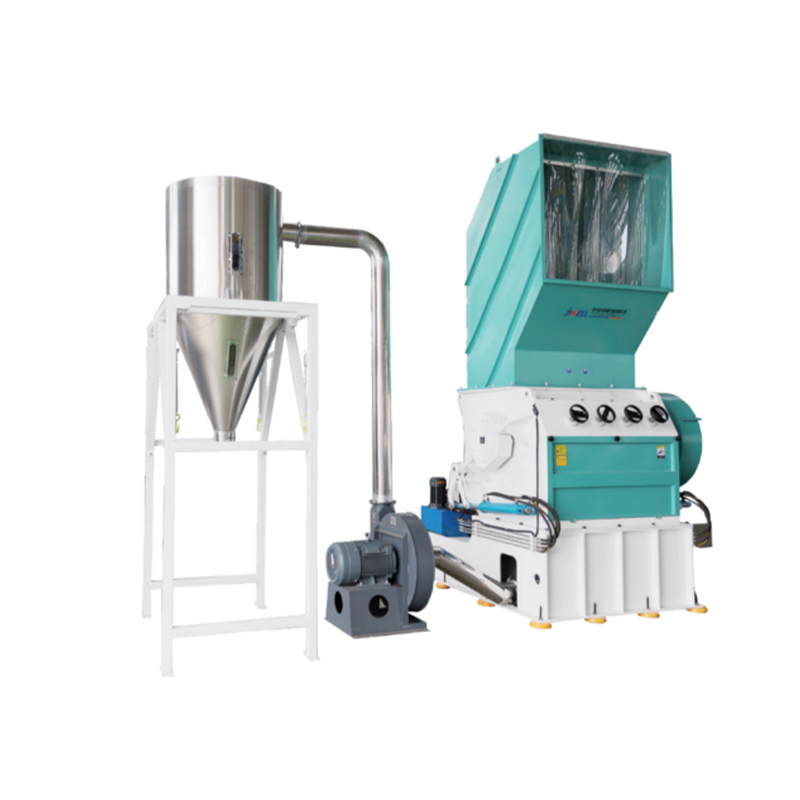
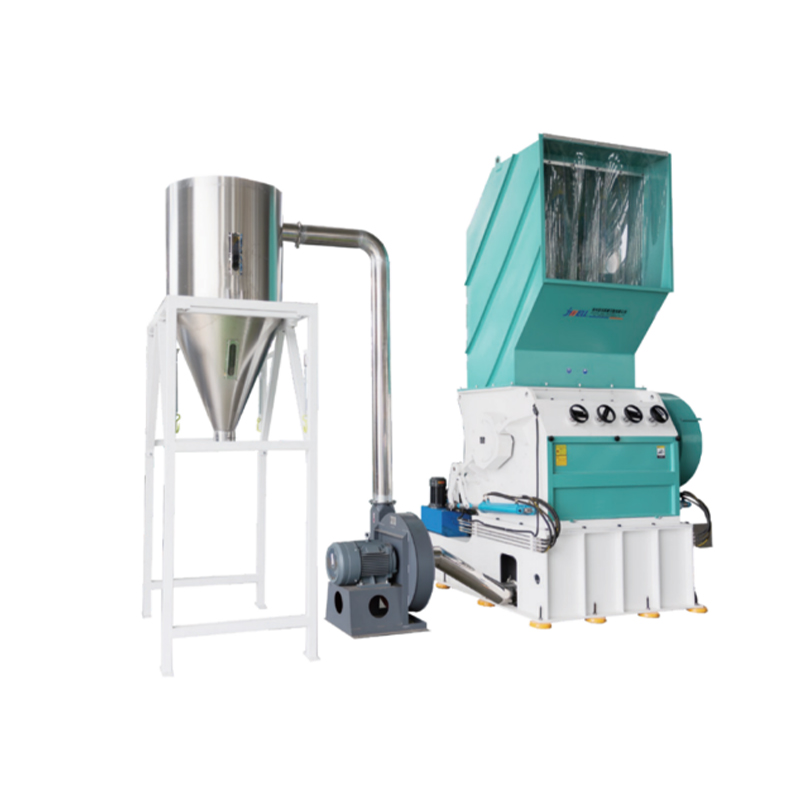
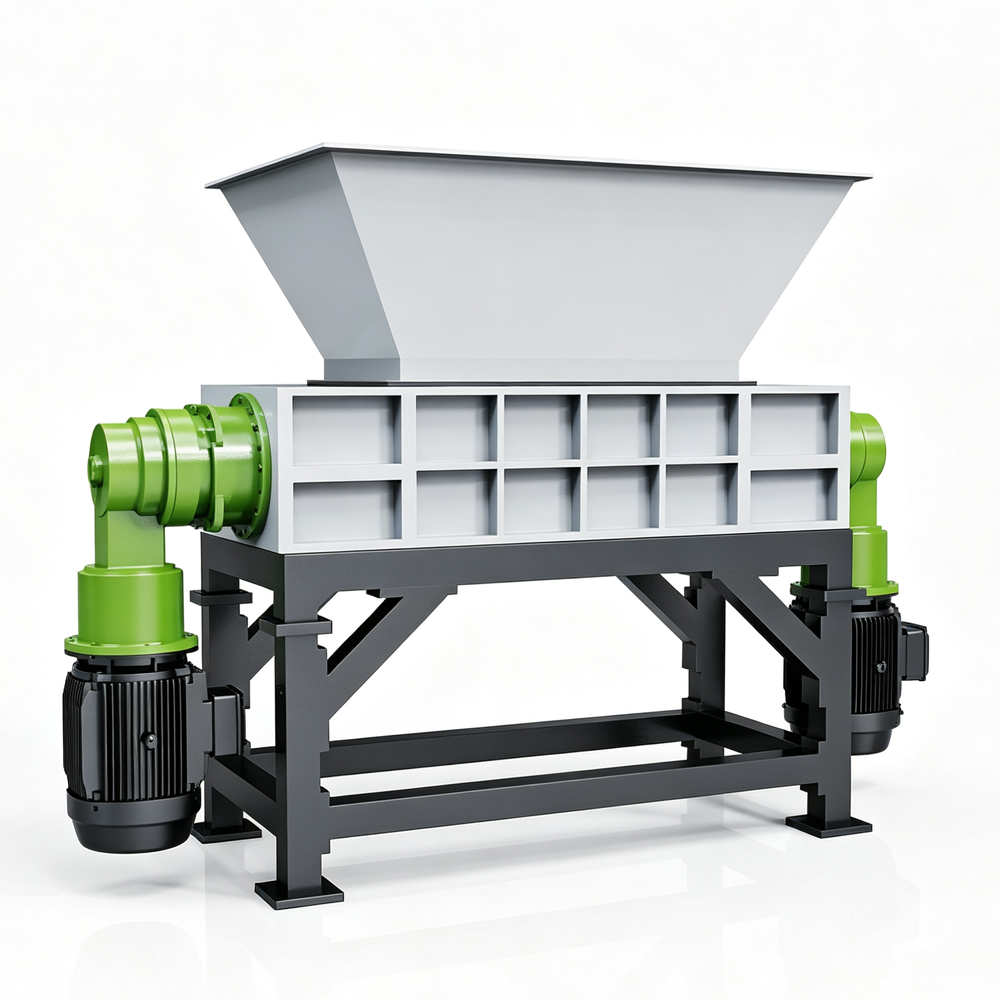
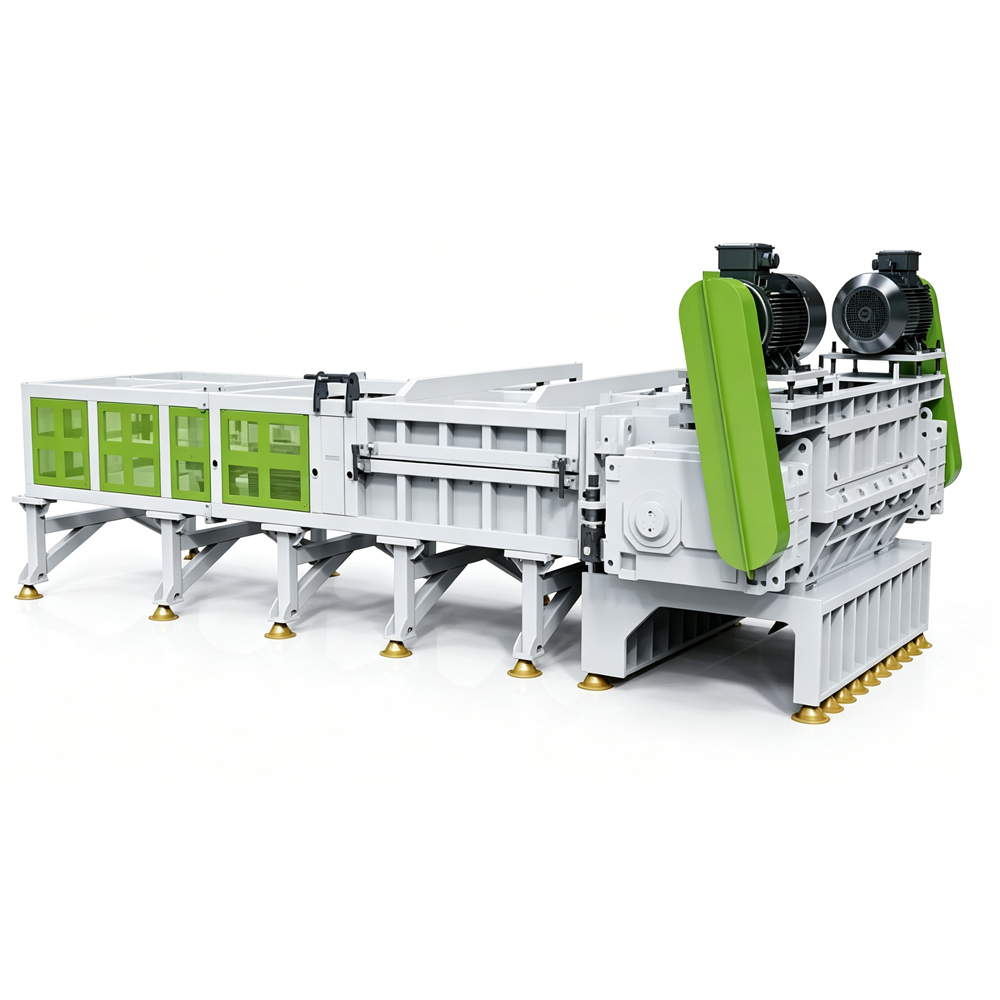
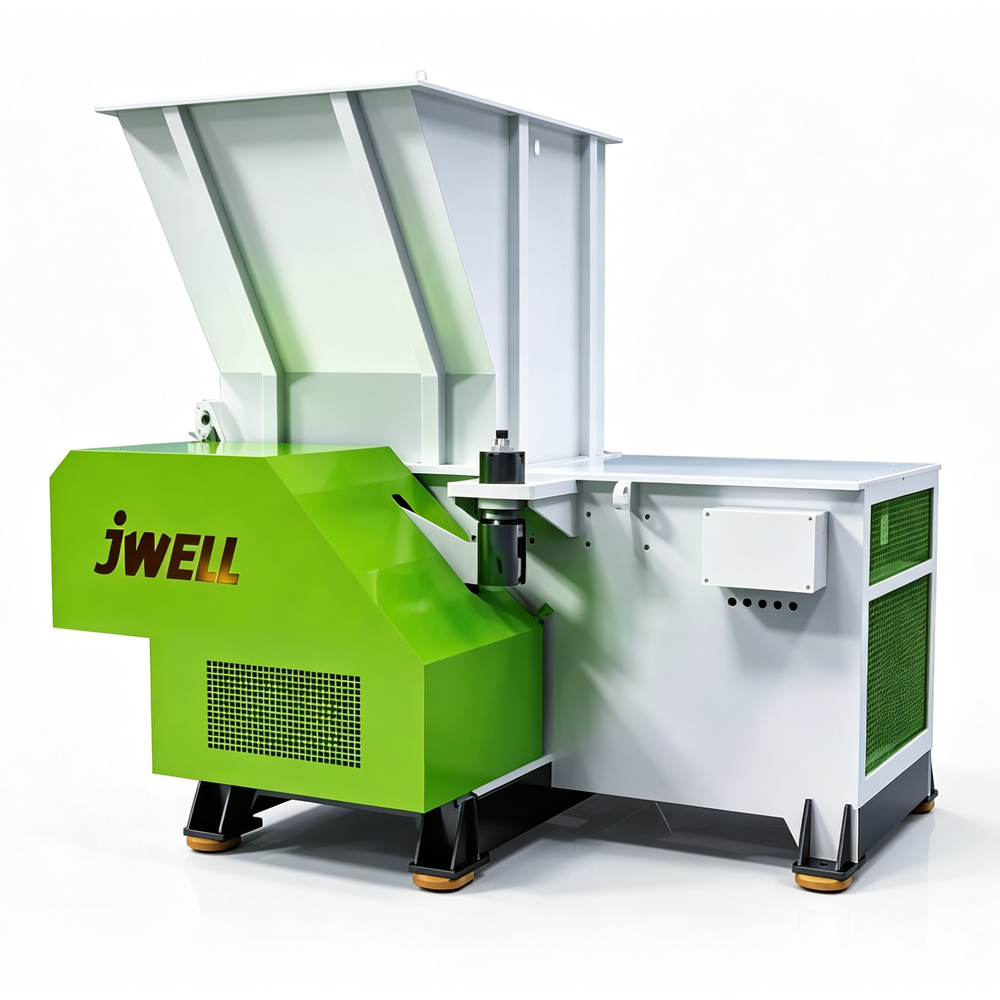
JWPS-ZX Series Crusher is designed by Jwell for medium-to-heavy reduction tasks, offering a shredder that balances large-capacity feeding with continuous cutting capability when processing large volumes of plastic waste.
With its feed opening sizes, rotor diameters, and output ranges, this series is the workhorse for recycling plants, plastic extrusion factories, injection molding workshops, and blow molding lines. Typical applications include:
Internal sprue/runner recycling – Suitable for manufacturers producing large injection-molded parts (e.g., car bumpers, pallets, crates). The 600×400 mm to 1400×1200 mm hopper allows whole sprues to be fed without pre-cutting.
Post-industrial waste – Thick sheets, extruder start-up lumps, blow-molded containers (e.g., 200 L drums).
Pipe/profile recycling – The max 800 mm rotor diameter easily grabs and cuts PE, PP, PVC pipes (up to 400 mm diameter).
WEEE and electronic housings – Durable ABS, HIPS, PC/ABS waste from monitor frames, printer casings, etc.
Real-World Case: A Spanish rigid plastics recycler processing post-consumer crates and pallets upgraded from a 50 HP machine to the JWPS-ZX-1000 (55–75 kW, 10 rotating blades). Their throughput increased from 550 kg/h to a stable 780–820 kg/h; thanks to the ZX series’ standard flip-up hopper design, screen change downtime was reduced by 40%.
The spec sheet you see (JWPS-ZX-600 to ZX-1400) reflects careful engineering. Here’s how each specification translates into real benefits:
|
Parameter |
Value for the User |
|
|
Large feed opening (e.g., 1200×1100 mm) |
Large or long items (pipes, large pallets) can be fed directly without pre-cutting, saving labor and pre-shredding costs. |
|
|
45–132 kW motor power |
High inertia, less jamming when cutting thick-walled materials (40–50 mm). ZX 800 and above support power upgrades – ideal for HDPE drums. |
|
|
10 rotating blades + 4 stationary blades |
More cuts per revolution = cleaner regrind with fewer fines. 2:1 rotor-to-stator blade ratio achieves shearing cuts, reducing dust. |
|
|
Φ600–800 mm rotor diameter |
Large rotor absorbs impact from heavy chunks while allowing wider blade gap adjustment, handling both brittle (PS, ABS) and elastic (LDPE film rolls) materials. |
|
|
Output 400–1500 kg/h |
Real continuous output at 80% load. ZX 1200 (90–132 kW) typically reaches 1100–1200 kg/h when shredding 30 mm HDPE sheet – verified by factory material testing. |
|
Unique Design Highlight: All JWPS-ZX shredders use a V-rotor configuration (staggered blades) combined with a deep hopper. This effectively prevents “bridging” of hollow items (bottles, drums).
Every JWPS-ZX machine goes through a 5-stage validation.
Stage 1 – Material & Weld Inspection
Rotor body – High-strength alloy steel (ZG270-500) casting, 100% ultrasonic testing for internal defects.
Cutting chamber welds – Penetrant testing (PT) to ensure no micro-cracks under heavy vibration.
Stage 2 – Rotor Dynamic Balancing
Assembled rotor (shaft + blades + blade holders) balanced at operating speed (typically 480–580 rpm for Φ600-800 mm).
Standard: ISO 1940-1 G6.3 or better. An unbalanced rotor damages bearings within weeks – we provide a balance report with the machine.
Stage 3 – No-Load & Material Load Testing
No-load run – 4 hours at max speed. Measure bearing temperature (≤65°C) and vibration (≤4.5 mm/s).
Material load test with customer’s material – If you send 200-300 kg of waste (e.g., PC/ABS sprues, glass-filled nylon 6), we run it on the corresponding model and record:
Actual throughput (vs. table reference)
Energy consumption (kWh/ton)
Regrind uniformity (sieve analysis)
Stage 4 – Blade Gap & Tool Steel Verification
Stationary blade material: D2 or Cr12MoV (HRC 56-60). We test hardness at three random points.
Rotor-to-stator gap typically set to 0.8-1.2 mm (for general plastics), but adjustable based on your material (e.g., film 0.3-0.5 mm, elastomer TPE 1.5-2 mm).
Stage 5 – Safety Interlock Verification
Microswitches on the hopper and screen cradle are tested 20 times – the machine can only start when all doors are locked.
Real Quality Case: A Canadian recycler ordered two JWPS-ZX-800 units. Upon arrival inspection, they measured blade hardness at HRC 58-59 (meeting specs) and rotor imbalance below 3.2 mm/s. Both units have been running for 14 months without bearing replacement, processing 8-10 tons/day of post-industrial PP waste.
|
Model
|
Feed Mouth Size (mm)
|
Motor Power (kW)
|
Rotor Blades (pcs.)
|
Fixed Blades (pcs.)
|
Rotor Diameter (mm)
|
Output (kg/h)
|
|
JWPS-ZX-600
|
600 × 400
|
22
|
6
|
2
|
Φ350
|
400
|
|
JWPS-ZX-800
|
800 × 700
|
45–55
|
10
|
4
|
Φ600
|
600
|
|
JWPS-ZX-1000
|
1000 × 900
|
55–75
|
10
|
4
|
Φ600
|
800
|
|
JWPS-ZX-1200
|
1200 × 1100
|
90–132
|
10
|
4
|
Φ800
|
1200
|
|
JWPS-ZX-1400
|
1400 × 1200
|
90–132
|
10
|
4
|
Φ800
|
1500
|
Q1: The "400 kg/h" for ZX-600 in the table – is that with a 10 mm or 20 mm screen?
A: The reference output was measured with a 12 mm round-hole screen, shredding 30 mm thick ABS (bulk density ~0.35 t/m³). Using a smaller screen (e.g., 6 mm) or softer material (LDPE) will reduce output by 20-30%. For coarse shredding with high throughput requirements (20-30 mm granules), actual output can be 25% higher than the table value.
Q2: What does "45~55 kW" mean on the ZX-800? Can it be upgraded later?
A: The main frame, rotor, and bearings are identical for both power levels. "45~55 kW" means the machine can be fitted with either motor. We pre-drill mounting holes for both. Yes – you can start with 45 kW and later upgrade to 55 kW by changing the motor and VFD, with no structural modification required.
Q3: How often do blades need sharpening/replacement?
A: Using standard D2 steel blades on clean, non-filled plastics (PP, PE, ABS):
Sharpening interval: 400-600 operating hours (e.g., every 2-3 months on single shift).
Blade life: After 6-8 sharpenings, blade height reaches wear limit.
For abrasive materials (glass-filled nylon, calcium carbonate-filled PP), we recommend carbide-tipped blades. The sharpening interval then extends to 800-1000 hours, but blade cost is about double.
Q4: My material is film or lightweight hollow items (bottles). Can the ZX series handle it?
A: Yes, but with two points to note:
For film rolls or bags: We recommend a pneumatic pusher or reducing rotor speed via VFD to prevent material bounce-back. The ZX rotor’s large inertia actually pulls film in better than lighter shredders.
For bottles (PET, HDPE): The deep hopper and V-rotor work well. For unwashed post-consumer bottles, we suggest adding a spray bar (optional) for wet shredding to reduce dust.
Q5: How do I choose between ZX-800, ZX-1000, and ZX-1200?
A: Based on your max part size and target output, refer to this quick selection table:
|
Model |
Max Part Size (L×W×H) |
Best For |
Typical Output (12 mm screen) |
|
ZX-800 |
750×650×400 mm |
Pipes up to 315 mm diameter, medium crates |
500-650 kg/h |
|
ZX-1000 |
950×850×450 mm |
Large pallets (halved), 400 mm pipes |
750-900 kg/h |
|
ZX-1200 |
1150×1050×500 mm |
Whole pallets, heavy sprues (up to 80 kg) |
1100-1300 kg/h |
Real Customer Choice: A Dutch blow molder processing scrapped 1000 L IBCs chose the ZX-1400. The 1400×1200 mm feed opening accepts whole IBC frames without dismantling. At 110 kW, they achieve 1400-1600 kg/h of 15 mm regrind.
Q6: Do you offer sound enclosures? What is the noise level?
A: Standard machine without enclosure: 88-94 dB(A) at 1 meter (material dependent). We offer a sound enclosure – 40 mm polyurethane foam inside + outer steel plate – reducing noise to 78-82 dB(A). The enclosure is hinged for easy access to the cutting chamber during maintenance.
Q7: What spare parts should I keep in stock?
A: For a single machine (two-shift operation), recommended minimum stock:
1 full set of rotating blades (10 blades for ZX-800/1000/1200)
2 stationary blades
1 set of blade mounting bolts + washers
1 set of main drive belts
2 screens (ZX series uses split screen design for easy handling)




Pipe Extrusion Production Line
Plastic Shredder Crusher Machine

Tel: +86-19057068112

E-mail: [email protected]

Company Address
No. 128 Qingfeng Road, Xieqiao Town, Haining City, Jiaxing City, Zhejiang Province

19057068112

 English
 русский