
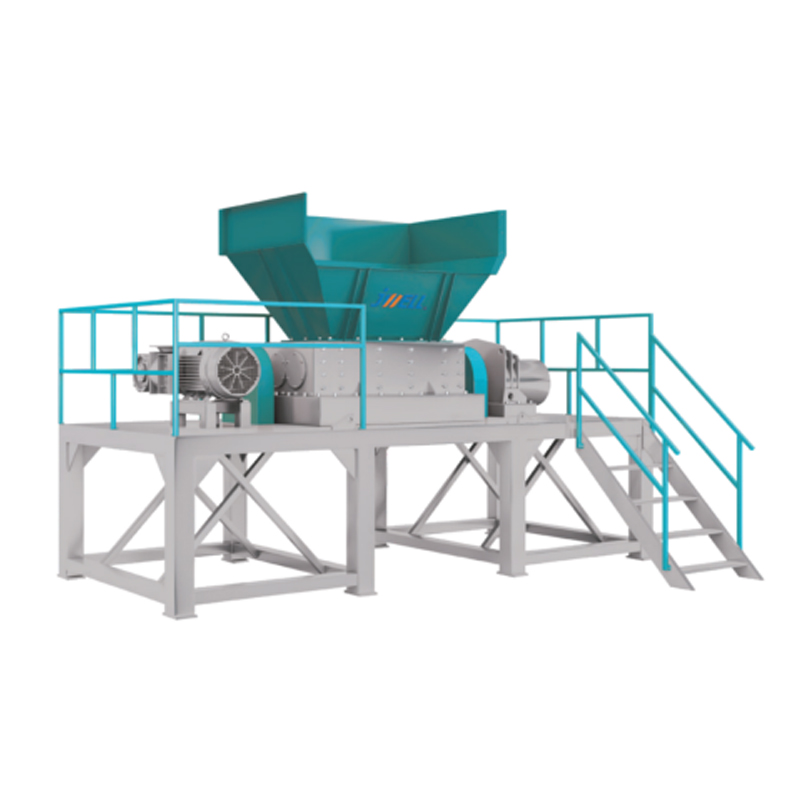
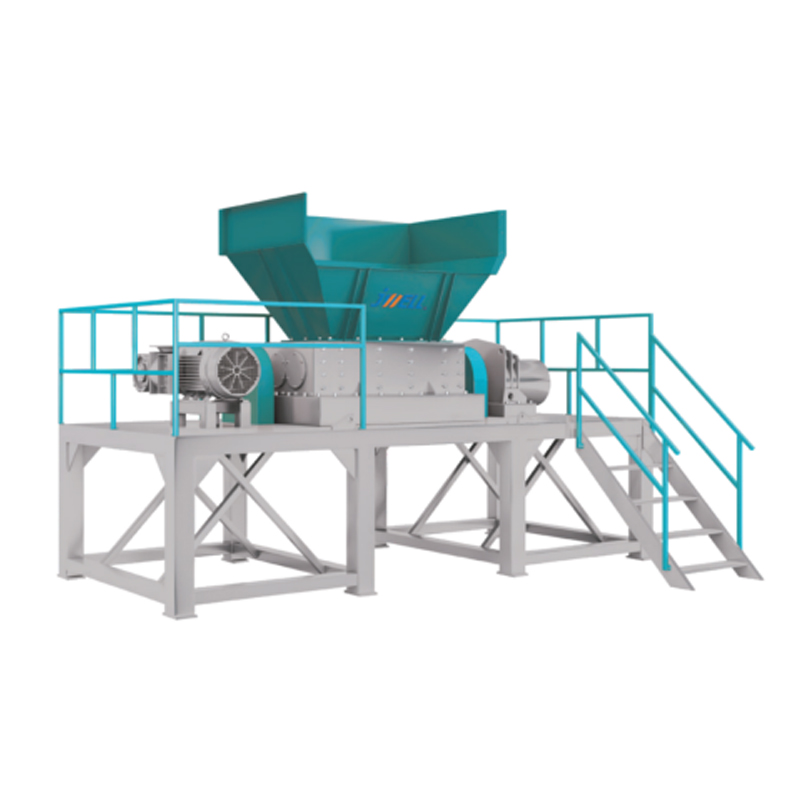
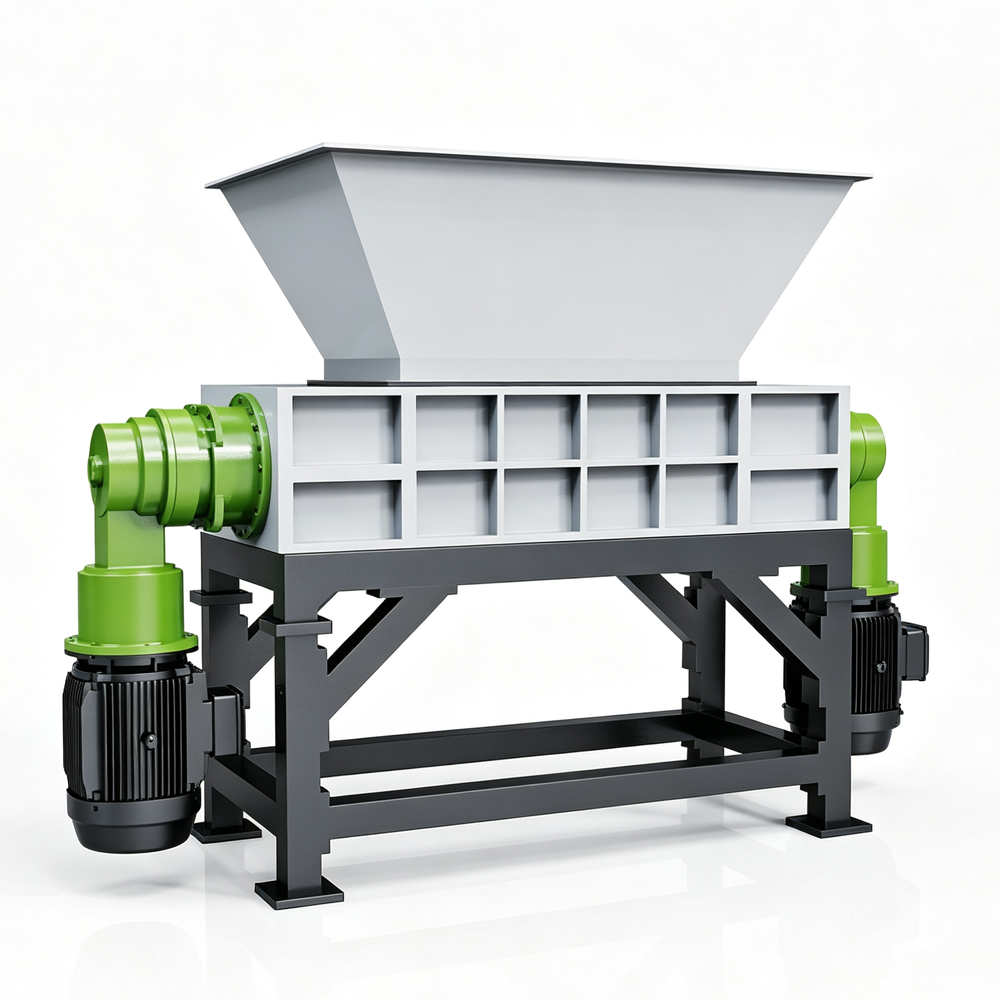
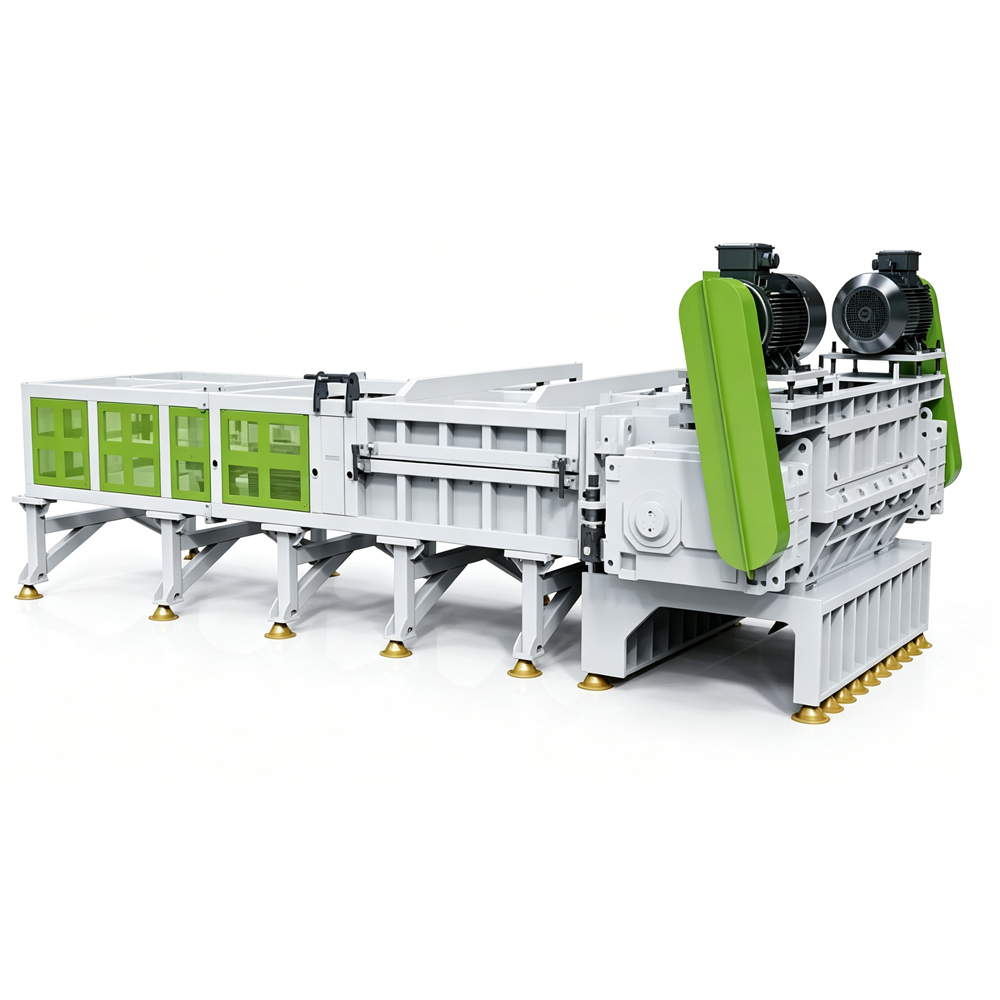
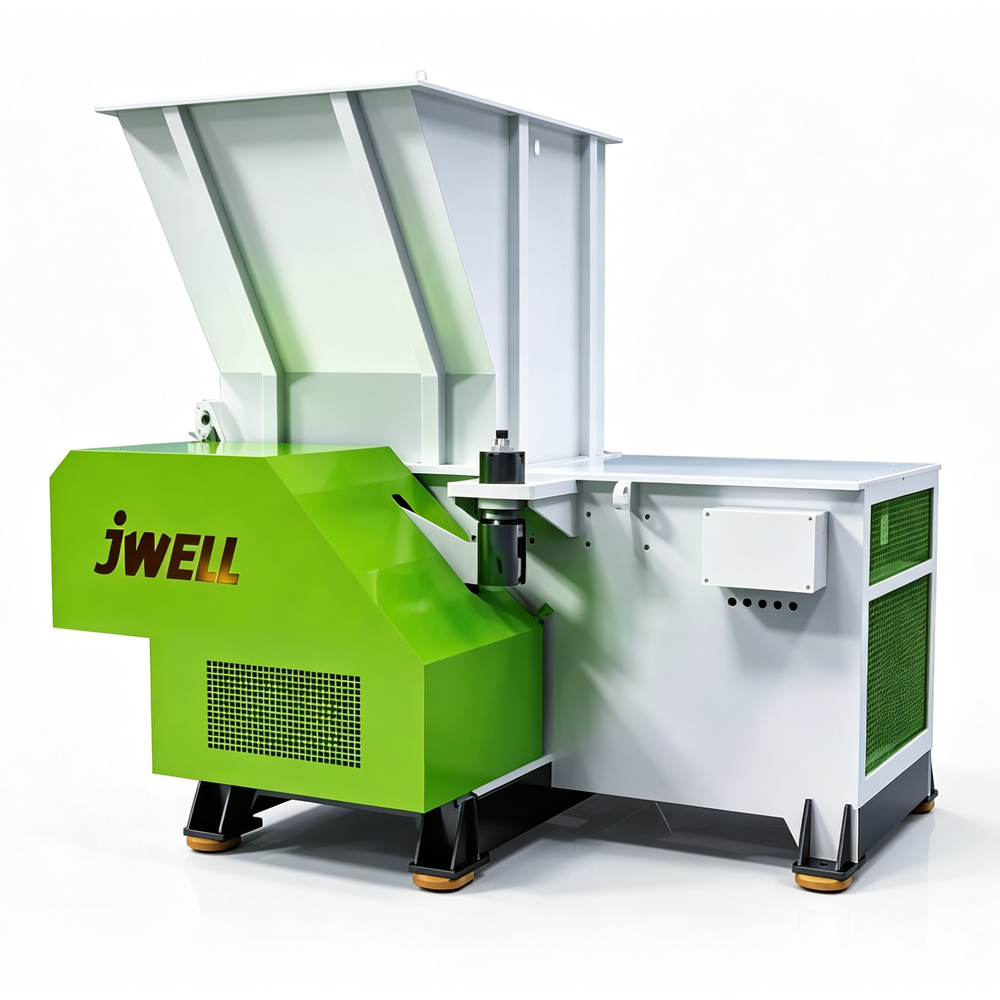
The JWTSS series is a reliable high-torque dual-shaft shredder product line. Designed for medium to large-scale waste processing, this series can handle everything from bulky household waste to hard industrial waste.
The JWTSS series includes five models: JWTTSS600, 800, 1200, 1500, and 1800. Their feed opening sizes, motor powers, and blade configurations determine the types of materials they are suitable for.
JWTTSS600 (Feed opening 600x460mm, motor power 18.5+18.5 kW, blade quantity 30, blade thickness 20mm)
Typical applications: Small electronic waste, plastic drums, aluminum profiles. A recycler in Poland uses this model to process post-consumer HDPE bottles and rigid plastic scrap at a capacity of 0.8–1.2 t/h.
JWTTSS800 (Feed opening 800x460mm, motor power 22+22 kW, blade quantity 40, blade thickness 20mm)
Typical applications: Wood pallets, paper rolls, light industrial waste. A packaging recycling plant in the UK installed a JWTTSS800 to shred wood pallets into 50mm chips for use as biomass fuel, achieving a capacity of 2 t/h.
JWTTSS1200 (Feed opening 1200x720mm, motor power 45+45 kW, blade quantity 60/30, blade thickness 20/40mm)
Typical applications: Mixed municipal solid waste, bulky plastics (IBC totes, car bumpers), waste textiles. A recycling plant in Australia uses the 40mm thick blade configuration to shred car tires at 3–4 t/h before further granulation.
JWTTSS1500 (Feed opening 1500x995mm, motor power 55+55 kW, blade quantity 30/20/15, blade thickness 50/75/100mm)
Typical applications: Heavy-duty conditions such as truck tires, light scrap metal (thin sheet), oil filters, demolition wood. For example, a tire recycling company in South Africa uses 75mm thick blades to process OTR tires – the dual 55kW motors provide the necessary torque to tear through reinforced rubber.
JWTTSS1800(Feed opening 1800x1150mm, motor power 90+90 kW, blade quantity 36/24/18, blade thickness 50/75/100mm)
Typical applications: Large-volume industrial waste, bulky municipal waste (sofas, mattresses), hazardous waste drums. A waste-to-energy plant in Canada feeds bulky refuse-derived fuel into a JWTTSS1800 equipped with 100mm thick blades, shredding material to below 120mm at a capacity exceeding 8 t/h.
The dual-motor design (each model has two motors) ensures balanced torque and automatic overload reversal – which is critical for heterogeneous materials.
1 Modular Blade System for Different Materials
Unlike many fixed-blade shredders, the JWTSS series allows you to choose blade thicknesses of 20/40/50/75/100mm on different models. Thinner blades (20mm) provide finer output for plastics and paper; thicker blades (75–100mm) provide maximum tearing force for tires and scrap metal. The number of blades also varies accordingly (e.g., JWTTSS1500: 30 blades for 50mm thickness, 20 blades for 75mm, 15 blades for 100mm) – this flexibility is rare among dual-shaft shredders in the same price range.
2 Large Feed Opening and Deep Cutting Chamber
Feed opening sizes (up to 1800x1150mm) allow complete car bumpers, 200L drums, or pallets to be fed without pre-cutting. The deep chamber of 460–1150mm prevents material from bouncing out, improving bite efficiency.
3 High Torque at Low Speed
Motor power ranges from 18.5+18.5 kW to 90+90 kW, with gear-driven dual shafts rotating at 50–80 RPM. Low speed means lower noise (typically <85dB), minimal dust, and less risk of jamming. The automatic reversal function clears unshreddable foreign objects (rocks, solid metal) without interrupting operation.
4 Robust Rotor and Blade Steel
All rotors have diameters of 300–620mm and are made of forged high-carbon steel. Blades are cast from Cr-Mo alloy (HRC 55–58), heat-treated for wear resistance. Even after shredding highly abrasive materials like glass-fiber reinforced plastics, the blade edge retention is 30% longer than ordinary 65Mn blades.
Each JWTSS shredder undergoes 5 stages of quality control before shipment:
Stage 1 – Raw Material and Component Verification
Blade material: Spectrometer analysis confirms Cr, Mo, and C content. Rockwell hardness test (minimum HRC 55).
Gearboxes and motors: Tested on a dynamometer for 2 hours to check temperature rise and vibration (ISO 10816 standard).
Stage 2 – Welding and Structural Inspection
All load-bearing welds on the shredder housing (Q345B steel) undergo 100% ultrasonic flaw detection.
Rotor journal runout is controlled within 0.05mm (laser alignment tool).
Stage 3 – No-Load Trial Run
Each machine runs without material for 4 hours. Measurements taken:
Bearing temperature rise (<40°C)
Noise level (target ≤82dB at 1 meter)
Current balance between the two motors (difference <5%)
Stage 4 – Load Trial Run (with real material)
This is the most critical step. Using customer-supplied material (or standard test material such as HDPE drums, tire chunks, or wood pallets), the shredder runs at 80% rated load for 1 hour. Recorded:
Capacity (kg/h) – compared to theoretical curve.
Output particle size distribution (sieve analysis).
Energy consumption per unit (kWh/t).
Real test example: A JWTTSS1200 (45+45 kW, 40mm blades) processing mixed plastic waste (bumpers, crates, drums) achieved a capacity of 3.8 t/h, with 92% of output smaller than 80mm – fully meeting specifications.
Stage 5 – Final Assembly and Safety Inspection
All guards and emergency stops (CE marking compliance).
Hydraulic system (if equipped with hydraulic ram) pressure tested at 1.5 times working pressure.
Serial number and inspection date laser-engraved on the main frame.
Each machine comes with a test video and a signed quality report – buyers can request a live factory test via video call.
Q1: Can the JWTSS shredder process scrap metal?A: Yes, but only light metals: aluminum profiles, copper wire (with insulation), thin steel drums (wall thickness <1.5mm), car body panels. For heavy steel or cast iron, a different model is required. We recommend 75–100mm thick blades (JWTTSS1500/1800) to avoid rotor bending.
Q2: How often do blades need replacement or sharpening?A: Blade life depends on material abrasiveness. Typical intervals:
Soft plastics/paper: 800–1200 hours
Hard plastics + wood: 500–700 hours
Tires/cables: 300–500 hours
Each blade has 4 cutting edges, can be reversed, and can be resharpened 2–3 times. Replacement cost ranges from $15–$40 per blade depending on thickness.
Q3: How is output particle size controlled?A: A hexagonal or round mesh screen is installed under the rotors. Standard screen hole sizes: 40mm, 60mm, 80mm, 100mm, 120mm. For finer output (<30mm), a tertiary crusher after the dual-shaft shredder is recommended.
Q4: My material contains long ropes or film plastic – will it wrap around the shafts?A: The JWTSS series is equipped with anti-wrap shaft seals and a special blade interleaving design for self-cleaning. For heavy films (agricultural silage stretch wrap), we recommend adding a hydraulic ram and a larger-hole bottom screen to prevent clogging.
Q5: What is the warranty period and spare parts availability?A: 18 months from shipment or 12 months from commissioning (whichever comes first). Spare parts such as blades, screens, bearings, and seals are stocked for all models. Emergency spare parts can be air-freighted within 3–5 working days.
Q6: Can it shred wet material (e.g., wet kitchen waste or wet municipal waste)?A: Yes, but avoid excessive moisture (>40%), as wet fine particles may stick to the screen. For wet organic waste, we recommend ordering the stainless steel liner option and a heated screen to prevent clogging.
Q7: What floor space is required for installation?A: The JWTTSS600 requires approximately 3.5×2.0 meters; the JWTTSS1800 requires 6.5×3.5 meters (including conveyor and electrical control cabinet). Minimum building clear height: 4 meters (for crane lifting).
Q8: Do you provide test reports before payment?A: Yes. We offer a paid material testing service (the fee can be deducted from the final invoice). You send 200–500kg of your material, we test it on the model you choose, and provide video, particle size analysis, and capacity report.




Pipe Extrusion Production Line
Plastic Shredder Crusher Machine

Tel: +86-19057068112

E-mail: [email protected]

Company Address
No. 128 Qingfeng Road, Xieqiao Town, Haining City, Jiaxing City, Zhejiang Province

19057068112

 English
 русский