
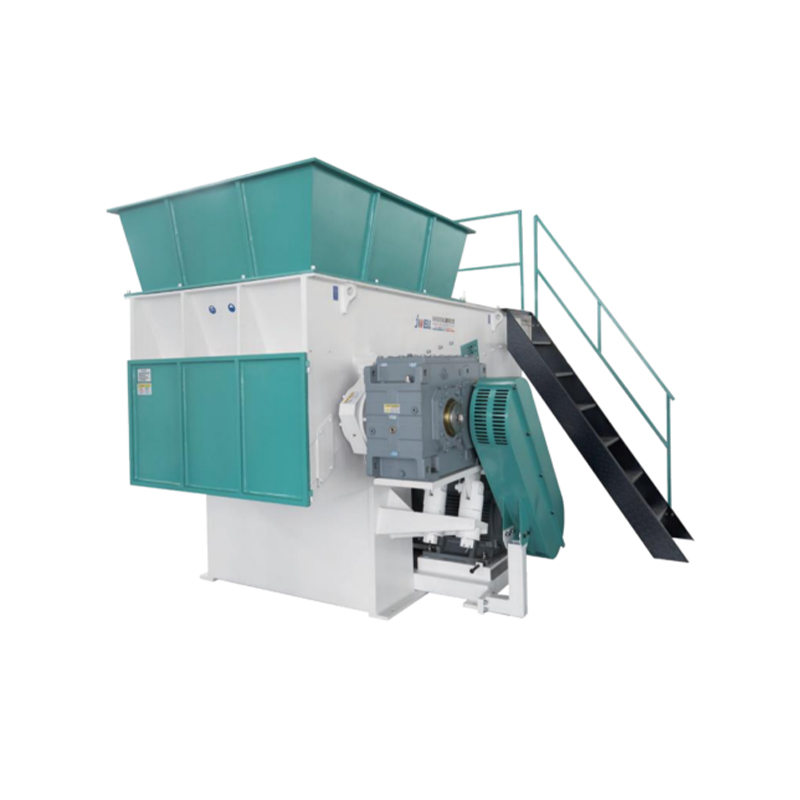
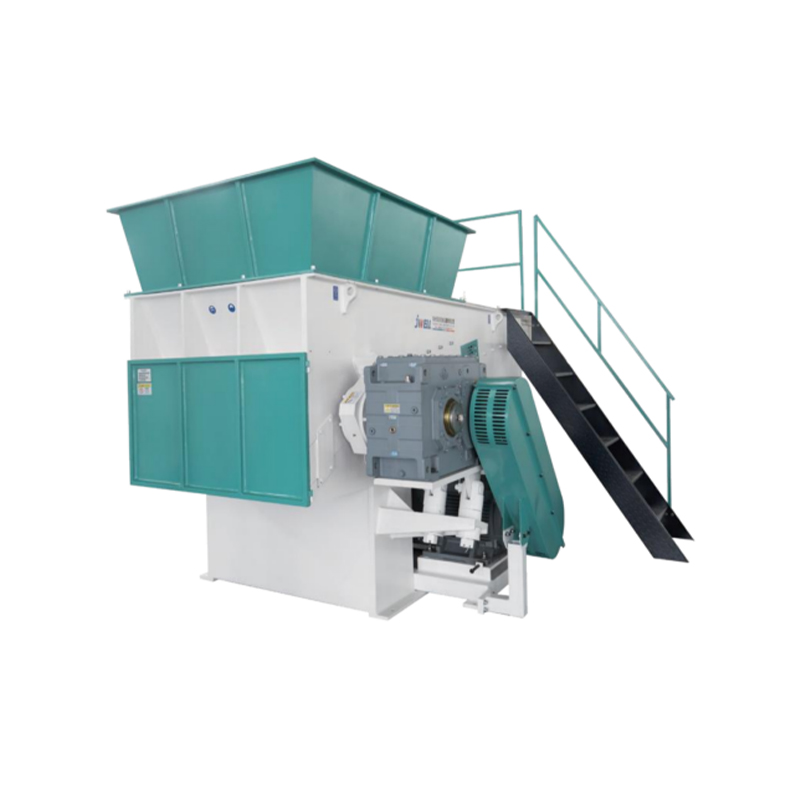
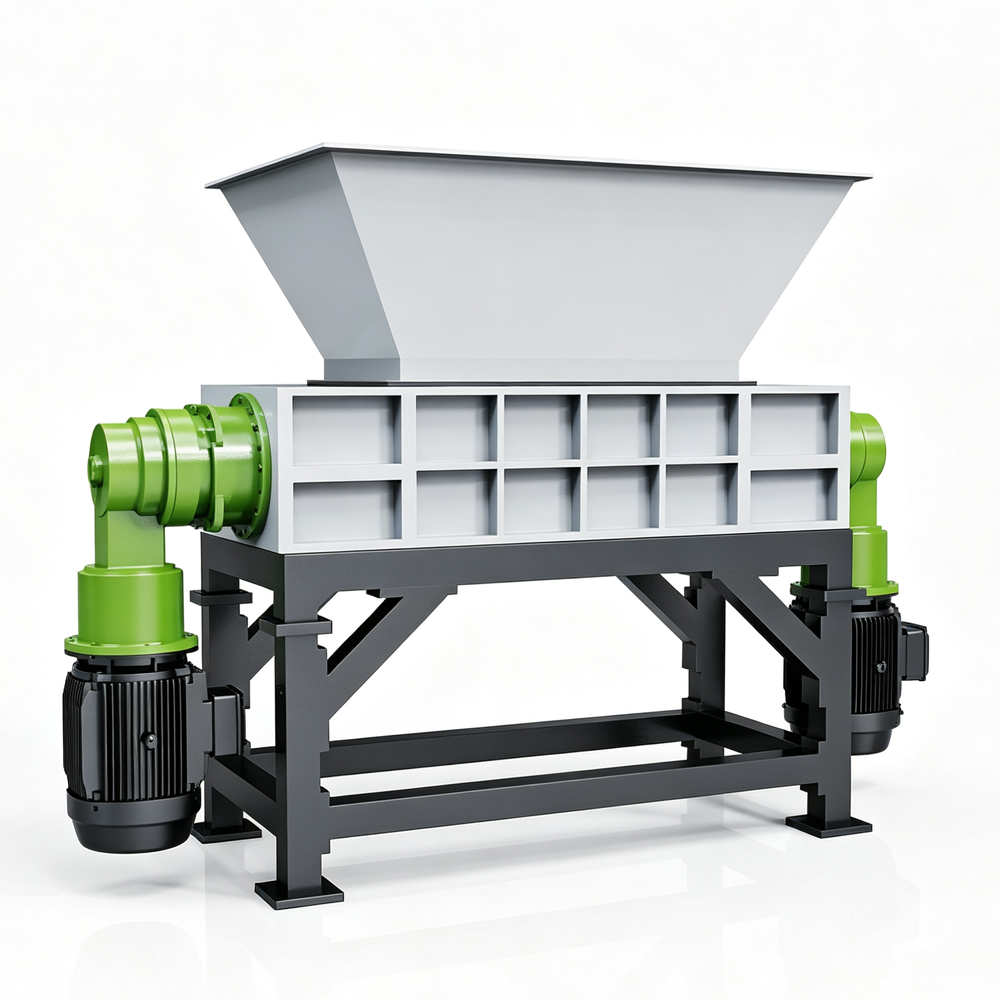
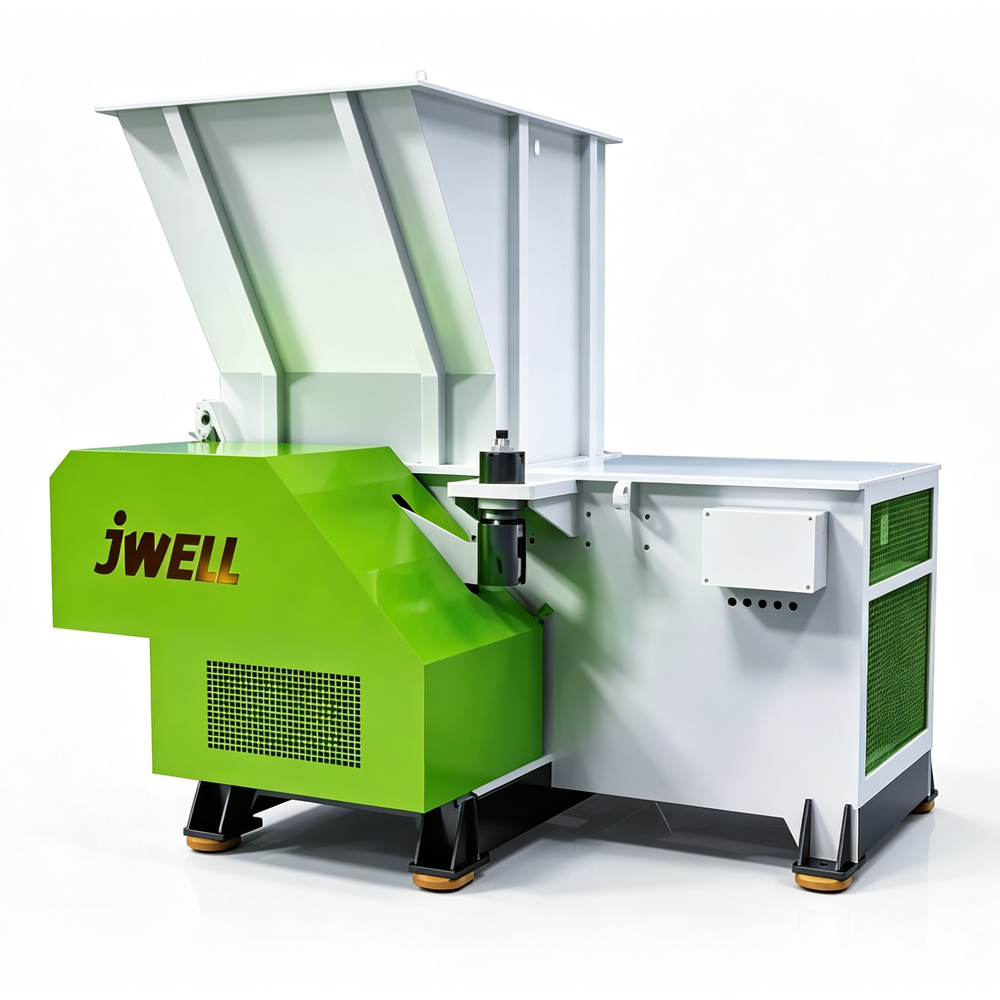
The JWSS series light single shaft shredder is designed for efficient volume reduction of various materials. From model JWSS600 to JWSS1400, these machines offer flexible hopper sizes, powerful motor options, and balanced rotor configurations.
Thanks to moderate throughput (300–1400 kg/h) and compact rotor diameters (300–460 mm), the JWSS shredder excels in small to medium recycling, internal waste management, and material pre-processing. Typical applications include:
Plastic Recycling – Shredding plastic lumps, pipes, purgings, film, and woven bags.
Case: A Spanish plastic recycler uses a JWSS800 (37 kW, 56 moving knives) to shred post-consumer HDPE drums at 500 kg/h, feeding directly into a washing line.
Wood Processing – Volume reduction of pallets, wood waste, plywood, and MDF offcuts.
Case: A Portuguese furniture workshop installed a JWSS1000 (55 kW, 64 moving knives) to process edge trim and broken pallets, achieving 700 kg/h with a 20 mm screen.
Paper & Cardboard – Destroying confidential documents, corrugated boxes, and kraft rolls.
Case: A UK packaging plant uses a JWSS600 (22 kW, 33 moving knives) to shred cardboard waste at 350 kg/h, reducing volume by 80% before baling.
Textiles & Fibers – Cutting fabric scraps, carpet remnants, and non-woven materials.
Case: A Polish textile recycler runs a JWSS1200 (75 kW, 72 moving knives) on denim cutting waste, producing 900 kg/h of fluff for insulation material.
E-waste & Light Metals – Pre-shredding ABS casings, aluminum profiles, and sheet metal.
Case: A French e-waste plant uses a JWSS1400 (110 kW, 92 moving knives) to shred computer monitor casings at 1300 kg/h.
Based on actual parameters and field feedback, the core advantages are:
|
Advantage |
How it is achieved |
|
Low energy consumption, high throughput |
Motor power from 22 to 110 kW – JWSS600 consumes only 22 kW yet outputs 300–400 kg/h, ideal for cost-conscious workshops. |
|
Fine and uniform output |
Rotor diameter 300–460 mm with 1–2 stationary knives ensures uniform particle size. Multiple moving knives (33–92) repeatedly cut material before discharge. |
|
Compact footprint |
Hopper sizes from 600×950 mm to 1400×1200 mm – easily integrates into existing production lines without major civil work. |
|
Easy maintenance |
Single-shaft design, bolt-mounted moving knives for quick replacement. Stationary knives can be flipped or replaced in minutes. |
|
Overload protection |
Standard hydraulic ram with reverse function – in case of jamming, the ram automatically retracts and re-advances, protecting the motor and gearbox. |
|
Optional screens |
Interchangeable screens (optional) – hole diameters from 10 mm to 80 mm allow you to control final particle size to match downstream processes. |
Every JWSS shredder goes through a 5-stage quality control and testing process to ensure reliability under continuous industrial use.
Stage 1 – Raw material & component inspection
Steel plates (housing and hopper): Tested for chemical composition and tensile strength per EN 10025.
Rotor shaft: 100% ultrasonic inspection for internal cracks.
Cutters: Hardness tested with a Rockwell tester – moving knives HRC 55–58, stationary knives HRC 50–53.
Stage 2 – Machining & welding quality control
Rotor dynamic balancing – run at 150% of rated speed, vibration ≤2.5 mm/s.
Welds – Magnetic particle inspection (MPI) on all load-bearing welds.
Stage 3 – Sub-assembly testing
Hydraulic system – Pressure held at 1.5× working pressure for 30 minutes, no leakage.
Gearbox & motor – No-load running for 2 hours, oil temperature rise ≤40°C.
Stage 4 – Load testing (with real materials)
Each machine is tested continuously for 4 hours with three typical materials:
Plastic pipe (HDPE) – verifying throughput (e.g., JWSS800 must achieve ≥400 kg/h).
Pallet wood – monitoring torque variation and cutter wear.
Mixed light waste – testing anti-jamming logic.
Data recorded: motor current (≤90% of rated), output consistency (≥95% passing specified screen), bearing temperature (≤75°C).
Stage 5 – Final assembly & factory run-out
Safety interlock check (hopper open → motor cannot start).
Paint thickness ≥80 μm (salt spray test >200 hours).
Each machine comes with a test report signed by a QC engineer, including a video of the actual load test.
|
Model
|
Feed Mouth Size (mm)
|
Motor Power (kW)
|
Rotor Blade (pcs.)
|
Fixed Blade (pcs.)
|
Rotor Dia. (mm)
|
Output (kg/h)
|
|
JWSS600
|
600 × 950
|
22
|
33
|
1
|
300
|
300–400
|
|
JWSS800
|
800 × 950
|
37
|
56
|
2
|
400
|
400–600
|
|
JWSS1000
|
1000 × 1000
|
55
|
64
|
2
|
460
|
600–800
|
|
JWSS1200
|
1200 × 1100
|
75
|
72
|
2
|
460
|
800–1000
|
|
JWSS1400
|
1400 × 1200
|
110
|
92
|
2
|
460
|
1200–1400
|
Q1: How often do the cutters need replacement or sharpening?
A: Under normal working conditions (plastic/wood, metal contamination <2%), moving knives need to be flipped/re-sharpened after 400–600 hours. Stationary knives last twice as long. JWSS series uses reversible moving knives – each edge can be used once. Replacement by a skilled technician takes about 1–1.5 hours.
Q2: What is the maximum material hardness a JWSS shredder can process?
A: Designed for light to medium-hard materials with Shore D hardness ≤65 (e.g., ABS, PE, PP, soft PVC, softwood, cardboard). For hard plastics (e.g., nylon+GF) or aluminum profiles <3 mm thick, reduce feed rate and use smaller screens (≤30 mm). Not recommended for steel, solid aluminum blocks, or rubber tires.
Q3: Can I change the output particle size without changing the screen?
A: No – output particle size is mainly controlled by the screen hole diameter. However, you can slightly influence particle size by adjusting the hydraulic ram thrust (less thrust = lighter cutting = coarser output). For consistent results, we recommend having a set of screens: 20 mm (fine), 40 mm (medium), 60 mm (coarse).
Q4: Does it jam easily when shredding film or woven bags?
A: The JWSS series is equipped with a hydraulic ram with auto-reverse function that detects current spikes. If the rotor stalls, the ram fully retracts, the rotor reverses briefly, then the ram advances again. This clears soft material jams within 3–5 seconds. For severe film wrapping, pre-cutting into strips <500 mm or choosing a lower rotor speed (field-installable) is recommended.
Q5: What daily/weekly maintenance is required?
Daily:
Check hydraulic oil level (sight glass).
Listen for abnormal bearing noise.
Clean discharge chute to prevent blockage.
Weekly:
Tighten all moving knife bolts (M16 bolts torque 220 Nm).
Grease main bearings (2 pumps of lithium grease per side).
Check stationary knife gap – should be 0.5–1.0 mm from the moving knife tip.
Monthly:
Replace hydraulic filter element (if equipped).
Inspect screen for cracks or worn holes.
Q6: What floor space does a JWSS1000 require?
A: Machine footprint (without conveyor): approx. 2500 mm (L) × 1800 mm (W) × 2200 mm (H). Reserve 1500 mm at the front for screen/hopper access, and 1000 mm at the rear for motor cooling airflow. A 4×3 m area is generally sufficient.
Q7: Is the shredder CE certified? Can it be used in the EU or North America?
A: Yes, all JWSS models carry CE marking (Machinery Directive 2006/42/EC, Low Voltage Directive 2014/35/EU). For North America, we offer optional UL/CSA compliant control cabinets (at extra cost). Standard 380–415V / 50 Hz motors can be replaced with 460V / 60 Hz upon request.
Q8: What is the typical lead time and warranty period?
A: In-stock models (JWSS600, 800) – 15 working days after deposit. Custom voltage or hopper – 25–30 days. Standard warranty: 18 months or 2000 operating hours (whichever comes first). Spare cutters are stocked in our EU and US warehouses for 24–48 hour delivery.




Pipe Extrusion Production Line
Plastic Shredder Crusher Machine

Tel: +86-19057068112

E-mail: [email protected]

Company Address
No. 128 Qingfeng Road, Xieqiao Town, Haining City, Jiaxing City, Zhejiang Province

19057068112

 English
 русский