
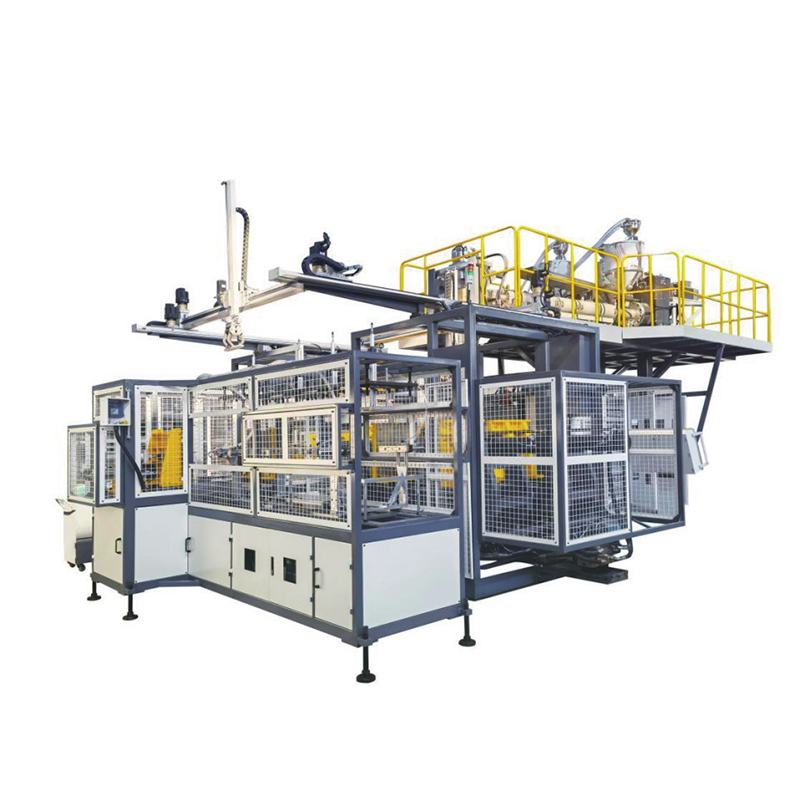
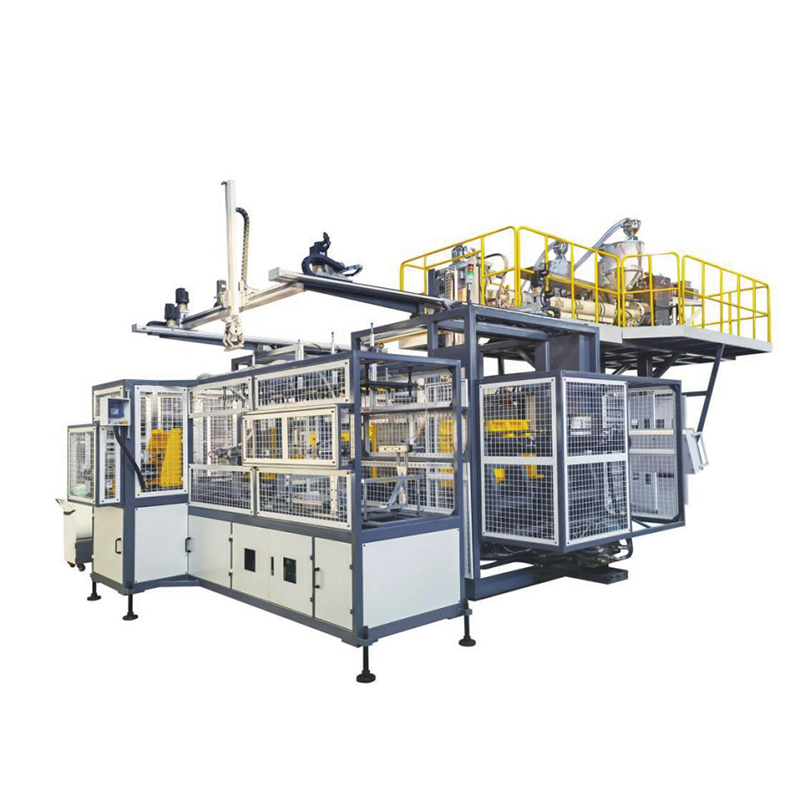
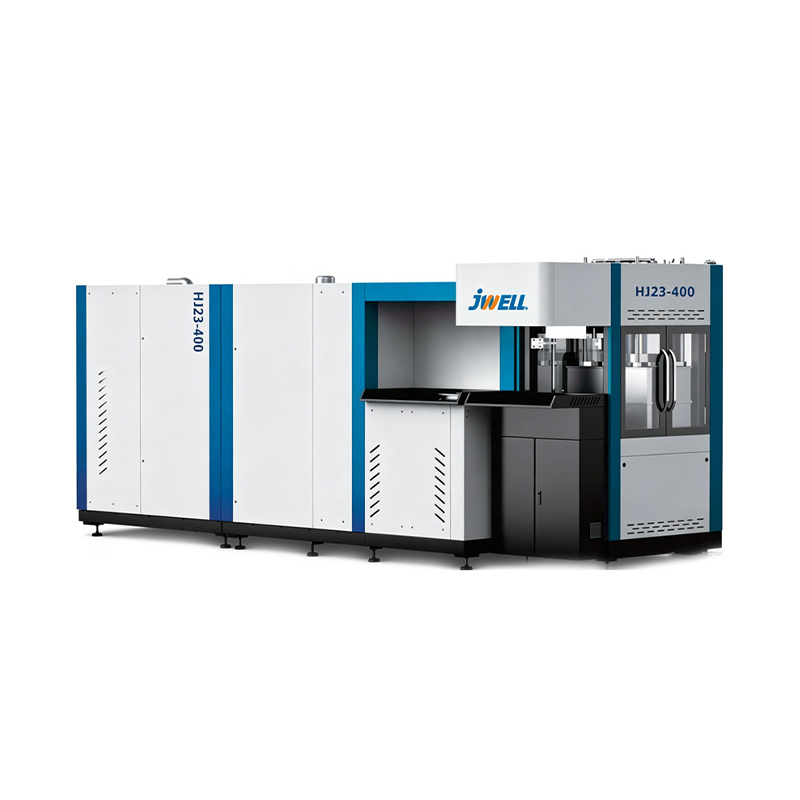
The BM30 is a high-performance continuous extrusion blow molding machine designed for medium to large-sized hollow containers. Featuring a 3-layer co-extrusion die head and four independent stations, it delivers superior production efficiency, energy efficiency, and product consistency.
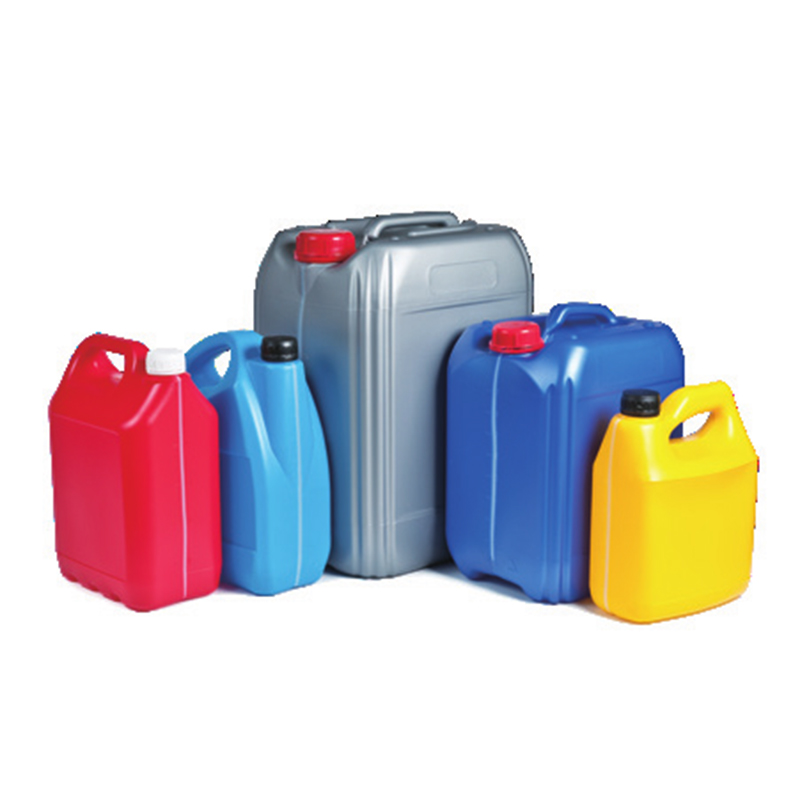
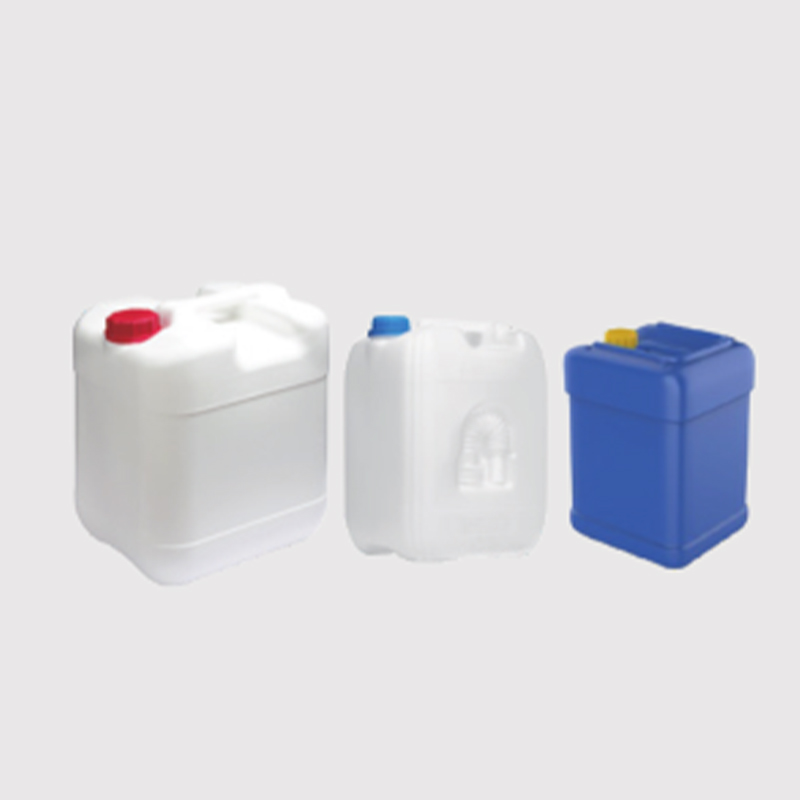
The BM30 has a maximum product volume of 30 liters and adopts a 4-station rotary design, making it ideal for high-volume production of the following products:
Industrial chemical drums (e.g., 20L–30L HDPE lubricant drums, coolant drums, or agrochemical drums)
Automotive air ducts and reservoirs (e.g., windshield washer fluid tanks, intake pipes)
Multilayer fuel tanks (with barrier layer, hydrocarbon-resistant)
Large toys and sporting goods (e.g., kayak seats, protective cases)
Real-world example: A Chinese packaging manufacturer replaced two old single-station machines with one BM30. Using a 3-layer structure (inner + middle + outer), they reduced material costs by 12% (adding regrind in the middle layer) while maintaining surface quality. The four stations run 24/7 producing 25L chemical drums, achieving over 5,000 finished pieces per day with only two operators.
Continuous 4-station rotary – higher output
Unlike reciprocating machines, the BM30’s four stations work in parallel. Plasticizing capacity reaches 780 kg/h (PE). Output is approx. 600–900 pcs/h for 1L small bottles, and 120–180 pcs/h for 30L drums (depending on wall thickness). The servo-driven oil pump (22 kW) saves 30–50% energy compared to a fixed displacement pump.
3-layer co-extrusion die head
Continuous die head (screw diameters 100/120/100 mm) allows independent control of each layer. You can use virgin material for the outer layer, regrind for the middle, and barrier material (e.g., EVOH) for the inner layer. This satisfies strict food/chemical safety standards while reducing raw material costs.
Powerful clamping and platen system
Clamping force: 240 kN – sufficient for 30L drums with minimal flash.
Platen opening distance: 450–950 mm – accommodates tall or complex shaped molds.
Platen size (600×640 mm) and max mold size (580×640 mm) – accepts multi-cavity molds for small products.
Reasonable total installed power
Total installed power is 410 kW, but due to sequential cycling of the four stations and the servo pump’s on-demand flow regulation, actual operating power in typical 25L drum production is usually below 220 kW.
Low-maintenance design
Three screws have independent drive motors (75/110/75 kW), allowing individual maintenance without full line shutdown. The continuous die head also reduces shear heat and material degradation.
To ensure consistent output, the BM30 should be paired with a structured QC process. Below is the standard process used by experienced manufacturers:
|
Stage |
Test/Inspection |
Method |
Acceptable range (based on BM30 specs) |
|
Incoming resin |
Melt Flow Index (MFI) |
ASTM D1238 |
Within ±5% of target value for each layer |
|
Melt temperature |
Die head thermocouple |
Continuous monitoring |
170–210°C (HDPE); 190–230°C (PP/EVOH) |
|
Wall thickness distribution |
Ultrasonic thickness gauge or cross-section |
Per product drawing |
Deviation ≤ ±8% for three-layer drum wall |
|
Clamp parallelism |
Dial gauge on platens |
During mold installation |
≤ 0.15 mm/m |
|
Short shot test |
Reduce shot weight by 10% |
Visual inspection |
No weld lines, pinholes, or unfilled corners |
|
Drop test |
Fill with water, drop from 1.2m (UN standard) |
After 24h conditioning |
No cracks or leaks for 30L drum |
|
Leak test |
0.3 bar air pressure, underwater |
Random sampling (1 per 200 pcs) |
No bubbles for 30 seconds |
|
Layer ratio check |
Cross-section microscopy or FTIR |
Per shift |
Outer 20–30%, middle 40–60%, inner 15–25% |
Real-world practice: A Turkish customer producing 20L oil bottles used an online wall thickness monitoring system (ultrasonic) connected to the BM30’s parison controller. When wall thickness deviation exceeded 6%, the machine automatically adjusted the die gap by 0.1 mm – scrap rate dropped from 4.2% to 1.8% in the first month.
Product Parameters:
|
Model
|
Unit
|
BM30
|
|
Max product volume
|
L
|
30
|
|
Station number
|
Pc/h
|
4
|
|
Die head structure
|
-
|
Continuous type
|
|
Main screw diameter
|
mm
|
100/120/100
|
|
Max plasticizing capacity (PE)
|
kg/h
|
780
|
|
Driving motor
|
Kw
|
75/110/75
|
|
Oil pump motor power (Servo)
|
Kw
|
22
|
|
Clamping force
|
KN
|
240
|
|
Space between platen
|
mm
|
450-950
|
|
Platen size W*H
|
mm
|
600*640
|
|
Max. mould size
|
mm
|
580*640
|
|
Heating power of die head
|
Kw
|
25
|
|
Total power
|
Kw
|
410
|
Q1: What is the actual energy consumption per unit output?
A: Based on field data (servo pump 22 kW, three screws at 70% load), the BM30 consumes approx. 0.35–0.42 kWh per kg of finished product (including auxiliary cooling and deflashing). Compared to a fixed displacement pump machine of similar capacity (0.55–0.65 kWh/kg), this saves about 35% on electricity costs.
Q2: How do I set the three-layer ratio to use regrind?
A: The three extruders are independent (Φ100/Φ120/Φ100). A common recipe for industrial drums:
Outer layer (Φ100): 25% virgin HDPE + UV stabilizer
Middle layer (Φ120): 60% regrind + 40% virgin (can be 100% regrind for non-food applications)
Inner layer (Φ100): 15% virgin HDPE (food-grade if required)
Maximum plasticizing capacity of 780 kg/h ensures output remains above 650 kg/h even with 50% regrind.
Q3: How long does mold change take?
A: With quick mold change clamps and the four-station design, a two-person team can change four molds in 45–60 minutes (including preheating). The platen opening distance (450–950 mm) and platen size (600×640 mm) accept most standard molds without adapter plates.
Q4: Can the BM30 produce fuel tanks with EVOH barrier layer?
A: Yes. The continuous die head supports 3–5 layers (additional extruder optional). A typical three-layer fuel tank structure would be HDPE/adhesive/EVOH (5-layer requires HDPE/adhesive/EVOH/adhesive/HDPE using a 5-layer adapter). The screw design (L/D=28:1) provides good mixing for temperature-sensitive EVOH. 25 kW die head heating ensures stable layer distribution.
Q5: What is the typical scrap rate and how can it be reduced?
A: Under normal operation (consistent material, skilled operator), scrap rate is 3–5% (flash, parison tails, startup waste). To reduce below 3%:
Use the BM30’s standard servo-driven parison wall thickness controller to adjust wall thickness along product height.
Install melt pressure sensors at the die head – alarm when pressure fluctuation exceeds ±5%.
Recycle flash immediately with a closed-loop granulator (do not store regrind for more than 4 hours to avoid moisture absorption).
Q6: Is the machine CE compliant?
A: The BM30 base model can be supplied with CE certification (LVD, EMC, MD) upon request. Safety features include light curtains, emergency stop buttons at each station, and a locking system that prevents mold closing when the operator door is open.




Pipe Extrusion Production Line
Plastic Shredder Crusher Machine

Tel: +86-19057068112

E-mail: [email protected]

Company Address
No. 128 Qingfeng Road, Xieqiao Town, Haining City, Jiaxing City, Zhejiang Province

19057068112

 English
 русский