
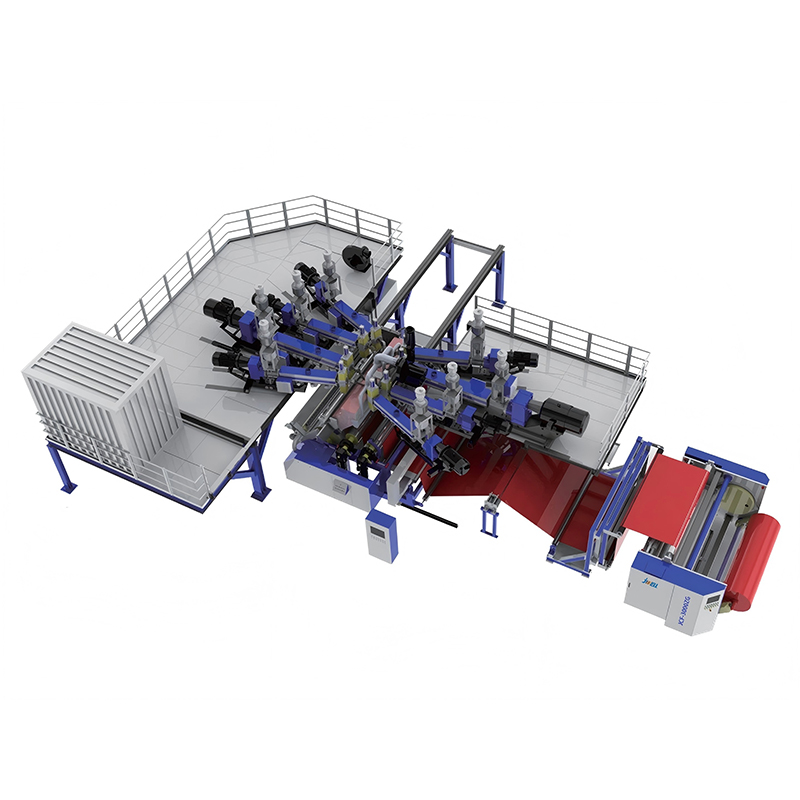
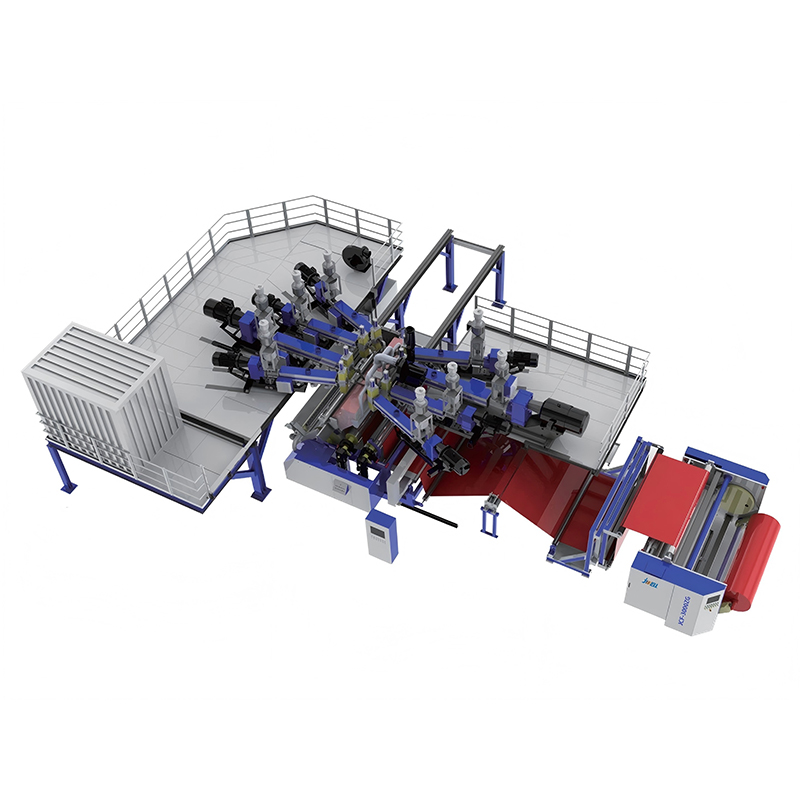
In the field of high-performance flexible packaging, the high-barrier cast film extrusion line is a key solution for producing multilayer films with excellent oxygen, water vapor, and light barrier properties. Our JCF-2500ZG and JCF-3000ZG models are designed for precision, speed, and reliability – widely used in food, medical, and industrial packaging.
Food Packaging: High-barrier films for meat, cheese, coffee, and snacks (using EVOH, PVDC, or AlOx layers).
Medical & Pharmaceutical: Sterile barrier bags and lidding films.
Industrial Laminates: Protective films for electronics or chemical-resistant liners.
Agricultural Films: Mulch films or silage stretch films requiring controlled water vapor transmission.
Real-World Case:
A European flexible packaging converter replaced a narrower line with the JCF-3000ZG. With a 2700 mm finished width and 150 m/min line speed, they increased output by 40% while maintaining a thickness tolerance of ±0.005 mm. The line produces a 5-layer EVOH-based barrier film for modified atmosphere packaging (MAP) of fresh pasta, achieving <2 cc/m²/day oxygen transmission rate.
Wide Width & High Output
2200–2700 mm finished width reduces slitting waste and increases throughput per batch.
Maximum output of 700 kg/h (JCF-3000ZG) supports high-volume continuous production.
Ultra-thin to Medium Thickness Flexibility
Thickness range 0.03–0.25 mm allows production of both ultra-thin high-barrier films and sturdy industrial-grade films.
High-Speed Stability
Runs at 150 m/min with automatic die lip adjustment and air knife system to prevent web flutter.
Multilayer Co-extrusion Capability
Supports 5–7 layers (optional up to 9 layers) for tailored barrier performance (e.g., symmetrical ABA or asymmetrical structures).
Energy-Saving Design
Servo-driven winders and variable frequency drives reduce energy consumption by approx 15–20% compared to conventional lines.
Fast Material & Color Change
Compact screw and barrel design with rapid purging system minimizes downtime between batches.
To ensure every roll of film meets international standards (ASTM, ISO, JIS), we implement a 4–stage QC protocol:
Stage 1 – Raw Material Validation
Melt flow index and moisture content testing for each resin layer.
Stage 2 – In–line Real–time Monitoring
Thickness gauge (X–ray or β–ray): ±1% accuracy across 2700 mm width.
Ultrasonic flaw detector: Identifies gels, fish eyes, or contaminants.
Optical surface scanner: Detects die lines, scratches, or carbon deposits.
Stage 3 – Laboratory Testing (per shift)
|
Test Parameter |
Standard |
Target Value |
|
Oxygen Transmission Rate (OTR) |
ASTM D3985 |
<2 cc/m²/day (with EVOH layer) |
|
Water Vapor Transmission Rate |
ASTM F1249 |
<5 g/m²/day |
|
Tensile Strength (MD/TD) |
ASTM D882 |
≥25 MPa |
|
Elmendorf Tear Strength |
ASTM D1922 |
≥10 g/µm |
|
Heat Seal Strength (hot tack) |
ASTM F88 |
≥30 N/15mm |
|
Haze & Clarity |
ASTM D1003 |
Haze <5% (for transparent films) |
Stage 4 – Finished Roll Inspection
Core inner diameter, roll hardness, telescoping, and static decay testing.
Real-World Case:
A customer in Southeast Asia using the JCF-2500ZG reported a scrap rate below 0.5% within six months of implementing our QC matrix, compared to 3–4% on their previous line.
|
Model
|
Width of die (mm)
|
Products width (mm)
|
Products thickness (mm)
|
Max line speed (m/min)
|
|
JCF-2500ZG
|
2500
|
2200
|
0.03–0.25
|
150
|
|
JCF-3000ZG
|
3000
|
2700
|
0.03–0.25
|
150
|
Q1: Can this line produce biodegradable high – barrier films?
A: Yes. With suitable screw design, it can process PLA, PBAT, or PBS – based materials. However, barrier performance (especially OTR) will be lower than EVOH – typically 50–100 cc/m²/day. It works well for short – shelf – life products (e.g., fresh produce).
Q2: How long does it take to clean the die once?
A: Complete disassembly, cleaning, and reassembly takes about 2–3 hours. We recommend cleaning every 800–1000 operating hours or when the optical scanner shows persistent die lines.
Q3: What is the typical energy consumption?
A: For a JCF-3000ZG running at full capacity (700 kg/h), average power consumption is around 280–320 kW, including extruders, heaters, chillers, and winders. That equals 0.4–0.46 kWh per kg of film.
Q4: Can the line run with post – consumer recycled (PCR) material?
A: Yes, up to 30% internal/post – industrial recyclate in the core layer, provided melt flow index variation is within ±15%. For post – consumer recyclate, a melt filtration system (≥80 µm) is recommended.
Q5: What is the lead time for spare parts?
A: Standard wear parts (screws, barrels, dies, chill rolls) are stocked in our warehouses in Europe and the US – 5–7 working days. Custom parts require 3–4 weeks.
Q6: How do you ensure thickness uniformity across the 2700 mm width?
A: Our automatic die with 55 thermal adjustment bolts (for JCF-3000ZG) and profile control software adjust each zone every 0.5 seconds. Typical tolerance is ±0.003 mm across the full width.





Tel: +86-19579950928

E-mail: [email protected]

Company Address
No. 128 Qingfeng Road, Xieqiao Town, Haining City, Jiaxing City, Zhejiang Province

19579950928

 English