
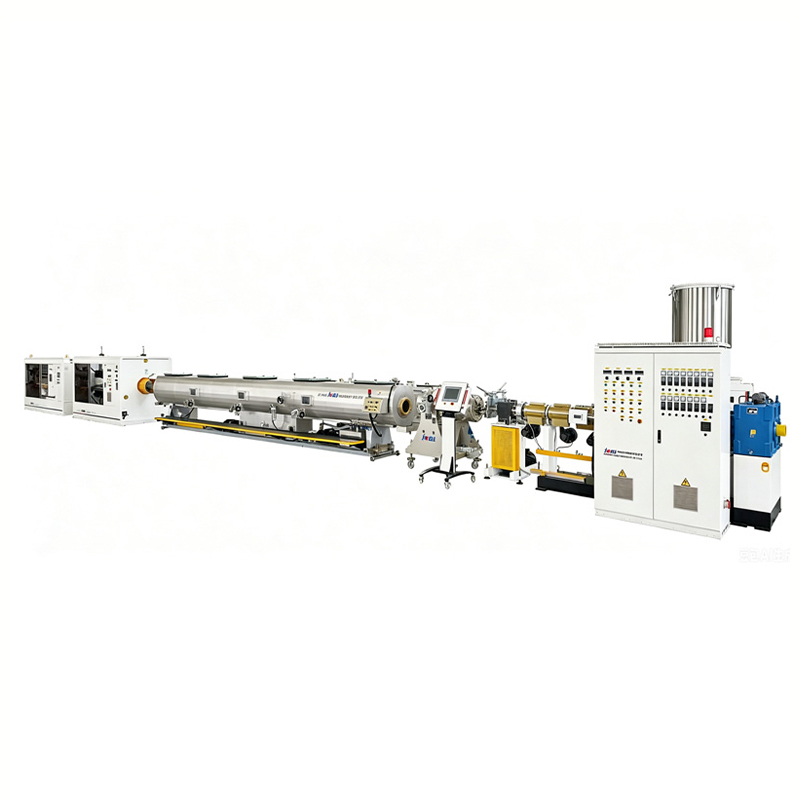
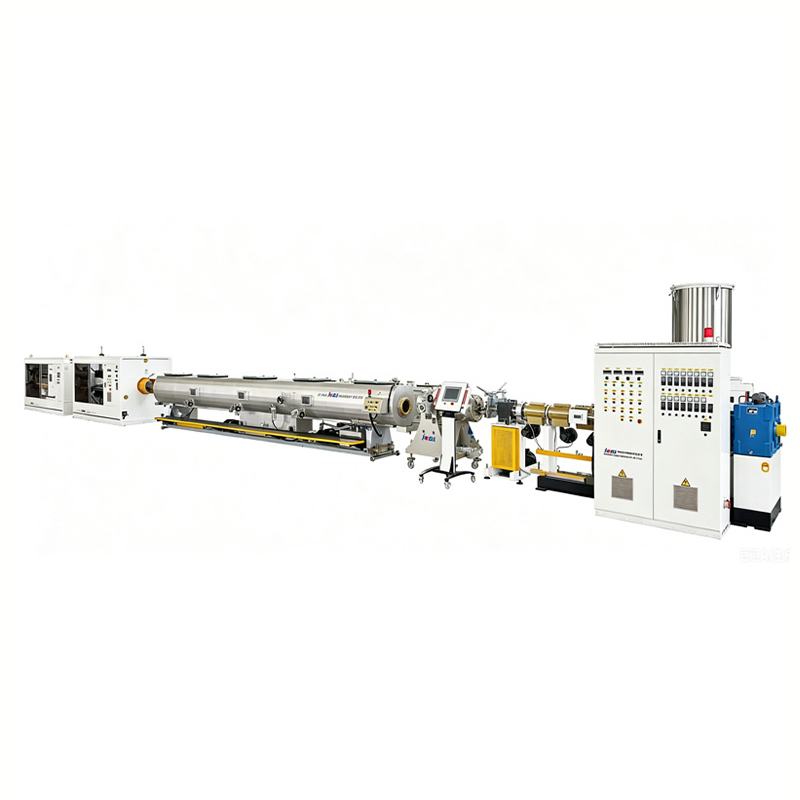
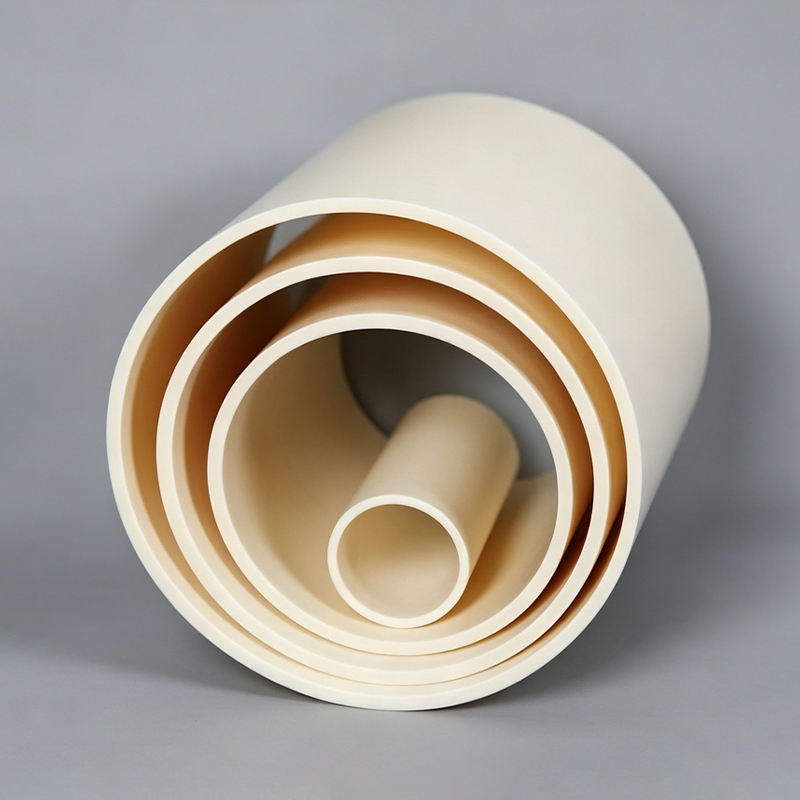
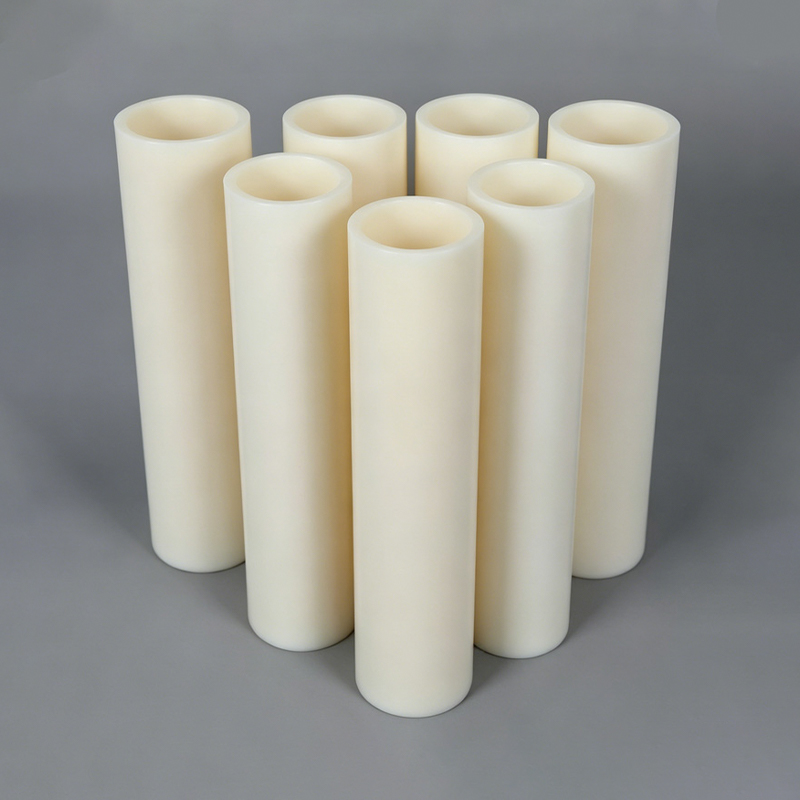
Our ABS PE core pipe extrusion line is specifically designed for the production of multi-layer composite core pipes, with the inner layer typically made of ABS or PE. It is suitable for building drainage, municipal sewage, cable protection, and industrial fluid conveyance. Measured ring stiffness, impact resistance, and peel strength all meet ISO standards. The line integrates online wall thickness/outer diameter monitoring, vacuum calibration, and automatic cutting, ensuring a first-pass yield of over 99%. It is a reliable choice for small-to-large diameter core pipe production.
JWS90/38 – Pipe inner diameter 75–153 mm, output 120–150 kg/h
Typical application: Small-to-medium core pipes for building drainage, ventilation, or cable protection.
Real case: A Malaysian pipe manufacturer uses this model to produce 110 mm PE core pipes for residential sewage systems, achieving a stable output of 135 kg/h with co-extruded ABS outer layer.
JWS120/38 – Pipe inner diameter 144–370 mm, output 350–450 kg/h
Typical application: Large-diameter core pipes for municipal drainage, industrial fluid conveyance, or underground piping systems.
Real case: A Turkish contractor uses this line to produce 315 mm ABS core pipes for a stormwater project, running 22 hours per day at an output of 420 kg/h, reducing joint failure rate by 30% compared to single-layer pipes.
Here "core pipe" refers to the structural inner layer in a multi-layer pipe system that provides pressure resistance and shape stability, while the outer layer provides protection against UV, abrasion, or chemical corrosion.
High output and low energy consumption
Both models feature 38:1 L/D ratio screws (JWS90/38 and JWS120/38), ensuring a longer melting zone and better homogenization. For ABS/PE materials, compared to 32:1 screws, back pressure is reduced, saving 15–20% energy.
Single screw covers wide inner diameter range
JWS90/38 covers 75–153 mm – can replace two smaller extruders.
JWS120/38 covers 144–370 mm – suitable for DN300 to DN350 core pipes.
Advantage: No screw change is required to produce different sizes within this range, saving changeover time and tooling costs.
Stable output for both ABS and PE
ABS requires low shear heat, PE requires high melt flow. Our 38:1 screw with grooved feed section adapts to both materials, preventing ABS degradation and ensuring adequate PE plasticization.
Real feedback: A Polish customer reported output fluctuation of only ±2% when switching between ABS and PE on the same JWS120/38 line.
Compact design, easy integration
The line can be directly connected to a multi-layer die head, vacuum tank, haul-off, and planetary cutter. Core pipe production is fully synchronized.
We implement a four-stage quality control process based on ISO 9001 and ASTM F1412 (for ABS/PE core pipes).
Stage 1: Raw material verification
Melt flow index test – PE: 0.2–0.5 g/10min (190°C/5kg); ABS: 2–4 g/10min (220°C/10kg)
Moisture content – below 0.02% for both materials (using online hygrometer)
Stage 2: Online extrusion monitoring
Ultrasonic wall thickness gauge – installed after the vacuum tank, scanning 4 axes simultaneously. Tolerance: ±0.15 mm for 75–153 mm pipe, ±0.3 mm for 144–370 mm pipe.
Laser outer diameter gauge – real-time feedback to haul-off speed. Alarm triggered when deviation exceeds ±0.5%.
Pre-die pressure sensor – target: 180–220 bar for PE, 150–190 bar for ABS. Triggers screw speed correction.
Stage 3: Offline physical testing (every 500 meters)
|
Test item |
Standard |
JWS90/38 typical result |
JWS120/38 typical result |
|
Ring stiffness (SN4) |
ISO 9969 |
4.8 kN/m² (110mm pipe) |
4.6 kN/m² (315mm pipe) |
|
Impact resistance (0°C) |
EN 744 |
No cracks after 10 blows (20J) |
No cracks after 10 blows (25J) |
|
Hydrostatic pressure (1h) |
ISO 1167 |
No leakage at 10 bar |
No leakage at 8 bar |
|
Peel strength (ABS-PE interface) |
ASTM D903 |
>6 N/mm |
>5.5 N/mm |
Stage 4: Finished pipe cutting and visual inspection
Automatic saw with burr detector – rejects pipe ends with burr height >0.2 mm.
Black light inspection for ABS surface cracks (for ABS core pipes only).
Real case: A Vietnamese buyer achieved a first-pass yield of 99.2% after using the JWS120/38 with the above quality control process, compared to 94% on their old line.
| Model | Pipe I.D(mm) | Output(kg/h) |
| JWS90/38 | 75-153 | 120-150 |
| JWS120/38 | 144-370 | 350-450 |
Q1: Can I use the same screw to produce both ABS and PE core pipes?
A: Yes, but with minor adjustments. Our 38:1 screw with twin-flight mixing section works for both materials. For ABS, set barrel temperature 190–210°C (lower compression ratio); for PE use 200–230°C. When switching materials, we recommend cleaning the screw with purging compound – the process takes 30 minutes.
Q2: What is the actual maximum pipe length for JWS90/38 when producing 153 mm inner diameter?
A: Limited by haul-off capacity, not the extruder. Using our standard 6-meter haul-off, you can produce 6 m or 12 m core pipes. For 153 mm ID, maximum line speed is approx. 1.2 m/min (based on 150 kg/h output and 8 mm wall thickness). Thus producing one 12 m pipe takes about 10 minutes/cycle.
Q3: My output is lower than specification (e.g., only 100 kg/h for JWS90/38). What should I check?
A: Most common causes:
Clogged screen pack – replace if pre-screen pressure >250 bar.
Feed zone temperature too high – keep hopper area below 50°C for PE to avoid bridging.
Incorrect screw speed – target 65–85 rpm for JWS90/38; below 50 rpm reduces output by 30%.
Real solution: A South African user restored output from 110 kg/h to 142 kg/h by cleaning the vacuum loader filter (material flow was obstructed).
Q4: How to prevent ovality for large-diameter core pipes (e.g., 370 mm)?
A: Use our 8-chamber vacuum tank with adjustable support rings. Set vacuum to -0.6 to -0.8 bar and ensure cooling water temperature is 15–20°C. Water should be sprayed evenly from top and bottom. Also check that haul-off belt pressure is symmetrical (we provide pressure gauges for each side). Target ovality ≤1.5%.
Q5: Can this line produce foamed core pipes?
A: Yes for PE foamed core pipe (not for ABS). You would need a chemical foaming agent feeder and a different screw design – we offer a dedicated 38:1 foam screw with lower compression ratio (2.2:1 instead of 2.8:1). Please contact us for retrofitting.
Q6: What is the typical energy consumption per kg of output?
A:
JWS90/38: 0.28–0.32 kWh/kg (ABS), 0.30–0.35 kWh/kg (PE)
JWS120/38: 0.24–0.28 kWh/kg (ABS) – more efficient due to larger motor and lower surface-to-volume ratio.




Pipe Extrusion Production Line
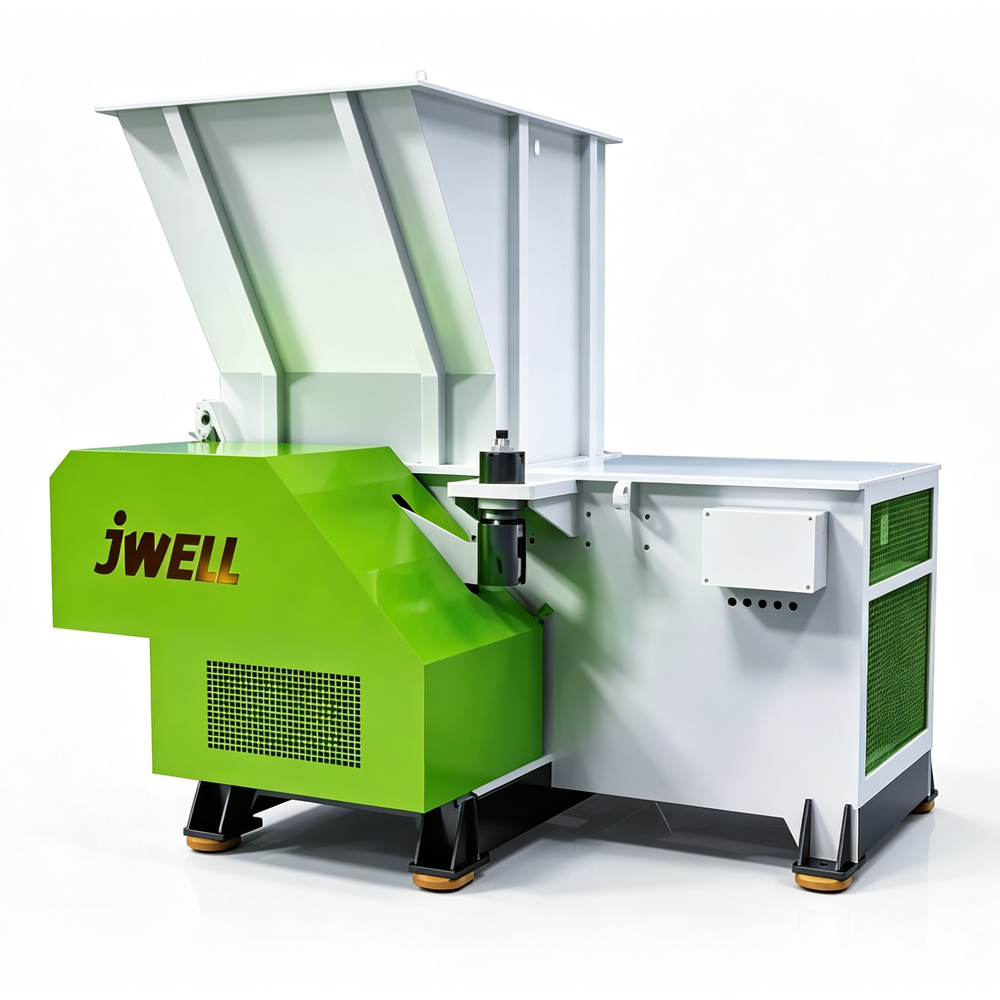
Plastic Shredder Crusher Machine

Tel: +86-19057068112

E-mail: [email protected]

Company Address
No. 128 Qingfeng Road, Xieqiao Town, Haining City, Jiaxing City, Zhejiang Province

19057068112

 English
 русский