
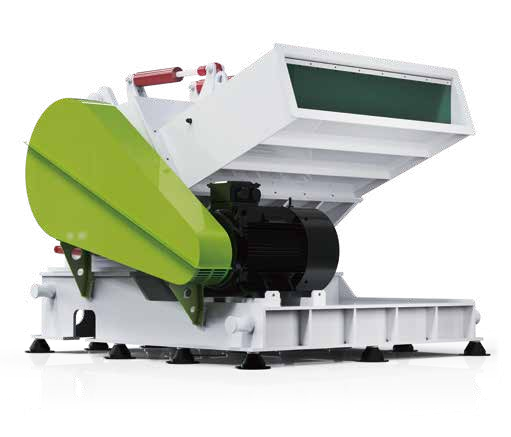
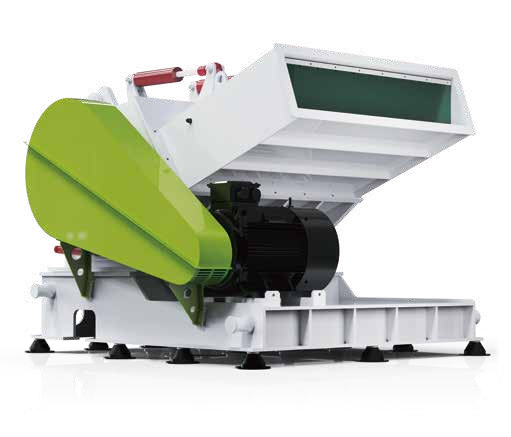
When processing large-volume plastic pallets, thick sheets, and large-diameter blow-molded parts, standard granulators often suffer from material jamming, overheating, or uneven output. The DYPS-T series is specifically designed to tackle these challenges. Featuring a wide feed hopper and a sturdy Φ600 mm rotor, this machine converts troublesome industrial waste into uniform recycled granules while minimizing downtime.
Primary target materials: plastic pallets (new or waste), ABS/PP/PE sheets up to 30 mm thick, purging compounds from injection molding machines, and large hollow parts (e.g., flattened drums, containers, IBC totes).
Real-world case: A Spanish pallet-pooling company processes 3,000 end-of-life HDPE pallets per week. Before using the DYPS-T1500, they used a conventional 1000 mm wide granulator that frequently stopped due to pallet legs jamming. With a 1500×300 mm feed opening, the DYPS-T1500 accepts whole stacked pallets without pre-shredding. Equipped with a 132 kW motor and 14 rotor blades, they now achieve approximately 780 kg/h of clean recycled granules (<10 mm flake), with blade wear reduced by 40% compared to their old machine.
Other proven applications include:
Automotive sheet scrap (bumpers, door liners)
Thermoforming skeletal waste (refrigerator liners, trays)
Extruder start-up lumps (width ≤1200 mm for T1200 model)
A. Ultra-wide, low-profile feed opening (1200/1500 mm wide × 300 mm high)
Unlike square or tall vertical openings, the 300 mm height forces large, flat materials to enter horizontally. This effectively prevents "bridging" and enables continuous feeding without a rammer or belt pressurization.
B.High-inertia Φ600 mm rotor
The 600 mm working diameter gives the rotor significantly higher kinetic energy storage compared to smaller-diameter designs (e.g., 400–450 mm). This means it can smash through thick pallet panels or stacks without dropping speed, resulting in cleaner cuts and lower peak current draw.
C.Flexible blade configuration (10 or 14 rotor blades)
10-blade setup: produces coarser particles (10–15 mm), higher throughput, suitable for material feeding directly into extruders with good melt filtration.
14-blade setup: produces finer particles (6–10 mm), better for direct injection molding or tight-tolerance applications.
All blades are D2-grade tool steel (HRC 58–60), with reversible cutting edges – each blade can be used up to 4 times before resharpening.
D.. 4 stator blades
Most comparable machines use 2 or 3 stator blades. Four stator blades provide additional cutting points per revolution, reducing material recirculation and improving particle uniformity. This also lowers the load on each blade, extending maintenance intervals.
E.Heavy-duty bearing housings and sealing chambers
The rotor is supported by oversized spherical roller bearings (SKF/FAG), isolated from the cutting chamber by multi-stage labyrinth seals. This prevents dust and melted fines from entering the bearings – a common failure point on cheaper equipment.
Every DYPS-T series granulator goes through a 9-step QC process. We do not rely on random sampling; each machine is tested as a complete system before shipment.
Step 1: Material traceability
Main steel plates (for hopper, cutting chamber, and frame) are sourced from approved mills. Batch numbers are recorded and linked to the machine's serial number.
Step 2: Weld inspection
All load-bearing welds are 100% visually inspected and spot-checked for internal porosity using ultrasonic testing (UT). The cutting chamber wall thickness is verified: not less than 20 mm for T1200, not less than 25 mm for T1500.
Step 3: Rotor dynamic balancing
Each Φ600 mm rotor (including blades and blade holders) is dynamically balanced at 120% of its operating speed (max speed 580 RPM). Residual unbalance is kept below 5 g·mm per plane – far superior to ISO 1940 G6.3 grade.
Step 4: Blade gap consistency check
After installation, the gap between rotor blades and stator blades is set to 0.8–1.2 mm. Measurements are taken at 8 positions along the rotor length using feeler gauges. Deviation must not exceed ±0.1 mm.
Step 5: No-load run test
The machine runs without material for 4 hours. We monitor:
Bearing temperature rise (< ambient +35°C)
Motor current fluctuation (±3% of rated value)
Vibration velocity (< 3.5 mm/s RMS at bearing housing)
Step 6: Full-load test with actual waste
This is where we differentiate ourselves. Instead of using idealized test blocks, every T1200 and T1500 is fed with real waste pallets (PP/PE mixed material) supplied by local recycling partners.
T1200 test: 1,200 kg of pallet regrind, target output 580–620 kg/h, motor load 90%.
T1500 test: 1,600 kg of sheet edge trim and pallet mix, target output 780–820 kg/h, power 132 kW.
We record energy consumption per kilogram of material and reject any machine that shows overheating or jamming.
Step 7: Safety device verification
Manual triggering of hopper limit switches, door interlock switches, and motor overload relays confirms immediate shutdown (response time <0.5 seconds).
Step 8: Vibration and noise measurement
Noise at 1 meter distance – below 85 dBA for T1200, below 88 dBA for T1500 (empty chamber). Vibration at the control panel – below 1.2 mm/s.
Step 9: Final assembly, painting, and documentation
Anti-rust coating is applied to unpainted surfaces. The machine is then disassembled for shipment; each critical bolt torque is marked with a paint pen. The test report (including balancing charts, blade gap diagrams, and power logs) is packed with the manual.
| Model | Feed Mouth Size (mm) | Main Motor Power (kW) | Rotor Blade (pcs.) | Fixed Blade (pcs.) | Rotor Dia. (mm) | Output (kg/h) |
|---|---|---|---|---|---|---|
| DYPS-T1200 | 1200×300 | 75-90 | 10/14 | 4 | Φ600 | 600 |
| DYPS-T1500 | 1500×300 | 90-160 | 10/14 | 4 | Φ600 | 800 |
Q1: Can I feed whole pallets without any pre-shredding?
Yes – that is the design intent. As long as the pallet width ≤ the machine's feed opening width (1200 mm for T1200, 1500 mm for T1500) and height is less than 300 mm, it can be fed directly. For double-deck pallets taller than 300 mm, simple manual splitting may be required, but most standard Euro or US pallets are <300 mm thick.
Q2: How do I choose between 10 and 14 rotor blades?
Use 10 blades if throughput is your priority and your downstream process (e.g., a washing line or extruder with a strong screen changer) can handle slightly larger flakes (12–15 mm). Use 14 blades when you need finer, more uniform particles (6–10 mm), such as feeding directly into injection molding machines making thin-walled products.
Q3: What is typical blade life?
For standard HDPE/PP pallets (without fiberglass or calcium carbonate), rotor blades last 300–500 operating hours before needing to be flipped/re-sharpened. Stator blade life is roughly double that. Blades can be re-sharpened 3–4 times. The cost of one set of reversible blades is approximately 15% of the annual maintenance budget.
Q4: Can the machine handle wet or dirty pallets?
Yes – the cutting chamber is equipped with drainage slots, and the bearing seals are grease-flushed to keep out moisture. However, wet material will reduce output by 20–25% and accelerate blade dulling. For heavily contaminated (dirt/chemical) pallets, we recommend pre-washing or a drying bed.
Q5: What screen sizes are available?
The DYPS-T series uses a curved screen under the rotor. Standard screen hole diameters: 10 mm, 12 mm, 14 mm, 20 mm. For the 14-blade setup, we recommend screens ≤14 mm. Screens can be changed via two side access doors without removing the hopper – about 10 minutes for two people.
Q6: How does output compare to a single-shaft shredder?
For clean pallets and sheets, the DYPS-T granulator is 2–3 times faster than a single-shaft shredder of the same power. Shredders produce irregular fluff that often requires secondary granulation; this machine produces ready-to-use recycled granules in a single pass. However, for heavily contaminated material (with steel straps or sand), a shredder is still a safer first step.
Q7: What electrical protections are standard?
Each machine includes: motor overload relay, phase sequence monitor, emergency stop pull-cords along both sides of the hopper edge, and a current-sensing module that can reverse the rotor upon detecting a jam. The control panel is IP54 rated.




Pipe Extrusion Production Line
Plastic Shredder Crusher Machine

Tel: +86-19057068112

E-mail: [email protected]

Company Address
No. 128 Qingfeng Road, Xieqiao Town, Haining City, Jiaxing City, Zhejiang Province

19057068112

 English
 русский