
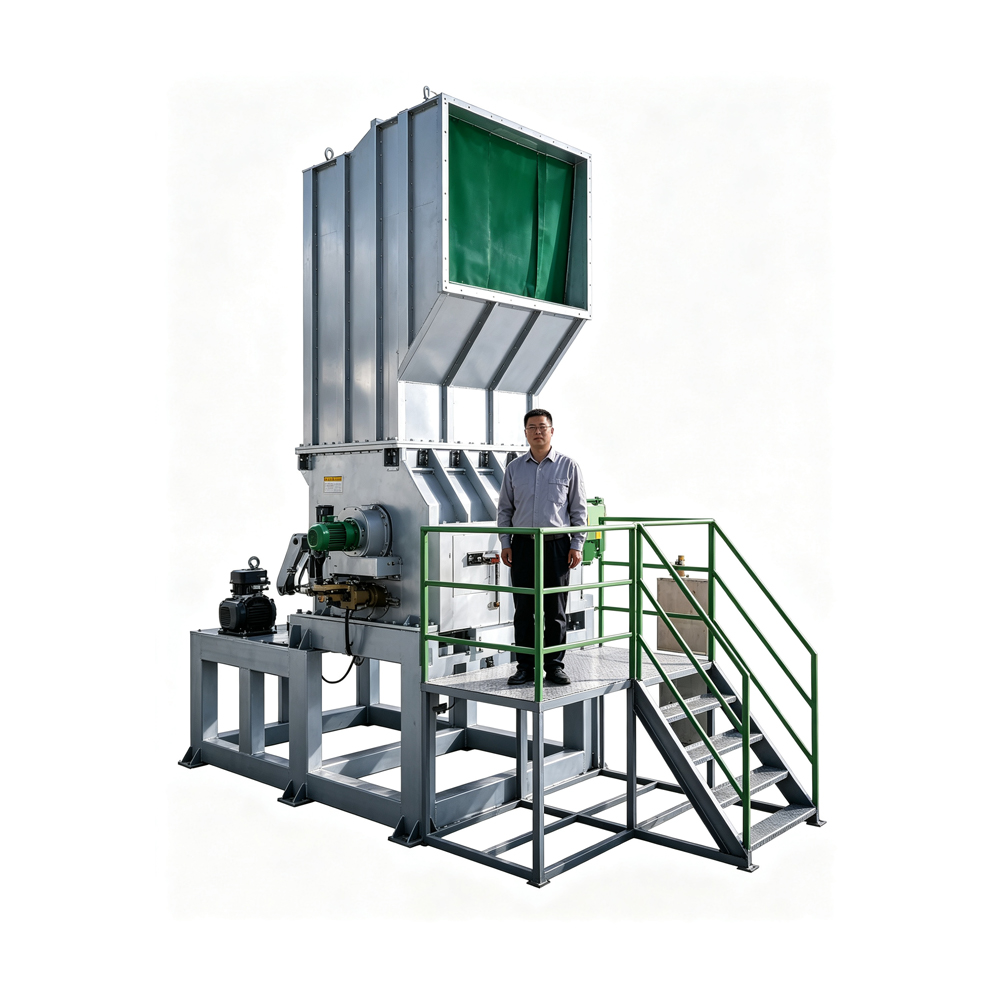
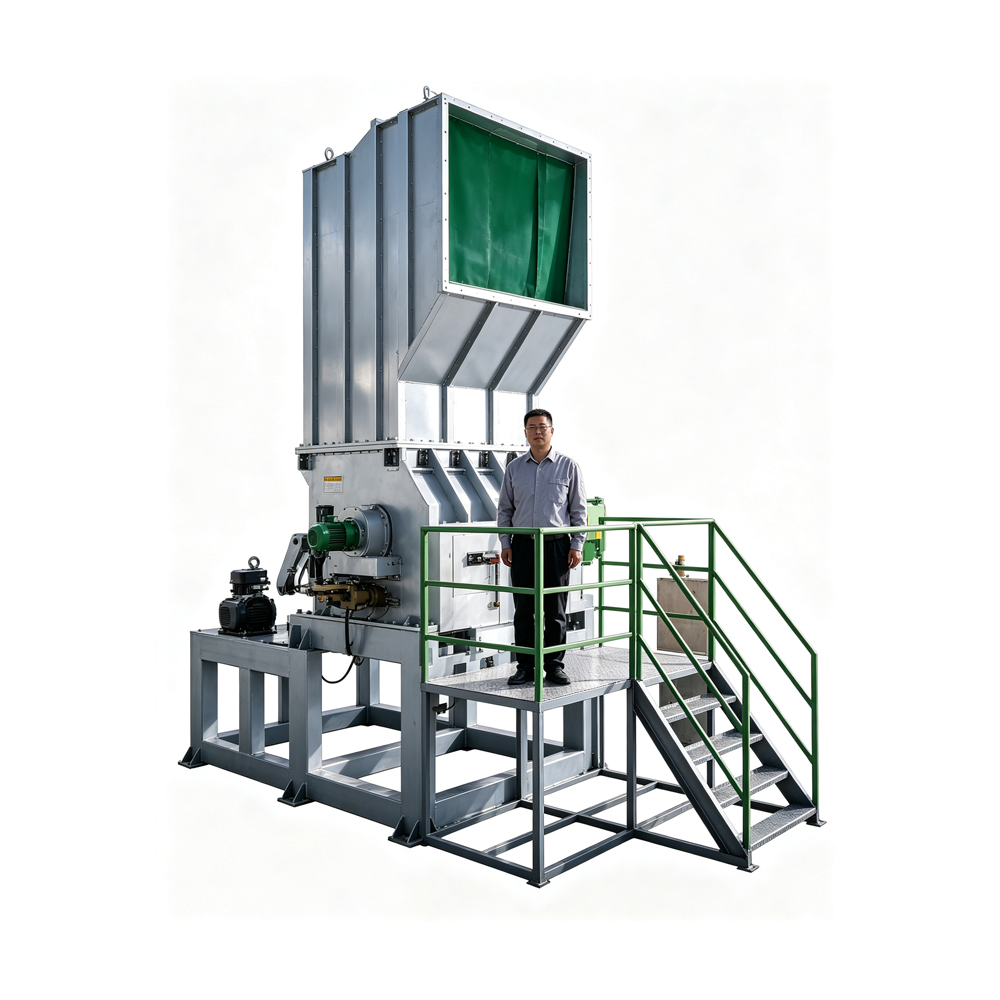
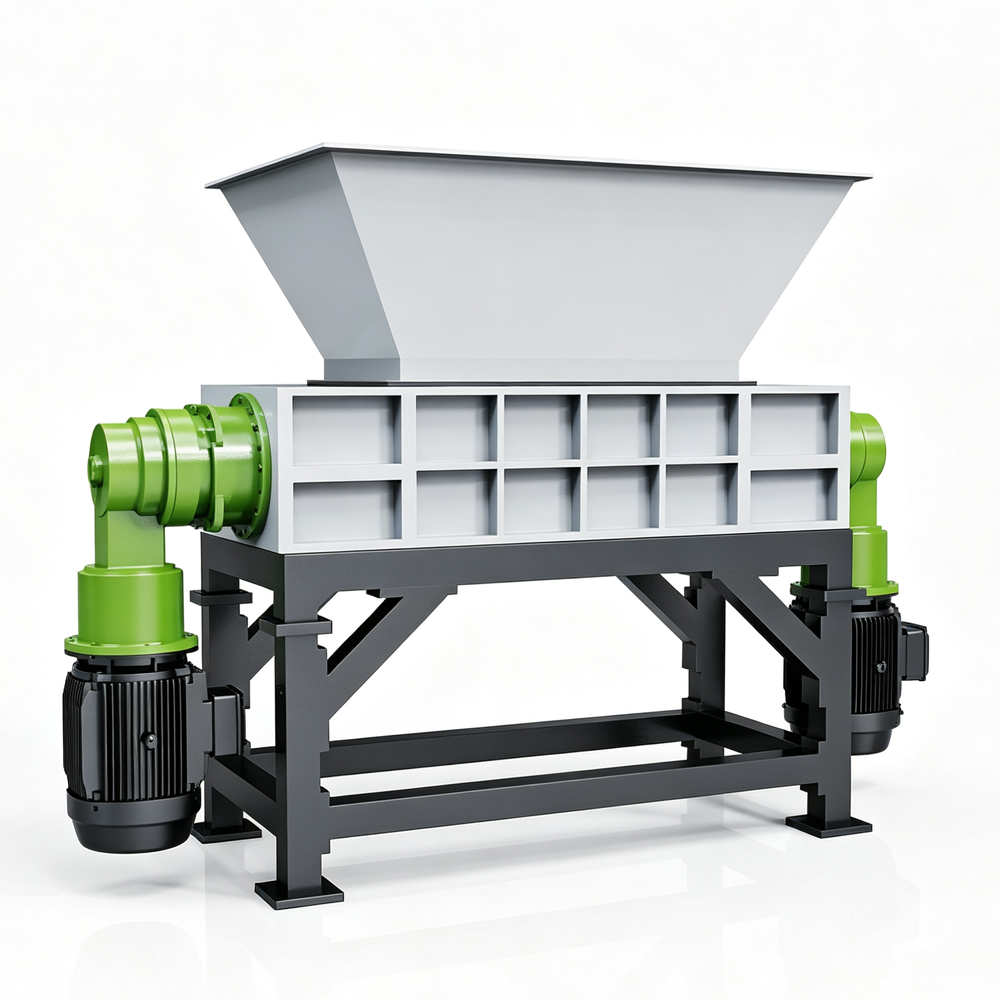
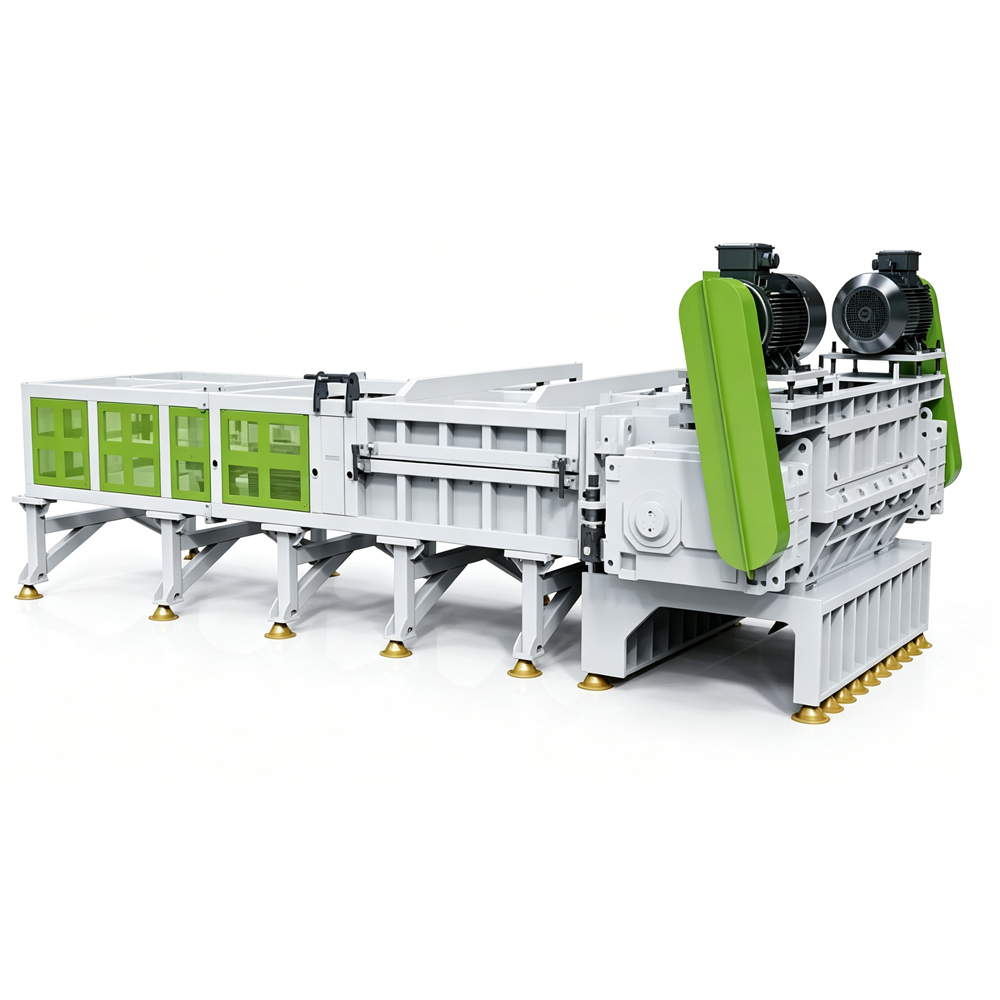
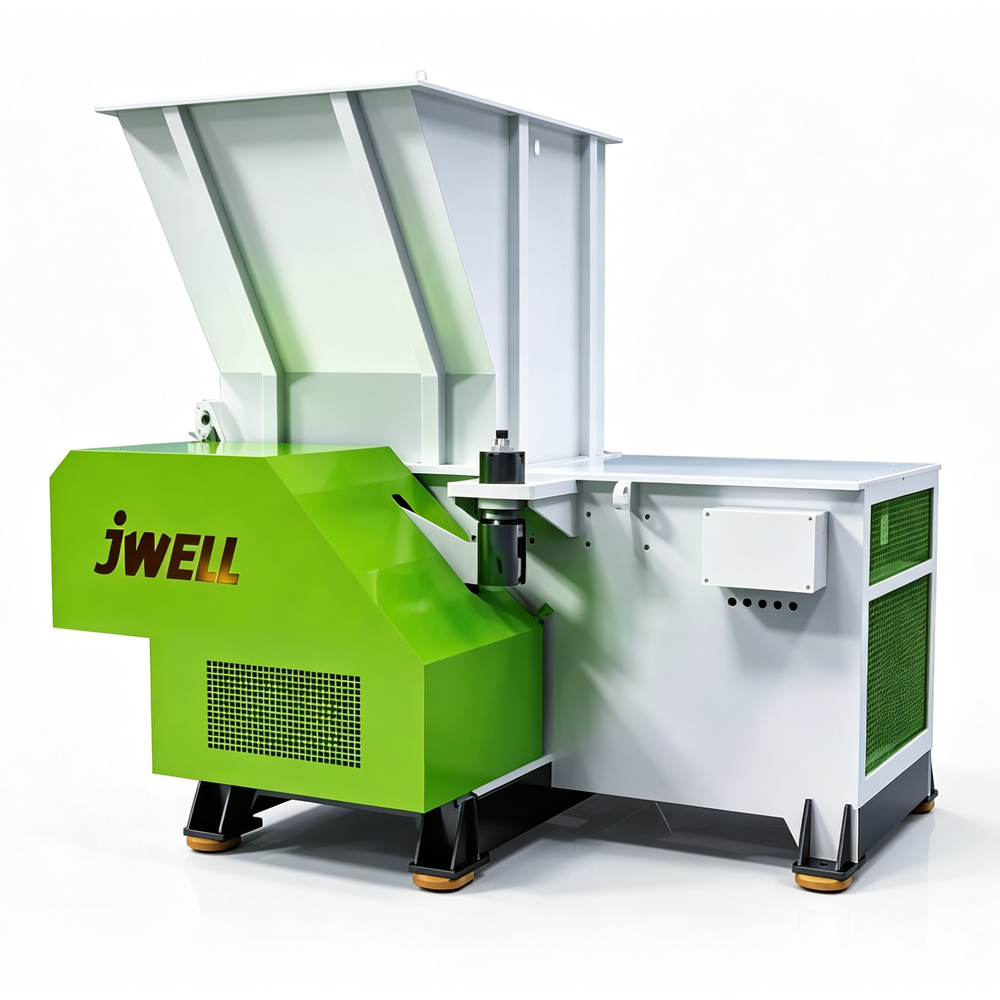
The DYPS-Z Series heavy-duty shredder is designed for high-volume plastic recycling and volume reduction applications. With its robust rotor design, flexible power configurations, and large feed opening, this series can easily handle bulky, rigid, and heavy materials. Below is a detailed analysis of its practical applications, performance advantages, quality control process, and common questions.
Based on technical specifications (feed opening size, rotor diameter, and output), the DYPS-Z series is ideally suited for:
Large plastic lumps (start-up lumps) and agglomerates – e.g., a 1000×1000mm feed opening can easily load large-sized industrial waste.
Thick-walled pipes and profiles – the max Φ1000mm rotor diameter provides the high torque required for processing hard materials.
Pallets, drums, IBC totes – commonly found in logistics and chemical industries.
Post-consumer rigid plastics – such as refrigerator liners, car bumpers, and heavy-duty returnable crates.
Real-world case:
A German recycling plant processing post-industrial HDPE lumps (single lumps weighing up to 80 kg) replaced their old shear shredder with a DYPS-Z 1200 (feed opening 1200×1000mm, 110kW motor, 18 rotor blades). The result: output increased from 800 kg/h to 1150 kg/h, fewer jams, and lower energy consumption per ton.
|
Feature |
Advantage |
|
Large feed opening (1000×1000mm to 1500×1000mm) |
Accepts large parts without pre-cutting – saves labor and pre-processing costs. |
|
Wide motor power range (55–200kW) |
Matches energy consumption to material hardness – lower operating cost for softer materials. |
|
Multiple rotor blade counts (10/14/18 blades) |
Flexible for coarse or medium-fine output – reduces re-shredding passes. |
|
Large rotor diameter (Φ700–Φ1000mm) |
Higher inertia, less stalling when cutting thick-walled sections. |
|
Heavy-duty bearing housings and welded steel structure |
Minimizes vibration, extends bearing life under continuous load. |
Other advantages:
Convenient screen and blade access – side or front opening reduces downtime.
Extra-large flywheels – smooth operation, handles peak loads.
CE, UL compliant safety interlocks – meets Western safety standards.
Each DYPS-Z shredder goes through a 6-stage quality control process before shipment:
1.Raw material inspection
Check steel plate thickness (20–40mm for main frame)
Check supplier certificates for hardened D2 steel or equivalent rotor blades
2.Machining tolerance inspection
Rotor dynamic balancing at 150% of operating speed (up to 850 RPM)
Shaft coaxiality ≤0.05mm
3.Pre-assembly no-load test
Continuous no-load operation for 4 hours
Vibration level ≤2.8 mm/s (ISO 10816-3 Class II standard)
4.Load test with standard materials
Example: DYPS-Z 1500 tested with 50mm thick ABS lumps
Continuous operation at 80–100% rated load for 8 hours
Output verification (within ±5% of specification value: 2000 kg/h)
5.Safety system verification
Emergency stop response time <0.2 seconds
Door-open sensor cut-off test
6.Final documentation delivery
Thermal imaging report for gearbox and motor
Sound level measurement (typically ≤85 dB(A) at 1 meter)
Real QC case: A batch of DYPS-Z 1000 units shipped to a Canadian recycler passed third-party SGS inspection with zero non-conformances – particularly in rotor balancing and weld integrity.
| Model | Feed Mouth Size (mm) | Main Motor Power (kW) | Rotor Blade (pcs.) | Fixed Blade (pcs.) | Rotor Dia. (mm) | Output (kg/h) |
|---|---|---|---|---|---|---|
| DYPS-Z 1000 | 1000×1000 | 55-110 | 10/14 | 4/6 | Φ700 | 800 |
| DYPS-Z 1200 | 1200×1000 | 90-132 | 10/14/18 | 4/6 | Φ800 | 1200 |
| DYPS-Z 1500 | 1500×1000 | 110-200 | 14/18 | 4/6 | Φ1000 | 2000 |
Q1: Can the DYPS-Z shredder process wet or washed materials?
A: Yes – the machine is equipped with water flushing ports and an inclined screen chamber, suitable for semi-wet shredding. However, for extremely wet materials (e.g., washed film with 20% moisture content), we recommend adding a dewatering screw.
Q2: How often should the blades be replaced or flipped?
A: With D2 steel blades, typical life is 400–600 operating hours for abrasive materials (e.g., glass-filled PP). For non-abrasive HDPE/lumps, life can reach 1200 hours. Blades are double-sided – each blade has two cutting edges.
Q3: What is the real-world output difference between a 10-blade and an 18-blade rotor?
A:
10-blade rotor → coarser output (10–20mm screen), higher throughput for pre-shredding.
18-blade rotor → finer output (6–12mm), suitable for direct extruder feeding.
Example: DYPS-Z 1200 with 18 blades and a 14mm screen processing PC/ABS lumps: output 920–1000 kg/h, output flake size 8–10mm.
Q4: Do I need a separate conveyor to feed the shredder?
A: Not mandatory, but for the DYPS-Z 1500 with a feed opening up to 1500mm, we recommend a belt conveyor or hopper elevator to safely guide large items (e.g., pallets). For smaller models like the Z1000, manual feeding of parts up to 60 kg is acceptable.
Q5: What is the actual noise level during operation?
A: Measured 1.5 meters from the machine using standard ABS lumps:
Z1000: 82–85 dB(A)
Z1200: 84–87 dB(A)
Z1500: 86–89 dB(A)
We offer optional acoustic enclosures that reduce noise by 12–15 dB.
Q6: What is the actual energy consumption per ton – for example, when the DYPS-Z1200 processes HDPE lumps?
A: Based on field data from a UK recycler running a DYPS-Z1200 unit equipped with a 110kW motor, 14 rotor blades, and a 12mm screen:
Material: HDPE waste (10–40 kg per piece)
Output: 1,150 kg/h
Average power draw: 78–85 kW (not full load)
Energy consumption per ton: 68–74 kWh/ton
This is about 15–20% lower than a conventional single-shaft shredder for the same material, thanks to the high-inertia rotor and efficient cutting geometry.




Pipe Extrusion Production Line
Plastic Shredder Crusher Machine

Tel: +86-19057068112

E-mail: [email protected]

Company Address
No. 128 Qingfeng Road, Xieqiao Town, Haining City, Jiaxing City, Zhejiang Province

19057068112

 English
 русский