
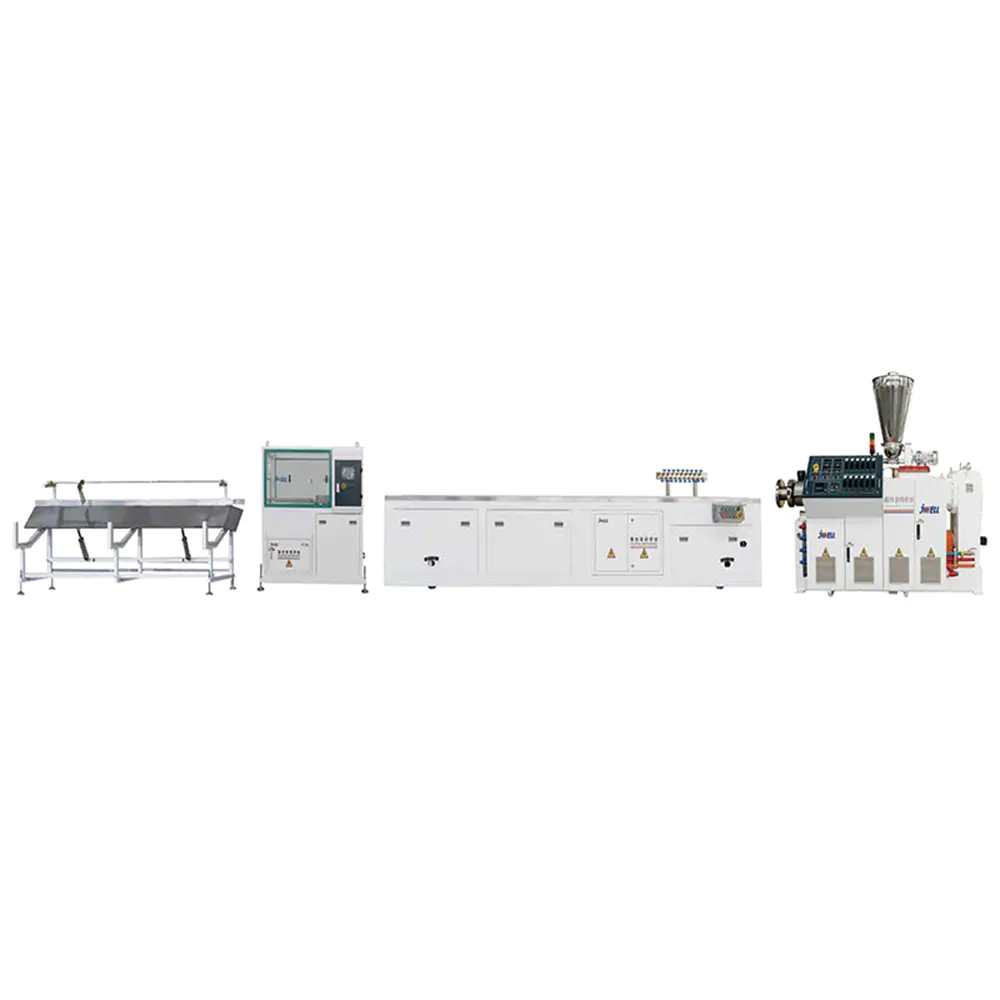
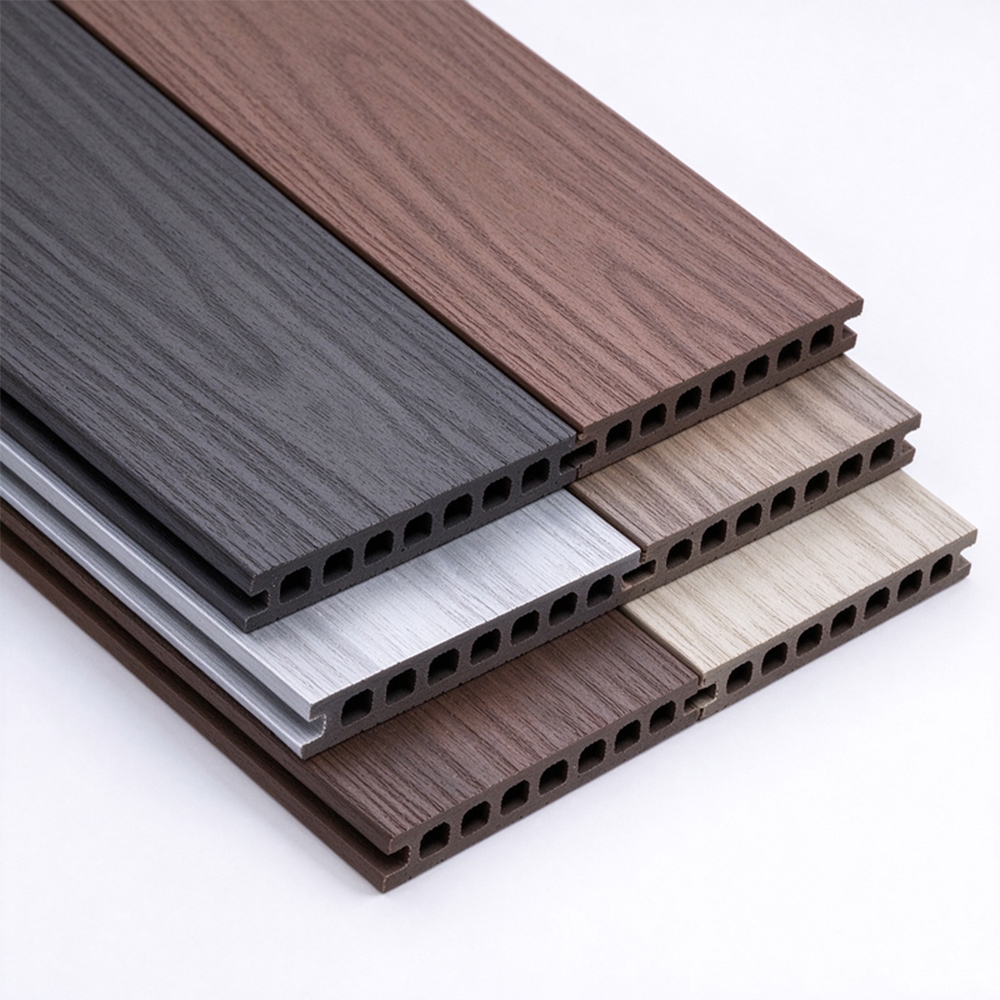
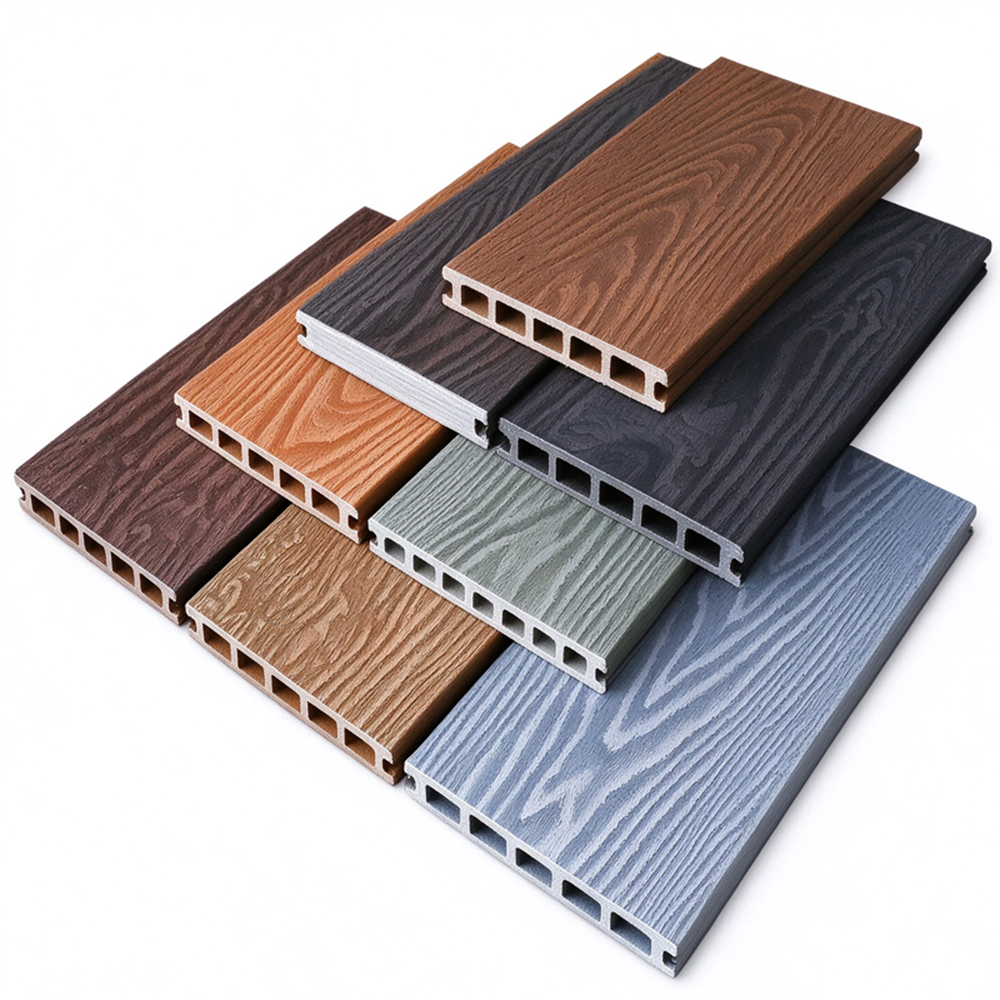
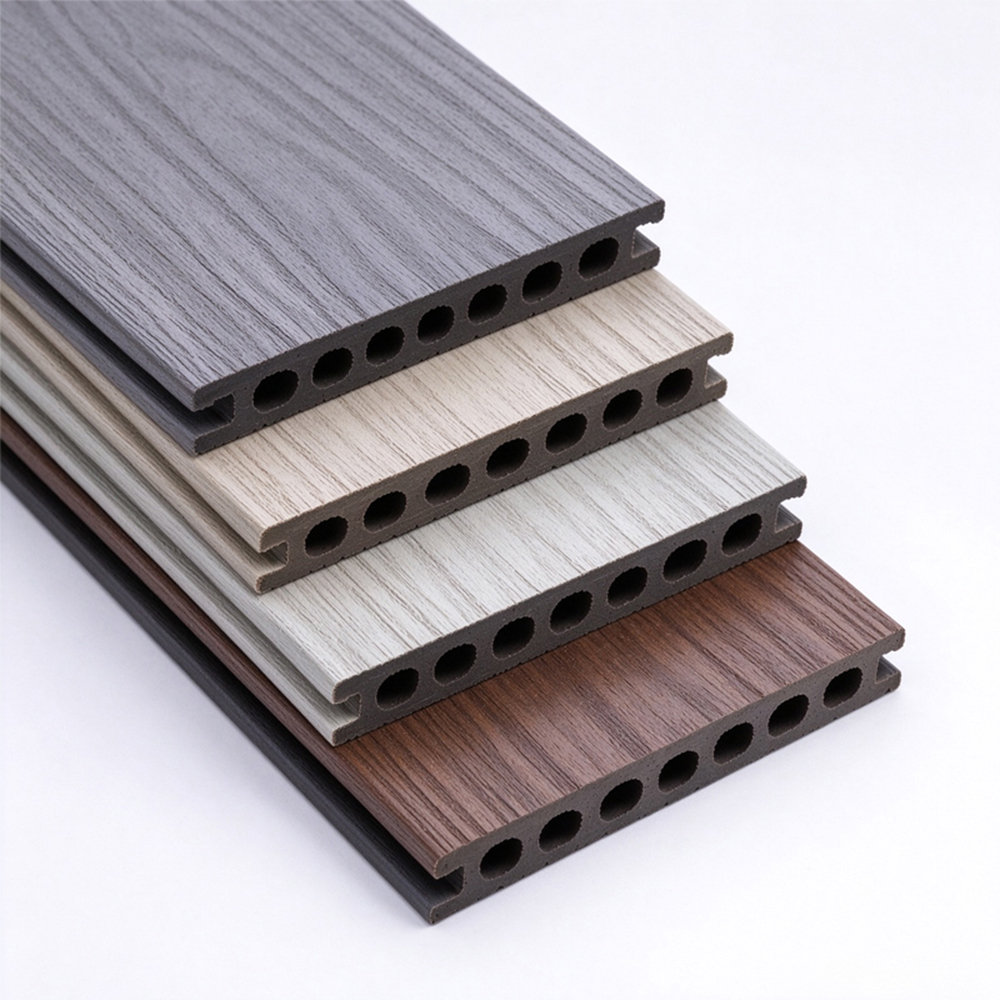
This series of PE/PP wood-plastic composite extrusion lines adopts SJZ65, SJZ72, and SJZ80 conical twin-screw main extruders, with screw specifications of 65/132, 72/152, and 80/162 mm respectively. The main motor power ranges from 37 to 75 kW, and the hourly output capacity is 160–350 kg/h. The equipment is specially designed for wood-plastic composite production of outdoor flooring, fences, and industrial profiles.
Our SJZ series conical twin-screw extruders (SJZ65, SJZ72, SJZ80) are specially designed for PE/PP wood-plastic composite (WPC) production. They are widely used in manufacturing:
WPC flooring & decking (outdoor terraces, garden paths)
WPC fences & railings (privacy screens, balcony railings)
WPC pallets & industrial profiles (moisture-resistant logistics solutions)
Automotive interior parts (wood-fiber reinforced panels)
Real case: A Malaysian customer uses an SJZ80 with a 75 kW main motor to produce 140 mm × 25 mm hollow decking boards, achieving an output of 280–320 kg/h while maintaining a smooth surface and high flexural strength with an 18% wood powder content (80 mesh).
|
Feature |
Advantage |
|
Conical twin-screw design (e.g., SJZ65: 65/132 mm) |
Larger feeding section ensures stable entry of high-bulk-density wood powder (filler up to 40%), preventing bridging. |
|
High-torque gearbox |
Handles sudden load changes caused by unstable moisture content in wood powder. |
|
Energy-saving motors (37/45/75 kW) |
SJZ65 consumes only 0.18–0.23 kWh per kg output, reducing production cost by ~15% compared to parallel twin-screw extruders. |
|
Wide output range (SJZ72: 120–300 kg/h) |
Flexible production from thin-walled profiles (low output) to thick beams (high output). |
|
Precise temperature control zones (4–6 zones) |
Minimizes wood charring; typical setting: 170–190°C for PE-WPC. |
Real-case advantage: A Turkish customer replaced their single-screw line with an SJZ72 and reduced scrap rate from 12% to 3% due to better melt uniformity.
Each extruder is shipped after following ISO 9001:2015 procedures:
a) Raw material & component inspection
Screw elements (65/132, 72/152, 80/162) – 100% hardness test (HRC 58–62) and alloy composition analysis.
Barrel liners – bimetallic centrifugal cast, inspected for porosity.
b) Assembly stage inspection
Screw-barrel clearance: measured with laser micrometer – 0.18–0.28 mm for SJZ65, 0.22–0.32 mm for SJZ80.
Heating/cooling system test: temperature deviation ≤ ±2°C after each heating band stabilizes for 30 minutes.
c) Performance test (using actual PE/PP + 30% wood powder)
No-load torque test: run at 80% of rated motor power (e.g., 60 kW for SJZ80) for 2 hours – oil temperature rise ≤ 40°C.
Output verification: e.g., SJZ65 must achieve ≥160 kg/h for 40×20 mm WPC strips.
Melt pressure fluctuation: ≤ ±3 MPa over 10 minutes (monitored by pressure sensor).
d) Final product quality check
Density test: target 1.2–1.4 g/cm³ for PE-WPC (ASTM D792).
Water absorption after 24h immersion ≤ 1.5%.
Surface gloss and wood fiber distribution observed under 50× microscope.
Real-case QC: Before shipping to a German customer, we ran the SJZ72 continuously for 48 hours producing 150×25 mm decking boards – it passed the TÜV-certified anti-sagging test (deflection 0.8 mm under 100 kg load at 80°C).
|
Model
|
SJZ65
|
SJZ72
|
SJZ80
|
|
Screw specifications(mm)
|
65/132
|
72/152
|
80/162
|
|
Power of main motor(kw)
|
37
|
45
|
75
|
|
Output(kg/h)
|
160~200
|
120~300
|
220~350
|
Q1: Why does the SJZ72 show 120–300 kg/h while the SJZ65 shows 160–200 kg/h? Isn't the SJZ72 larger?
A1: The lower end (120 kg/h) applies to high-filler (50% wood powder) or heavy calcium carbonate formulations that require lower screw speeds (8–12 rpm). For standard 30% wood powder (80 mesh), the SJZ72 can reach 250–300 kg/h. The SJZ65 is optimized for lower filler ratios (20–30%) and typically runs at higher speeds (15–20 rpm). Therefore the SJZ72 actually offers a wider processing window – you can run both thin-walled profiles (low output) and large beams (high output).
Q2: What is the maximum possible wood powder content?
A2: With our conical screw geometry, the SJZ series can handle up to 60% wood powder (100 mesh) in PP-WPC, but for stable output and surface finish we recommend 30–45%. Above 50%, you may need a side feeder.
Q3: How often should the screws be recoated?
A3: For regular PE-WPC (30% wood powder), inspect the flights after 4000–5000 operating hours. Our screws are nitrided (depth 0.4–0.6 mm). Each machine comes with a wear measurement gauge.
Q4: Can I use recycled PP/PE?
A4: Yes – but ensure the melt flow index (MFI) > 3 g/10min (230°C/2.16kg). For recycled materials, we recommend installing a melt filter (optional) to avoid contaminants.
Q5: How to avoid "burn marks" on the profile surface?
A5: Burn marks come from local overheating. Set your barrel zones to a "descending" curve: 185°C (zone 1) → 175°C (zone 2) → 165°C (zone 3) → 160°C (die). Also ensure wood powder moisture content < 3% – wet powder produces steam explosions that look like burn marks.




Pipe Extrusion Production Line
Plastic Shredder Crusher Machine

Tel: +86-19057068112

E-mail: [email protected]

Company Address
No. 128 Qingfeng Road, Xieqiao Town, Haining City, Jiaxing City, Zhejiang Province

19057068112

 English
 русский