
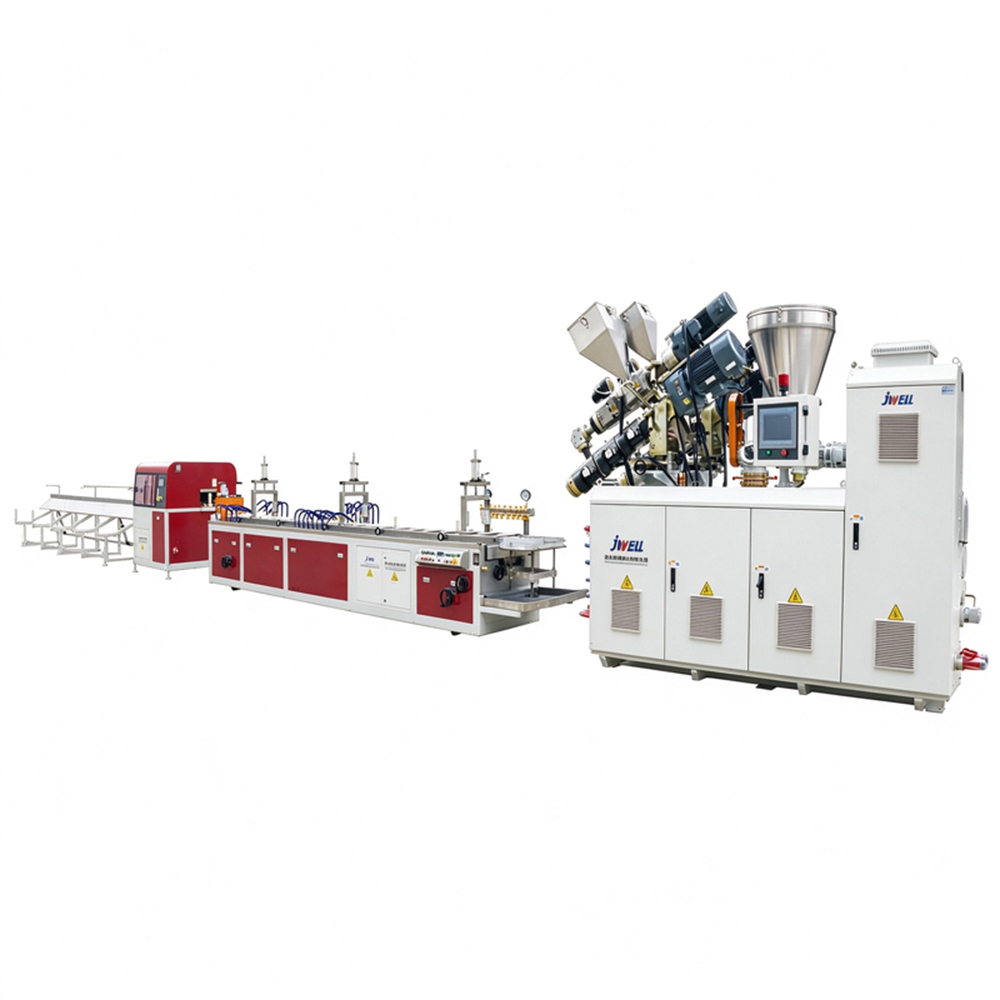
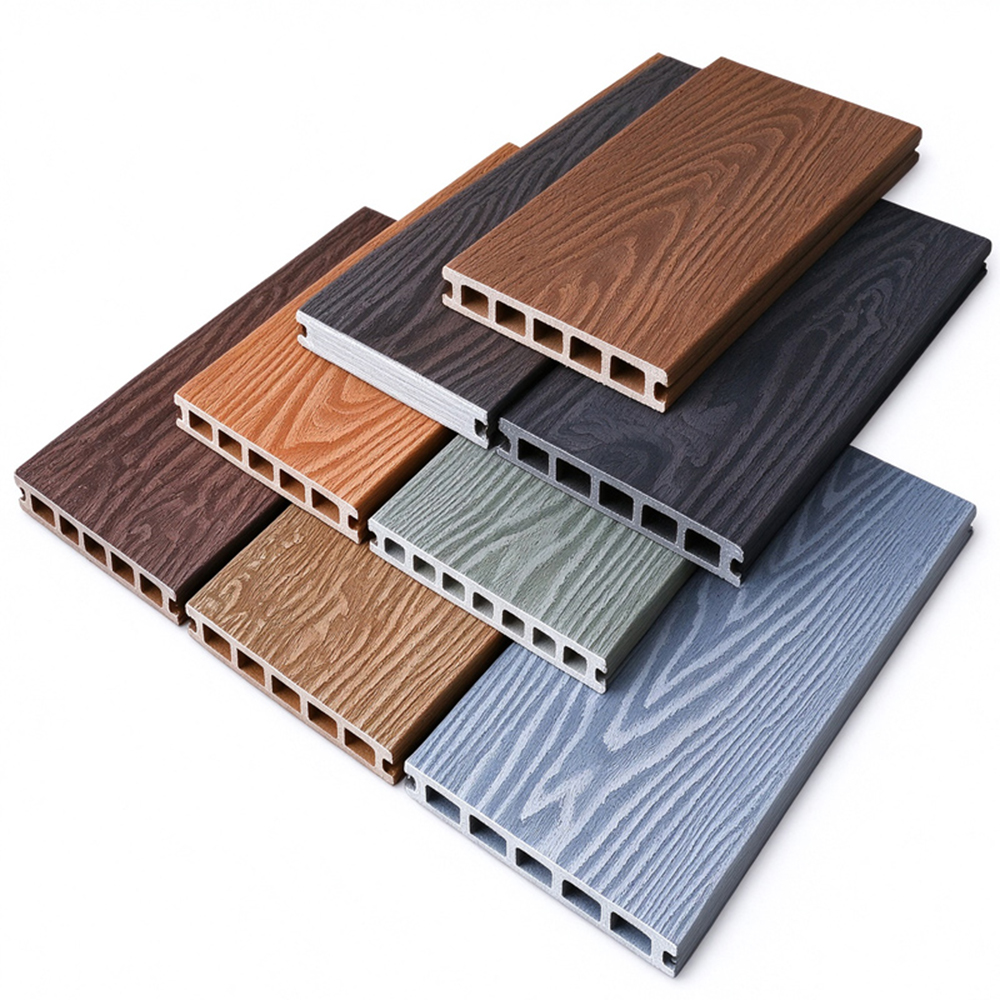
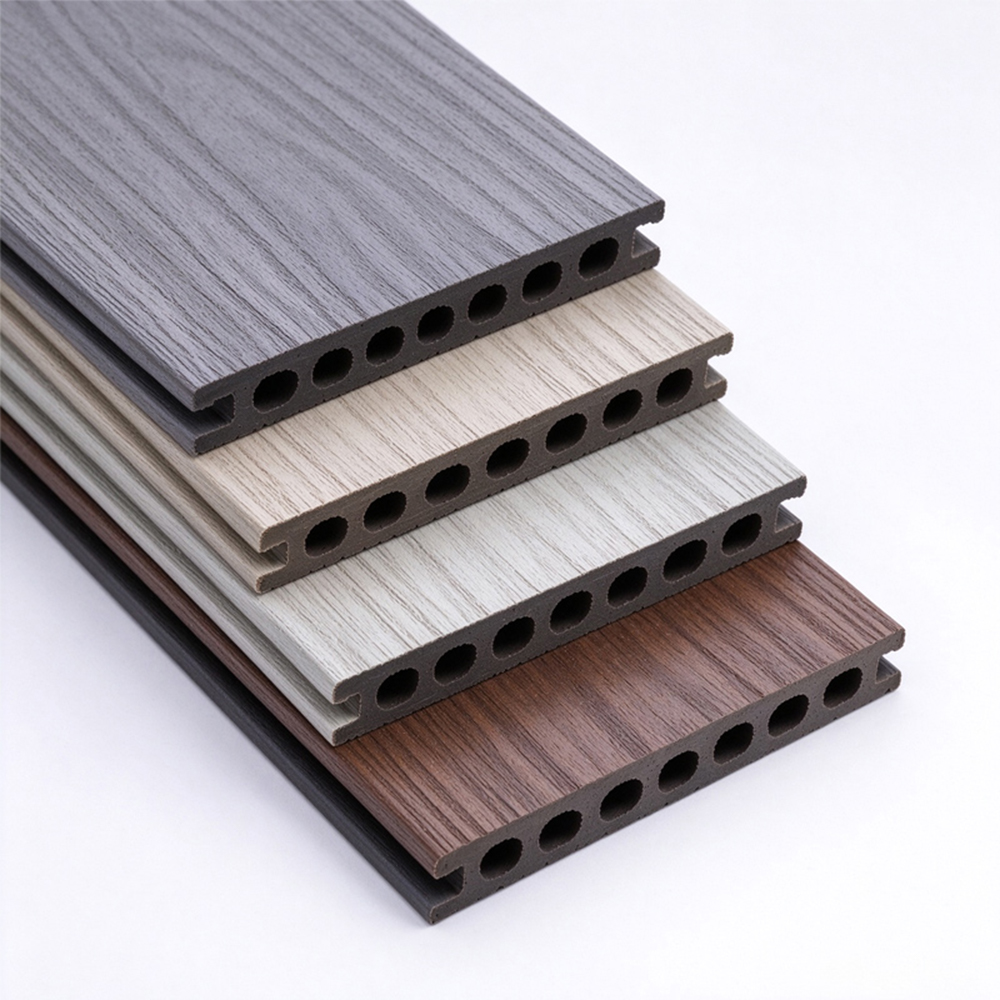
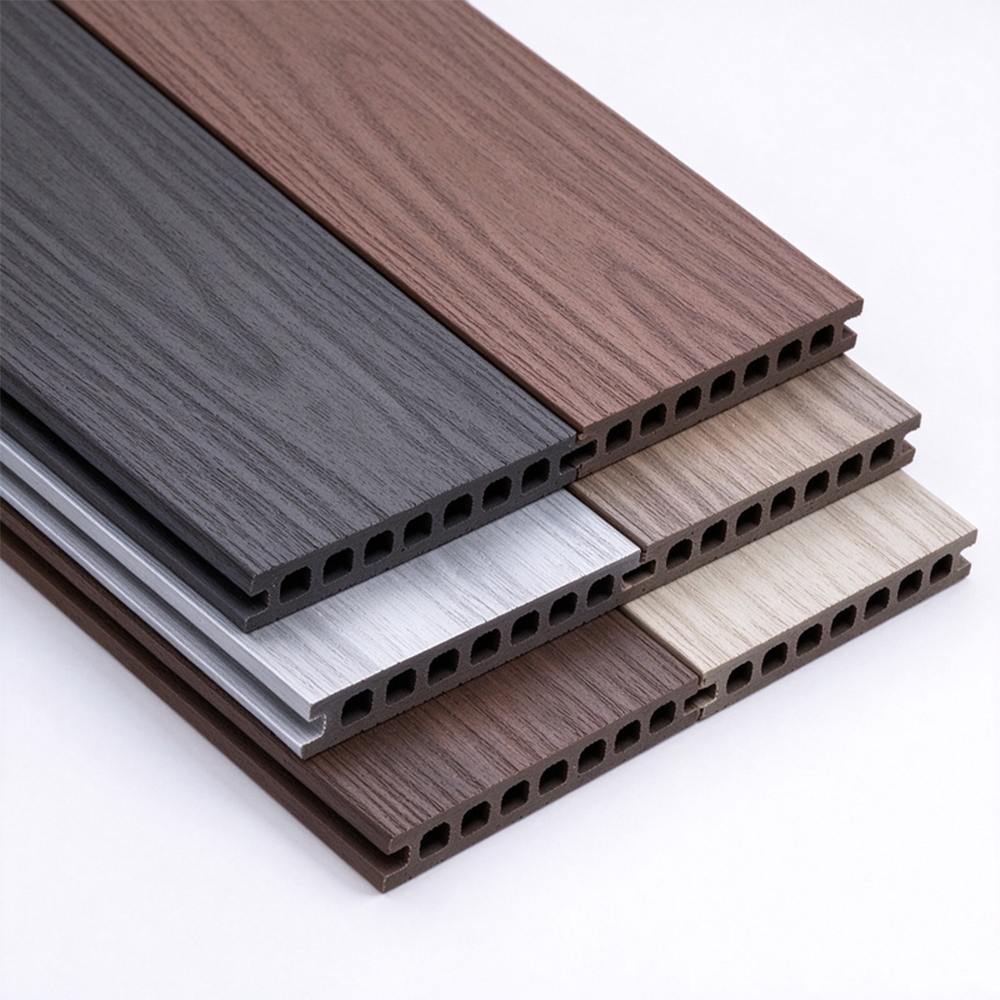
This series of PE/PP wood-plastic extrusion lines uses SJZ65/72/80 conical twin-screw extruders, with screw specifications of 65/132mm, 72/152mm, and 80/162mm respectively, main motor power 37–75 kW, and production capacity 120–350 kg/h. The equipment is specifically designed for compounding wood powder and plastics, suitable for outdoor decking, railings, pallets, and other products.
Our SJZ series conical twin-screw extruders (SJZ65, SJZ72, SJZ80) are specially designed for PE/PP wood-plastic composite (WPC) profiles. Unlike ordinary extruders, the conical screw design ensures uniform mixing of wood fiber (40–70%) and thermoplastic resin.
Typical finished products include:
Decking and railings (solid or hollow profiles) – e.g., a Spanish customer uses the SJZ80 to produce 140×25mm decking at 350 kg/h.
Outdoor furniture (benches, planters) – a French garden brand uses the SJZ72 to produce hollow seats at 250–300 kg/h.
Automotive interior parts (PP+wood fiber) – low-density, high-strength panels.
Construction formwork and pallets – replace plywood with reusable WPC.
Parameter-based selection guide:
|
Model |
Screw specification |
Motor power |
Output (kg/h) |
Best suitable scenario |
|
SJZ65 |
65/132mm |
37 kW |
160–200 |
Small profiles, R&D lines, small-batch custom parts |
|
SJZ72 |
72/152mm |
45 kW |
120–300 |
Medium decking, window frames (flexible output range) |
|
SJZ80 |
80/162mm |
75 kW |
220–350 |
High-volume production of thick decking, large pallets |
Real case: A Turkish WPC plant replaced two single-screw lines with one SJZ80 – output doubled to 340 kg/h, while wood fiber burning defects were reduced by 90%.
Low speed, high torque
Conical screws (e.g., 65/132mm) achieve gradual material compression. Specific energy consumption is 15–20% lower than parallel twin-screws – your 37 kW SJZ65 outputs the same as a 55 kW single-screw machine.
Wide processing window
The SJZ72’s output range (120–300 kg/h) remains stable even when wood fiber moisture content varies (8–12%). No need to stop for recipe adjustment.
Lower screw wear
Screw material: bimetal coating + segmented design. Our customer in Vietnam ran an SJZ80 continuously for 8,000 hours without screw replacement (processing 45% pine fiber + 55% recycled PP).
Compact footprint
SJZ65 line length <12 meters – perfect for workshop expansion without building newfactory buildings.
Each extrusion line undergoes four mandatory inspection stages before shipment:
Stage 1 – Component inspection (incoming)
Screws and barrels: laser measured runout ≤0.02mm.
Heating/cooling zones: thermocouple accuracy ±1°C.
Stage 2 – No-load test (after assembly)
Run at 120% of maximum screw speed for 2 hours.
Gearbox oil temperature stable below 65°C (standard ≤70°C).
Stage 3 – Load test with actual WPC formulation
We use a standard formulation: 60% wood powder (80 mesh) + 35% recycled PP + 5% coupling agent.
Test duration: 4 consecutive hours.
Pass criteria:
Output fluctuation < ±5% of rated value (e.g., SJZ80 stable at 330–350 kg/h).
Melt pressure fluctuation < ±1.5 MPa.
No die drool or wood fiber burn spots.
Stage 4 – Profile quality inspection
Cut 10 samples every 30 minutes – measure density (target 1.25–1.35 g/cm³) and flexural modulus (≥25 MPa for decking).
Water absorption test (24h immersion): ≤1.5%.
Real case: Before delivery to a UK customer, one SJZ72 line failed initial load test due to unstable output dropping from 280 to 210 kg/h. We replaced the feeding screw and added a gravimetric feeder – then passed at 295±3 kg/h.
|
Model
|
SJZ65
|
SJZ72
|
SJZ80
|
|
mm
|
65/132
|
72/152
|
80/162
|
|
Power of main motor (kw)
|
37
|
45
|
75
|
|
Output (kg/h)
|
160~200
|
120~300
|
220~350
|
Q1: Why does my SJZ65 sometimes drop from 200 kg/h to 140 kg/h?
A: Likely bridging in the hopper. Wood powder with >12% moisture sticks to the hopper wall. Solutions: add a vibratory feeder or pre-dry wood fiber to 6–8%. A Brazilian customer fixed this by installing a rotating scraper inside the hopper – output stabilized at 190–200 kg/h.
Q2: Can I use 100% recycled plastic (e.g., shredded PP woven bags)?
A: Yes, but install a melt filter before the die. Recycled PP contains aluminum or paper residues. Our SJZ72 line with a 120-mesh screen changer produces clean profiles at 250 kg/h. Without filtration, die clogging could occur every 2 hours.
Q3: The SJZ72 spec sheet says 120–300 kg/h. Why such a wide range?
A: Output depends on wood fiber content.
Low wood fiber (40% wood + 60% PP) → up to 300 kg/h.
High wood fiber (70% wood + 30% PP) → approx. 120–150 kg/h (higher viscosity).
This flexibility is a design advantage, not a defect. If you consistently run high-wood-fiber formulations, choose the SJZ80.
Q4: For PP + wood fiber, how often should I replace screw elements?
A: With our nitrided steel + tungsten carbide coating:
SJZ65: 6,000–8,000 hours (for moderately abrasive materials like rice hulls).
SJZ80: 8,000–10,000 hours (pine fiber).
Case: A Canadian customer extruded 70% maple fiber on an SJZ72 and replaced screws after 7,200 hours – still usable, but output had dropped 12%.
Q5: Does your warranty cover wear parts?
A: Standard warranty: 12 months for electrical/mechanical defects. Screws/barrels are wear parts – we provide lifetime technical support and offer replacement parts at cost +15%. Many Chinese suppliers charge double; we keep stock for SJZ65/72/80.
Q6: How long does a screw last when processing PP+wood powder?
A: With nitrided steel + tungsten carbide coating: SJZ65 approx. 6,000–8,000 hours, SJZ80 approx. 8,000–10,000 hours. In a real case, a Canadian customer processing 70% maple fiber saw 12% output drop after 7,200 hours before replacement.
Q7: The SJZ72 rated output is 120–300 kg/h – why such a wide range?
A: Output depends on wood powder addition. At 40% wood powder content, output approaches 300 kg/h; at 70% content, output drops to about 120–150 kg/h due to higher viscosity. This is a design advantage allowing flexible adaptation to different formulations.




Pipe Extrusion Production Line
Plastic Shredder Crusher Machine

Tel: +86-19057068112

E-mail: [email protected]

Company Address
No. 128 Qingfeng Road, Xieqiao Town, Haining City, Jiaxing City, Zhejiang Province

19057068112

 English
 русский