
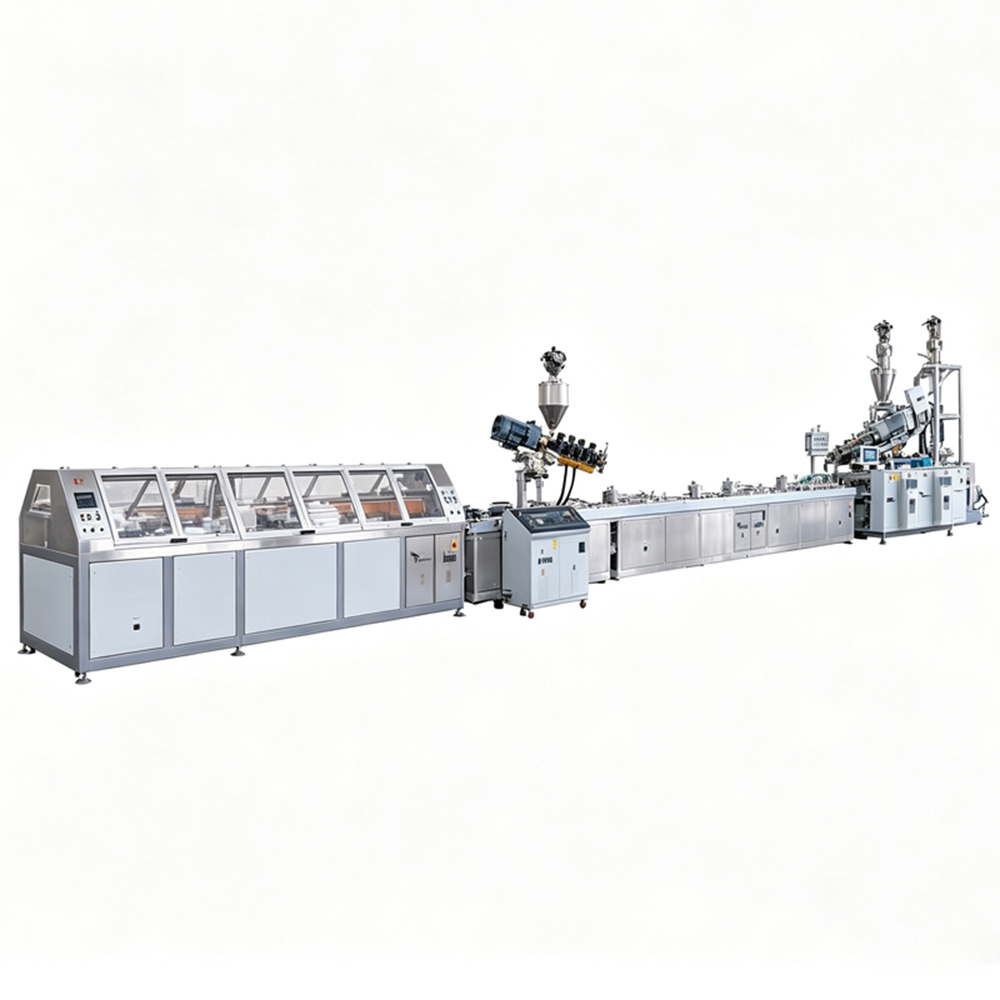
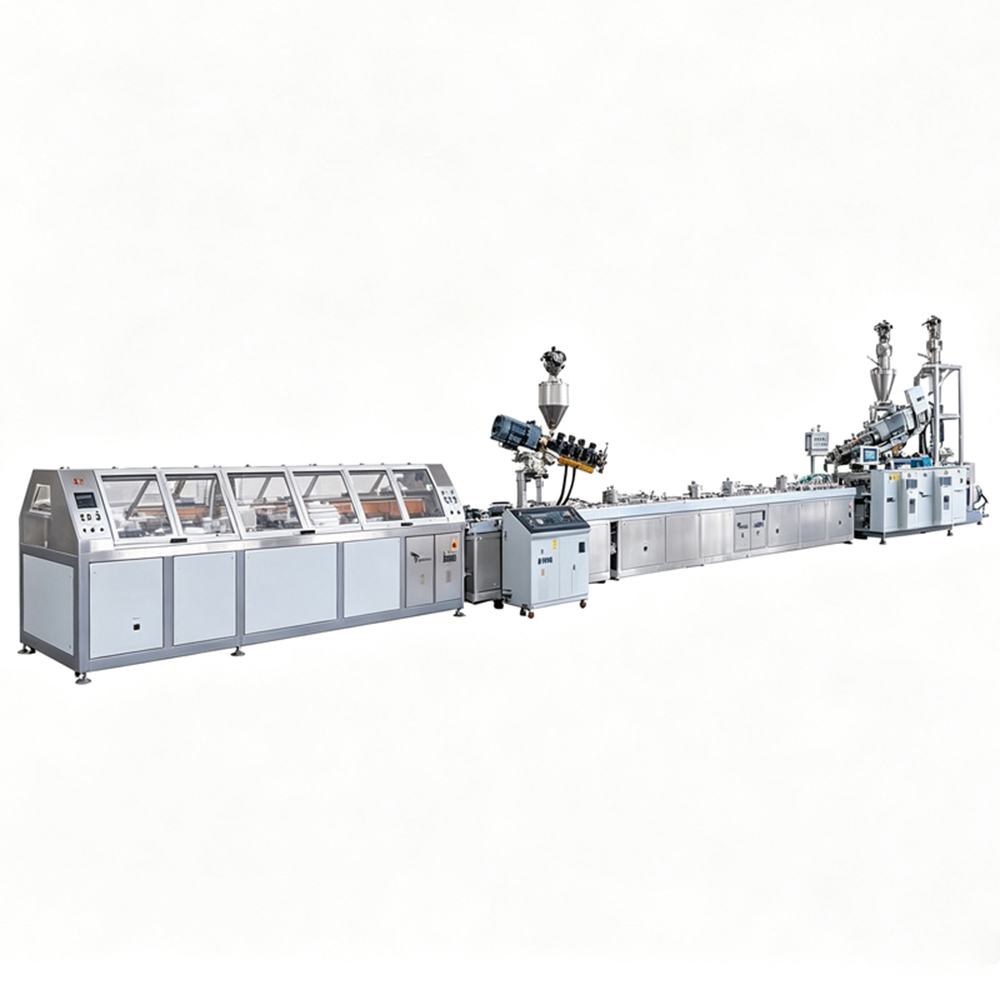
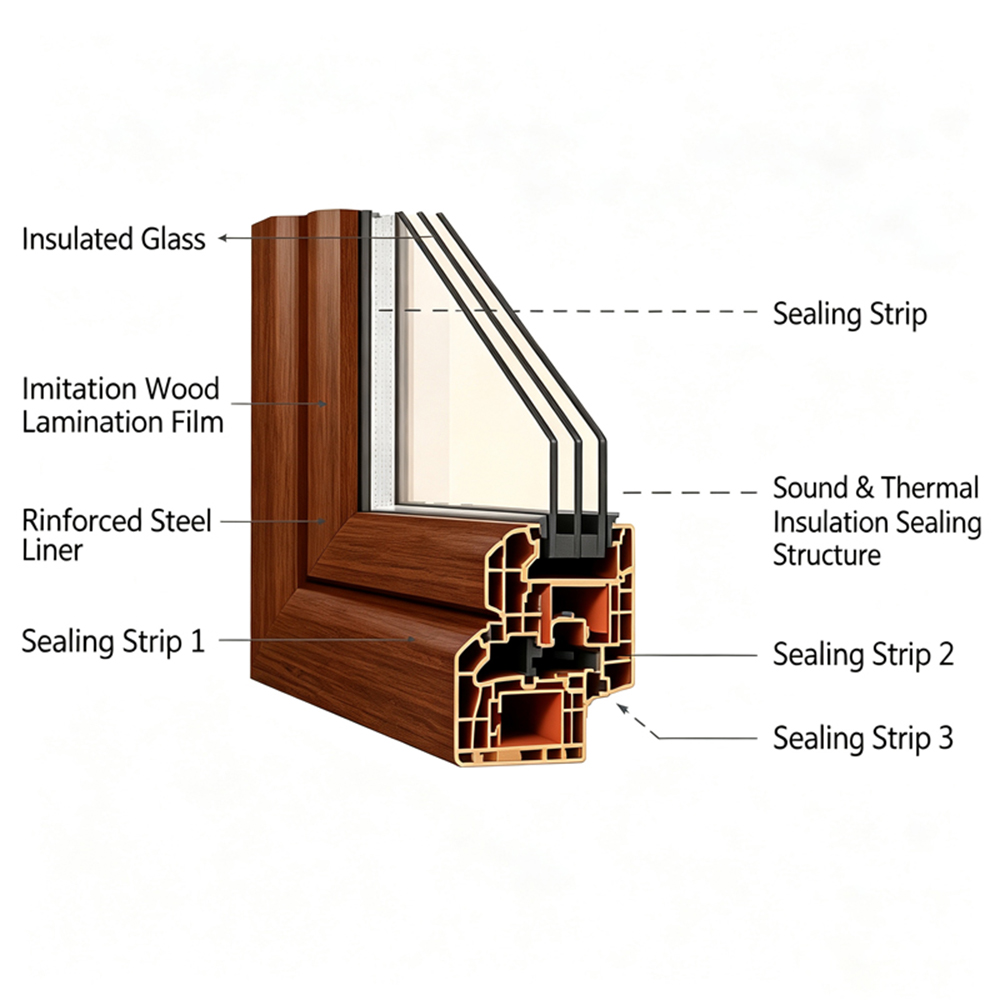
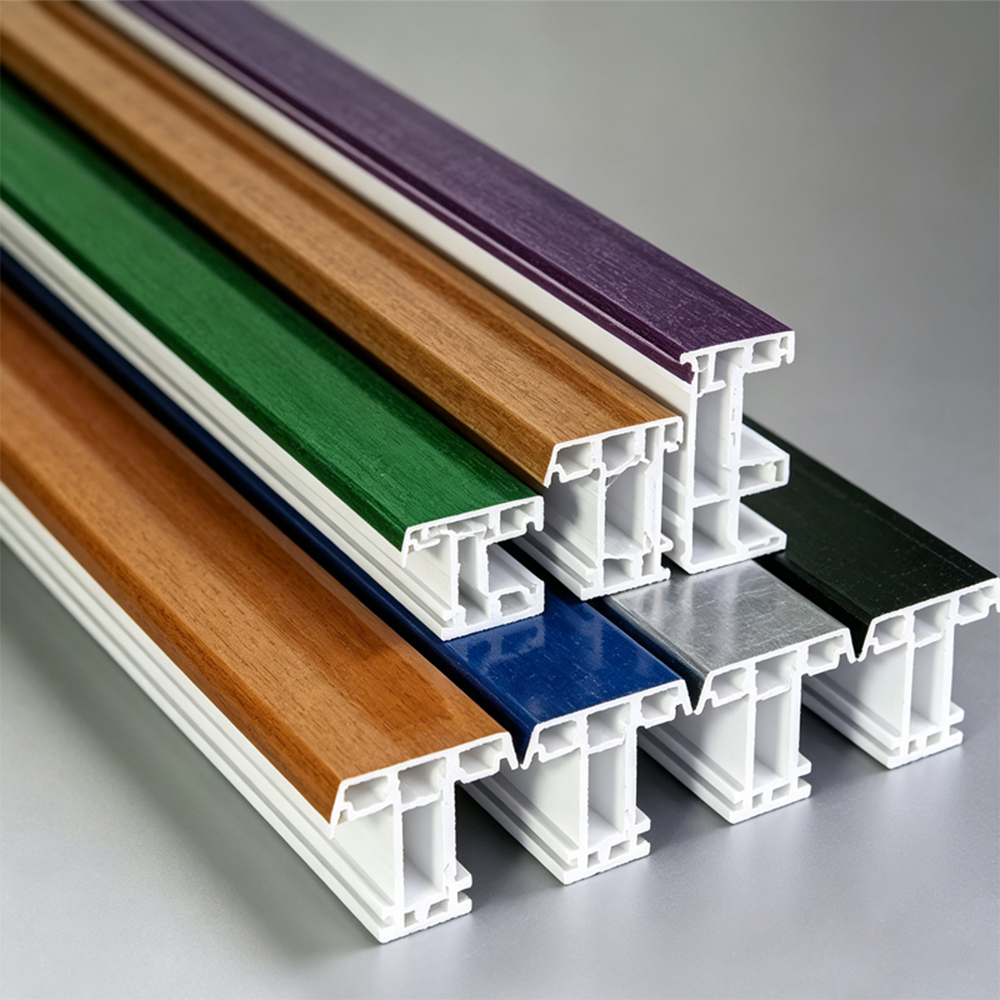
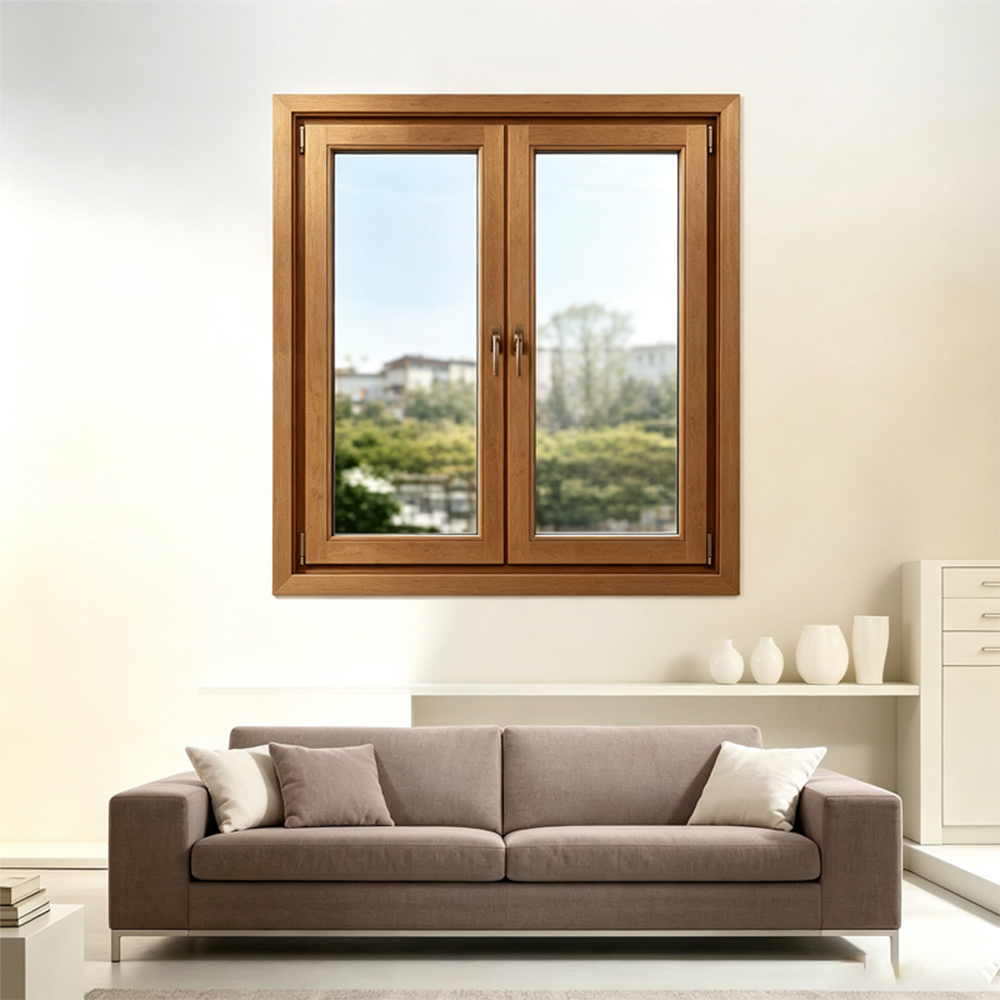
This PVC high-speed profile extrusion line is suitable for the production of window & door frames, cable ducts, decorative strips, and other profiles. The main motor power ranges from 37 to 75 kW, with a maximum output of 150–500 kg/h. Cooling water consumption is only 7–10 m³/h, offering low energy consumption. The complete machine has passed continuous full-load testing and operates stably.
Our PVC high-speed profile extrusion lines (models YF240, YF240A, and SJZ series) are specifically designed for continuous, high-output production of rigid PVC profiles. Typical finished products include:
Window & door frames (casement, sliding, tilt & turn)
Cable trays and ducts
Wall panel decorative strips, skirting boards, and decorative lines
Fencing and railing profiles
Real-world case: A Southeast Asian window profile manufacturer uses a YF240 line equipped with an SJF75/28 extruder, processing 150–250 kg/h to produce profiles up to 240 mm wide. For dual-line production (e.g., producing two 150 mm profiles simultaneously), the YF240A line with an SJF110/28 extruder can achieve 400–500 kg/h, effectively doubling output without increasing floor space.
The SJZ55/110, SJZ65/132, and SJZ80/156 conical twin-screw extruders are specially designed for PVC powder compounds, offering better plasticization and thermal stability than single-screw machines.
|
Feature |
Technical basis |
User benefit |
|
High output & stability |
Max output: 150–500 kg/h (YF series); SJZ80/156: 300–400 kg/h |
Shorter production cycles, faster ROI |
|
Energy saving power |
Main motor: 37–75 kW (YF); SJZ65/132 uses 37/30 kW |
Low electricity cost per kg |
|
Low utility consumption |
Cooling water: 7–10 m³/h; Compressed air: 0.6–0.8 m³/min |
Reduced operating costs |
|
Compact dual-line option |
YF240A: 150*2 mm width |
Produce two profiles simultaneously – ideal for small cross-section products like pipe clips or small ducts |
|
Standardized center height |
All SJZ models: 1050 mm center height |
Easy integration with existing haul-offs, saws, and stacking racks |
|
Heavy-duty construction |
SJZ80/156 net weight: 5500 kg |
Vibration-free operation even at max screw speed (34.7 rpm) |
Real-world advantage case: A PVC gutter factory in Eastern Europe replaced an old 80 mm single screw line with an SJZ65/132 (180–250 kg/h). Thanks to better melt uniformity from the conical twin screw design, they reduced energy consumption by 18% and scrap rate from 5% to 2.3%.
We follow a four-stage QC protocol to ensure each extrusion line complies with ISO and CE standards.
Stage 1 – Component inspection
Hardness test of screw and barrel (HRC 55–60 after nitriding)
Heater band temperature distribution check (±1°C)
Stage 2 – Idle and no-load test
Extruder runs at 34.7 rpm (SJZ series) for 2 hours without load
Measure vibration (≤0.05 mm/s), main motor current stability, and gearbox oil temperature rise (≤40°C)
Stage 3 – Loaded extrusion trial (using real PVC dry blend)
Test parameters for YF240 with SJF75/28:
Set temperature: 180°C–200°C from feed zone to die
Extrusion speed gradually increased to maximum 250 kg/h
Check profile dimensions every 15 minutes (critical wall thickness tolerance ±0.1 mm)
Measure wall thickness using ultrasonic thickness gauge (min. 1.2 mm for window frames)
For dual-line YF240A:
Ensure independent melt pressure control (pressure fluctuation <3% between the two lines)
Cut samples from both lines – both must pass the same impact test (drop hammer: 1 kg from 1 m height, no cracks)
Stage 4 – Post-extrusion tests
Heat shrinkage test (100°C oven, 30 min) – shrinkage <2%
Vicat softening temperature (≥80°C for indoor profiles, ≥75°C for outdoor profiles)
Impact resistance (Charpy method: 8–15 kJ/m² depending on application)
All test data is recorded in traceable logs. Before shipment, the line must run at rated output for 4 continuous hours without any fault.
| Model | YF240 | YF240 | YF240A |
| Production width(mm) | 240 | 240 | 150*2 |
| Extruder model | SJP75/28 | SJP93/28/31 | SJP110/28 |
| Max of extrusion capacity(Kg/h) | 150-250 | 250-400 | 400-500 |
| Extruder power(Kw) | 37 | 55 | 75 |
| Cooling water(m³/h) | 7 | 8 | 10 |
| Compressor air(m³/min) | 0.6 | 0.6 | 0.8 |
| Note: The specifications are subject to change without prior notice. | |||
| Model | SJZ55/110 | SJZ65/132 | SJZ80/156 |
| Screw speed(rpm) | 34.7 | 34.7 | 34.7 |
| Motor power(Kw) | 22 | 37/30 | 55 |
| Production capacity(Kg/h) | 100/150 | 180/250 | 300/400 |
| Center height(mm) | 1050 | 1050 | 1050 |
| Net weight(Kg) | 3500 | 4000 | 5500 |
| Note: The specifications are subject to change without prior notice. | |||
Q1: What is the difference between YF240 and YF240A?
YF240: Single line, max width 240 mm, uses SJF75/28 extruder (37 kW) – best for standard window frame profiles.
YF240A: Dual line, each line max width 150 mm (total combined width 300 mm), uses SJF110/28 (75 kW) – suitable for small profiles requiring double output.
Q2: Can the SJZ65/132 run recycled PVC?
Yes, but with caution. The conical twin-screw provides good mixing. However, recyclate should be pre-screened (impurities <1 mm) and blended with 30–50% virgin powder. Expect 15–20% lower output compared to virgin (about 200 kg/h instead of 250 kg/h). Clean the screws every 200 hours when using high amounts of recyclate
Q3: How often should the screw and barrel be replaced?
Under normal conditions (CaCO₃ addition ≤15 phr, proper temperature control), the nitrided screw/barrel have a service life of 8,000–10,000 hours. For an SJZ80/156 running at full 400 kg/h, inspect once a year. Wear limit: screw flight height reduction >0.5 mm.
Q4: What water quality is required for cooling water?
Soft water or closed-loop deionized water is strongly recommended. Hard water (CaCO₃ >200 ppm) will cause scale deposits in cooling channels – the YF240 requires 7 m³/h water flow; scaling reduces heat exchange efficiency and leads to melt temperature spikes. If local water is hard, use a water treatment unit.
Q5: My YF240 line shows unstable profile width. What should I check?
First, check compressed air supply: YF240 requires 0.6 m³/min at 6–8 bar. Insufficient air pressure causes uneven calibration cooling.
Second, measure melt temperature at die exit – if >215°C, the PVC degrades and expands unevenly. Reduce barrel temperature by 5°C.
Finally, check for slipping of the haul-off rubber belts (common after 1,500 operating hours). Replace if hardness <60 Shore A.
Q6: Can I later upgrade from an SJZ55/110 to an SJZ65/132?
Mechanically yes, but you must replace the adapter plate and die head because the screw diameter and flange are different. The downstream haul-off and cutter of the SJZ55/110 (max 150 kg/h) are undersized for the SJZ65/132 (250 kg/h) – you will also need to upgrade the cooling tank length (+2 m) and cutter motor power.




Pipe Extrusion Production Line
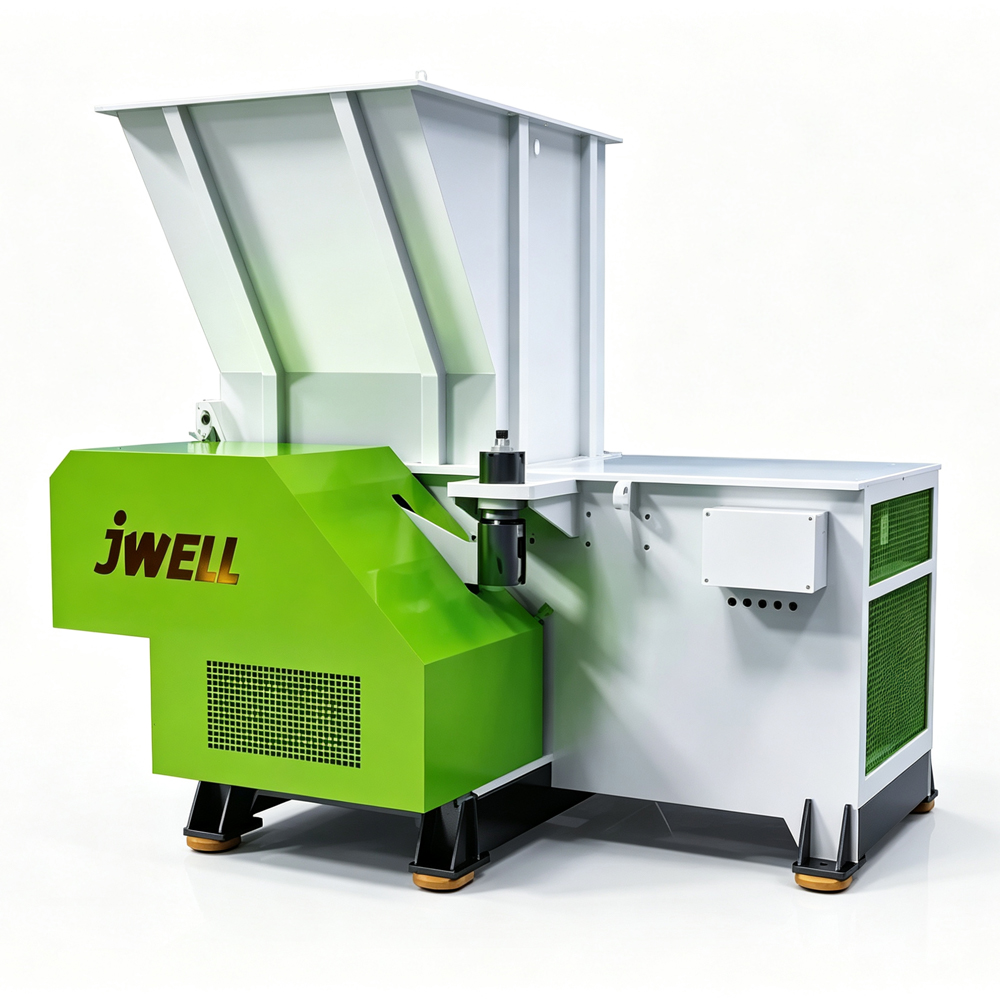
Plastic Shredder Crusher Machine

Tel: +86-19057068112

E-mail: [email protected]

Company Address
No. 128 Qingfeng Road, Xieqiao Town, Haining City, Jiaxing City, Zhejiang Province

19057068112

 English
 русский