
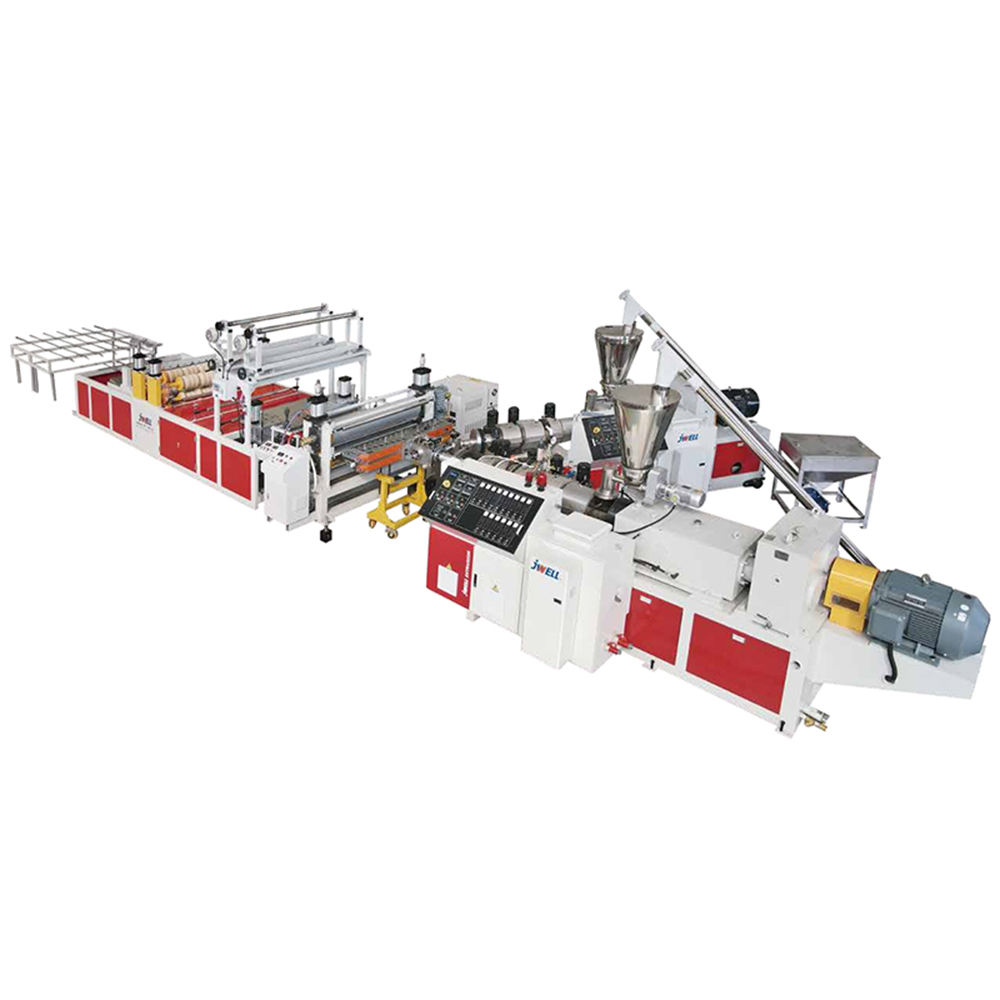
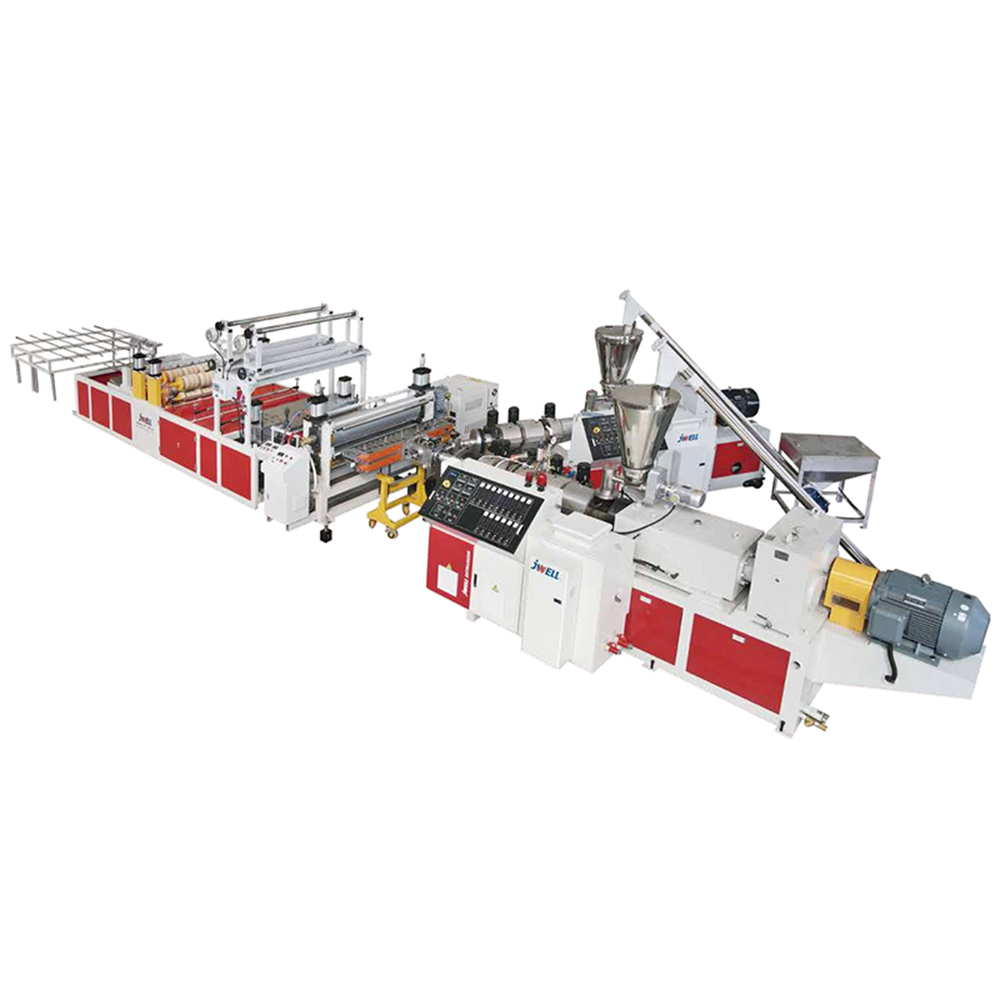
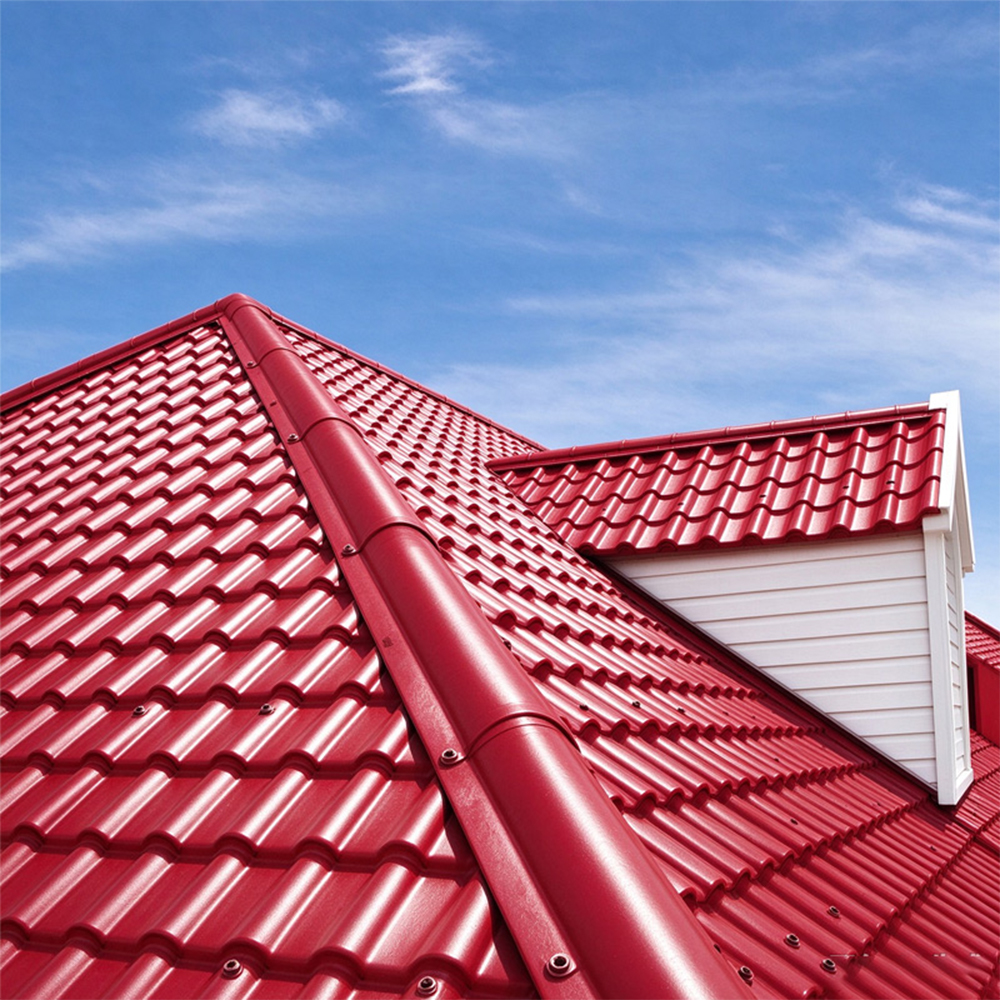
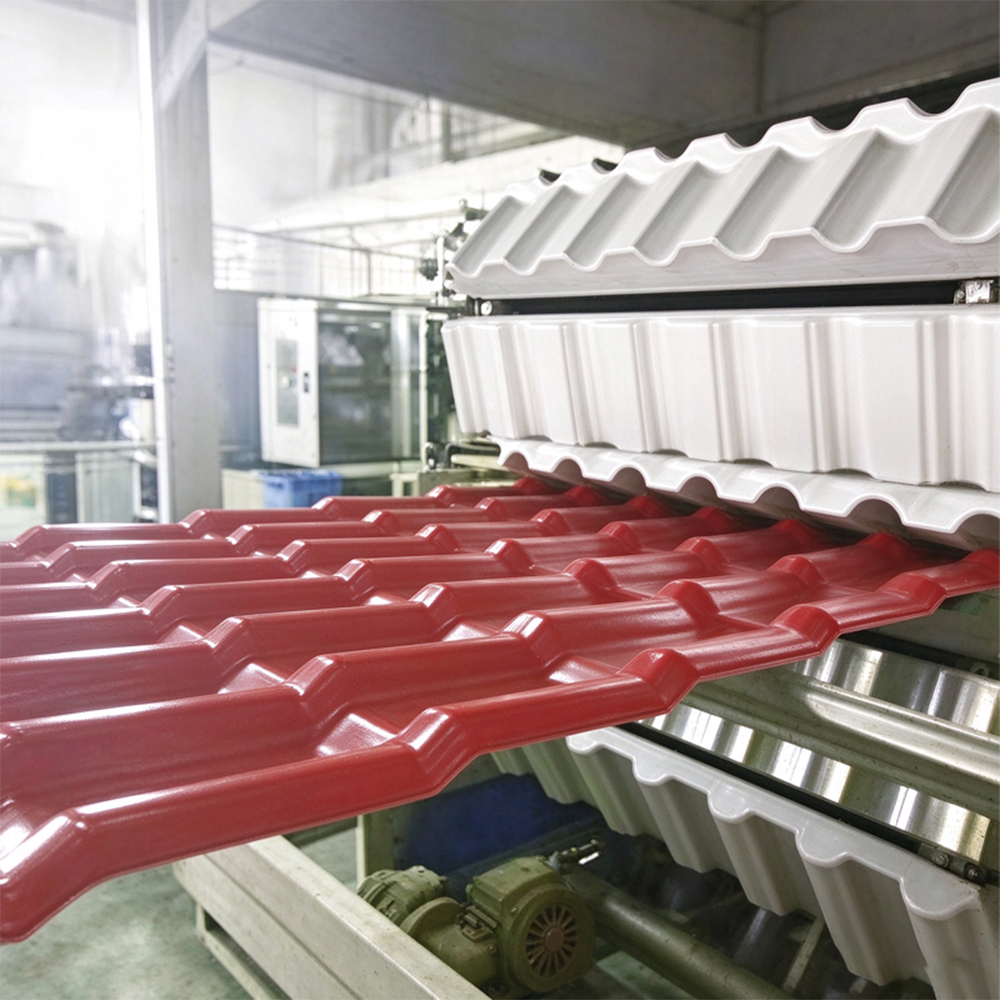
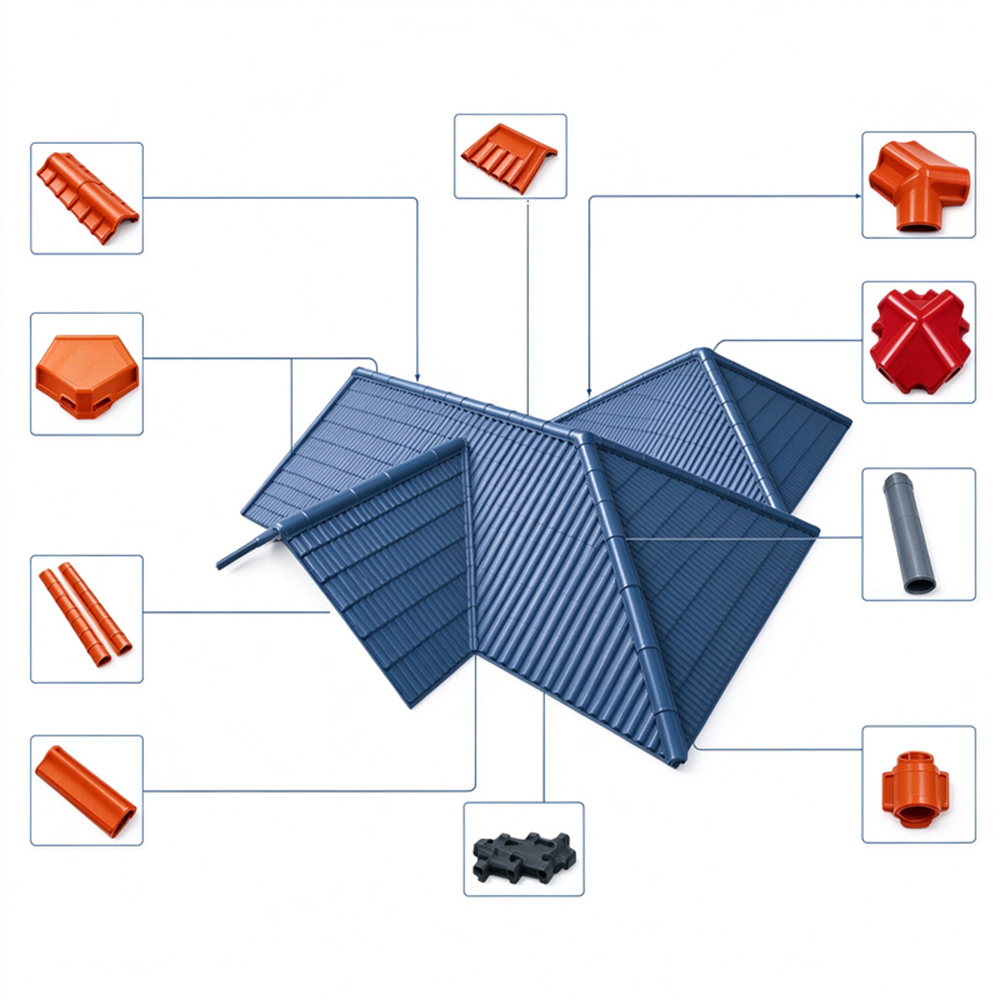
This extrusion line is specifically designed for producing PVC single-layer or multi-layer insulated corrugated sheets and Roman tiles. Based on conical twin-screw technology, the three models feature main motor powers of 55kW, 55kW, and 110kW respectively, with product widths covering 850mm to 1140mm and a maximum extrusion capacity of 600 kg/h. The two-stage drive configuration reduces energy consumption by approximately 22% compared to traditional models, enabling stable processing of recycled materials and composite structures to meet the continuous production demands of roofing building materials.
This extrusion line is specifically used to produce PVC corrugated roof sheets, Roman-style synthetic tiles, and multi-layer insulation boards. According to the technical specifications, different models meet production requirements as follows:
SJZ80/156 & SJZ65/132 (width 1140mm, output 300-400 kg/h):
Best suited for large agricultural and industrial roofing. A Vietnamese greenhouse builder uses this line to produce 1.14m wide single-layer corrugated sheets, covering 50,000 m² per month. The wide format reduces the number of overlaps, cutting installation time by 20%.
SJZ80/156 & JW550/30 (width 850mm, output 300-400 kg/h):
Ideal for Roman tiles and decorative wall panels. A Philippine roof tile supplier uses this model to produce multi-layer (air cavity) tiles, achieving 30% better thermal insulation than single-layer sheets. The narrower width ensures perfect interlocking for residential roofing.
SJZ92/188 & JW565/30 (width 880mm, output 400-600 kg/h):
High-output solution for export-oriented factories. A Nigerian customer runs three shifts around the clock, producing 2.0mm thick corrugated sheets at 500 kg/h – enough for 8,000 linear meters per day – supplying a housing project across West Africa.
|
Feature |
Practical Benefit |
|
Two-stage motor configuration (55kW + parallel extruder or JW series) |
Unlike single-screw lines, the conical twin-screw design (SJZ series) provides low-shear, high-torque mixing. The JW series calender delivers uniform melt pressure – zero thickness deviation (±0.05mm) even at 600 kg/h. |
|
Flexible product width (850/880/1140mm) |
One line can switch between Roman tiles (850mm) and flat corrugated sheets (1140mm) by changing the die. A Malaysian customer reported saving $45,000 in dedicated line costs. |
|
Max output 600 kg/h (SJZ92/188) |
Equipped with a 110kW main motor, energy consumption is only 0.18 kWh/kg – 22% lower than conventional lines. For a plant producing 300 tons per month, annual electricity savings reach $6,800. |
|
Multi-layer capability |
Produces A/B/A or A/B structures (e.g., white cap layer + recycled core). A Kenyan recycler uses 40% post-industrial PVC waste in the middle layer, achieving ISO 9001 quality certification while reducing material costs by 18%. |
Each line undergoes a 5-stage QC protocol before shipment. The actual test procedures and measurable standards are as follows:
Stage 1: Component Inspection
Screw/barrel hardness: ≥68 HRC (Rockwell), verified by eddy current testing.
Heating bands: Check for uniform thermal expansion at 200°C – no cold zones allowed.
Stage 2: No-Load & Load Test (at factory)
Parameter validation: Run at full load (55kW/110kW) for 6 hours.
Example: SJZ92/188 must run continuously at 550 kg/h for 4 hours, with motor current fluctuation ≤ ±5%.
Extruder stability: Melt pressure variation ≤ ±1.5 MPa (measured at the die).
Stage 3: Product Dimensional QC
Width accuracy: Laser micrometer – tolerance of ±1mm for 1140mm sheets.
Corrugation height check: Profile gauge every 50 meters – e.g., pitch 30mm ±0.3mm.
Multi-layer adhesion strength: Peel test per ASTM D903 – minimum 3.5 N/mm for A/B layers.
Stage 4: On-Site Commissioning (customer factory)
Material test: Run 2 tons of standard PVC dry blend (CaCO₃ 8 phr, CPE 6 phr).
Record actual output: Must reach ≥95% of nominal capacity (e.g., 380 kg/h for 400 kg/h spec).
Cooling tank calibration: Exit sheet temperature ≤40°C to prevent warping.
Stage 5: Long-Term Reliability
24-hour continuous run test: Line runs non-stop after installation – record parameters every 30 minutes.
Actual case: A Saudi Arabian line showed a 0.5% output drop after 24 hours, well below the 2% tolerance.
| Type | SJZ80/156 & SJZ65/132 | SJZ80/156 & JWS550/30 | SJZ92/188 & JWS65/30 |
| Main motor power | 55kw | 55kw | 110kw |
| Products Width | 1140mm | 850mm | 880mm |
| Capacity (Max.) | 300-400kg/h | 300-400kg/h | 400-600kg/h |
Q1: Can I produce both single-layer and multi-layer sheets on the same line?
A: Yes, all three models support interchangeable dies. For multi-layer production, you need an additional co-extruder (JW series optional).
Example: An Indonesian customer runs SJZ80/156 + JW550/30 – 8 hours producing single-layer (for economy roofing), 8 hours producing A/B/A multi-layer (for premium villa tiles).
Q2: How can I achieve 600 kg/h on the SJZ92/188? My line only reaches 450 kg/h.
A: Check three aspects:
Screw speed – must be 38-42 RPM (do not go higher to avoid melt fracture).
Formulation – increase CPE to 8 phr and external lubricant to 1.2 phr to improve flow.
Feed zone – ensure barrel fill rate at 70% (use starve feeder with input 510-530 kg/h).
Practical fix: A Turkish customer adjusted screw speed from 48 RPM down to 40 RPM and added a gravimetric blender – output jumped from 470 kg/h to 580 kg/h.
Q3: How often do I need to replace the screw and barrel?
A: For non-corrosive PVC formulations (no residual HCl), expect 18-24 months of continuous operation. Signs: output drop >15% or black specks on products.
Case: A Russian winter roofing factory replaced after 26 months (had processed 9,800 tons) – wear depth only 0.25mm, still within the 0.5mm limit.
Q4: The edges of 1140mm wide sheets are warping. What went wrong?
A: Common cause: uneven cooling. Set cooling tank rollers so the center is 0.5mm higher than the edges. Also, check vacuum on the calibrating table – edge zones require 5-10% higher vacuum than the center (e.g., -0.6 bar at edges, -0.55 bar at center).
Solution implemented for a Brazilian customer: added edge cooling fans (2 x 120W) – warpage reduced from 8mm/m to below 2mm/m.
Q5: Can this line use recycled PVC?
A: Yes, but for single-layer sheets recycled content is limited to 30%; for the middle layer of multi-layer sheets, 40-50% is possible. Fines (below 3mm) must be pelletized, and add 2% virgin stabilizer.
Validated: A Colombian roof producer uses 45% post-consumer window frame recyclate in the core layer – still passes UV resistance test (1000h QUV test, ΔE<3).
Q6: Can the same equipment produce both single-layer and multi-layer tiles?
A: Yes. All three models support die changes for production. To achieve a multi-layer structure (e.g., A/B/A three layers), you need to add an additional co-extruder (compatible with JW series).




Pipe Extrusion Production Line
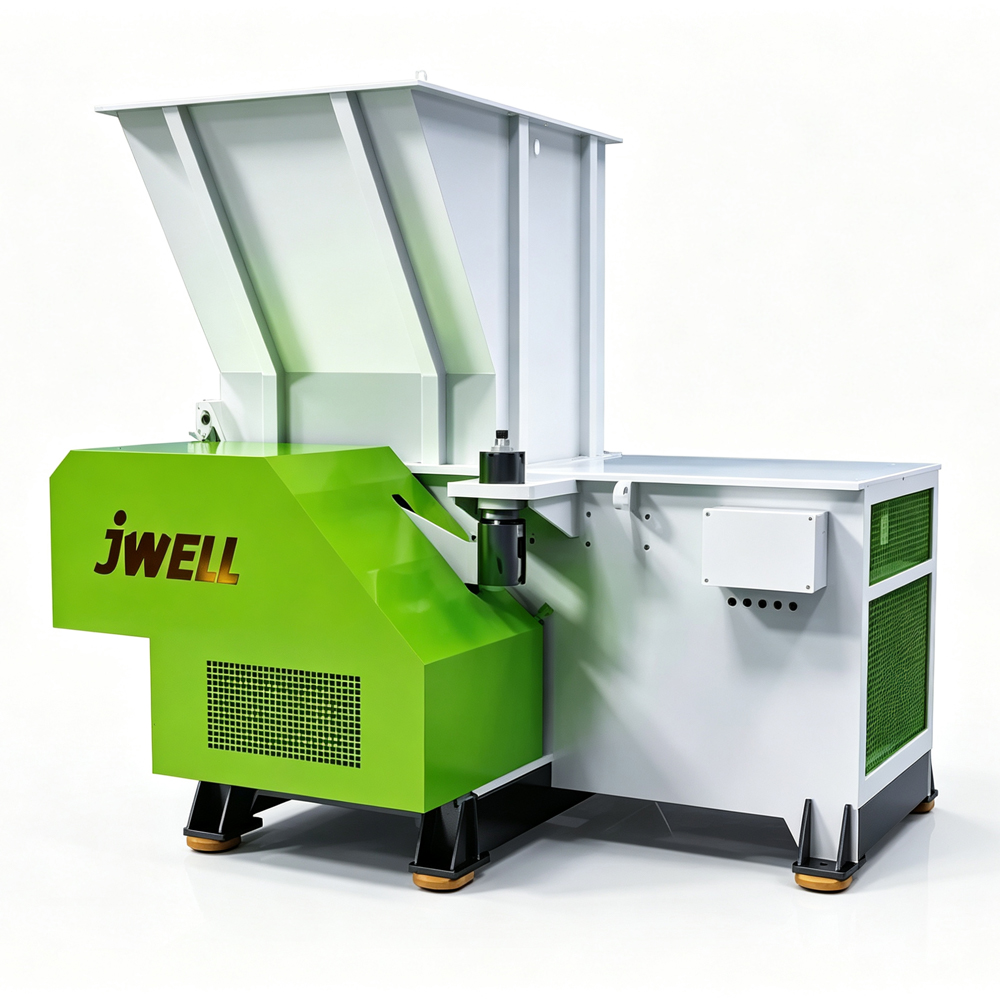
Plastic Shredder Crusher Machine

Tel: +86-19057068112

E-mail: [email protected]

Company Address
No. 128 Qingfeng Road, Xieqiao Town, Haining City, Jiaxing City, Zhejiang Province

19057068112

 English
 русский