
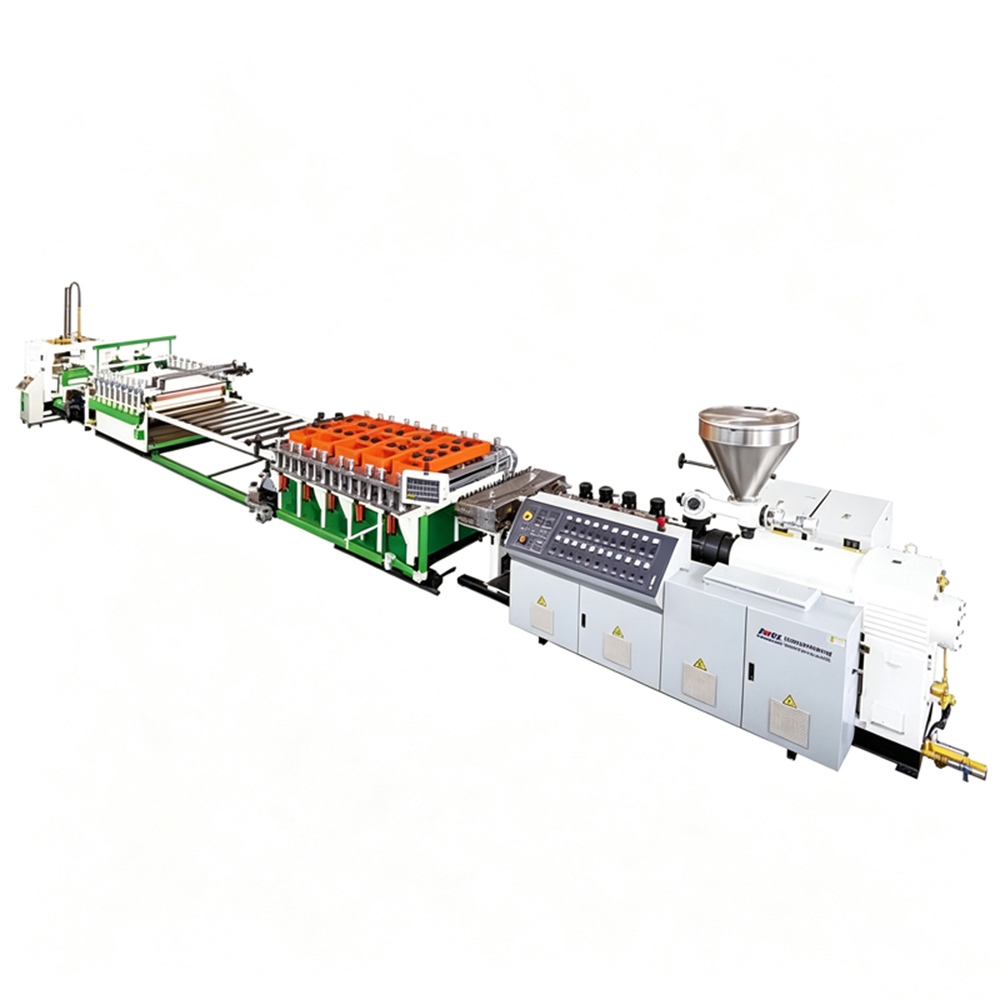
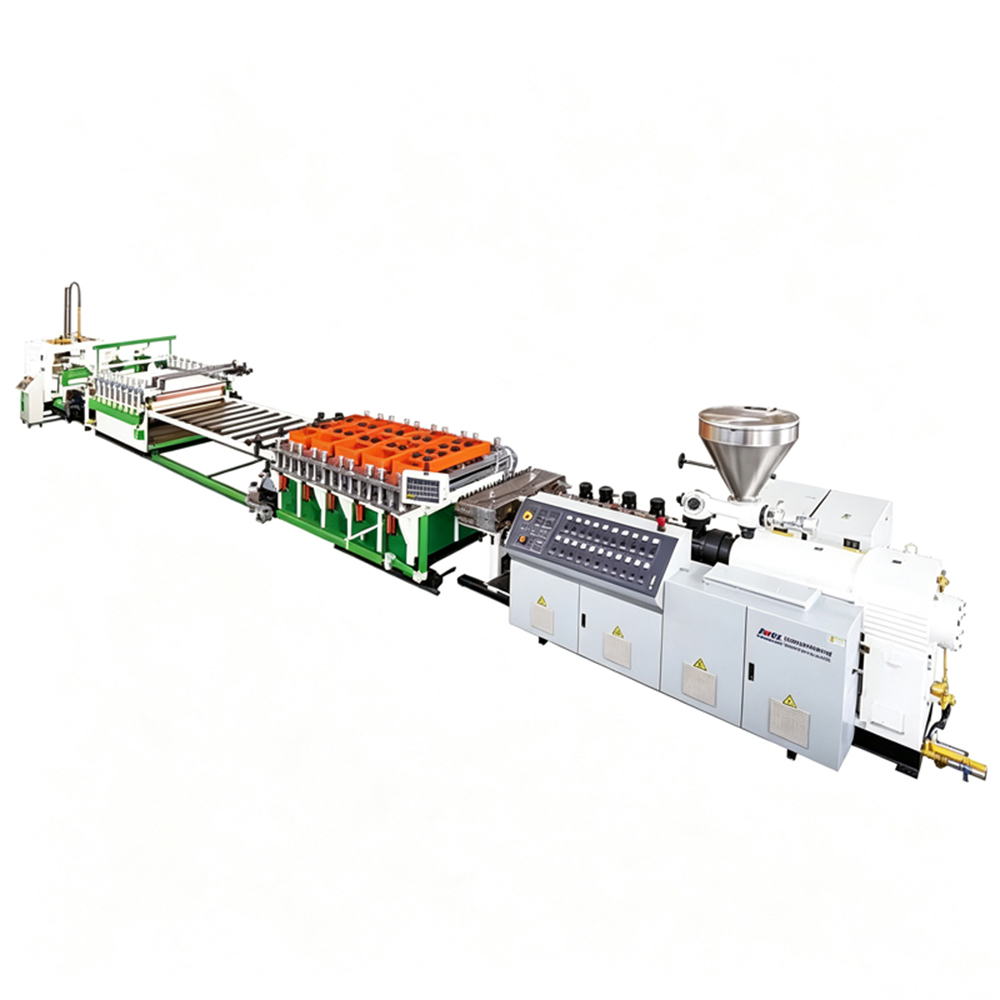
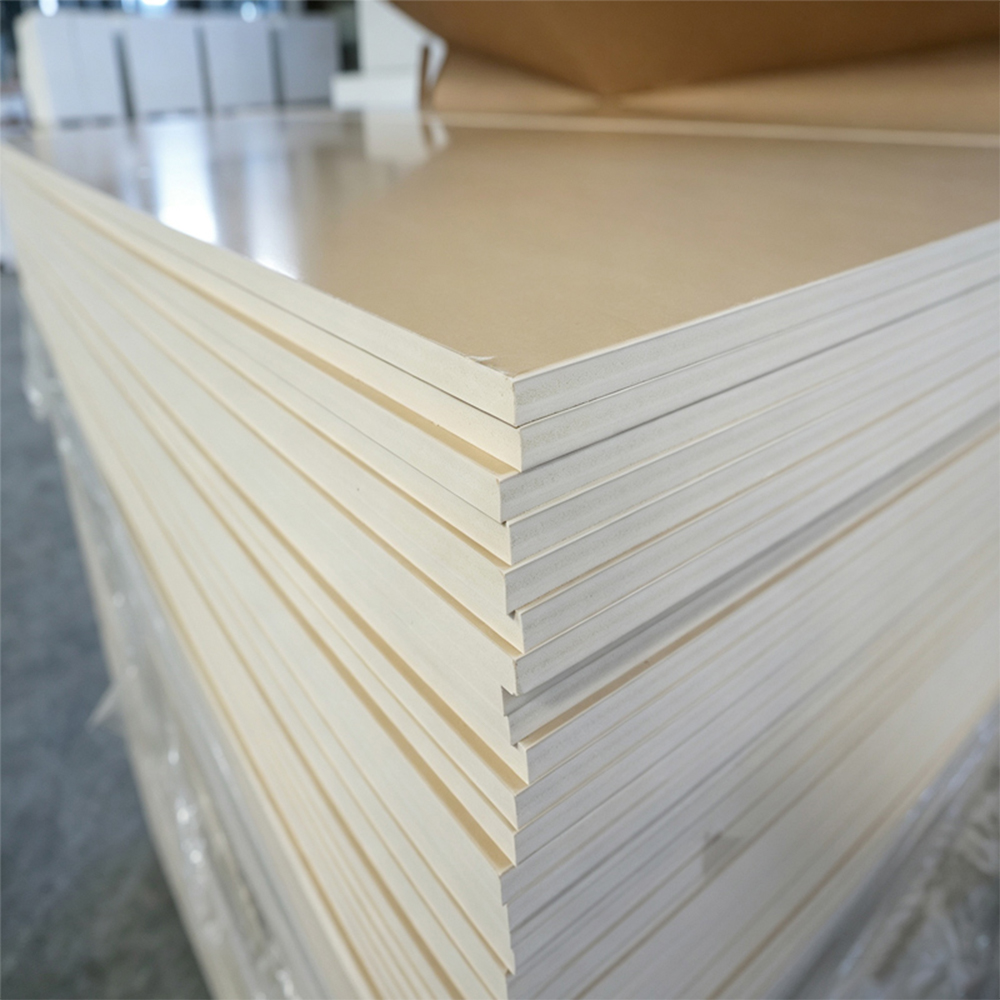
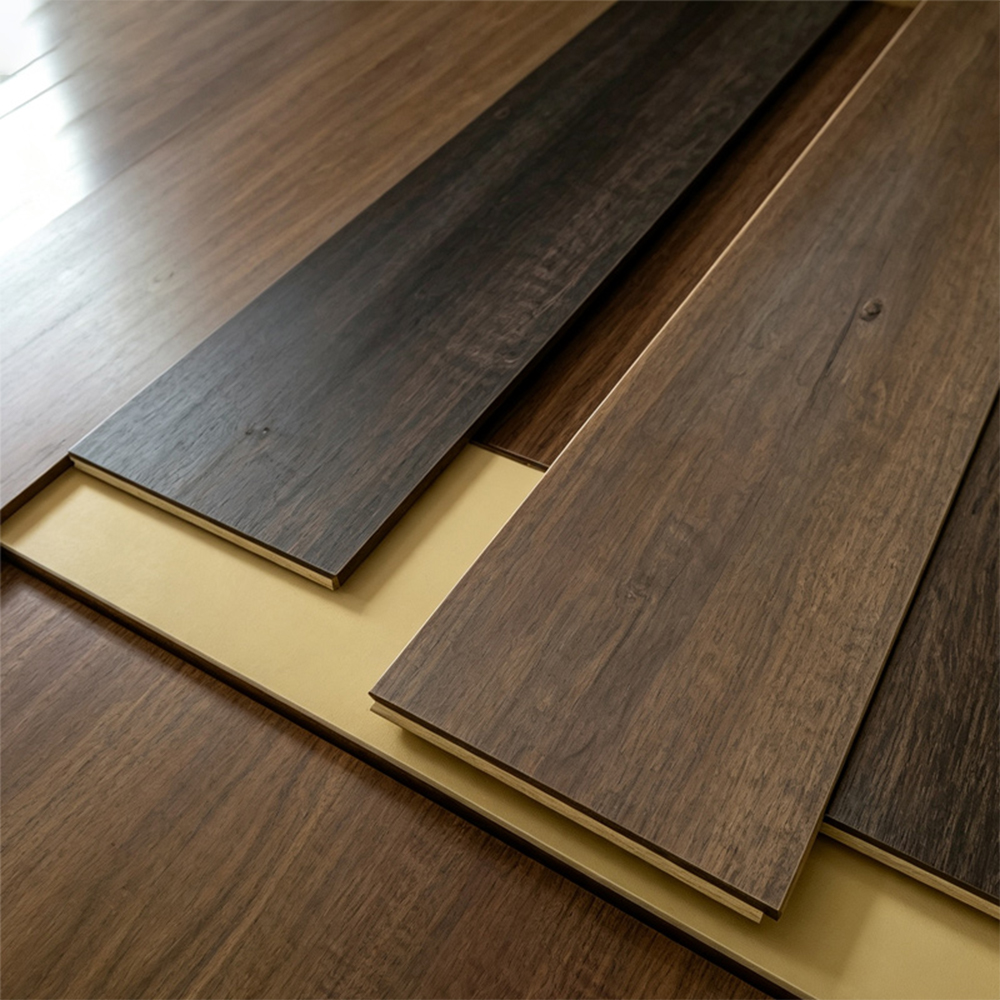
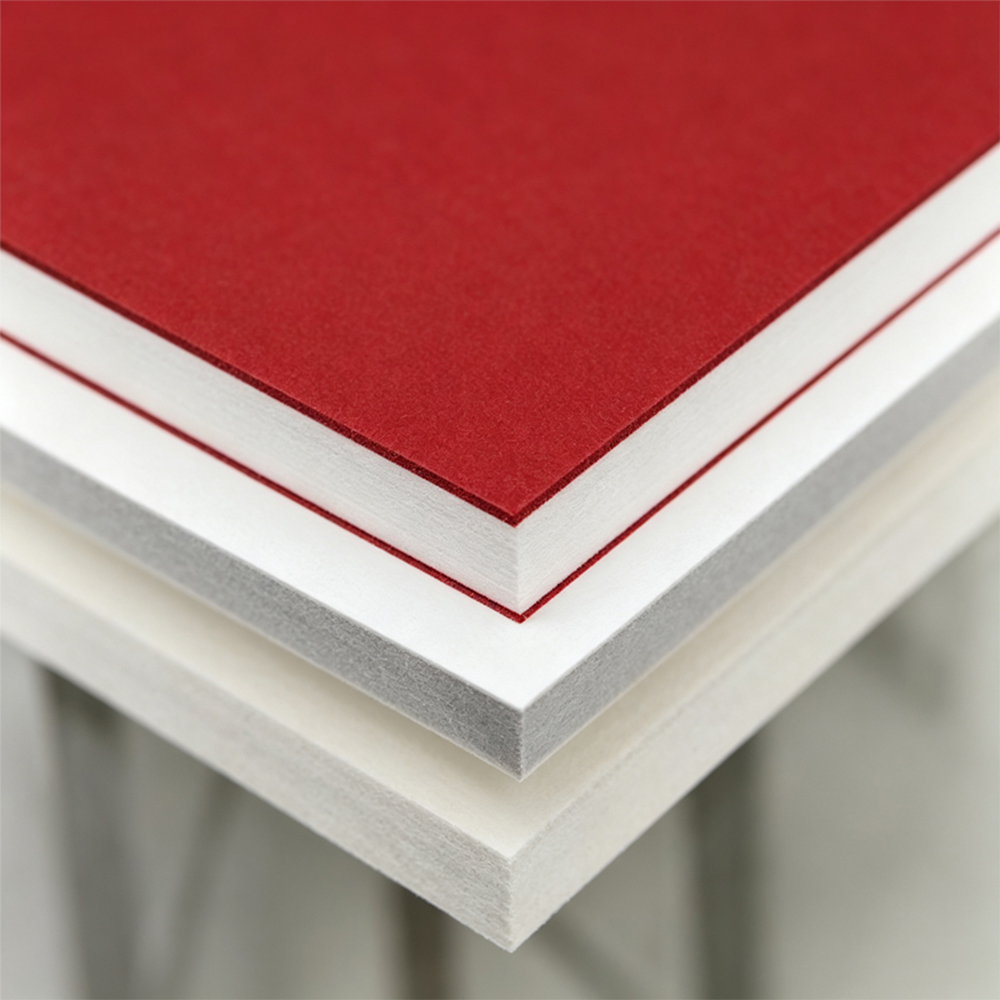
The PVC semi-compact (also known as Wood-Plastic Composite – WPC) foam board and free-foam board production line is a high-performance extrusion system, available in single-screw or co-extrusion configurations. The main extruder is a conical twin-screw extruder of model SJZ80/156 or SJZ92/188, producing board widths of 1220–2050 mm, thicknesses of 5–20 mm, with a maximum output of 550 kg/h. The equipment offers high energy efficiency and excellent board surface hardness, widely used in furniture, construction formwork, and advertising boards, with support for customized production.
Construction & Decoration
Wall cladding & ceiling panels – A construction company in Vietnam uses the SJZ92/188 line (width 1560 mm, thickness 8–18 mm) to produce lightweight, waterproof decorative panels for high-humidity areas. The 550 kg/h output enables them to supply large-scale projects within tight deadlines.
Concrete formwork – The 2050 mm wide boards from the same extruder serve as ideal reusable concrete formwork, reducing labor and material costs by 40% compared to plywood.
Furniture & Cabinetry
Kitchen cabinet back panels & bathroom vanities – An Indonesian furniture manufacturer adopted a co-extrusion foam line (width 1220 mm, thickness 5–20 mm, output 500 kg/h) to produce co-extruded boards with a hard, smooth surface and a foamed core. Result: moisture-proof, termite-resistant cabinets at 30% lower cost than solid wood.
Advertising & Signage
Digital printing substrates – The 1220 mm semi-compact line (SJZ80/156) produces boards 5–10 mm thick with excellent surface flatness, ideal for UV printing. A sign maker in the Philippines reported a 50% increase in production efficiency and no warping in outdoor displays.
Transport & Packaging
Truck liners & pallets – A logistics company in Australia uses 8–15 mm thick boards from the 2050 mm line to replace plywood liners, reducing weight by 200 kg per truck and improving fuel efficiency.
High output & energy efficiency
The SJZ92/188 extruder achieves a maximum output of 550 kg/h with only 132 kW motor power – that is 4.17 kg per kWh, among the best energy efficiency ratios in the industry.
The co-extrusion line (75+37 kW) produces 500 kg/h, providing balanced output for multi-layer boards.
Wide product range
Thickness flexibility: 5–20 mm (semi-compact) and 8–18 mm / 8–15 mm (wide boards) – suitable for everything from thin signage to thick structural panels.
Width options: 1220 mm, 1560 mm, 2050 mm – covering standard and oversized dimensions to reduce cutting waste.
Excellent board properties
Semi-compact technology: Produces a dense, hard outer layer and a microcellular core. This provides high impact strength (≥8 kJ/m²) and screw-holding force comparable to natural wood.
Co-extrusion capability: The SJZ80/156 + SJZ65/132 configuration allows adding a cap layer (e.g., UV-resistant, colored, or scratch-resistant) during extrusion, eliminating secondary lamination.
Low maintenance & stable operation
The twin-screw extruders (SJZ series) are equipped with high-torque gearboxes, ensuring consistent melt pressure and less screw wear, even when using recycled PVC or wood fiber fillers (up to 30% wood flour).
To ensure every board meets international standards (e.g., ASTM D6662, EN 15534-4), our factory follows strict quality control procedures:
A. Incoming material testing
PVC resin: K-value 65–68, volatiles <0.3%.
Wood fiber / calcium carbonate filler: particle size 80–120 mesh, moisture <1.5%.
Blowing agent: decomposition temperature matched to extrusion profile.
B. In-process inspection
|
Parameter |
Method |
Target value |
|
Melt temperature |
Thermocouple |
170–185°C (±2°C) |
|
Die pressure |
Pressure sensor |
12–18 MPa |
|
Board thickness |
Laser micrometer (inline) |
±0.2 mm tolerance |
|
Width shrinkage |
Optical edge sensor |
<1.5% |
C. Final product testing (physical & mechanical properties)
Density (ASTM D792): 0.45–0.65 g/cm³ – measured by hydrostatic balance method. Example: a 1220x2440x12 mm board weighs approximately 19–26 kg.
Surface hardness (Shore D): semi-compact layer ≥55.
Flexural strength (ASTM D790): ≥18 MPa for 10 mm thick board.
Water absorption (24h immersion): <1.5% – critical for bathroom applications.
Screw pull-out resistance: ≥800 N – tested with 4 mm diameter screws.
Flammability: UL 94 V-0 or Class B1 (self-extinguishing within 5 seconds).
D.Real-world quality troubleshooting case
A customer using the SJZ92/188 line reported occasional surface bubbles. Our quality team traced the issue to moisture content of 2.2% in their wood flour (instead of <1.5%). After installing a hot-air dryer before mixing, the defect rate dropped from 8% to 0.3%.
| Model | Extruder model | Products width(mm) | Products thickness(mm) | Main motor power(kw) | Max. Capacity(kg/h) |
| Semi-skin foaming | SJZ80/156 | 1220 | 5–20 | 75 | 400 |
| SJZ92/188 | 1560 | 8–18 | 132 | 550 | |
| SJZ92/188 | 2050 | 8–15 | 132 | 550 | |
| Co-extrusion foaming | SJZ80/156+SJZ65/132 | 1220 | 5–20 | 75+37 | 500 |
Q1: How do I choose between a semi-compact foam line and a co-extrusion foam line?
Use the semi-compact foam line (e.g., SJZ80/156) if you need a single-material board with a hard surface and foamed core – best for general construction and signage.
Choose the co-extrusion foam line (SJZ80/156 + SJZ65/132) if you need a decorative cap layer (e.g., wood grain, white cover, or UV-resistant coating) without post-printing or lamination. The co-extrusion line increases energy costs by only 15% but boosts product value by 40%.
Q2: Why do my boards have an uneven cell structure (large bubbles near the surface)?
This is usually caused by:
Melt temperature fluctuations (common when running near the 550 kg/h limit). Keep the temperature profile stable within ±2°C.
Insufficient back pressure – check the screen changer and die lip gap. For the SJZ92/188 extruder, maintain a die lip gap of 1.2–1.8 mm for 8–15 mm boards.
Q3: Can I produce thinner boards (e.g., 3 mm) on the 5–20 mm line?
Technically yes, but the recommended minimum thickness is 5 mm. Below this, the cooling calibrator cannot quench the board fast enough, leading to warping. For 3 mm sheets, use a dedicated free-foam line (not this model).
Q4: How often should the twin screws on the SJZ series be replaced?
With proper lubrication and filler content ≤25%, nitrided steel screws last 8,000–10,000 running hours. For high wood flour content (30–40%), consider bimetallic screws – 30% higher cost but up to 15,000 hours of life. A customer in Turkey replaced their screws after 4 years of two-shift operation.
Q5: My co-extruded boards have poor interlayer adhesion between the cap layer and the foamed core. What went wrong?
This is most likely a temperature mismatch. The cap layer (from the SJZ65/132) should enter the co-extrusion adapter at a temperature 5–10°C higher than the foamed core (from the SJZ80/156). Also ensure adapter pressure balance – cap layer pressure should be 10–15% higher than core pressure.
Q6: What is the maximum wood fiber content I can use without losing surface quality?
For semi-compact boards: up to 35% wood flour (100 mesh) while maintaining a smooth skin.
For co-extruded boards, wood fiber is retained only in the core – the cap layer should be neat PVC for good adhesion. A real case from Malaysia: 30% rice husk filler produced boards with excellent screw retention but 12% lower impact strength – acceptable for indoor furniture.
Q7: How can I achieve the lowest density (lightest board) on the 2050 mm line?
Lower the cooling calibration temperature (set the first vacuum tank to 15°C instead of 25°C) and increase the blowing agent dosage by 8–10%. On the SJZ92/188 extruder, density can go as low as 0.38 g/cm³ (standard is 0.55 g/cm³). However, below 0.4 g/cm³, nail pull-out force drops sharply – test according to your application.




Pipe Extrusion Production Line
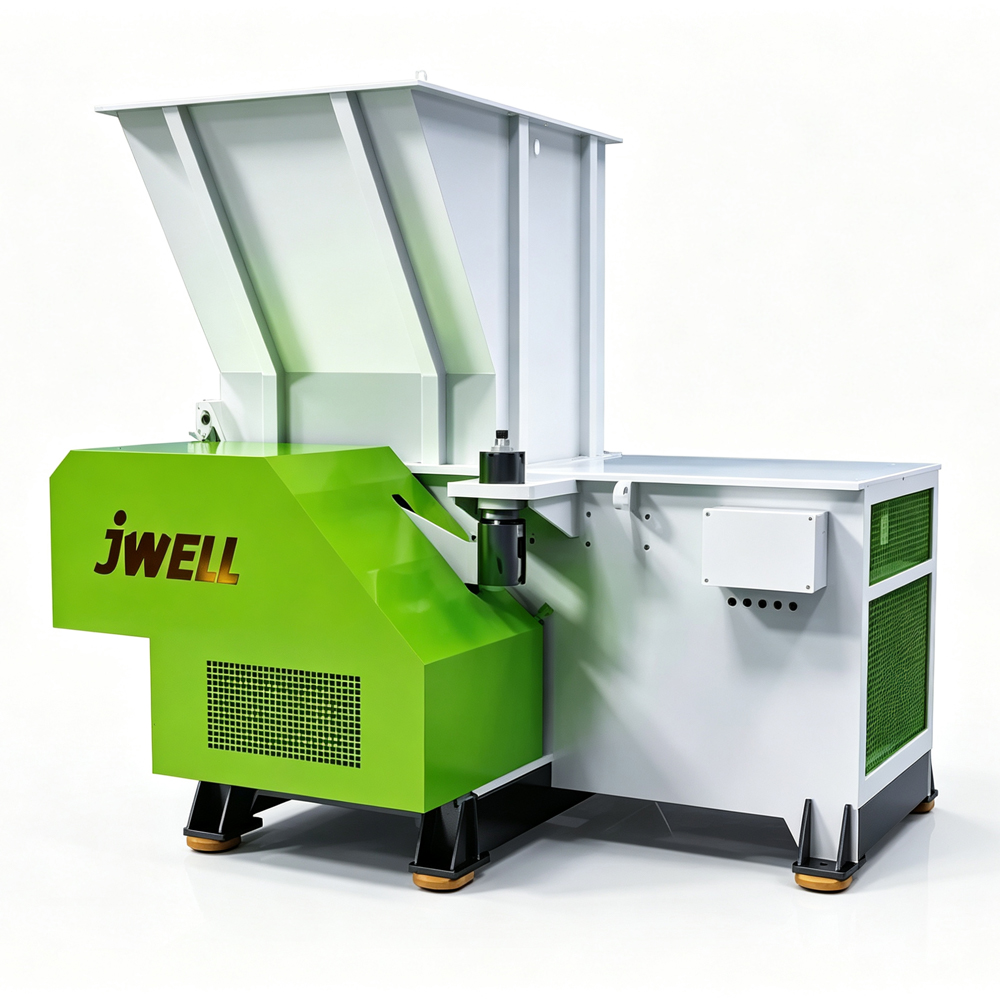
Plastic Shredder Crusher Machine

Tel: +86-19057068112

E-mail: [email protected]

Company Address
No. 128 Qingfeng Road, Xieqiao Town, Haining City, Jiaxing City, Zhejiang Province

19057068112

 English
 русский