
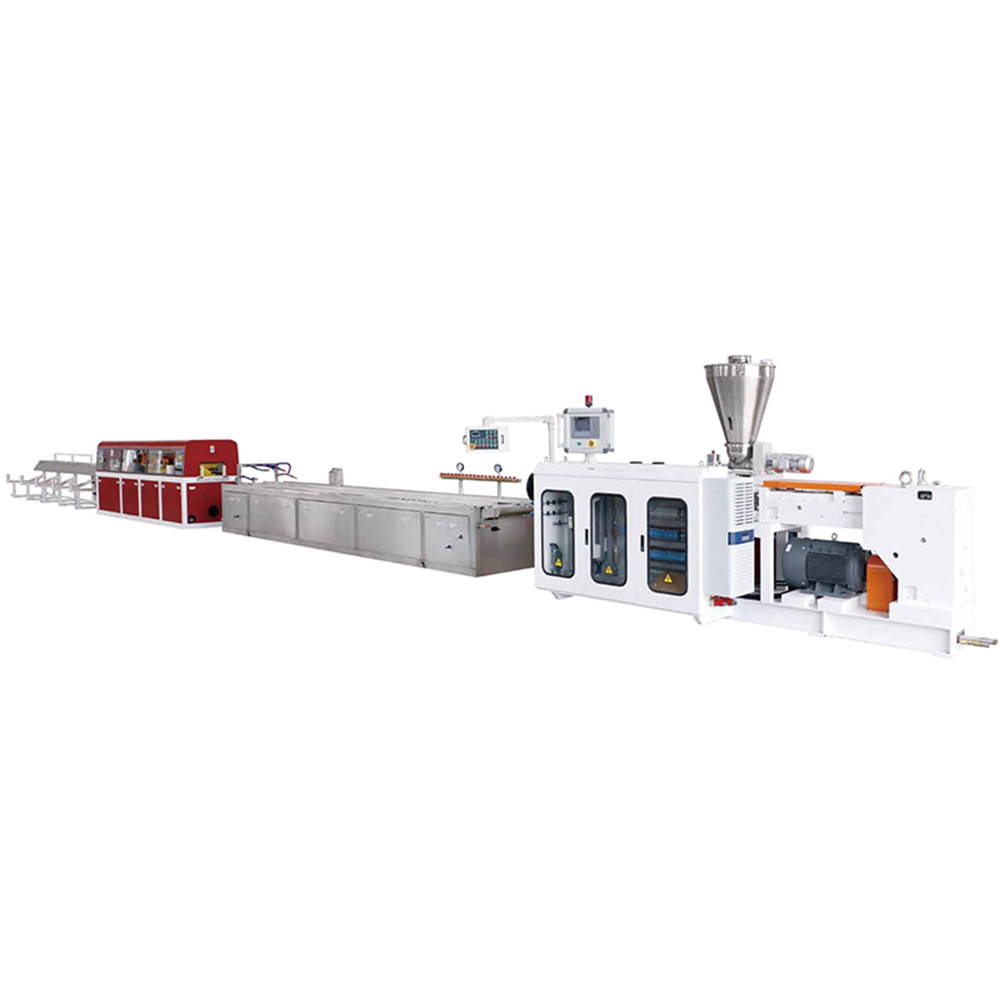
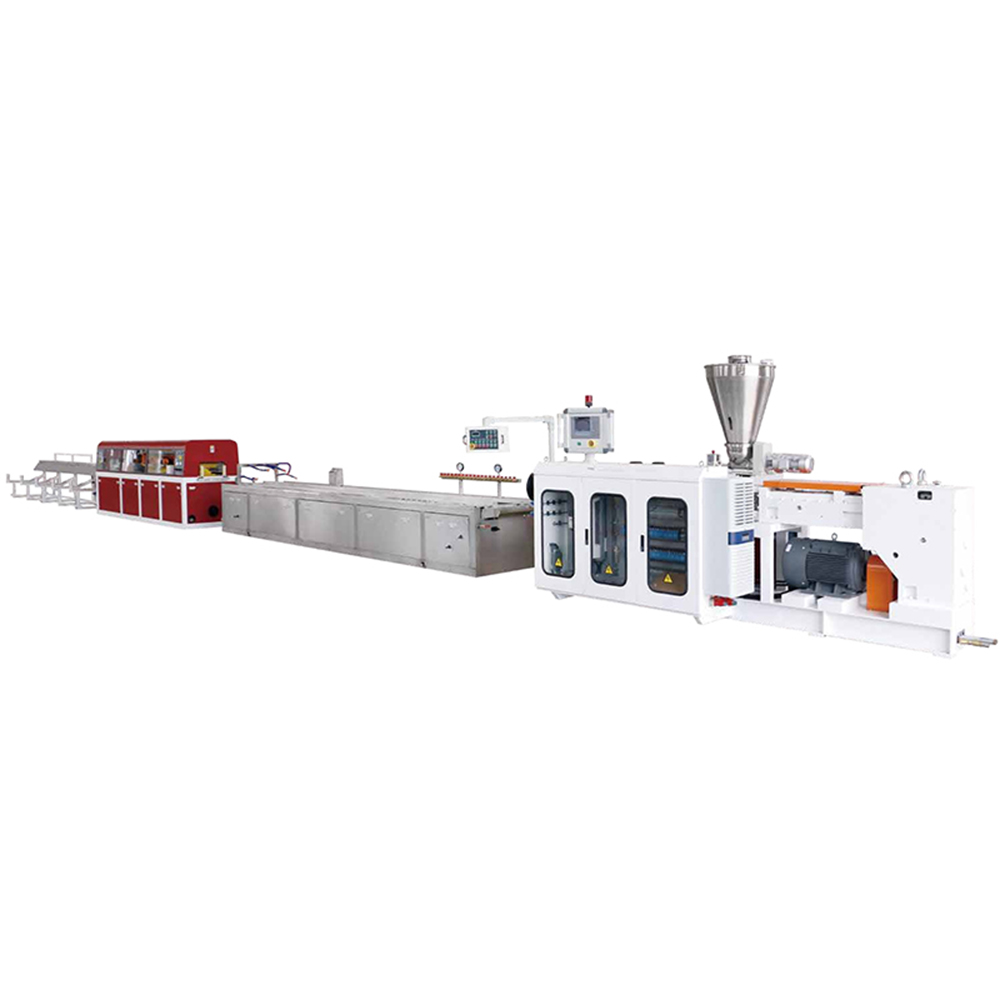
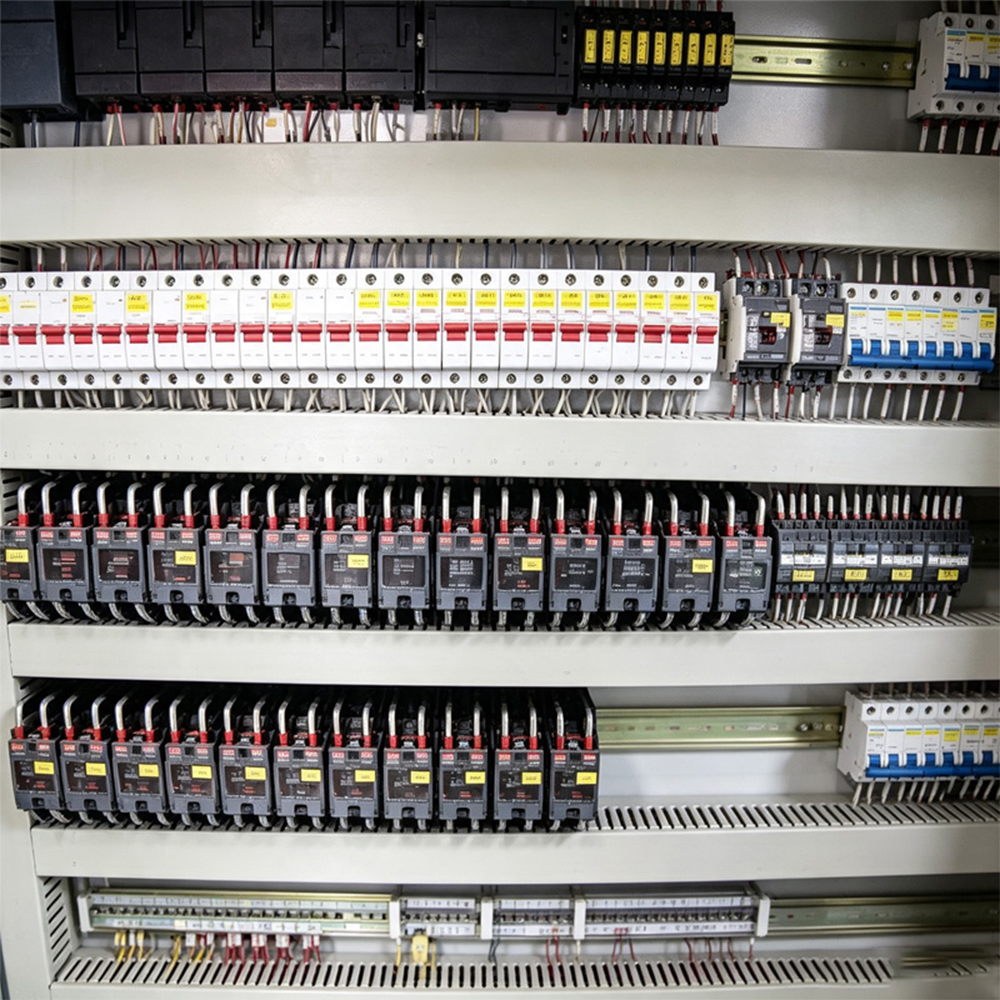
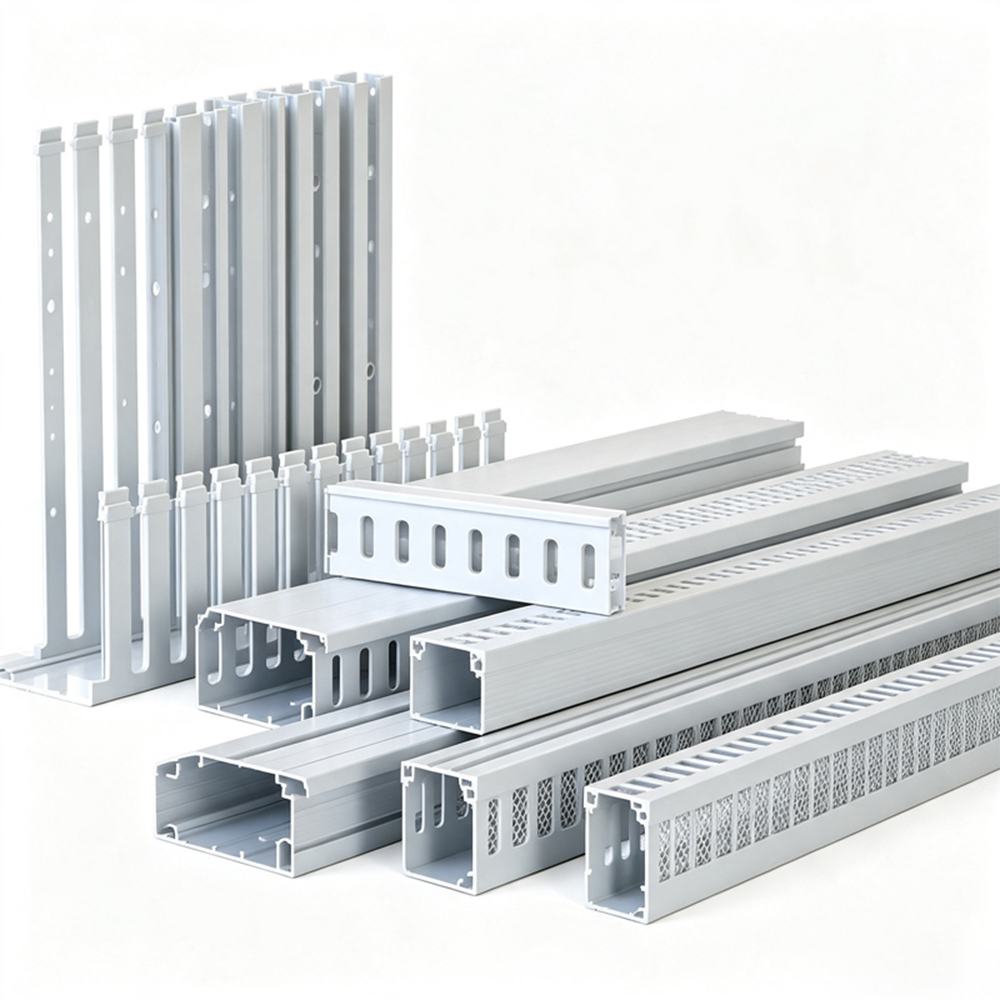
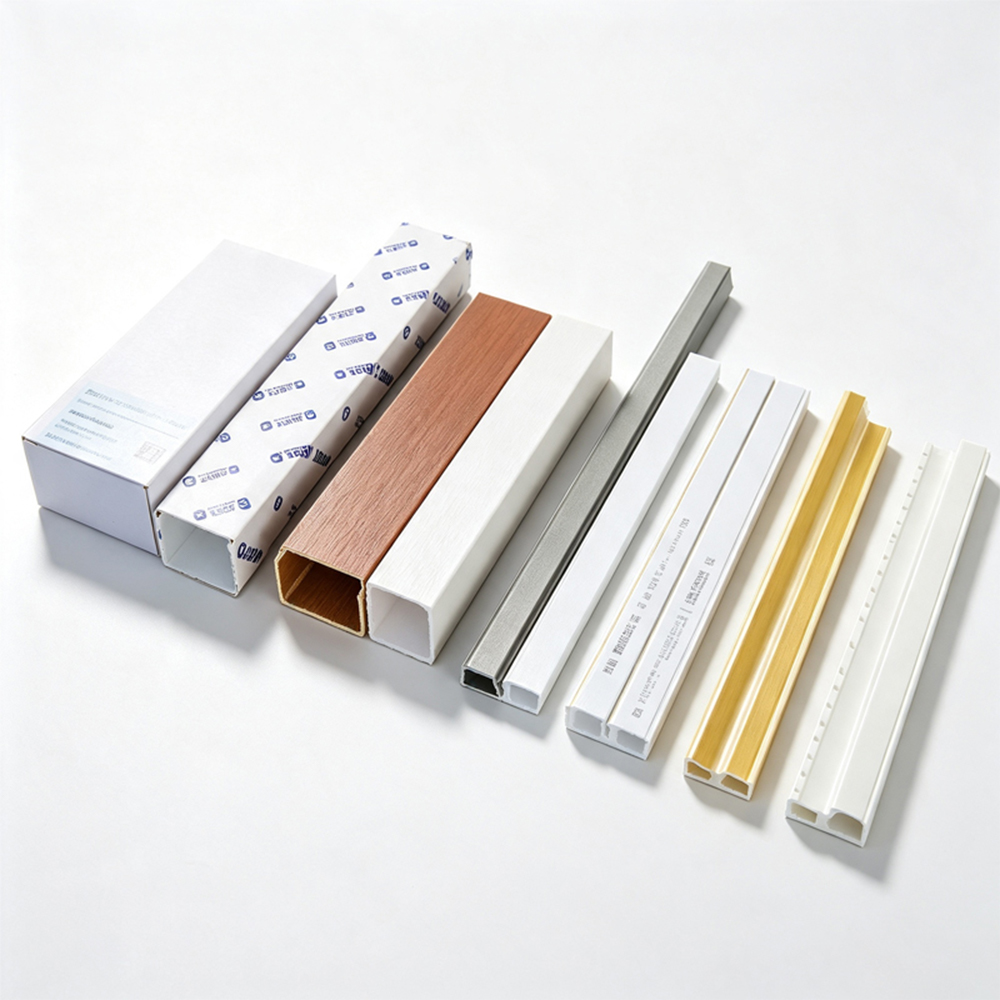
This PVC wire duct extruder production line adopts the SJZ series conical twin-screw extruder (SJZ51/55/65), specially designed for producing PVC cable trunking (cable raceways, cable trays). The output capacity covers 80-200 kg/h, featuring excellent plasticization, low energy consumption, and stable continuous operation. Combined with in-line calibrating, hauling-off, cutting, and punching devices, it can complete the extrusion of trunking base and cover in one line, widely used in distribution boxes, data centers, and building wiring fields.
PVC cable trunking is essential for organizing and protecting cables in residential, commercial, and industrial environments. The SJZ series is widely used for producing:
Slotted trunking for control panels (e.g., in factories, data centers, and elevator systems).
Solid-wall cable raceways for surface-mounted wiring in offices and homes.
Flame-retardant PVC profiles for public buildings and transport vehicles.
Real case:
A German control cabinet manufacturer uses the SJZ55 (output 120 kg/h) to produce 40×40 mm slotted trunking for automotive assembly lines. Stable extrusion speed and precise dimensional control reduced their material waste by 12% compared to a previous single-screw line.
Optimized conical twin-screw geometry
The screw diameter ratio (e.g., 51/105 mm for SJZ51) provides a large feeding zone and progressive compression. This design:
Ensures excellent plasticization of PVC powder or pellets.
Reduces shear heat and prevents material degradation.
Delivers higher torque at lower motor power (e.g., 18.5 kW for SJZ51, while older models typically require 22 kW for the same output).
Energy efficiency
Thanks to the efficient screw design and hardened bimetallic barrel, energy consumption per unit is 15-20% lower than the industry average. For example, the SJZ65 (37 kW) produces 180 kg/h of 60×60 mm trunking, whereas a conventional parallel twin-screw would need 45 kW for the same output.
Wide output range by model
SJZ51: Suitable for small-batch, high-variety production (80-100 kg/h) of narrow trunking (width 15-25 mm).
SJZ55: Workhorse for medium-sized trunking (30-50 mm) – used by many cable management brands in Southeast Asia.
SJZ65: Capable of 24/7 operation, output 180-200 kg/h, for large trunking (60-100 mm), equipped with a 37 kW robust motor that withstands high backpressure.
Easy maintenance and long service life
All models feature:
Nitrided or bimetallic screws (HRC 58-62) – wear life >15,000 hours for PVC containing 20% CaCO₃.
Segmented heater bands for quick zone replacement.
Integrated cooling fans on the barrel to prevent overheating, requiring no water cooling (reduces scaling risk).
To ensure every SJZ extrusion line produces consistent, defect-free trunking, we follow a multi-stage QC protocol based on ISO 9001:2015 and EN 50085 (European standard for cable trunking).
Raw material inspection
PVC resin and additives: Test K-value, moisture content (<0.3%), and particle size distribution using Malvern Mastersizer.
Calcium carbonate: Check whiteness (>90%) and fineness (≤10 µm) to avoid scratching the die.
In-process production testing
Ultrasonic wall thickness monitoring (accuracy ±0.05 mm) – installed after the vacuum calibration tank.
Laser diameter gauge – scans trunking every 10 cm; rejects products exceeding ±0.2 mm tolerance.
Vision system for slotted trunking – detects missing slots or burrs in real time.
Periodic quality assurance (every 2 hours)
Flame retardancy test: A 100 mm long sample must self-extinguish within 5 seconds after removing a 20 mm flame (UL94 V-0 or V-2, as per order requirement).
Impact strength (Izod notched): ≥6 kJ/m² at 23°C (ASTM D256).
Heat deflection temperature (HDT): ≥70°C for standard PVC, ≥80°C for modified rigid PVC.
Final line acceptance test
Before shipment, each SJZ extruder undergoes a 48-hour continuous run at maximum rated output (e.g., 200 kg/h for SJZ65). We record:
Motor current variation (<5% of rated value).
Melt temperature stability (±2°C).
Screw speed consistency (±1 rpm).
Real case:
A customer in Saudi Arabia requested a third-party audit of our QC process. We ran an SJZ55 continuously for 72 hours producing 50×50 mm trunking at 120 kg/h. The SGS report showed dimensional CPk values of 1.33 and zero flame test failures – the line was accepted on the spot.
| Model | SJZ51 | SJZ55 | SJZ65 |
| Screw size(mm) | 51/105 | 55/110 | 65/132 |
| Motor power(Kw) | 18.5 | 22 | 37 |
| Output(Kg/h) | 80-100 | 100-150 | 150-200 |
Q1: Daily output 2400 kg (working 20 hours/day), which model should I choose?
A: Calculation: 2400 kg / 20 h = required 120 kg/h. SJZ55 (100-150 kg/h) is a perfect fit. SJZ51 would be too close to its upper limit (100 kg/h), risking downtime for screw cleaning. SJZ65 would be overpowered and less energy-efficient at that throughput.
Q2: How often should the screw be re-nitrided?
A: For standard rigid PVC with ≤10% recycled content, typically re-nitride every 12,000-15,000 operating hours. For highly filled PVC (>30% CaCO₃), check at 8,000 hours. A >15% drop in output at the same screw speed is the first sign of wear.
Q3: The trunking surface shows matte/dark spots – what is the problem?
A: Possible causes:
Insufficient plasticization – increase barrel temperatures in zones 2 and 3 by 5-8°C.
Worn screw flight edges – check compression zone clearance (should be ≤0.2 mm for SJZ51/55, ≤0.25 mm for SJZ65).
Moisture in PVC – if humidity >0.4%, pre-dry at 70-80°C for 1 hour.
Field case: A Malaysian customer using an SJZ55 experienced matte trunking issues after 9,000 hours. We found screw flight wear of 0.35 mm. After replacing the screw, gloss was immediately restored.
Q4: Can this line run both rigid PVC and flexible PVC alternately?
A: Yes, but you must change the screw and adjust the cooling section. Rigid PVC requires deeper flight depth and a higher compression ratio. We recommend dedicated screw sets per material type to avoid cross-contamination. The barrel can remain the same (bimetallic lining works for both materials).
Q5: Your SJZ55 is rated at 100-150 kg/h. If I only make small trunking of 15×10 mm, will the output drop significantly?
A: It will drop, but not drastically. The rated output refers to medium-sized trunking (e.g., 40×40 mm, wall thickness 1.5 mm). When the product cross-section is very small (e.g., 15×10 mm), extrusion resistance increases because the die flow channels are narrower, and the haul-off speed must be increased to prevent sagging.
Q6: Can your extrusion line punch holes or cut notches inline? For example, cut a mounting hole every 200 mm.
A: Yes, but an inline punching/notching unit needs to be added. The standard configuration is: extrusion → calibration → cooling → haul-off → inline punching unit → fixed-length cutting.




Pipe Extrusion Production Line
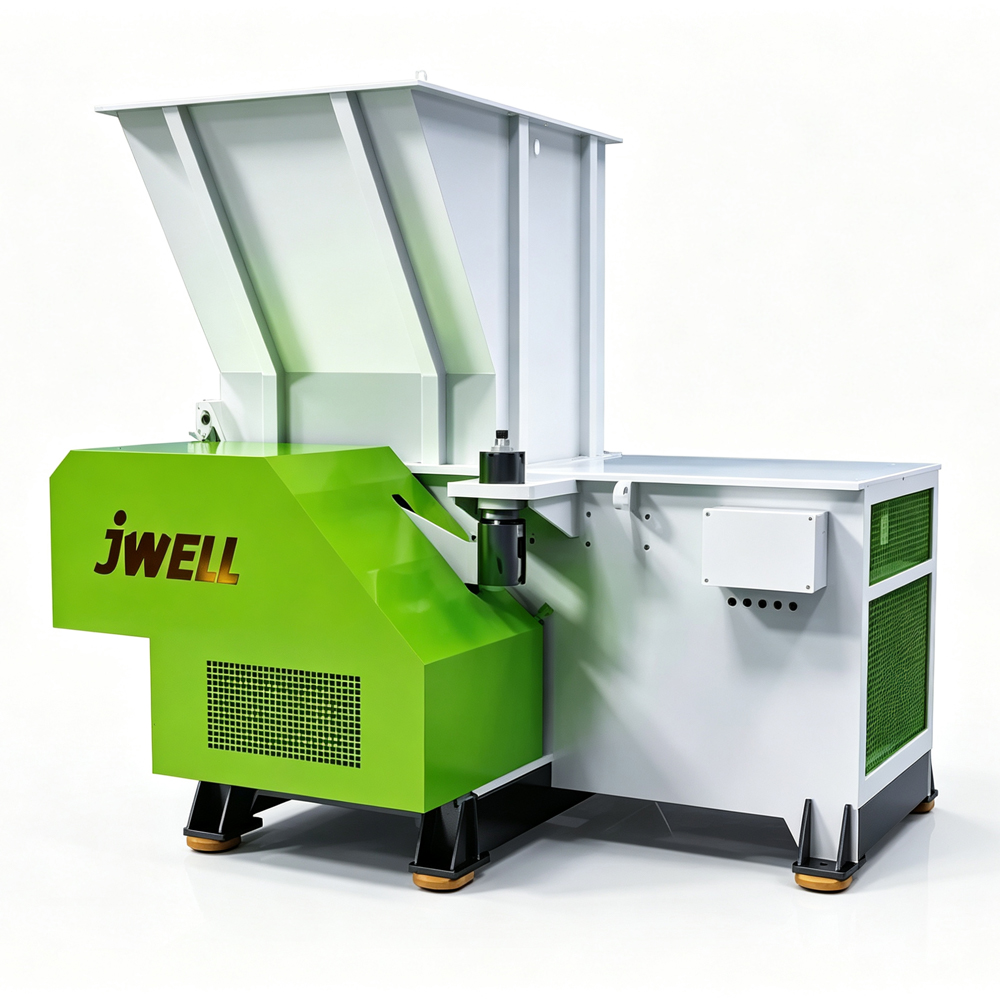
Plastic Shredder Crusher Machine

Tel: +86-19057068112

E-mail: [email protected]

Company Address
No. 128 Qingfeng Road, Xieqiao Town, Haining City, Jiaxing City, Zhejiang Province

19057068112

 English
 русский