
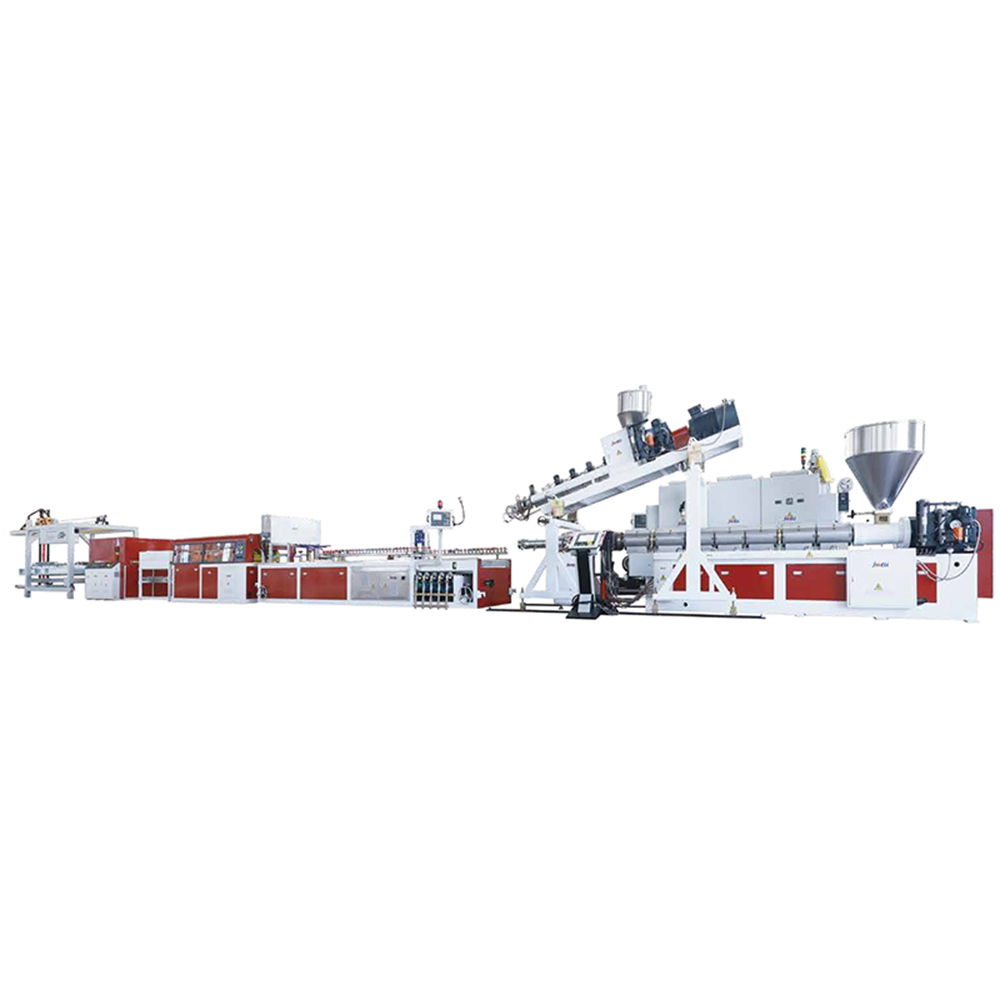
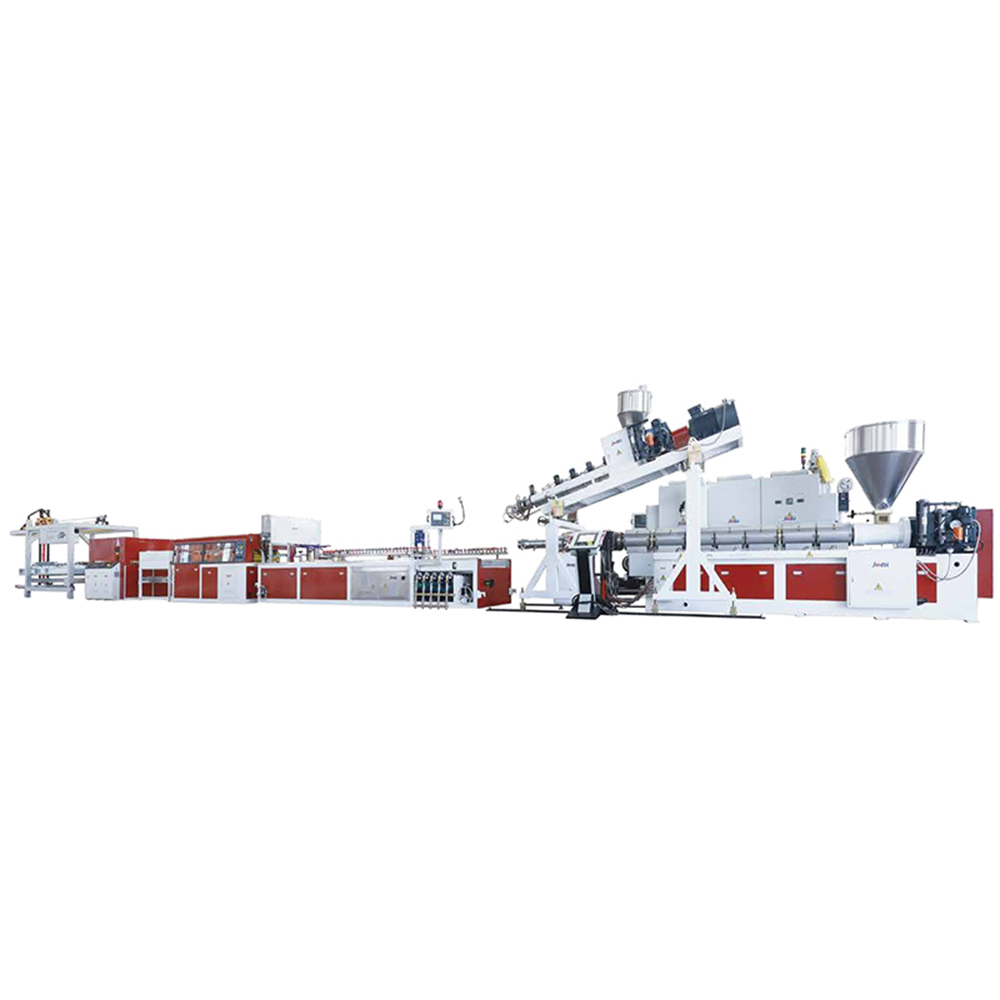
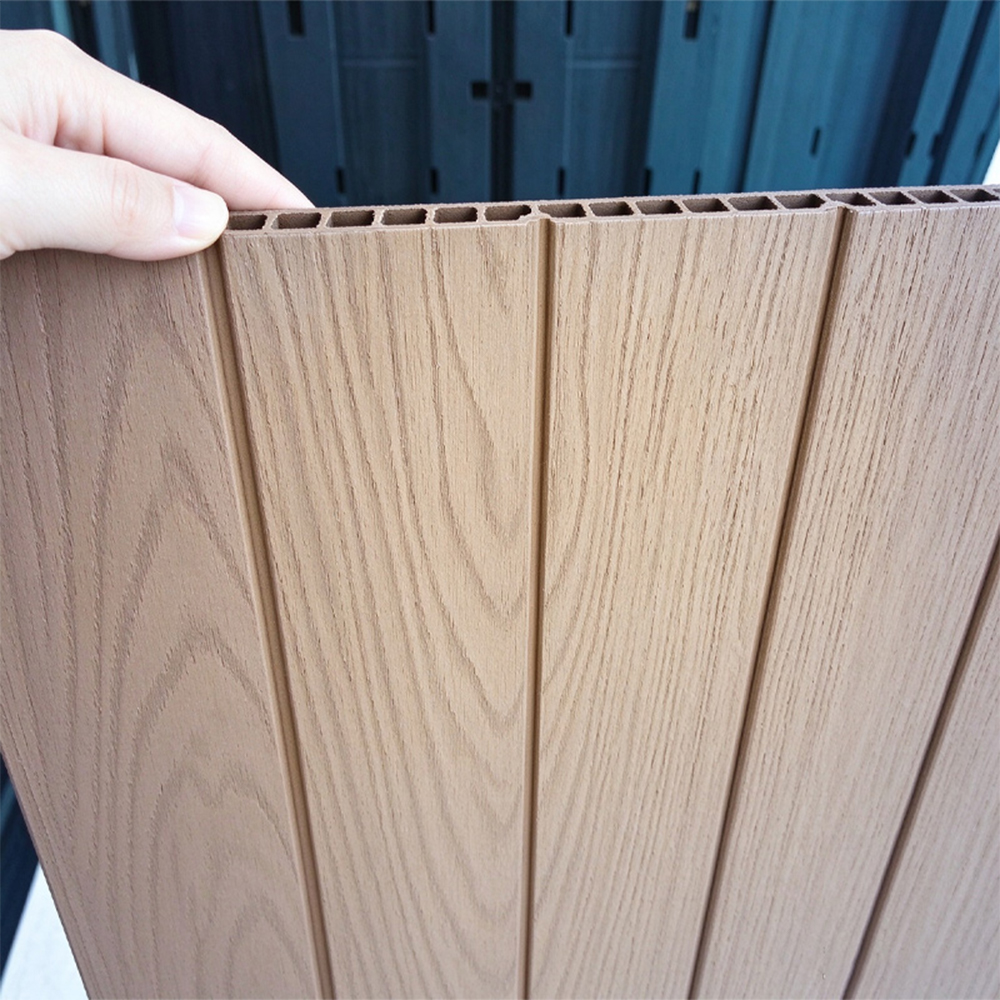
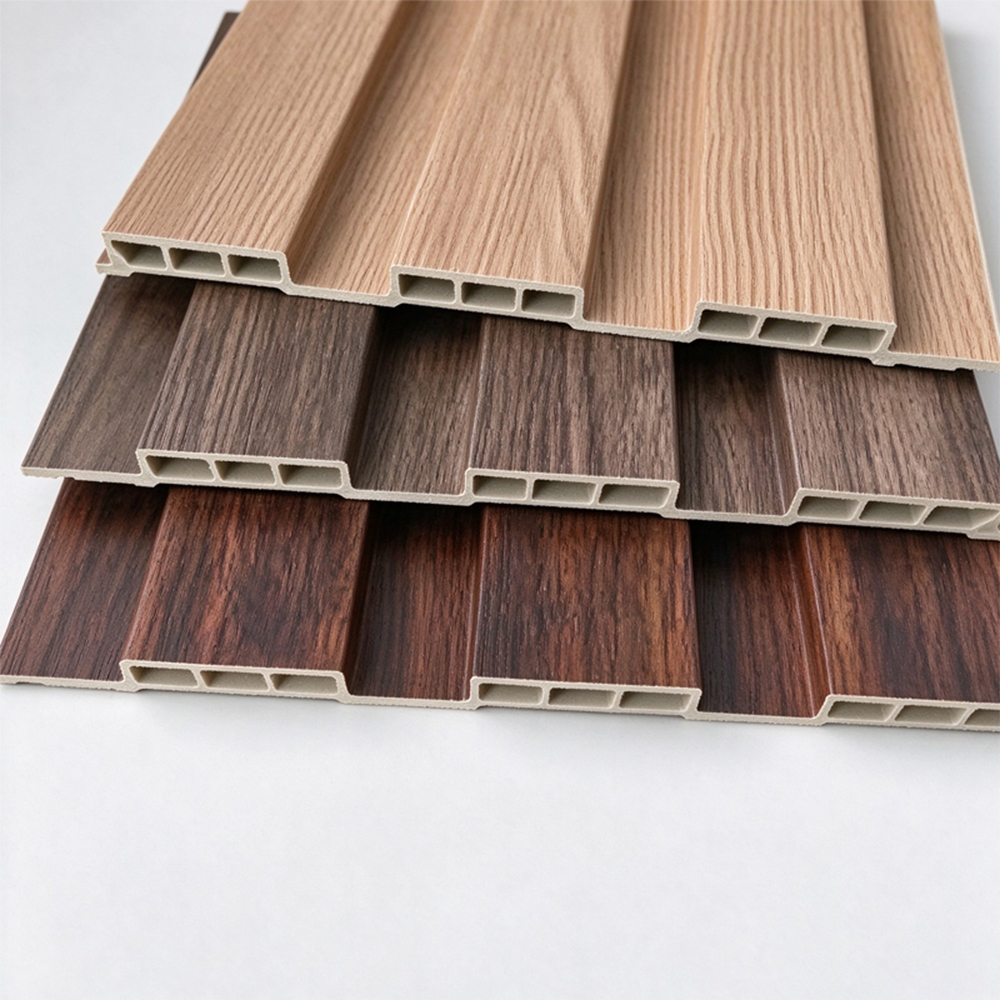
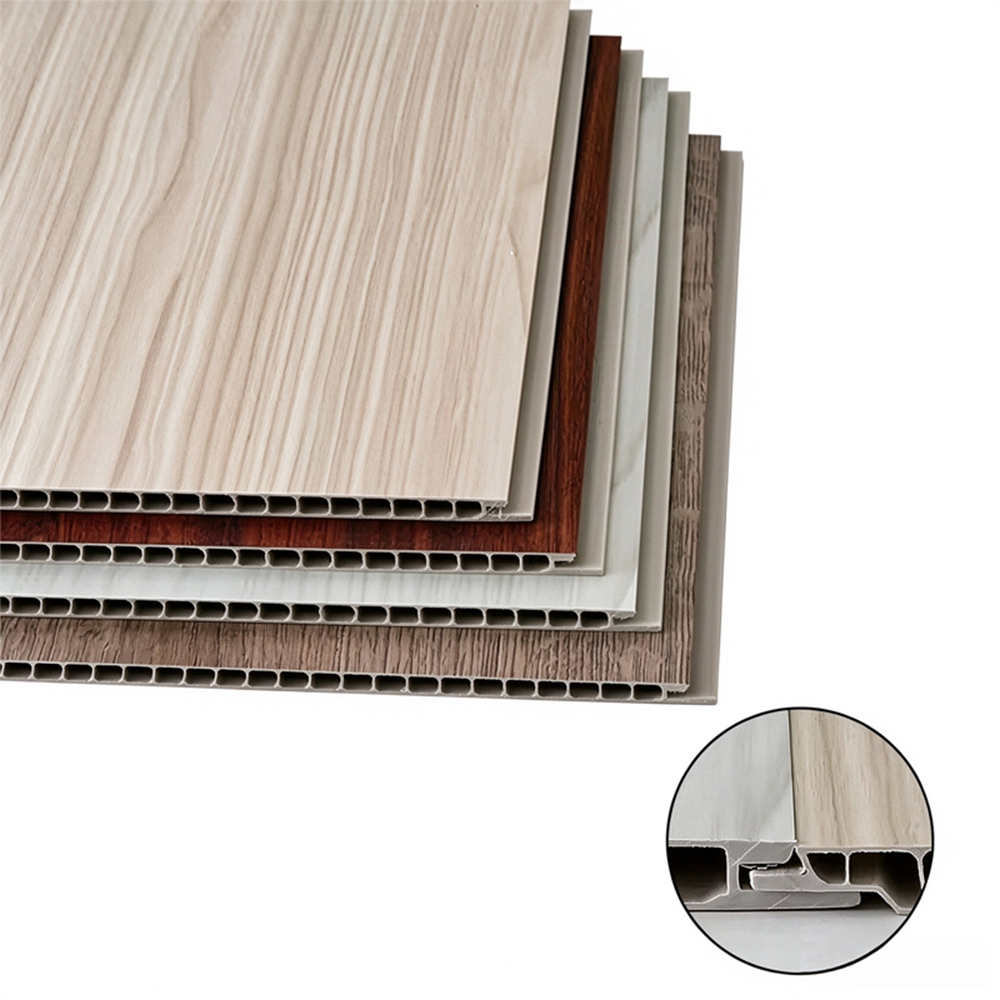
Our JWS series two-stage extrusion lines are designed for the production of PVC wallboards with widths ranging from 50 to 800 mm. Through the cooperative plasticizing of the main and secondary extruders, they can stably output 60 to 450 kg/hour of product. Paired with YF series downstream equipment, they can flexibly meet the requirements from narrow decorative strips to large siding panels.
Our extrusion lines are widely used for the production of the following products:
Interior decorative PVC wallboards (bathrooms, kitchens, hotel lobbies)
Waterproof ceiling panels for coastal or humid areas
Wainscoting and cladding panels (widths from 50 mm to 800 mm)
Co-extruded two-color or UV-protected panels for outdoor applications
Actual case: A manufacturer in Vietnam installed a JWS100/33+JWS65/33 line (output 200-300 kg/h, width 400-600 mm) to produce 550 mm embossed wallboards. Within 3 months, thanks to the consistency of two-stage mixing, they reduced material waste by 12% compared to single-screw lines.
Another example: A customer in Nigeria uses a JWS75/33+JWS45/33 with YF400 downstream equipment to produce 350 mm wallboards at 130 kg/h for affordable housing projects – achieving a perfect balance between speed and surface gloss.
Based on field feedback and technical audits, the following advantages stand out:
2.1 High Output with Low Energy Consumption
The 33:1 L/D ratio screw provides excellent plasticizing capability, enabling the JWS120/33+JWS65/33 to reach an output of 400 kg/h while saving 15-18% electricity compared to conventional 30:1 designs.
2.2 Wide and Flexible Width Range
From 50 mm (suitable for edge trims) to 800 mm (large-format wallboards) – all on one modular platform. Switching between YF300, YF400, YF600, or YF800 downstream units can be completed within 4 hours.
2.3 Superior Surface Quality Thanks to Two-Stage Design
The main extruder (e.g., JWS75/33) handles melting and conveying; the secondary extruder (JWS45/33) acts as a low-pressure homogenizer, eliminating fisheyes and weld lines. This is critical for high-gloss or wood-grain finished PVC wallboards.
2.4 Stable Co-extrusion Capability
Ideal for adding a thin ASA or PVC cap layer without additional equipment – raw material costs can be reduced by up to 20% compared to single-layer panels.
Each line undergoes a nine-step QA process before leaving our factory. The following is our actual procedure:
|
Step |
Test Item |
Method |
Acceptance Criterion |
|
1 |
Raw material verification |
Melt Flow Index (MFI) of PVC compound |
MFI 0.5-1.2 g/10min @190°C |
|
2 |
Screw concentricity |
Dial gauge runout test |
≤0.02 mm |
|
3 |
Barrel heating uniformity |
Thermal imaging of 5 zones |
Deviation ±1.5°C |
|
4 |
No-load output check |
2-hour no-load run |
Vibration ≤0.05 mm/s |
|
5 |
Load production test |
8-hour continuous run with actual wallboard formulation |
Output stability ≥97% |
|
6 |
Wallboard dimensional accuracy |
Laser micrometer at die exit |
Width tolerance ±0.5 mm, thickness ±0.1 mm |
|
7 |
Impact resistance |
Falling dart impact test (ASTM D4226) |
No cracks at 2 Joules |
|
8 |
Surface gloss consistency |
60° gloss meter at 10 points |
Gloss variation <5 units |
|
9 |
Water absorption (24h) |
ISO 62 method |
Weight gain <0.5% |
Actual case: During FAT for a JWS100/33+JWS65/33 line destined for Poland, we observed width fluctuation of 0.3 mm over 6 hours – well below the 0.5 mm tolerance. The customer's own QA team confirmed the boards met EN 13245-2.
| Model | JWS65/33+JWS45/33 | JWS75/33+JWS45/33 | JWS100/33+JWS65/33 | JWS120/33+JWS65/33 |
| Output(Kg/h) | 60-90 | 100-150 | 200-300 | 300-450 |
| Model | YF300 | YF400 | YF600 | YF800 |
| Product width(mm) | 50-300 | 300-400 | 400-600 | 600-800 |
Q1: How do I choose among the four models?
A: Match according to your target daily output and wallboard width.
For decorative lines or narrow boards 50-300 mm → JWS65/33+JWS45/33 (60-90 kg/h) with YF300.
For standard wallboards (400-600 mm) → JWS100/33+JWS65/33 (200-300 kg/h) – most popular choice worldwide.
For high-volume 800 mm wallboards → JWS120/33+JWS65/33 (300-450 kg/h) with YF800.
Q2: What if my wallboard width changes after purchase?
A: All downstream models (YF300 to YF800) are interchangeable on the same main frame. You only need to replace the calibrator, puller, and cutter – no need to buy a new extruder.
Q3: How often should I replace the screws?
A: For standard PVC (CaCO₃ addition ≤15 phr), the bimetal screw life is 8,000-10,000 hours. Actual case: A customer in Saudi Arabia using 20% limestone filler needed replacement after 6,500 hours. With our optional screw hardening treatment, life can be extended to 12,000 hours.
Q4: My wallboard has intermittent surface roughness. What is the problem?
A: Likely PVC degradation or insufficient venting. Check three things:
Melt temperature at the die – should be 170-185°C (use infrared sensor)
Vacuum vent port on the JWS45/33 secondary extruder – ensure suction reaches at least -0.06 MPa
Screen pack condition – replace if pressure drop exceeds 8 MPa
Actual troubleshooting: A Thai customer reported surface shark-skin on 600 mm wallboards. We found the screw speed of the JWS65/33 secondary extruder was too high (25 rpm vs recommended 18 rpm). After reducing speed, gloss improved by 40%.
Q5: Can this line process recycled PVC?
A: Yes, but limited to 30% of the total formulation. The two-stage design (JWS main + JWS secondary) provides additional degassing capacity, so volatiles from recycled material are effectively removed. Always use a melt filter (optional 120 mesh).
Q6: Can I just replace the screw on my existing extruder to reach the output of your series?
A: Not recommended. Our JWS series uses a two-stage main+secondary configuration (e.g., JWS100/33+JWS65/33) with both main screws at 33:1 L/D and an independent secondary plasticizing unit. Simply changing a single screw cannot replicate the two-stage venting and low-pressure stable output. Actual tests show that forcing higher output on a conventional single screw easily causes surface ripples or scorching, whereas our two-stage design maintains thickness tolerance of ±0.1 mm even at 200-300 kg/h.




Pipe Extrusion Production Line
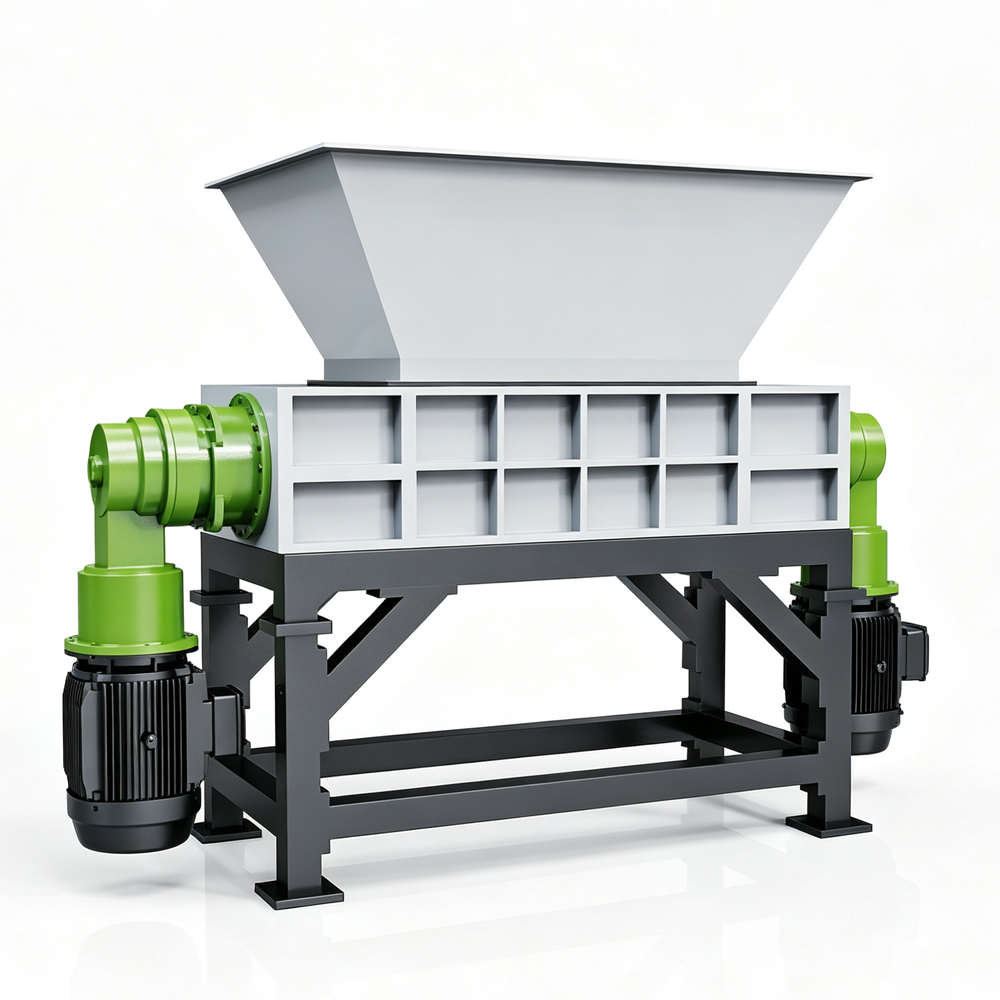
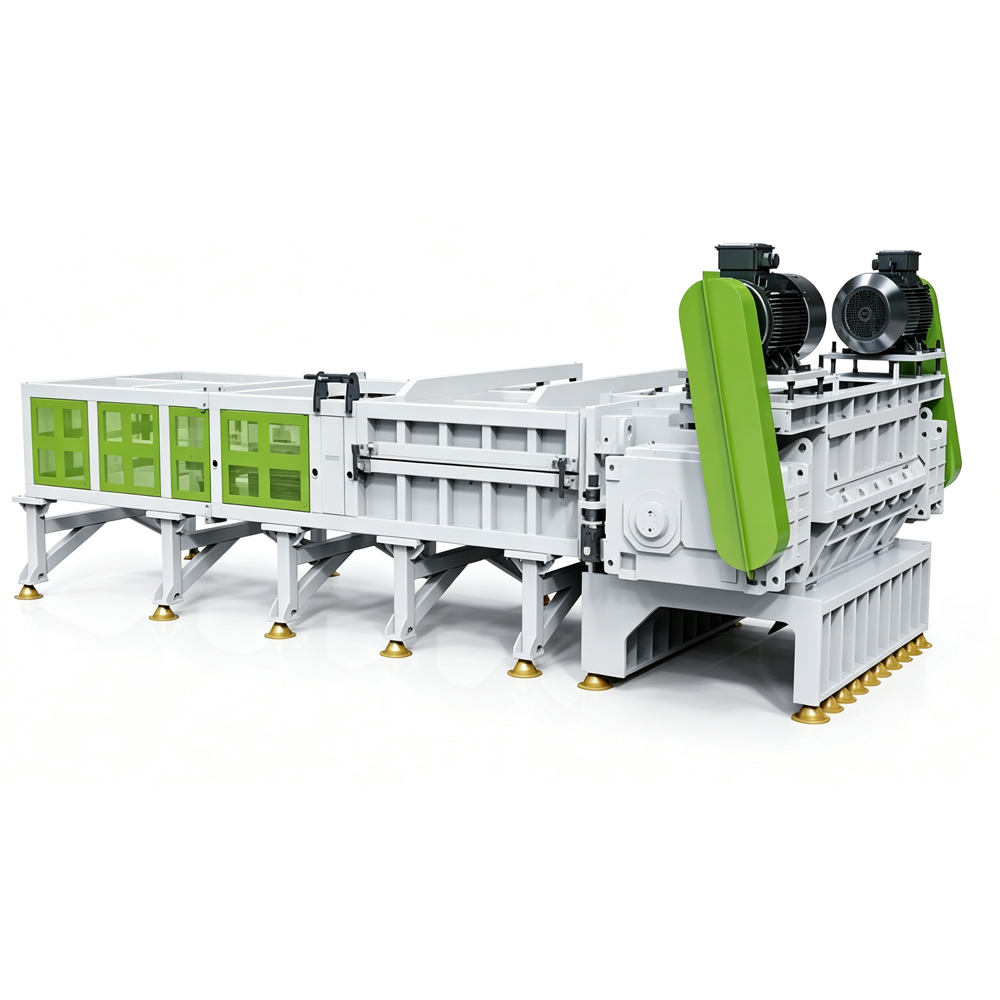
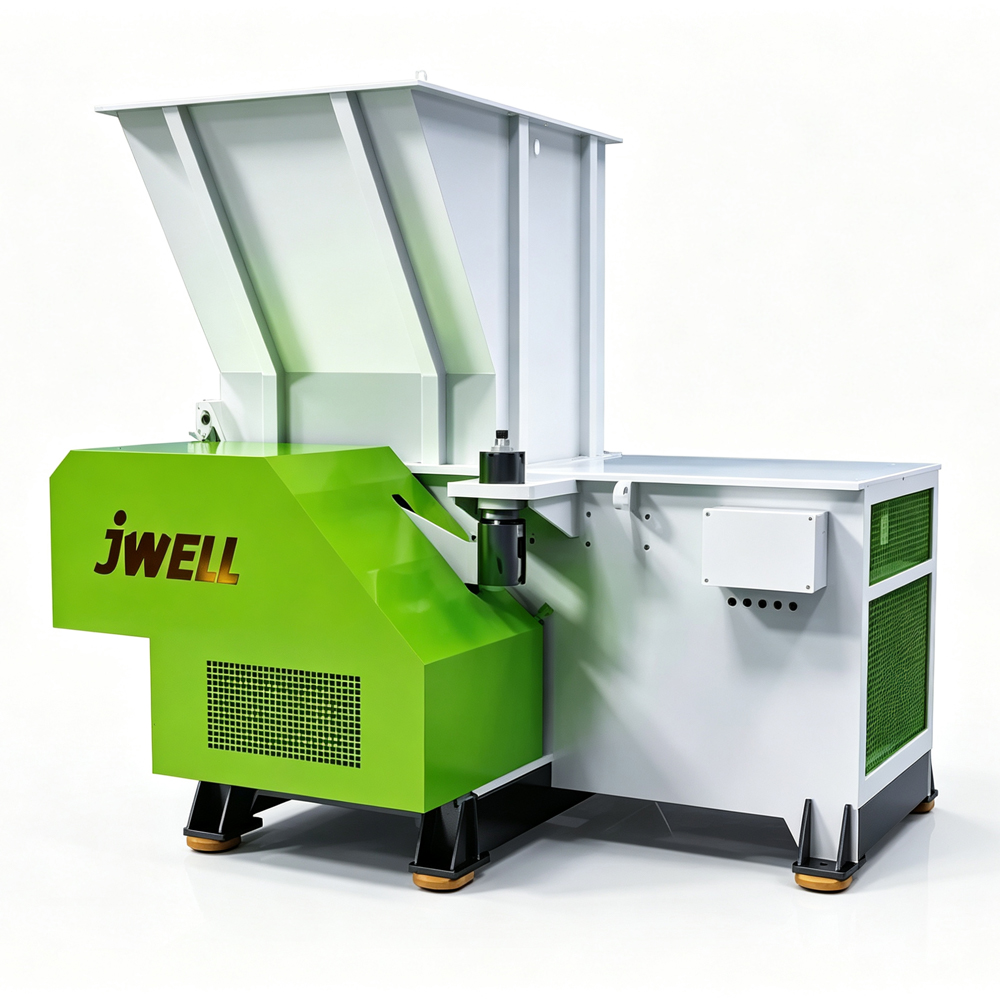
Plastic Shredder Crusher Machine

Tel: +86-19057068112

E-mail: [email protected]

Company Address
No. 128 Qingfeng Road, Xieqiao Town, Haining City, Jiaxing City, Zhejiang Province

19057068112

 English
 русский