
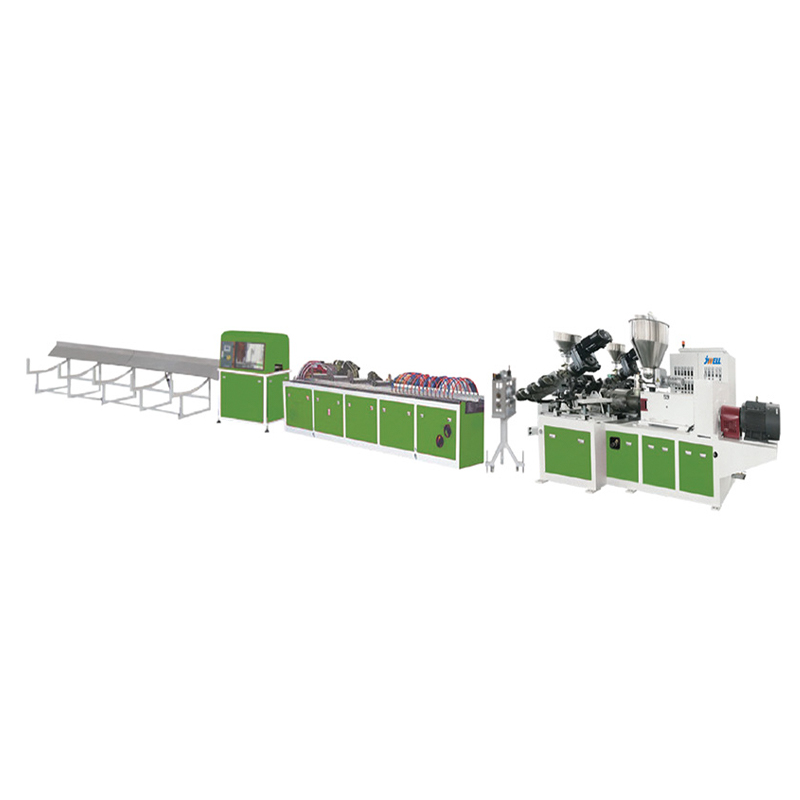
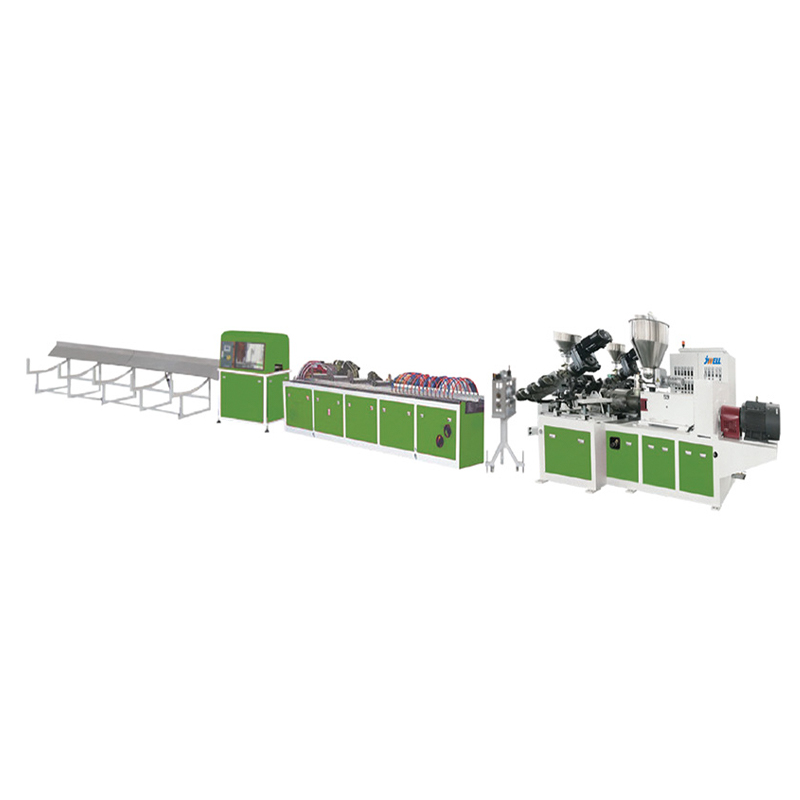
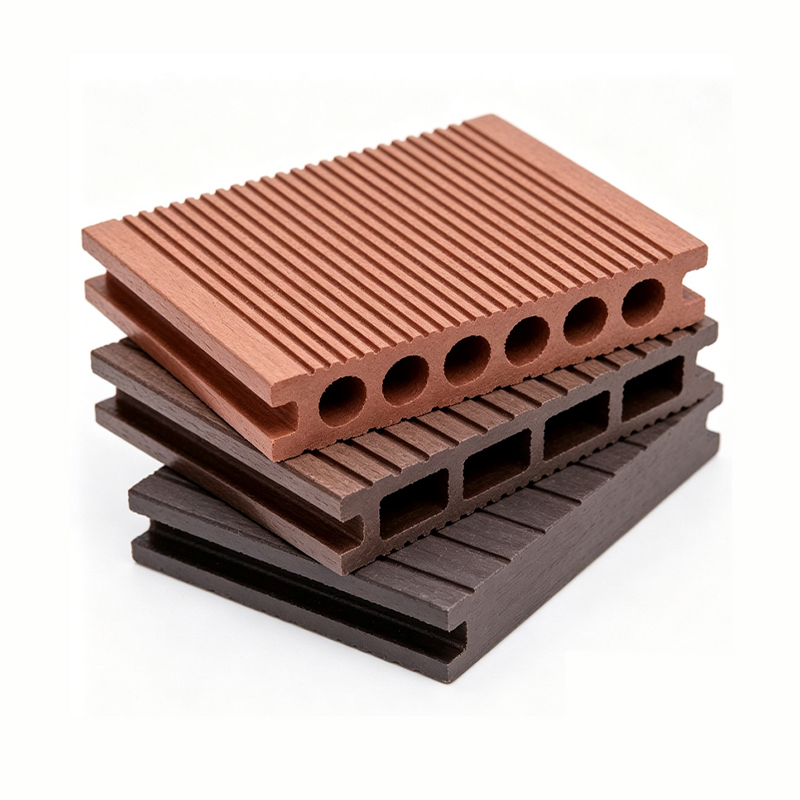
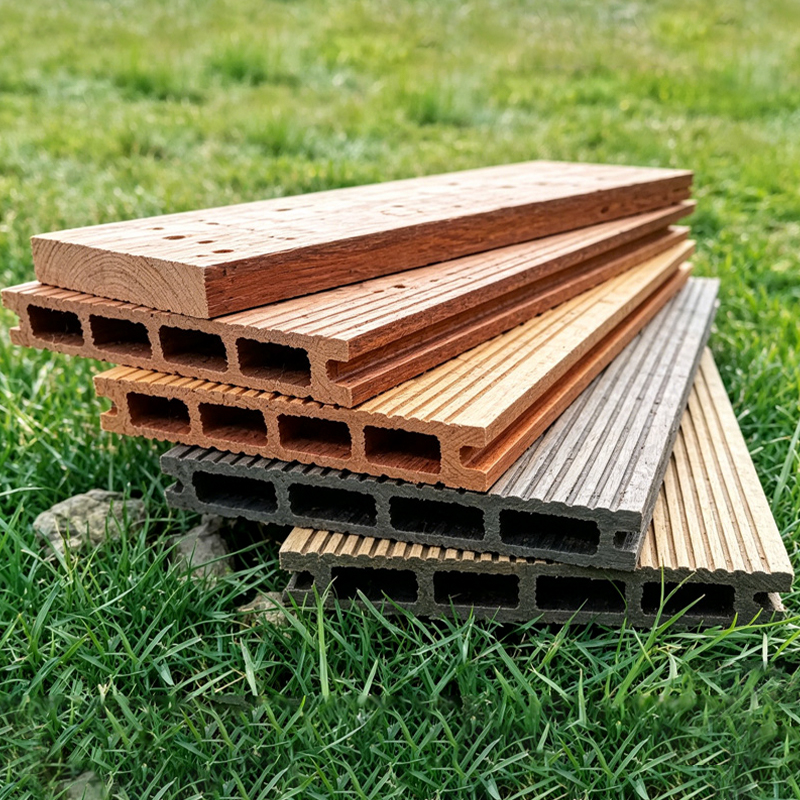
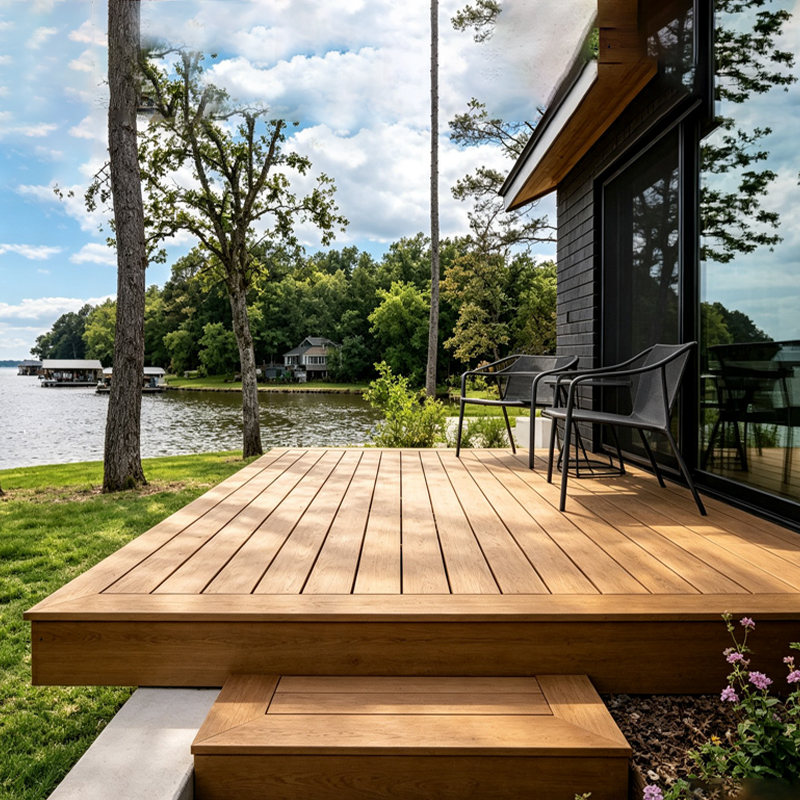
The WPC (PE&PP) Wood-plastic Floor Board Extrusion Line is specifically designed to produce wood-plastic composite (WPC) flooring based on PE (polyethylene) or PP (polypropylene) polymer matrices.
These extruders are widely used in the outdoor and indoor flooring industry, especially suitable for:
Outdoor decking (terraces, gardens, pool surroundings)
WPC decking tiles for balconies and walkways
Industrial pallets and marine boards with high moisture resistance
Practical example:
A Vietnamese producer with an annual output of 150,000 m² of WPC flooring uses the SJZ80 model. The screw specification is 80/156, main motor power 55 kW, achieving a stable output of 280–330 kg/h (within the 200–350 kg/h range) when extruding 22 mm thick boards containing 60% wood fiber and 40% recycled PE. The SJZ65 model (150–180 kg/h) is more popular among small workshops for custom narrow boards.
Material flexibility:
·PE-based WPC – better impact resistance, suitable for cold climates
·PP-based WPC – higher stiffness, suitable for load-bearing flooring
|
Parameter |
SJZ65 |
SJJ72 |
SJZ80 |
Advantage description |
|
Screw specification (mm) |
65/132 |
72/152 |
80/156 |
Increased plasticizing length, helps better dispersion of wood fiber |
|
Motor power (kW) |
37 |
45 |
55 |
Lower specific energy consumption per kg of product (e.g., SJZ80 approx. 0.20 kWh/kg, conventional 0.27) |
|
Output range (kg/h) |
150–180 |
125–300 |
200–350 |
Wide turndown ratio – SJJ72 can produce special profiles at low output or standard boards at high output |
Key operational advantages:
·Conical twin-screw design (all models) – self-cleaning screws prevent material degradation, critical for heat-sensitive wood fiber.
·High torque at low screw speed – reduces fiber burning, retains natural wood texture.
·Energy saving – after replacing a single-screw extruder with an SJZ80, a Chinese flooring plant reduced electricity costs by 18% and increased output by 35%.
·Low maintenance cost – segmented screw elements with cemented carbide provide service life exceeding 12,000 hours when processing WPC containing 15% talc.
Q1: Why does the SJJ72 have a wider output range (125–300 kg/h) than the SJZ65 (150–180 kg/h)?
A: The screw geometry of SJJ72 (72/152) allows a wider compression ratio adjustment range. At the low output end (125 kg/h), it can process high-filler formulations (70% wood flour, 30% PP) for lightweight boards; at the high output end (300 kg/h), it can process PE-based blends containing lubricants. The SJZ65 is optimized for a stable mid-range, avoiding flow instability under extreme filler ratios.
Q2: Can the SJZ80 produce PP-based WPC stably at 280 kg/h?
A: Yes, but with two considerations:
PP requires higher melt temperatures (190–200°C). Ensure that barrel cooling fans have been upgraded (at least 4 fans per zone).
Practical example: A Turkish flooring producer runs SJZ80 at 275–290 kg/h for 18 hours per day, but screw speed must be kept below 22 rpm to avoid excessive shear heat.
Q3: How often should the screw and barrel be replaced?
A: With regular maintenance (weekly cleaning of wood fiber residues) and use of wear-resistant alloys (bimetallic barrel), typical lifetimes are:
SJZ65: 8,000–10,000 hours
SJZ80: 10,000–12,000 hours
Replacement cost is about 18–22% of the extruder price.
Q4: My SJZ65 output dropped from 175 kg/h to 140 kg/h. What's wrong?
A: Most likely the screen pack is clogged with carbonized fine wood dust. Solutions:
Check melt pressure: if > 18 MPa, change the screen pack.
Also check the vent port – blocked volatiles can cause backflow.
A Polish factory solved this by adding a melt pump, stabilizing output at 168 kg/h.
Q5: Can this line produce co-extruded WPC flooring (cap layer + core layer)?
A: The main extruder can feed the core layer. For co-extrusion, a smaller extruder (e.g., SJZ35) is needed downstream. Both SJZ65 and SJZ80 have sufficient torque to drive the co-extrusion adapter without loss of stability.
Q6: What is the typical energy consumption per ton of WPC flooring produced?
A: According to field data:
SJZ65: 210–230 kWh/ton
SJJ72: 200–220 kWh/ton (at 250 kg/h output)
SJZ80: 190–210 kWh/ton (at 330 kg/h output)
This is 15–20% lower than parallel twin-screw extruders.
| Model | SJZ65 | SJZ72 | SJZ80 |
| Screw size | 65/132 | 72/152 | 80/156 |
| Power of main motor(kw) | 37 | 45 | 55 |
| Output(kg/h) | 150-180 | 125-300 | 200-350 |
Q1: Can I produce both solid and hollow profiles on the same line?
A: Yes. The SJ65, SJ72, and SJ80 can all work with different molds and calibration tables. For hollow profiles (e.g., 4-cavity decking), we recommend the SJ72 or SJ80 because they provide higher melt pressure to fully fill thin ribs. Quick mold change takes about 45 minutes.
Q2: What typical wood-to-plastic ratios can these extruders handle?
A:
SJ65: up to 50% wood fiber (by weight)
SJ72: up to 55%
SJ80: up to 60% (thanks to the 156 kW motor and larger screw channels)
Higher wood flour content reduces material cost but requires better cooling. We equip high-filling formulations with a 12-meter vacuum calibration tank.
Q3: How do you control warpage of profiles after cooling?
A: Warpage is mainly caused by uneven cooling or internal stress. Our lines include:
6-zone vacuum calibration sleeve with independent water flow control
4-meter spray cooling tank with adjustable nozzles
Servo-driven caterpillar haul-off that maintains constant tension (tension range 0–5000 N)
For the SJ80, we also add an online laser straightness sensor that automatically adjusts haul-off speed when deviation exceeds 1.5 mm/m.
Q4: What is the average energy consumption per kg of finished product?
A: Based on customer reports (continuous 8-hour operation):
SJ65: approx. 0.24 kWh/kg
SJ72: approx. 0.22 kWh/kg
SJ80: approx. 0.20 kWh/kg (lower due to higher output, spreading fixed costs)
These values assume a typical WPC formulation: 55% wood flour, 40% HDPE, 5% additives.
Q5: Do you provide complete lines including mixing, feeding, and downstream equipment?
A: Yes. Each extrusion line includes:
Automatic batch mixer (500 L or 1000 L)
Volumetric or gravimetric feeder (±0.5% accuracy)
Extruder + die
Vacuum calibration table (6 m / 8 m / 12 m)
Spray cooling tank (4 m / 6 m)
Haul-off unit (caterpillar type)
Flying cut-off saw with dust collection
Tilted discharge conveyor
For the SJ80, we also offer an optional fully automatic stacking robot for heavy decking profiles (up to 6 m long, 15 kg each).




Pipe Extrusion Production Line
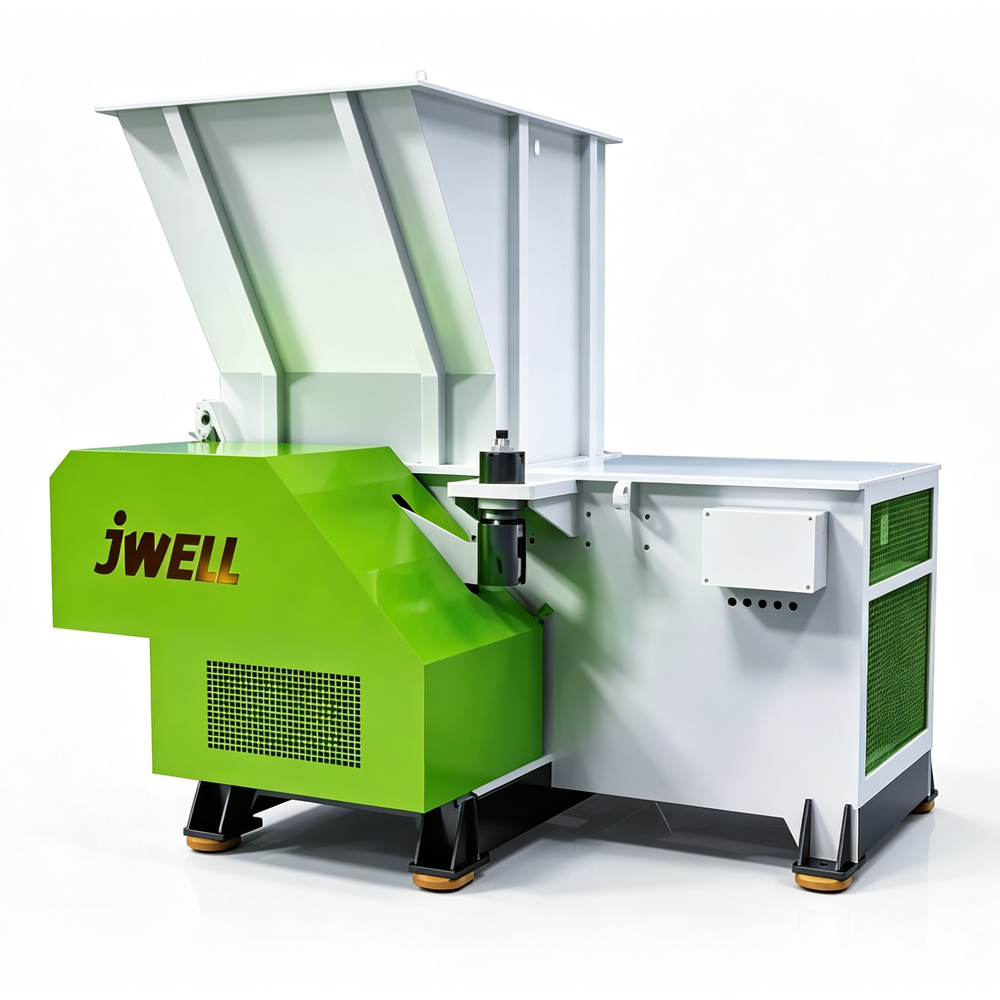
Plastic Shredder Crusher Machine

Tel: +86-19057068112

E-mail: [email protected]

Company Address
No. 128 Qingfeng Road, Xieqiao Town, Haining City, Jiaxing City, Zhejiang Province

19057068112

 English
 русский