
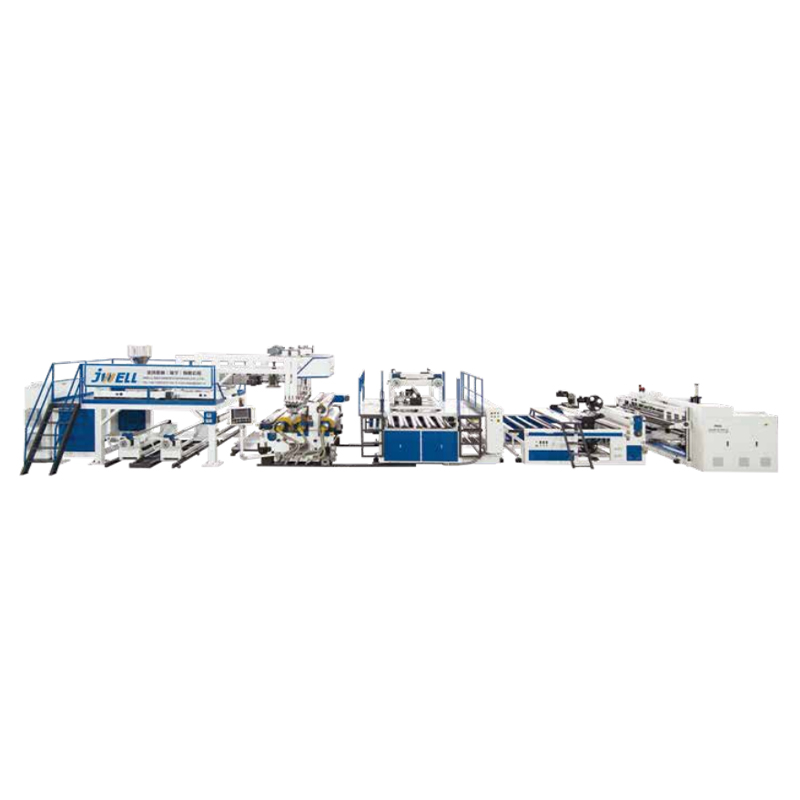
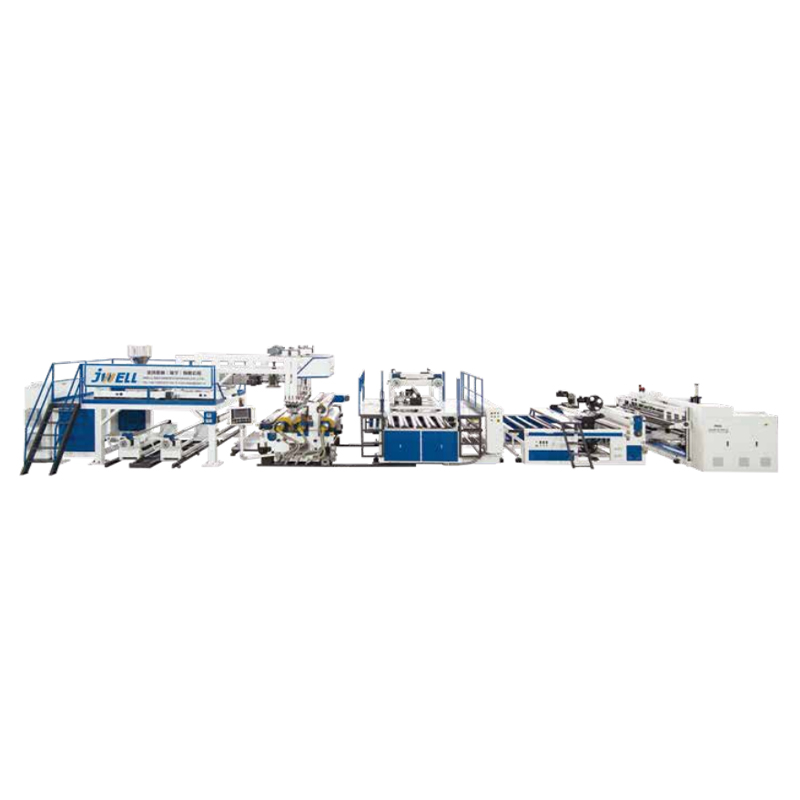
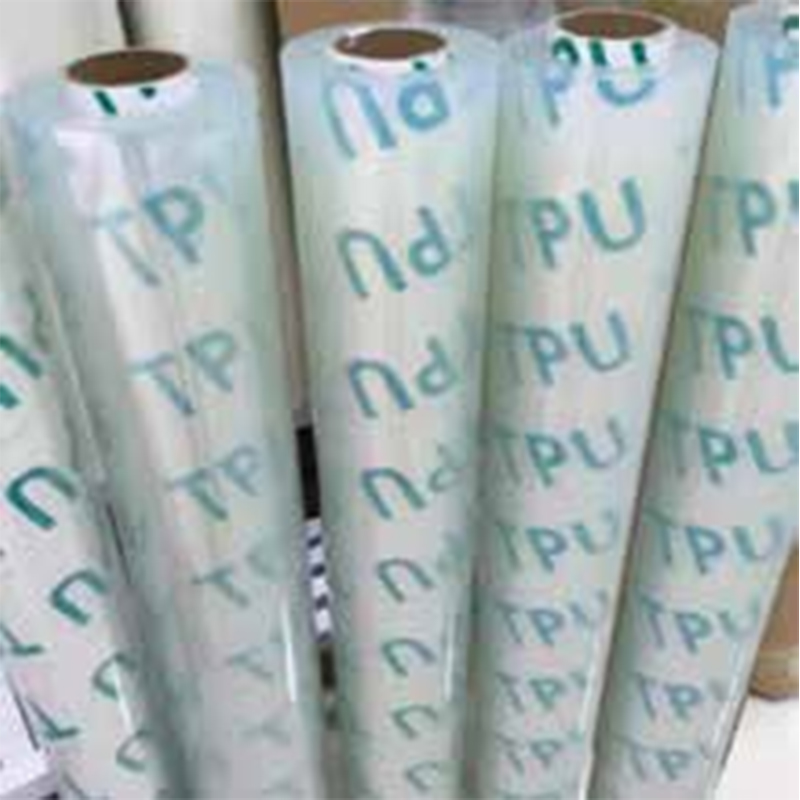
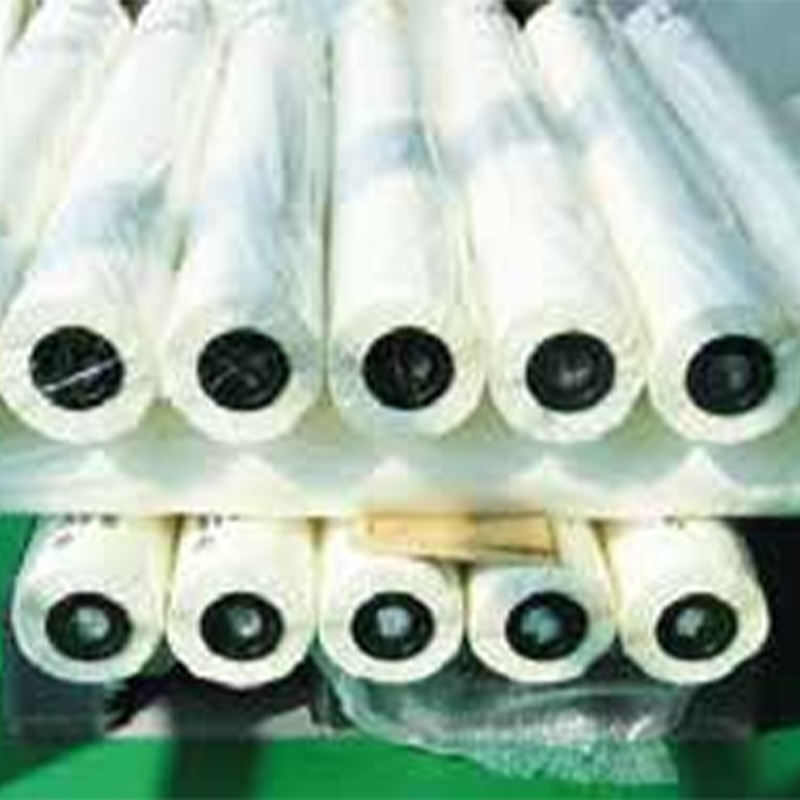


The JWS90-2000, JWS100-2000, and JWS120-2000 are three cast extrusion lines specifically designed for thermoplastic elastomer films, suitable for materials such as TPU, TPE, and EVA. All models support a fixed finished width of 1620mm and film thickness ranging from 0.03mm to 0.30mm, meeting the production needs of both ultra-breathable films and medium-thickness industrial films.
Thanks to its wide width (1620mm) and ultra-thin processing capability (down to 0.03mm), this series is widely used for:
Breathable TPU films for sportswear and outdoor equipment – laminated with fabric to achieve waterproof and breathable performance.
Heel counters/toe puffs for footwear – using TPU or EVA for lightweight, durable reinforcement.
Medical mattress covers and surgical drapes – soft, hypoallergenic TPU films.
Air cushions / inflatable films – for packaging or air spring systems.
Elastic films for TPE fitness resistance bands – high resilience performance.
Real case:
A Vietnamese sport shoe component supplier uses the JWS100-2000 to produce 0.15mm TPU air cushion film at an output of 180 kg/h. Thanks to the 1620mm die width, they slit it into three 500mm rolls with minimal edge waste, saving 8% of raw material per month.
|
Feature |
Advantage |
|
Three output levels – 100-150 / 150-200 / 200-250 kg/h |
Match capacity to order volume. Start with JWS90, upgrade to JWS120 as demand grows. |
|
Fixed finished width 1620mm |
Standardized slitting – no need for custom dies for common widths (e.g., 1.6m rolls for lamination lines). |
|
Thickness range 0.03–0.30mm |
One line covers thin breathable films (0.03-0.05mm) and thicker industrial films (0.25-0.30mm). |
|
Multi-material capability – TPU, TPE, EVA |
Switch between materials without changing screw geometry. Ideal for compounders producing different elastomers. |
|
Energy-saving screw design (JWS90/100/120) |
Lower melt temperature, reducing degradation risk for heat-sensitive TPU. |
Real case – ultra-thin film challenge:
A German medical film manufacturer needed TPU film <0.04mm with tolerance ±0.002mm. The JWS90-2000 running at 120 kg/h, with optional automatic lip adjustment, achieved stable thickness. Scrap rate dropped from 11% in the first month to 3.2%.
We apply a four-stage quality control protocol for every JWS line before shipment and during production.
A.In-process monitoring (during extrusion)
Online thickness gauge (beta or X-ray) – scans full 1620mm width, closed-loop feedback to automatic die.
Melt pressure & temperature sensors – at adapter and die – alarm on TPU viscosity fluctuations.
Winding tension control – prevents stretching or wrinkling of thin films.
B.Laboratory testing (samples per shift)
|
Test item |
Standard |
Target value for TPU film |
|
Thickness uniformity |
ASTM D374 |
≤ ±5% across full width |
|
Tensile strength |
ASTM D882 |
MD ≥ 25 MPa, TD ≥ 20 MPa |
|
Tear strength |
ASTM D1004 |
≥ 80 kN/m |
|
Modulus at 100% |
ASTM D412 |
2–8 MPa (depending on grade) |
|
Elmendorf tear |
ISO 6383-2 |
≥ 10 N (for 0.05mm film) |
C.Real-world condition simulation
Heat aging – 7 days at 70°C, check yellowing (ΔE < 3).
Moisture resistance – 85% RH / 40°C, no delamination of laminated film.
D.Finished roll inspection
Visual inspection for fish eyes, gels, black specks (critical for transparent TPU).
Core ID and edge alignment – ensures smooth unwinding on customer's lamination or bag-making equipment.
Example from our factory:
Before shipping a JWS120-2000 to a US packaging film converter, we ran a 6-hour production trial using their own TPU resin (Shore 85A). The online thickness profile showed a maximum deviation of 0.008mm across 1620mm width – far better than their requirement of ±0.010mm. The customer witnessed the test via live video.
|
Mode
|
JWS90-2000
|
JWS1000-2000
|
JWS1200-2000
|
|
Material
|
TPU、TPE、EVA
|
TPU、TPE、EVA | TPU、TPE、EVA |
|
Extruder Specification
|
JWS90
|
JWS1000
|
JWS1200
|
|
Products Width(mm)
|
1620
|
1620
|
1620
|
|
Products Thickness(mm)
|
0.03-0.30
|
0.03-0.30
|
0.03-0.30
|
|
Capacity(Max.)(kg/h)
|
100-150
|
150-200
|
200-250
|
Q1: Which model should I choose for TPU film thickness between 0.10–0.20mm?
A:
JWS90-2000 (100-150 kg/h) – for trial production or small batches (<300 tons/year).
JWS100-2000 (150-200 kg/h) – most popular medium-output model; best balance of investment and output.
JWS120-2000 (200-250 kg/h) – for high-volume orders, e.g., continuous production of diaper breathable film.
Real data: A customer producing 0.12mm TPU floor mat film found that the JWS100 achieved 175 kg/h at 25 rpm screw speed, while the JWS120 reached the same output at only 18 rpm – less wear.
Q2: Can I run TPE and EVA on the same line without cross-contamination?
A: Yes, but thorough purging is required. We recommend a screw with interchangeable screw tip design. In practice, customers switch from TPU (85A) to TPE (65A) in about 45 minutes using commercial purging compound. For EVA (VA content 18-28%), the same screw works – just lower the melt temperature by 15-20°C compared to TPU.
Q3: How do you maintain thickness tolerance on ultra-thin films down to 0.03mm?
A: Three key factors:
Die lip precision – our flat die has 30 adjustment points across 1620mm width.
Chill roll temperature uniformity – roll surface temperature ±0.5°C (internal spiral baffle design).
Air knife position – precisely set to pin the melt curtain.
We provide operating settings for each thickness range. One Italian customer produced 0.035mm TPU film continuously for 72 hours with thickness variation below 2%.
Q4: What is the energy consumption?
A: At full production, the JWS100-2000 consumes approximately 110-125 kW (including heating, drives, and cooling). That equates to 0.65-0.75 kWh per kg of TPU film – very competitive for this width range. The JWS90, being smaller, has slightly higher consumption per kg (0.80 kWh/kg).
Q5: Do you provide spare parts and remote troubleshooting?
A: Yes. Commonly used wear parts (screw elements, barrel liners, die lip inserts) are all in stock. For software or drive issues, we perform remote access via VPN. A customer in Brazil recently resolved a winding tension fluctuation issue within 2 hours with the help of our remote engineer.
Q6: The line's nominal finished width is 1620mm. If I only want 800mm or 1000mm wide film, do I have to run full width?
A: No. 1620mm is the maximum effective width of the die flow channel; you can certainly produce narrower film. Two practical approaches:
Adjust die lip opening – close some adjustment bolts at both ends of the die to concentrate melt in the desired central width. For example, narrow the effective width to 1000mm, leaving about 310mm on each end as transition zones (later trimmed). Suitable for small batches or frequent width changes.
Run full width and slit – extrude full width (1620mm), then slit into narrow rolls on a separate slitter. This is what most customers do, because 1620mm evenly yields three 540mm rolls or four 400mm rolls with low edge trim waste.
Real case: A customer producing TPU film for phone cases needed a final width of 320mm. Using a JWS100-2000, they extrude full 1620mm film and then slit into five 320mm rolls (5×320=1600mm, with 10mm trim each side). Compared to a custom narrow die, this approach gives them flexibility for different orders and reduces die cost by over 60%.
Q7: When producing TPU film, we occasionally get gels (fish eyes) on the surface. What causes this and how to avoid it?
A: Gels (also called specks or unmelted particles) are a common issue in TPU extrusion. Main causes and countermeasures:
|
Cause |
Mechanism |
Solution |
|
Insufficient resin drying |
TPU is hygroscopic; moisture causes hydrolysis at high temperature, forming crosslinked gels |
Use a dehumidifying dryer, ensure resin moisture ≤0.02%. Dry at 90-100°C for 3-4 hours |
|
Excessive melt temperature or shear heating |
Local overheating degrades TPU, forming yellow or black gels |
Use JWS series low-shear energy-saving screw; control melt temperature at 180-200°C (depending on grade). Avoid long idle periods with heat on |
|
Insufficient screen mesh size |
Impurities or unmelted material pass through the screen |
Recommend dual-layer screen: 100 mesh bottom, 150 mesh top. For high-clarity films, use 200 mesh + sintered mesh |
|
Screw and barrel wear |
Worn areas create dead spots where material stagnates and degrades |
Regularly check screw clearance. JWS series screws use bimetallic alloy; normal service life is about 8000-10000 hours (when processing neat TPU) |
Real data: A customer producing transparent TPU medical film encountered excessive gels (>15 per m²). Investigation found drying temperature only 70°C with insufficient time. After changing to drying at 100°C for 4 hours, gels dropped to <3 per m², fully meeting medical standard ISO 16671. Additionally, installing a melt pressure gauge before the screen pack and changing screens when pressure rises 20% further reduces gel formation.





Tel: +86-19579950928

E-mail: [email protected]

Company Address
No. 128 Qingfeng Road, Xieqiao Town, Haining City, Jiaxing City, Zhejiang Province

19579950928

 English