
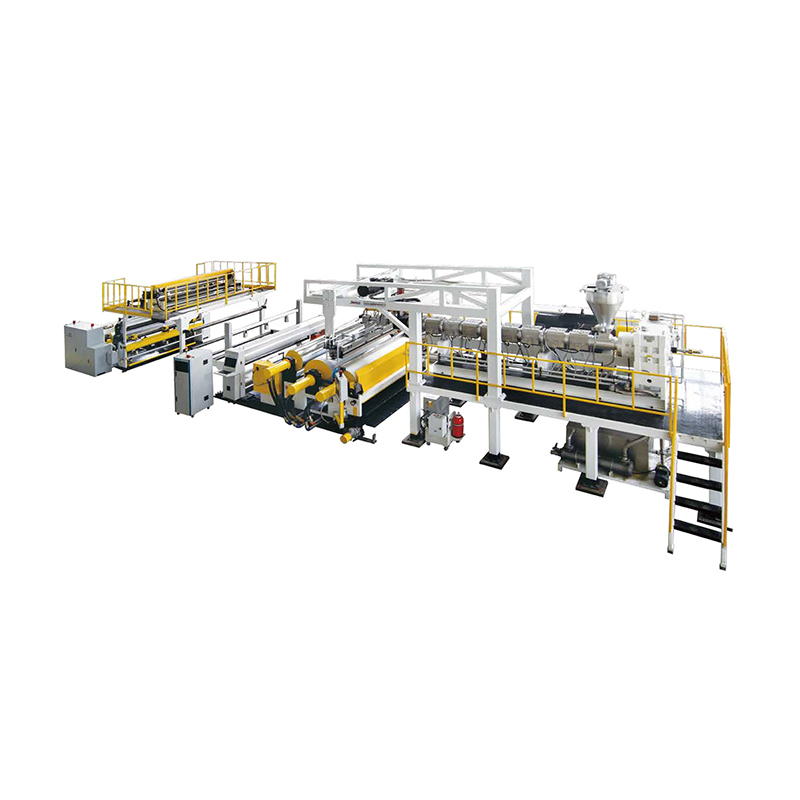
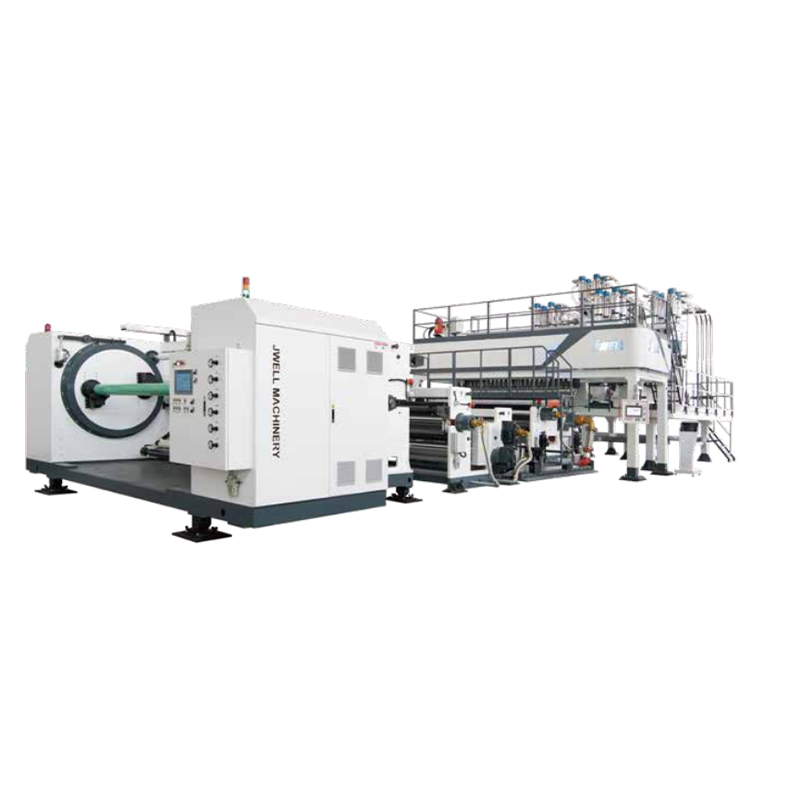
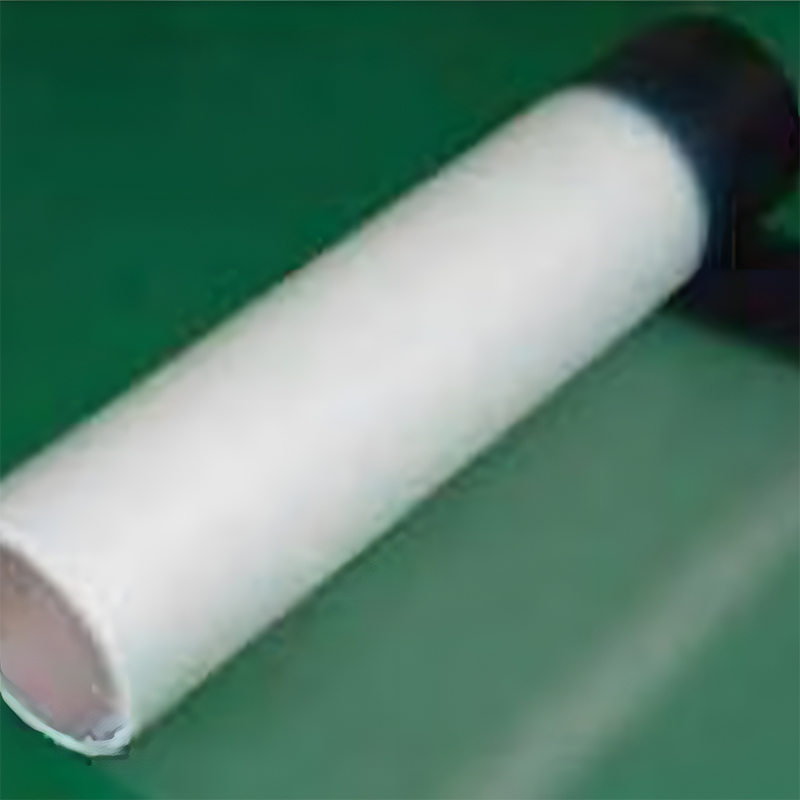

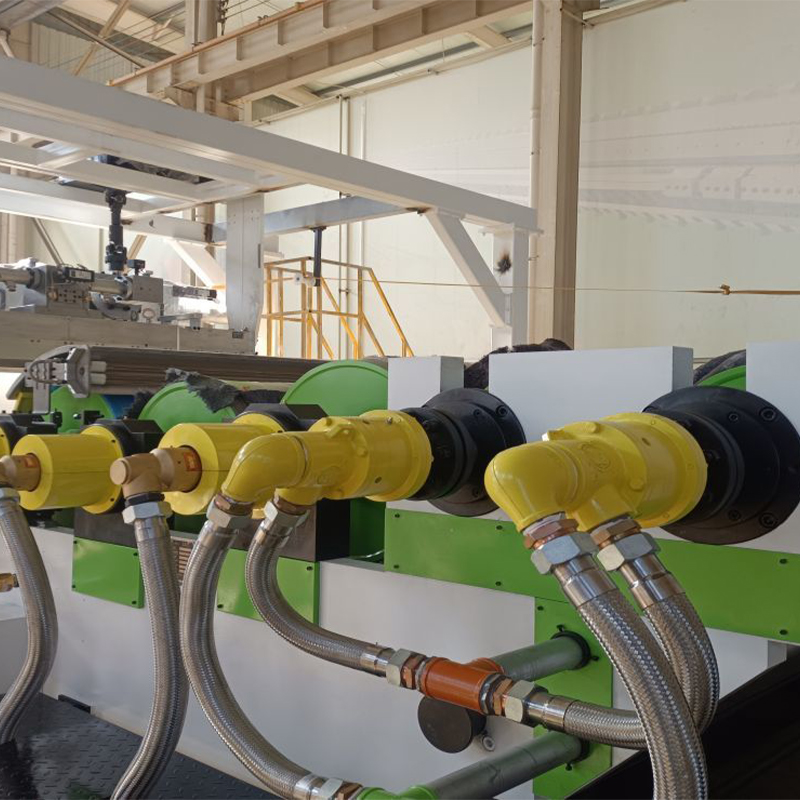
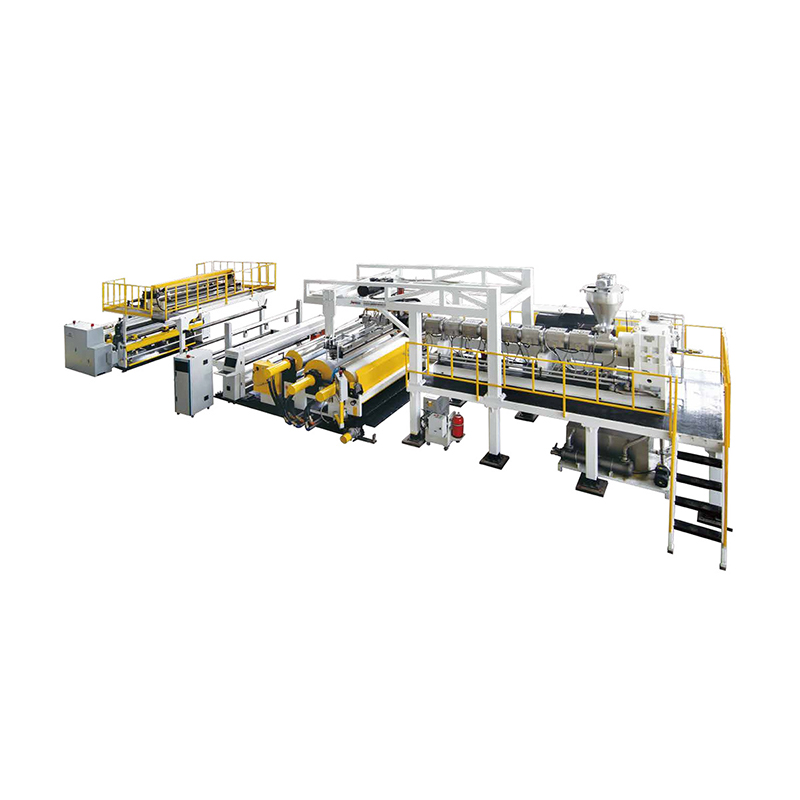
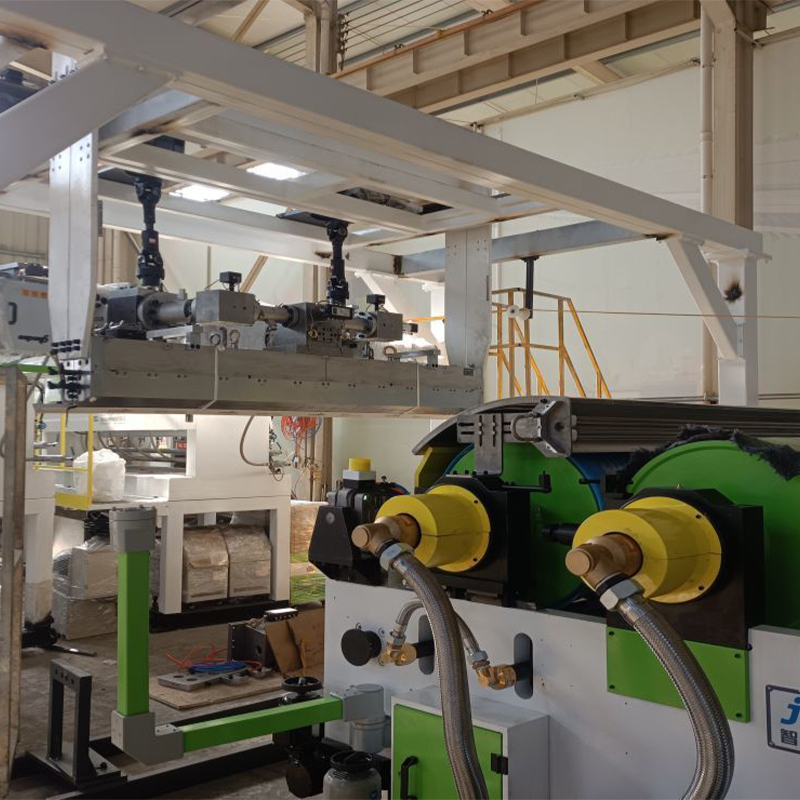
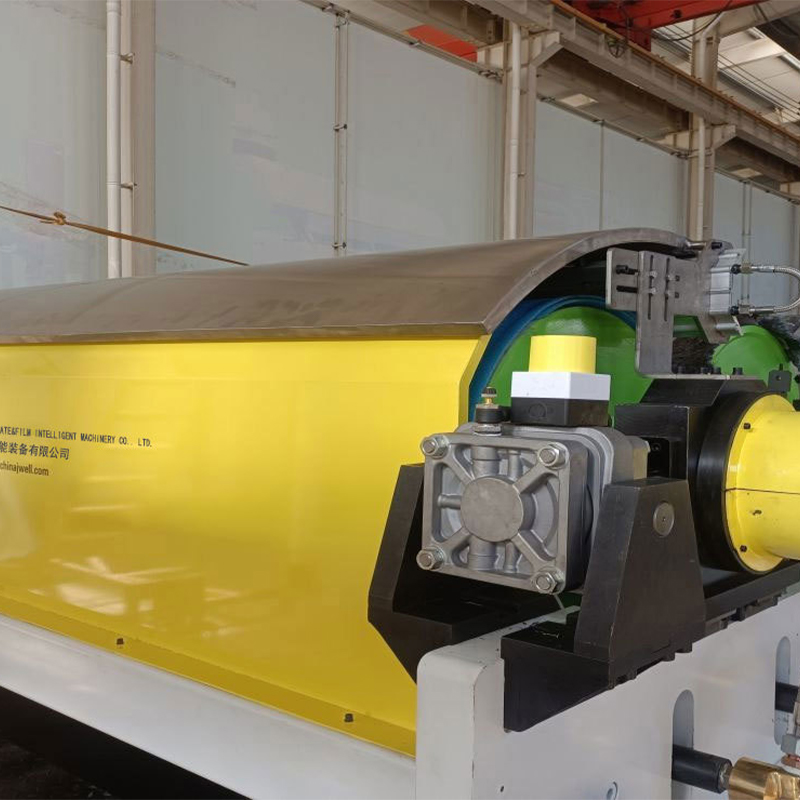
This series of EVA/POE/PVB/SGP film extrusion lines features a flat die cast design, dedicated to the continuous production of encapsulant films for photovoltaic modules and interlayer films for architectural/automotive laminated glass. The series includes five models: JWS120/150/120-2400, JWS180-2400, JWS150, JWE95-JWE65, and JWE135-JWE95. Applicable raw materials cover EVA, POE, PVB, and SGP. Finished product width ranges from 2000 mm to 3600 mm, thickness from 0.38–1.52 mm, design line speed up to 20 m/min, and maximum single-machine extrusion output up to 1200 kg/h.
Benefiting from the diversity of materials (EVA, POE, PVB, SGP) and adjustable dimensional parameters, this extrusion line serves two major industries:
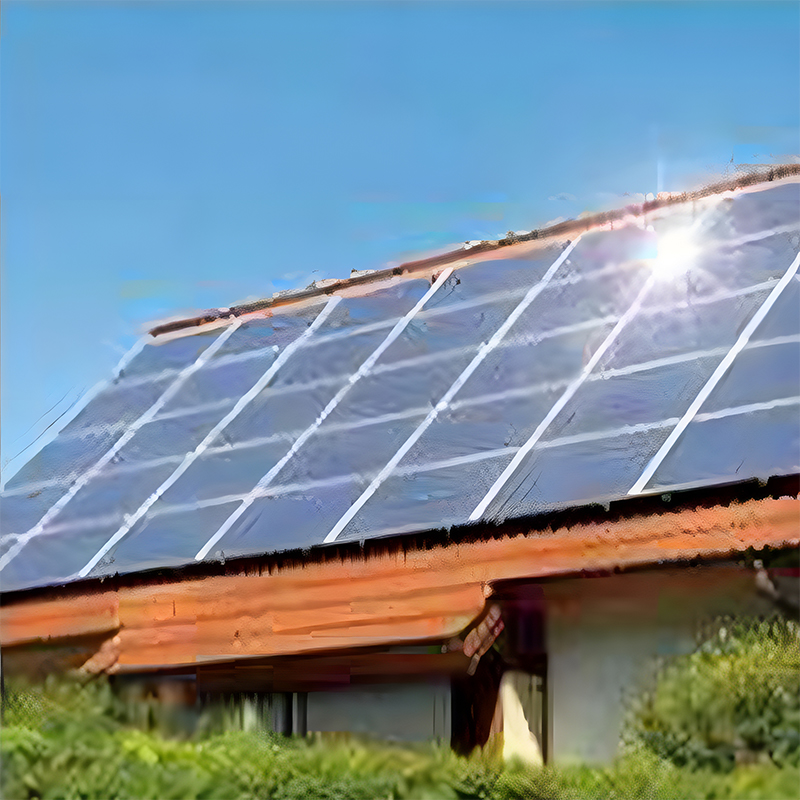
Photovoltaic encapsulation – EVA/POE films
Applicable models: JWS120/150/120-2400, JWS180-2400, JWE135-JWE95
Film width: 2000–2400 mm (suitable for 210 mm wafers and half-cut modules)
Thickness: 0.38–1.0 mm (conventional 0.45 mm or 0.60 mm for bifacial modules)
Line speed: 12–20 m/min → suitable for high-volume production
Real case: A tier-1 PV module manufacturer in Vietnam installed a JWE135-JWE95 line (width 3000–3600 mm, output 1000–1200 kg/h) to produce POE film for bifacial modules. The 20 m/min line speed increased daily output by 35% compared to older single-screw lines.
Laminated safety glass – PVB/SGP films
Applicable models: JWS150, JWE95-JWE65, JWE135-JWE95
Film width: 2400–3600 mm (suitable for large curtain walls and hurricane-resistant windows)
Thickness: 0.38–1.52 mm (from 0.38 mm acoustic grade to 1.52 mm structural SGP grade)
Real case: A European architectural glass processor used a JWE95-JWE65 (width 2400–3000 mm, output 600–700 kg/h) to produce SGP film for a high-rise airport curtain wall in London. The line’s stability at 10 m/min ensured thickness deviation below 2% across 2.8 m width.
2.1 Ultra-high output, suitable for large-scale production
JWE135-JWE95 output up to 1000–1200 kg/h – ideal for 24/7 continuous operation.
Example: Producing 0.5 mm EVA film at 20 m/min yields over 9 tons per day.
2.2 Wide width capability (up to 3600 mm)
JWE135-JWE95 supports 3000–3600 mm finished width, directly matching next-generation PV modules and oversized glass panels (no slitting waste).
JWS150 max width 2600 mm – perfect for automotive laminated glass.
2.3 Flexible thickness range
EVA/POE lines: 0.38–1.0 mm (covers standard PV encapsulation and anti-PID grades)
PVB/SGP lines: 0.38–1.52 mm (meets EN, ANSI, and Chinese GB explosion-proof glass standards)
2.4 High line speed = shorter lead times
20 m/min on JWE135-JWE95 → up to 1200 meters of finished film per hour.
Even the PVB-focused JWS150 reaches 10 m/min, competitive for high-transparency architectural films.
2.5 Multi-screw co-extrusion (built into models)
JWS120/150/120-2400 uses a three-screw design (120/150/120) enabling ABA or ABC multilayer films – critical for UV-blocking EVA or low-fluorescence POE.
JWE95-JWE65 and JWE135-JWE95 are tandem extruders, providing better melt uniformity for SGP (SGP requires higher melt strength).
Every extrusion line we deliver comes with documented quality control protocols. Below are the standard tests performed on both the machine and the produced film.
3.1 Online process monitoring (real-time)
Online thickness gauge (NDC or beta ray) – scans full width every 30 seconds. Tolerance: ±0.01 mm.
Melt pressure and temperature sensors on each screw – triggers alarm if deviation exceeds 2%.
3.2 Film performance tests (per batch/per roll)
|
Test Item |
Equipment/Standard |
Acceptable Range for EVA/POE |
Acceptable Range for PVB/SGP |
|
Thickness deviation |
ISO 527-3 |
≤ ±3% across full width |
≤ ±2.5% across full width |
|
Tensile strength (MD/TD) |
Universal tester |
≥ 18 MPa |
≥ 22 MPa (SGP ≥ 40 MPa) |
|
Light transmittance |
ASTM D1003 |
≥ 91% (PV grade) |
≥ 88% (architectural) |
|
Shrinkage (120°C, 3 min) |
Oven method |
≤ 2.5% (MD), ≤ 1.0% (TD) |
≤ 1.5% (MD/TD) |
|
Crosslinking degree (EVA) |
DSC |
75–85% |
N/A |
|
Peel strength from glass |
90° peel test |
≥ 60 N/cm (EVA) |
≥ 80 N/cm (PVB) |
3.3 Real quality control case
A customer in Saudi Arabia used a JWS180-2400 to produce POE film and adopted our recommended online thickness feedback system. Within one week, the CPK value increased from 0.85 to 1.25, and scrap rate dropped from 5.2% to 1.8%.
|
Model
|
Suitable material
|
Products width (mm)
|
Products thickness (mm)
|
Designed line speed (m/min)
|
|
JWS120/150/120-2400
|
EVA/POE
|
2000-2400
|
0.38-1.0
|
15
|
|
JWS180-2400
|
EVA/POE
|
2000-2400
|
0.38-1.0
|
12
|
|
JWS150
|
PVB/SGP
|
2000-2600
|
0.38-1.52
|
10
|
|
JWE95-JWE65
|
PVB/SGP
|
2400-3000
|
0.38-1.52
|
10
|
|
JWE135-JWE95
|
PVB/SGP
|
3000-3600
|
0.38-1.52
|
20
|
Q1: Can I switch between EVA and POE on the same line?
A: Yes – JWS120/150/120-2400 and JWS180-2400 are designed for both EVA and POE. However, POE requires a slightly lower melt temperature (approx. 75–85°C vs. 90–100°C for EVA). We recommend a thorough screw cleaning using purging compound when switching. The switchover takes about 45–60 minutes.
Q2: How do I adjust film thickness uniformity across 3.6 m width?
A: Use an automatic die with more than 48 heating bolts (optional on JWE135-JWE95). Our online thickness gauge sends signals to individual lip heaters. For manual adjustment, the flat die is equipped with a flexible lip with 0.1 mm precision. Always start with melt temperature uniformity – ensure temperature deviation of each zone on each screw is within ±2°C.
Q3: What is the MOQ for customized widths?
A: We customize each line according to your required working width. For example, the JWS150 can be customized in 100 mm increments from 2000–2600 mm. Lead time for non-standard widths is 90–120 days.
Q4: How does line speed affect product performance?
A: Higher speeds (e.g., 20 m/min on JWE135-JWE95) increase molecular orientation, slightly improving MD tensile strength but potentially increasing TD shrinkage. For SGP films, if optical clarity >92% is required, we recommend keeping speed below 15 m/min. Our control system supports recipe-based speed presets.
Q5: What maintenance is required for the three-screw configuration (JWS120/150/120)?
A: The main screws (120 mm and 150 mm) should be extracted for inspection every 8000 operating hours. If using highly filled EVA (≥30% CaCO₃), the side screw (120 mm) wears faster. We stock screw elements and barrels for global 48-hour shipment.
Q6: Can I produce both PVB and SGP on the same line?
A: Partially yes – JWS150, JWE95-JWE65, and JWE135-JWE95 all support both materials. However, SGP requires higher melt temperature (210–230°C) and corrosion-resistant screws (our standard is nitrided steel + bimetallic barrel). PVB runs at 170–190°C. When switching between these two materials, the seals of the melt pump and screen changer must be replaced.





Tel: +86-19579950928

E-mail: [email protected]

Company Address
No. 128 Qingfeng Road, Xieqiao Town, Haining City, Jiaxing City, Zhejiang Province

19579950928

 English