
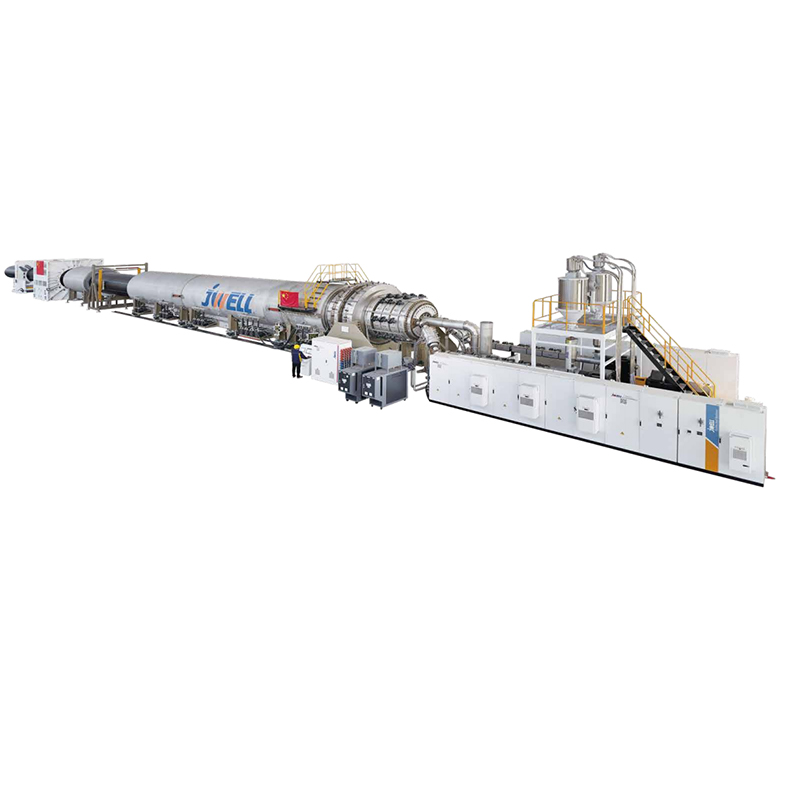
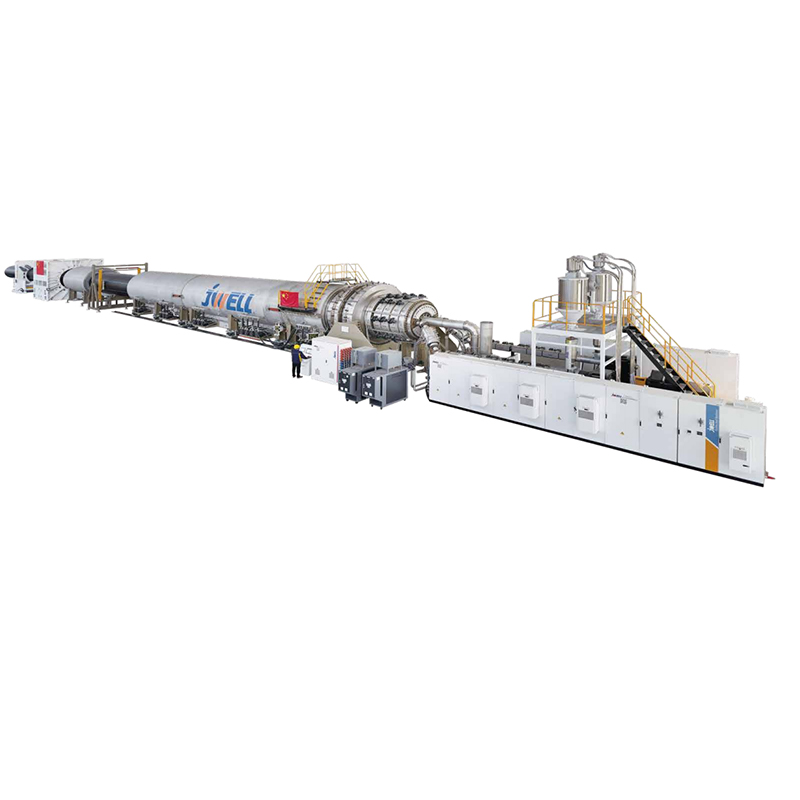
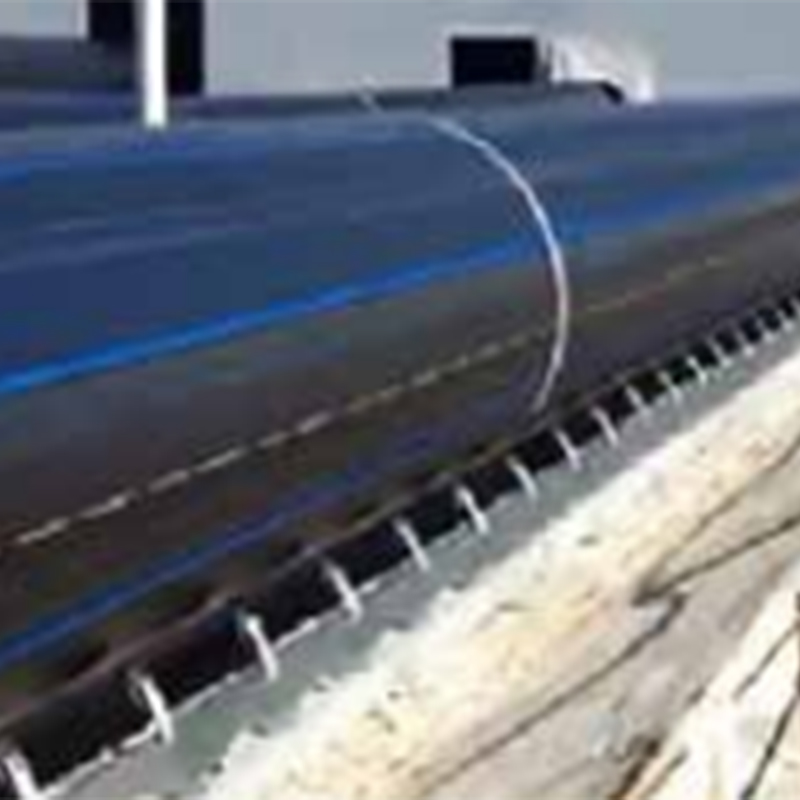
Our Large diameter HDPE solid wall tube extrusion line (JWG 800 to JWG 3000 models) is specially designed for high-output production of pressure and non-pressure pipes, suitable for water supply, sewage, industrial slurry transportation, and mining applications.
The pipe outer diameter range of this production line is 400 mm to 3000 mm, suitable for large-scale infrastructure projects:
Municipal water transmission – Main urban pipelines (e.g., 1200 mm pipe supplying water to over 200,000 residents)
Stormwater and sewage systems – Pipes with high ring stiffness for deep burial or heavy traffic loads.
Industrial wastewater and mining – Wear-resistant HDPE pipes for tailings or chemical waste.
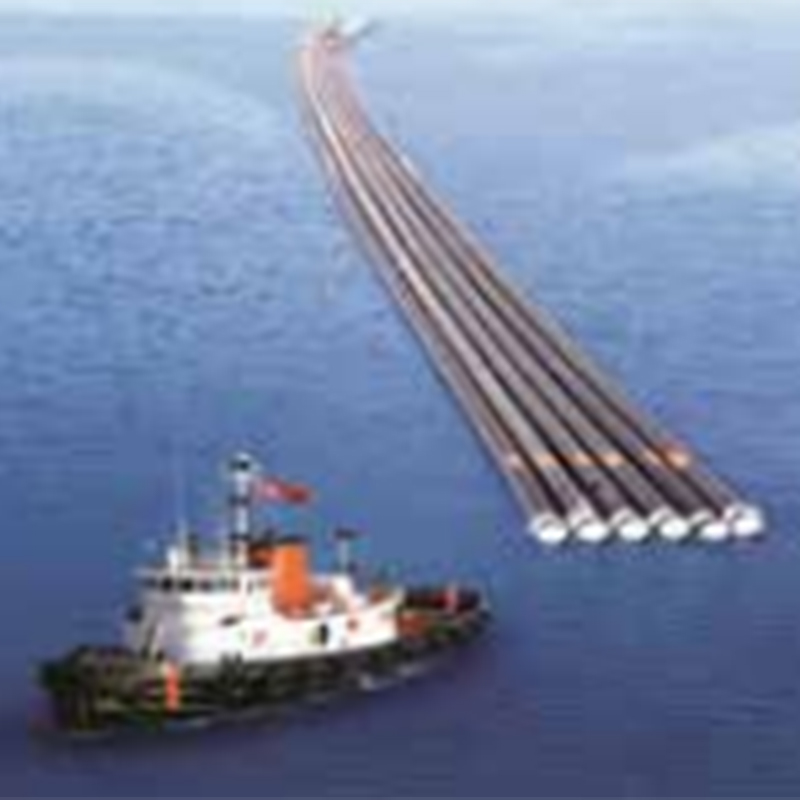
Dredging and marine outfalls – Floating or underwater pipelines requiring corrosion resistance.
Real case: A water authority in Southeast Asia used the JWG-1600 (twin JWS 90/42 extruders, 2×315 kW) to produce DN1500 HDPE pipes at 2100 kg/h for a 45 km raw water transmission project. The twin-extruder configuration allows co-extrusion of an indicator stripe layer without reducing output.
|
Feature |
How the parameter creates value |
|
Wide diameter range |
One line covers 400-3000 mm (4 models). JWG-800: 400-800 mm; JWG-3000: 2000-3000 mm – no need for multiple lines. |
|
High specific output |
JWG-1200: single JWS 120/38 (400 kW) reaches 1500-1600 kg/h. That means lower specific energy consumption (approx. 0.25-0.27 kWh/kg). |
|
Twin-extruder technology |
JWG-1600 and JWG-3000 use two extruders. JWG-3000: 2×400 kW → 2600-2800 kg/h. Ideal for extra-thick wall pipes or sandwich layers. |
|
Energy efficiency |
315-400 kW main motor with high-torque gearbox and barrier screw lowers melt temperature, saving up to 15% energy compared to conventional designs. |
Competitive edge: While many lines max out at 1200 kg/h, our JWG-3000 reaches 2.8 tons/hour – ideal for large-diameter, thick-wall pipes (SDR 11 or SDR 9).
We implement a 3-stage quality control plan compliant with ISO 4427 / ASTM F714.
A. Raw material and in-process inspection
MFR test (melt flow rate) for each batch of HDPE (PE100 requires 0.2-0.4 g/10min).
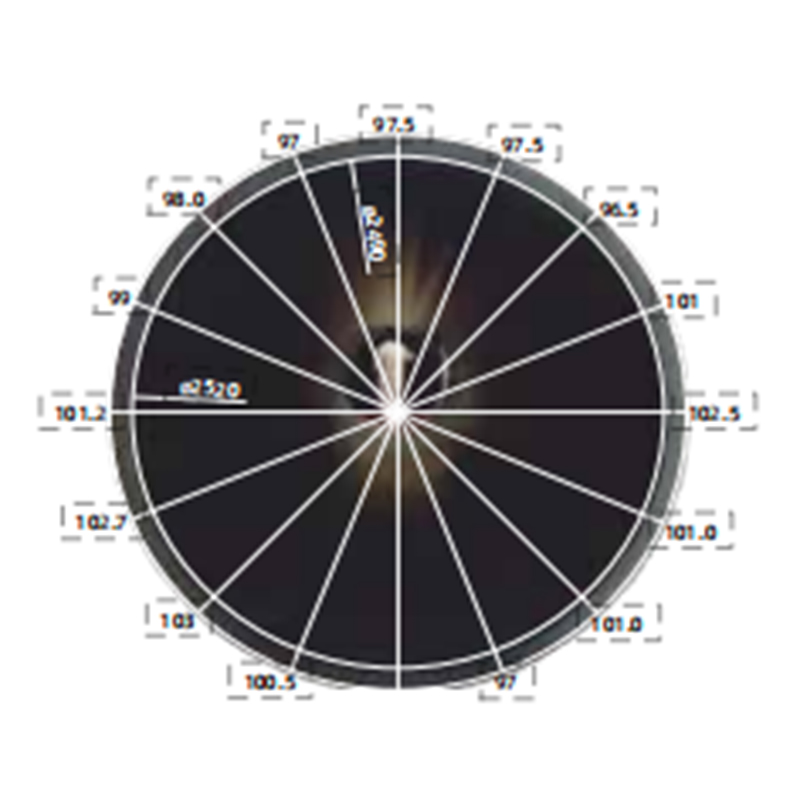
Online wall thickness monitoring (ultrasonic) – accuracy ±0.2 mm.
Melt pressure and temperature recording at the die – alarm when deviation exceeds 3%.
B. Finished pipe testing (per shift)
|
Test |
Equipment |
Acceptance criteria |
|
Hydrostatic pressure test (20°C, 100h) |
Burst testing machine |
PE100 reaches 12.0 MPa |
|
Ring stiffness (SN) |
Universal testing machine |
SN 4 / SN 8 / SN 16 as per design requirements |
|
OIT (Oxidation Induction Time) |
Differential scanning calorimeter |
≥20 minutes at 200°C |
|
Carbon black dispersion |
Microscope |
≤ Grade 3 (ISO 18553) |
C. Real case (JWG-1200)
A pipe manufacturer in the Middle East uses the JWG-1200 (630-1200 mm) for rapid pressure testing: take a 1 m pipe sample every 2 hours, pressurize to 1.5 times the working pressure and hold for 10 minutes. Over 18 months, no field failures have been reported for pipes used in an irrigation network covering 5000 hectares.
|
Model
|
Pipe Spec (mm)
|
Extruder
|
Main Power (kW)
|
Output (kg/h)
|
|
JWG-800
|
400-800
|
JWS 90/42
|
315
|
1100-1200
|
|
JWG-1000
|
450-1000
|
JWS 120/38
|
355
|
1200-1400
|
|
JWG-1200
|
630-1200
|
JWS 120/38
|
400
|
1500-1600
|
|
JWG-1600
|
800-1600
|
JWS 90/42 + JWS 90/42
|
315×2
|
2000-2200
|
|
JWG-3000
|
2000-3000
|
JWS 120/38 + JWS 120/38
|
400×2
|
2600-2800
|
Q1: What is the maximum wall thickness achievable with the JWG-3000?
A: Using twin JWS 120/38 extruders with grooved feed sections, you can achieve wall thickness up to 120 mm (SDR 7.4 for 3000 mm OD). The 2×400 kW motors provide sufficient torque even at low screw speeds (5-8 rpm).
Q2: Can these lines use recycled HDPE?
A: Yes – but only as a core layer and via co-extrusion. The twin-extruder models (JWG-1600 and 3000) allow virgin skin (10-15% of total thickness) and recycled core. To maintain hydrostatic strength, a 70/30 virgin/recycled ratio is recommended.
Q3: How to change pipe diameter on the same production line?
A: Each model covers a diameter range (e.g., JWG-800: 400-800 mm). Changeover time takes about 4 hours – replace the die, sizing sleeve, and haul-off rubber blocks. The screw and barrel remain unchanged because the high-torque design adapts to varying back pressure.
Q4: What is the typical energy consumption per ton?
A: From actual production records:
JWG-800 (1100 kg/h) → 286 kWh/ton
JWG-1600 (2100 kg/h) → 300 kWh/ton (two extruders but higher output)
JWG-3000 (2700 kg/h) → 296 kWh/ton
These figures are 12-18% lower than single-screw lines without barrier screws.
Q5: Do you provide installation and training?
A: Yes – our team handles on-site commissioning (typically 10-14 days) and trains operators in centering adjustment, wall thickness optimization, and preventive maintenance. We also supply spare parts packages based on your annual output.
Q6: How much does output drop when producing different SDR (wall thickness grades)?
A: Output is mainly affected by the pipe's weight per meter. Take JWG-1200 producing DN1000 pipe as an example:
SDR 17 (wall thickness approx. 59 mm) → linear speed approx. 0.45 m/min → output approx. 1550 kg/h (near upper limit).
SDR 11 (wall thickness approx. 91 mm) → linear speed drops to approx. 0.28 m/min → output approx. 1520 kg/h, a drop of about 2%.
SDR 7.4 (wall thickness approx. 135 mm) → linear speed approx. 0.18 m/min → output approx. 1480 kg/h, a drop of about 5%.
Conclusion: Because the screw torque and plasticizing capacity remain fully loaded, the output drop is very small (typically no more than 8%) when wall thickness increases. The real limitations are linear speed and cooling length. If you mainly produce thick-wall pipes, we recommend ordering an extended cooling water tank (add 6 meters) to ensure adequate cooling.
Q7: On the JWG-3000 twin-extruder configuration, if one extruder fails, can the other temporarily produce pipes alone?
A: Yes. We design the twin-extruder models with independent drive and control systems. When one extruder fails, the other extruder can be connected to the corresponding flow channel of the co-extrusion die to temporarily produce pipes near the lower end of the diameter range and with thinner walls. Specific limitations:
In temporary single-extruder mode, the maximum stable outer diameter is about 60% of the model's upper limit (e.g., JWG-3000 single extruder can produce ≤1800 mm).
The maximum wall thickness is about 40% of normal twin-extruder mode (because a single extruder cannot provide enough melt pressure to push extra-thick wall pipes).
Real case: A customer in North America using a JWG-3000 had one extruder's inverter under repair/replacement for 3 days. During that time, they used the other extruder alone to produce DN1600 SDR 26 drainage pipes (wall thickness approx. 61 mm) with output maintained at 1250 kg/h, without interrupting the project schedule. After repair, the two extruders were re-combined and co-extrusion performance remained unaffected.





Tel: +86-19579950928

E-mail: [email protected]

Company Address
No. 128 Qingfeng Road, Xieqiao Town, Haining City, Jiaxing City, Zhejiang Province

19579950928

 English