
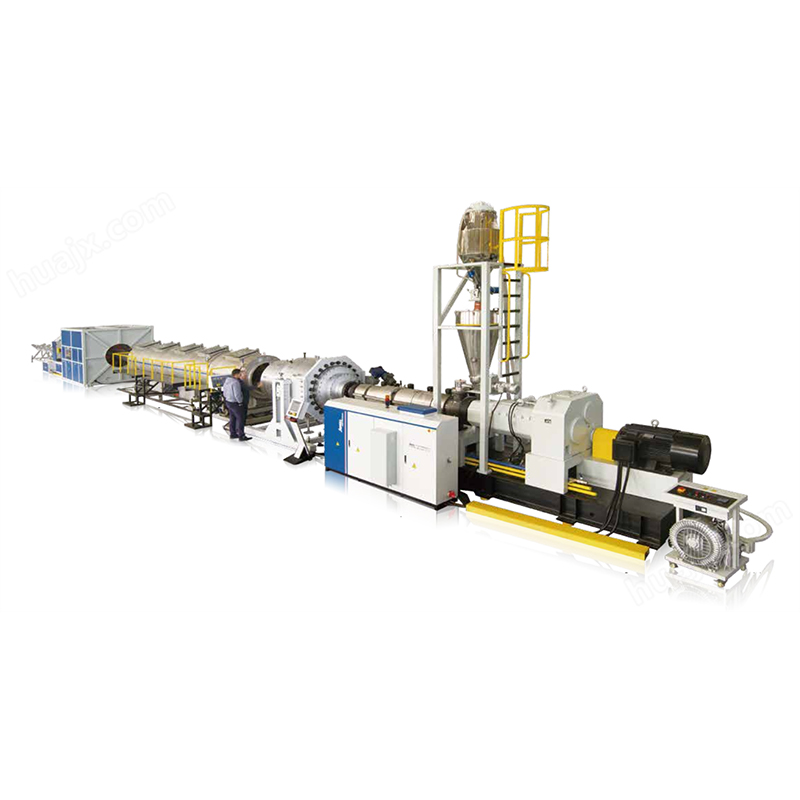
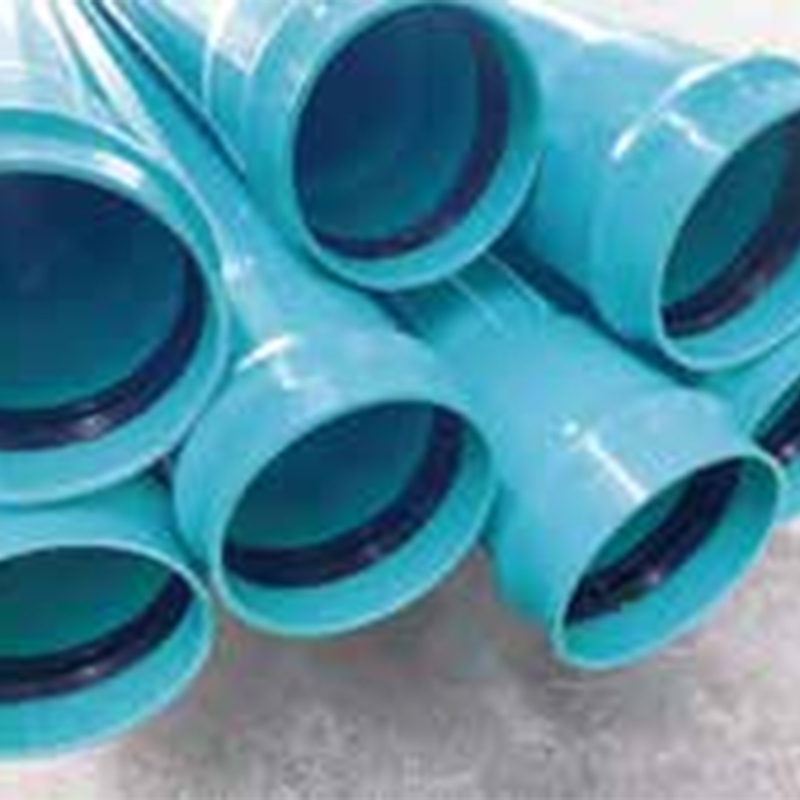
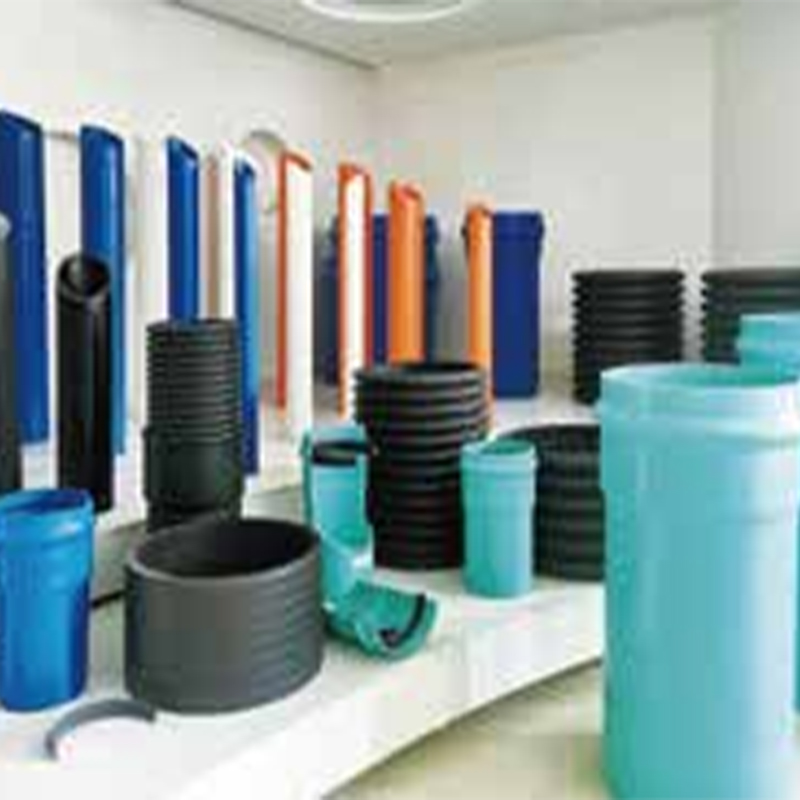
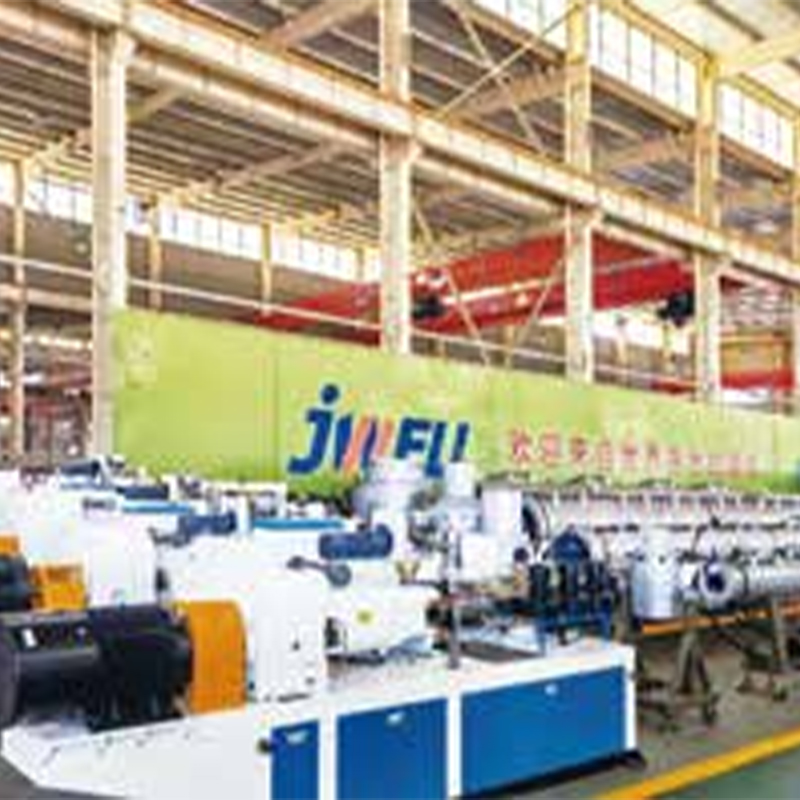
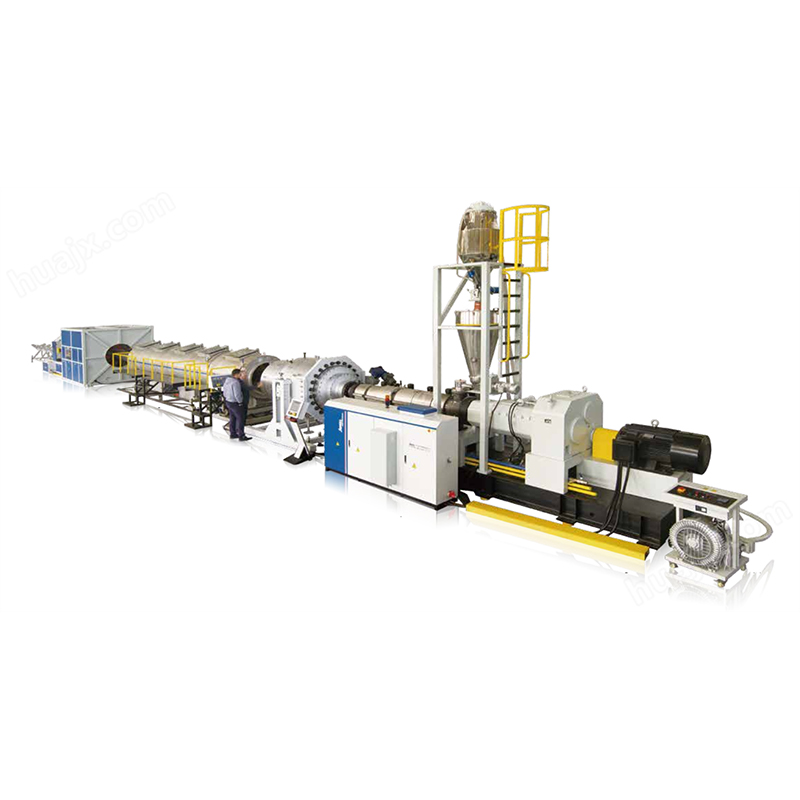
In the field of high-performance rigid pipe production, the JWG series PVC pipe extrusion lines (including single-layer and three-layer co-extrusion models) deliver proven reliability across a wide diameter range – from Ø16 mm to Ø1200 mm.
These extrusion lines are designed for PVC-U, PVC-UH, UPVC, and CPVC pipes. Typical end uses include:
Water supply & drainage (municipal, residential, industrial)
Power & communication conduits (direct burial or overhead)
Sewage & stormwater systems (requiring high ring stiffness)
Chemical delivery (CPVC for higher temperature resistance)
Pipe jacking / trenchless installation (thick-wall PVC-UH)
Real project case:
A municipal department in Southeast Asia uses the JWG-PVC800 line (SJZ110/220 extruder, 160 kW, output 1100–1200 kg/h) to produce Ø630 mm water pipes. The line runs 22 hours per day, achieving a stable output of 1150 kg/h, reducing energy consumption per ton by 18% compared to their old twin-screw line.
Wide diameter coverage, tooling sharing
Single-layer models cover Ø16 mm to Ø1200 mm across 10 standard line types.
Three-layer co-extrusion models (Ø75–Ø630 mm) can add a recycled inner layer or UV-resistant outer layer without reducing production speed.
High output, low energy consumption
|
Model |
Extruder |
Main motor power |
Output |
Typical diameter |
|
JWG-PVC250 |
SJZ80/156 |
55 kW |
450–550 kg/h |
Ø200 mm |
|
JWG-PVC630 |
SJZ92/188 |
110 kW |
700–800 kg/h |
Ø500 mm |
|
JWG-PVC1200 |
SJZ110/220 |
160 kW |
1100–1200 kg/h |
Ø1000 mm |
The SJZ series conical twin-screw extruders provide better mixing and lower melt temperature, meaning less stabilizer consumption – tangible cost savings for UPVC pipe producers.
Three-layer co-extrusion advantages (e.g., JWG-PVC450 Three-layer model)
Outer layer: virgin PVC + UV stabilizer (weather resistance)
Middle layer: up to 50% calcium carbonate or recycled material (cost reduction)
Inner layer: virgin PVC or CPVC (chemical resistance)
An Indian pipe manufacturer switched from single-layer to JWG-PVC450 three-layer co-extrusion (SJZ80/156 + SJZ65/132, 55+37 kW, output 500–700 kg/h) for producing Ø400 mm sewage pipes. They passed the 8 kN/m² ring stiffness test while reducing material costs by 22%.
Easy operation, fast size changeover
All lines feature vacuum calibration tanks with automatic water level control.
On the JWG-PVC400 model, a die change from Ø250 mm to Ø400 mm takes approximately 45 minutes.
Complete production and finished product testing procedures are critical for PVC-UH / UPVC pipes. Below are standard practices supported by JWG lines:
Incoming material inspection
K-value (PVC resin) – 67–68 for pressure pipes
Thermal stability test (200°C oven for 10 minutes)
Moisture content below 0.3% – otherwise pre-dryer recommended
Online process control
|
Parameter |
Monitoring method |
Target value (e.g., Ø315 mm UPVC pipe) |
|
Melt temperature |
Thermocouple at extruder adapter |
185–195°C (CPVC: 200–210°C) |
|
Wall thickness |
Ultrasonic wall thickness scanner (optional) |
Tolerance ±0.2 mm |
|
Ovality |
Laser diameter gauge |
≤1.5% of outer diameter |
|
Vacuum level |
Pressure gauge on calibration tank |
-0.03 to -0.06 MPa |
Offline / laboratory tests (recommended equipment)
Hydrostatic pressure tester – PN16 pipe: 4.2 MPa × 1 hour (no failure)
Falling weight impact tester – 0°C, 2 kg hammer, 2 m drop height (TIR ≤10%)
Vicat softening temperature – PVC-U ≥80°C, CPVC ≥110°C
Extraction test (for lead-free UPVC pipes) – ≤0.01 mg/L
Real quality case:
A customer in Nigeria using JWG-PVC250 (output 450–550 kg/h) occasionally experienced rough inner walls. Inspection revealed the vacuum pump for the calibration tank was running at only 70% power. After restoring it to -0.05 MPa, the inner wall became smooth again. The line now lists the digital vacuum gauge as a standard check item.
Product Parameter:
|
Line Model
|
Pipe Specification (mm)
|
Extruder Model
|
Main Motor Power (kW)
|
Production Output (kg/h)
|
|
JWG-PVC63
|
Φ16 - Φ63
|
SJZ65/132
|
37
|
250~300
|
|
JWG-PVC110
|
Φ20 - Φ110
|
SJZ65/132
|
37
|
250~300
|
|
JWG-PVC160
|
Φ50 - Φ160
|
SJZ65/132
|
37
|
250~300
|
|
JWG-PVC250
|
Φ75 - Φ250
|
SJZ80/156
|
55
|
450~550
|
|
JWG-PVC400
|
Φ200 - Φ400
|
SJZ80/156
|
75
|
550~650
|
|
JWG-PVC500
|
Φ250 - Φ500
|
SJZ92/188
|
110
|
700~800
|
|
JWG-PVC630
|
Φ315 - Φ630
|
SJZ92/188
|
110
|
700~800
|
|
JWG-PVC800
|
Φ400 - Φ800
|
SJZ110/220 or SJP135/31
|
160
|
1100~1200
|
|
JWG-PVC1000
|
Φ630 - Φ1000
|
SJZ110/220 or SJP135/31
|
160
|
1100~1200
|
|
JWG-PVC1200
|
Φ800 - Φ1200
|
SJZ110/220 or SJP135/31
|
160
|
1100~1200
|
|
Type
|
Pipe spec (mm)
|
Extruder
|
Main Power (kW)
|
Output (kg/h)
|
|
JWG-PVC250 Three-layer
|
Ø75 ~ Ø250
|
SJZ65/132+55/110
|
37+22
|
400~500
|
|
JWG-PVC450 Three-layer
|
Ø200 ~ Ø450
|
SJZ80/156+65/132
|
55+37
|
500~700
|
|
JWG-PVC630 Three-layer
|
Ø315 ~ Ø630
|
SJZ92/188+65/132
|
110+37
|
780~900
|
Q1: Can I produce both CPVC and PVC-U on the same line?
A: Yes, but modifications are required. CPVC needs higher melt temperature (200–210°C) and corrosion-resistant screw/barrel (e.g., bimetallic lining). For models like JWG-PVC400, we offer a CPVC upgrade kit (heating bands + dedicated screw). Output will drop by about 15–20% compared to PVC-U.
Q2: What is the actual output of JWG-PVC630 – 700 or 800 kg/h?
A: The range (700–800 kg/h) depends on pipe diameter and wall thickness. For Ø500 mm SDR17 (wall thickness ~29 mm), output is about 780 kg/h. For Ø315 mm SDR26 (wall thickness ~12 mm), output drops to about 710 kg/h because cooling becomes the bottleneck. Please provide your target pipe specifications for a guaranteed value.
Q3: On the JWG-PVC450 three-layer co-extrusion line, how to change from Ø250 mm to Ø450 mm?
A: You need to change the die (about 60 minutes), adjust the calibration tank height (15 minutes), and recalibrate the haul-off speed. The line’s PLC stores recipes – just recall “Ø450xSDR21” and screw speeds adjust automatically. Total downtime for two operators is about 2 hours.
Q4: What is the power consumption per ton of product?
A: Based on field data from JWG-PVC800 line (160 kW main motor, output 1150 kg/h): total line power (including haul-off, vacuum pumps, cooling) is about 220 kW. That equals 191 kWh per ton. For JWG-PVC160 line (37 kW, output 280 kg/h), about 210 kWh per ton – larger models are more energy-efficient.
Q5: Can I add a co-extruder later to a single-layer line?
A: Possible but not economical. You would need a new three-layer co-extrusion die, adapter, and second extruder. For example, upgrading a JWG-PVC250 single-layer to three-layer co-extrusion costs about 70% of a brand new JWG-PVC250 three-layer line. We recommend choosing the three-layer model at the time of purchase.
Q6: How often should the screw and barrel be replaced?
A: For standard PVC-U (without abrasive recyclates), SJZ conical twin-screws can run 12,000–15,000 hours before the nitrided layer wears more than 0.3 mm. For CPVC or high calcium carbonate (≥20 parts), expect 8,000–10,000 hours. Spare screw sets are available.





Tel: +86-19579950928

E-mail: [email protected]

Company Address
No. 128 Qingfeng Road, Xieqiao Town, Haining City, Jiaxing City, Zhejiang Province

19579950928

 English