
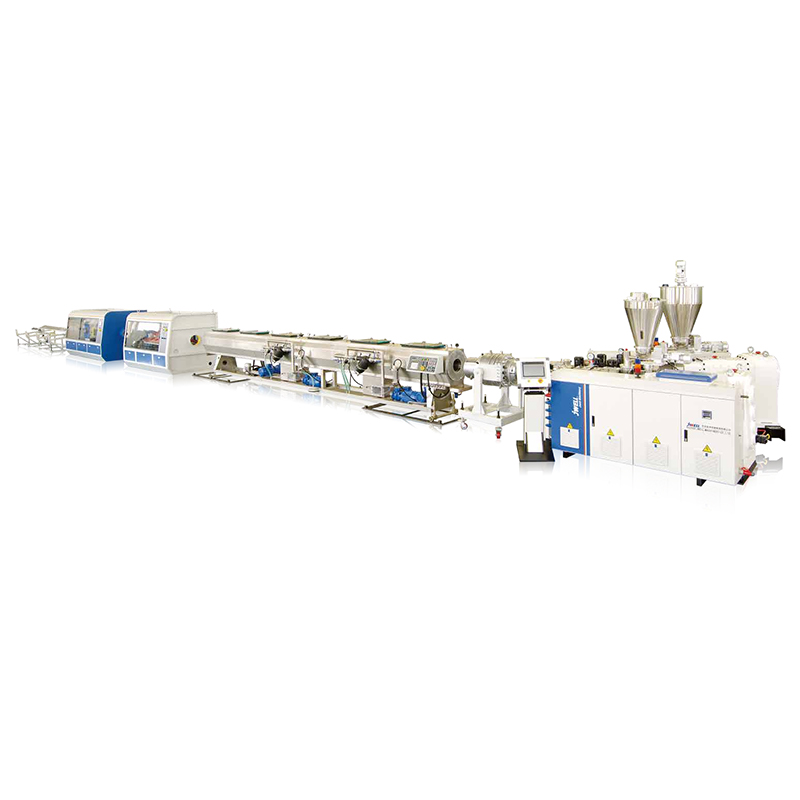
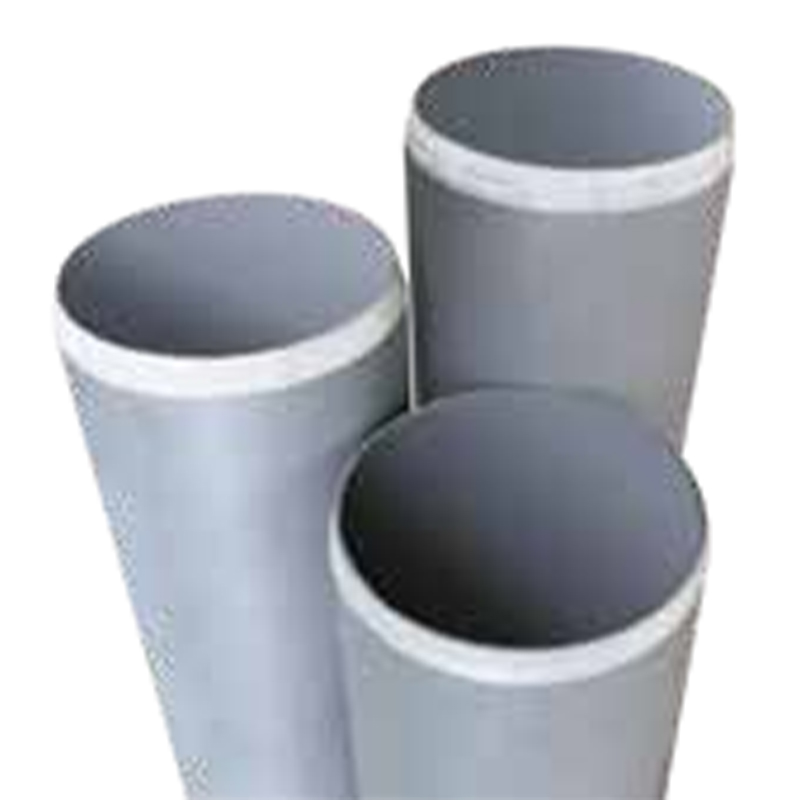
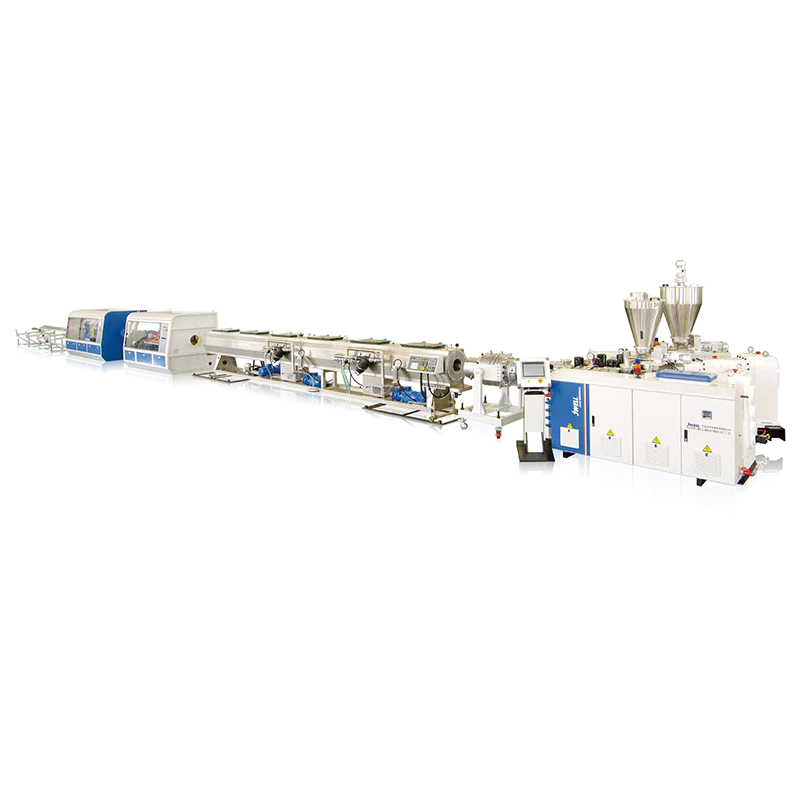
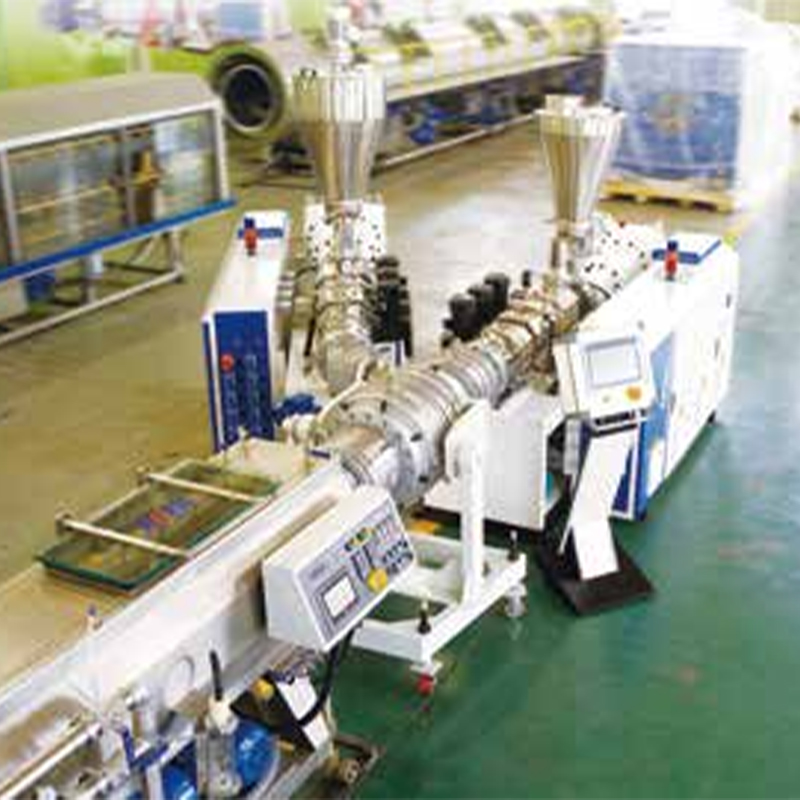
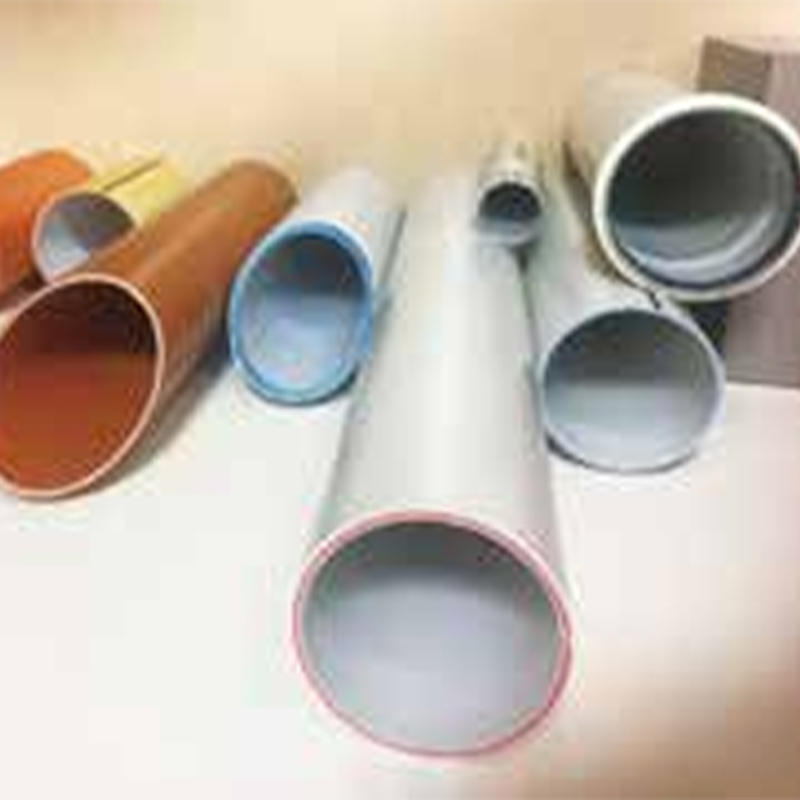
This production line is a three-layer PVC solid-wall pipe co-extrusion line, utilizing a main extruder and two co-extruders working together to produce pipe wall structures with three different formulations for the inner, middle, and outer layers in a single pass. Typical equipment configuration: main extruder 75/30, co-extruders 50/30 or 65/30, pipe diameter range 50–800 mm, maximum output up to 450–600 kg/h.
This three-layer co-extrusion line is widely used for producing high-strength PVC pipes for the following applications:
Municipal drainage and sewage systems – corrosion resistance and high ring stiffness enable them to withstand heavy loads and corrosive wastewater.
Stormwater management – large diameters (up to 800 mm) ensure high flow capacity.
Industrial fluid transport – chemical resistance and smooth inner layer reduce friction and scaling.
Communication and power conduit – lightweight yet rigid, easy to install.
Agricultural irrigation – UV-resistant outer layer suitable for outdoor environments.
Real case study: A municipal project in Southeast Asia replaced old concrete sewage pipes with a 300–600 mm three-layer PVC pipe production line. The produced pipes achieved SN8 stiffness and passed a 10,000-hour hydrostatic pressure test, reducing maintenance costs by 40% over five years.
|
Parameter |
Typical value |
Advantage |
|
Pipe diameter range |
50 – 800 mm |
Covers most civil and industrial requirements |
|
Extruder model |
Main extruder 75/30, co-extruders 50/30 or 65/30 |
Flexible control of layer thickness ratio |
|
Maximum output |
450 – 600 kg/h |
High productivity for continuous production |
|
Three-layer structure |
Inner layer (virgin material), middle layer (recycled/calcium carbonate filled), outer layer (virgin + UV stabilizer) |
Saves material cost while ensuring surface quality |
|
Line speed |
0.5 – 4 m/min |
Adapts to different wall thickness requirements |
Key advantages:
Material saving – By using a filled middle layer (CaCO₃ up to 40 phr), virgin material consumption is reduced by up to 30% while maintaining mechanical strength.
High ring stiffness – Achievable SN4 to SN12; the three-layer design improves the moment of inertia.
Excellent surface finish – The outer layer uses pure compound, free from die flow marks or fish eyes.
Low energy consumption – Co-extrusion allows a lower melt temperature for the middle layer, reducing energy consumption by about 15%.
Quick color change – Only the outer layer needs to be changed, reducing downtime and scrap.
A reliable three-layer production line includes both online and offline inspections:
Online monitoring
Ultrasonic wall thickness gauge – Simultaneously measures inner, middle, and outer layer thickness (accuracy ±0.02 mm).
Melt pressure and temperature sensors – Installed at each extruder die head; alarms when deviation >3%.
Laser diameter gauge – 360° non-contact measurement, triggers automatic vacuum correction.
Offline testing (according to ISO 1452 or ASTM F891)
|
Test item |
Standard |
Acceptance criteria |
|
Falling weight impact |
ISO 3127 |
0°C, 2 kg hammer, 2 m drop height, TIR ≤10% |
|
Ring stiffness |
ISO 9969 |
SN4, SN8, SN12 (≥4 kN/m²) |
|
Hydrostatic pressure |
ISO 1167 |
4.2 MPa for 1 hour without failure (DN≤300) |
|
Interlayer adhesion |
Peel test |
Bond strength >2.5 N/mm |
|
Vicat softening temperature |
ISO 2507 |
Outer layer ≥79°C |
Real quality case study: A factory in Vietnam reduced its scrap rate from 3.2% to 0.8% after installing a three-layer production line with closed-loop wall thickness control. The system corrected layer eccentricity in real time, saving 120 tons of material per year.
|
Type
|
Pipe spec (mm)
|
Extruder
|
Main Power (kW)
|
Output (kg/h)
|
|
JWG-PVC250 Three-layer
|
Φ75 ~ Φ250
|
SJZ65/132+55/110
|
37+22
|
300~400
|
|
JWG-PVC450 Three-layer
|
Φ200 ~ Φ450
|
SJZ80/156+65/132
|
55+37
|
400~600
|
|
JWG-PVC630 Three-layer
|
Φ315 ~ Φ630
|
SJZ92/188+65/132
|
110+37
|
740~900
|
Q1: Can recycled PVC be used in the middle layer?
A: Yes. The three-layer design is ideal for recycling. The middle layer can contain up to 50% clean recycled material or 30% post-industrial waste without affecting surface quality or ring stiffness. Ensure the recycled material has a stable melt flow index (0.5–1.2 g/10min) and is free of metal contaminants.
Q2: How to prevent delamination between layers?
A: Delamination is usually caused by melt viscosity mismatch or contamination. Maintain die temperatures: inner layer 185–195°C, middle layer 175–185°C, outer layer 180–190°C. Use a three-layer spiral distribution die with a land length of 20–25 mm. For highly filled formulations, add 2–3% CPE as a compatibilizer.
Q3: What is the typical energy consumption for a 300 kg/h production line?
A: Total installed power is about 120–150 kW, actual power consumption is about 80–100 kWh per ton of pipe. Energy-efficient models (with AC inverter drives and barrel insulation) can reduce it to 70 kWh/ton.
Q4: How often does the die need to be replaced/cleaned?
A: For continuous production of the same diameter, clean the die every 500–800 operating hours. When changing diameters, use a quick-change die set (≤30 minutes). Regularly inspect the chrome plating on the spiral distributor surface – replace if scratches exceed 0.1 mm in depth.
Q5: The pipe has ovality problems – what is the cause?
A: Ovality >2% is usually caused by uneven cooling or misalignment of the puller. Check:
Cooling tank water level – the pipe must be fully submerged for at least 4 meters.
Vacuum tank sealing – air leaks reduce roundness.
Puller belt pressure – adjust to avoid flattening.
Practical solution: Add an 8-roller calibrator after the vacuum tank; a factory in Brazil reduced ovality from 3.5% to 0.9% using this method.
Q6 (re-numbered as Q6 in original, but here keep as Q6 for consistency): Can this production line produce pipes in different colors?
A: Yes. Simply change the compound color of the outer layer extruder; the inner and middle layers remain unchanged. The color change process takes about 15–20 minutes, with less than 50 kg of waste.
Q7 (re-numbered as Q7): What is the maximum pipe length?
A: Depending on customer requirements, pipes can be cut to fixed lengths of 6 m, 9 m, or 12 m, or continuously coiled for small diameters (DN≤160 mm).





Tel: +86-19579950928

E-mail: [email protected]

Company Address
No. 128 Qingfeng Road, Xieqiao Town, Haining City, Jiaxing City, Zhejiang Province

19579950928

 English