
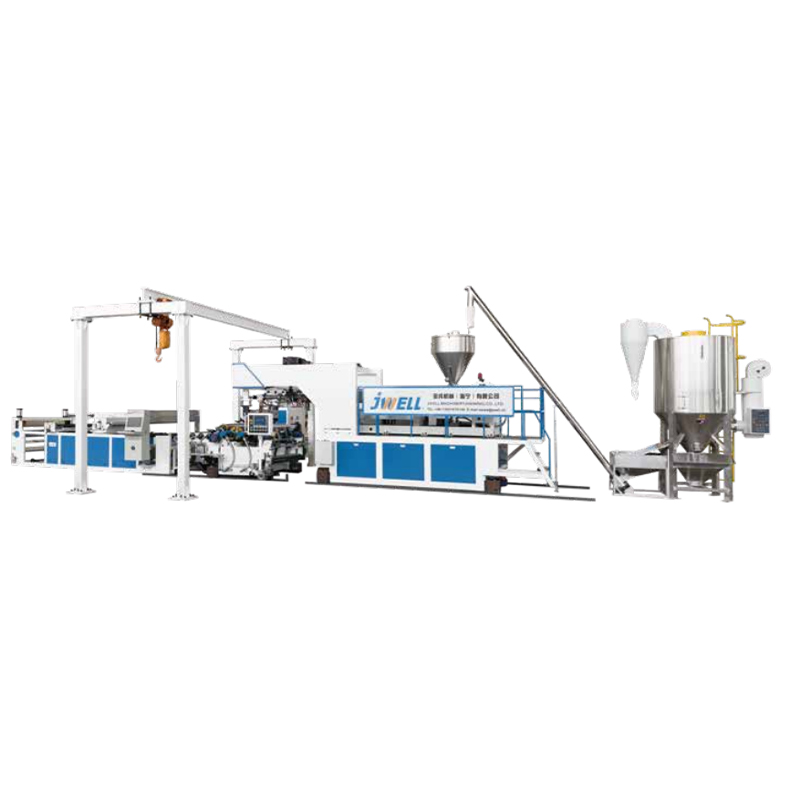
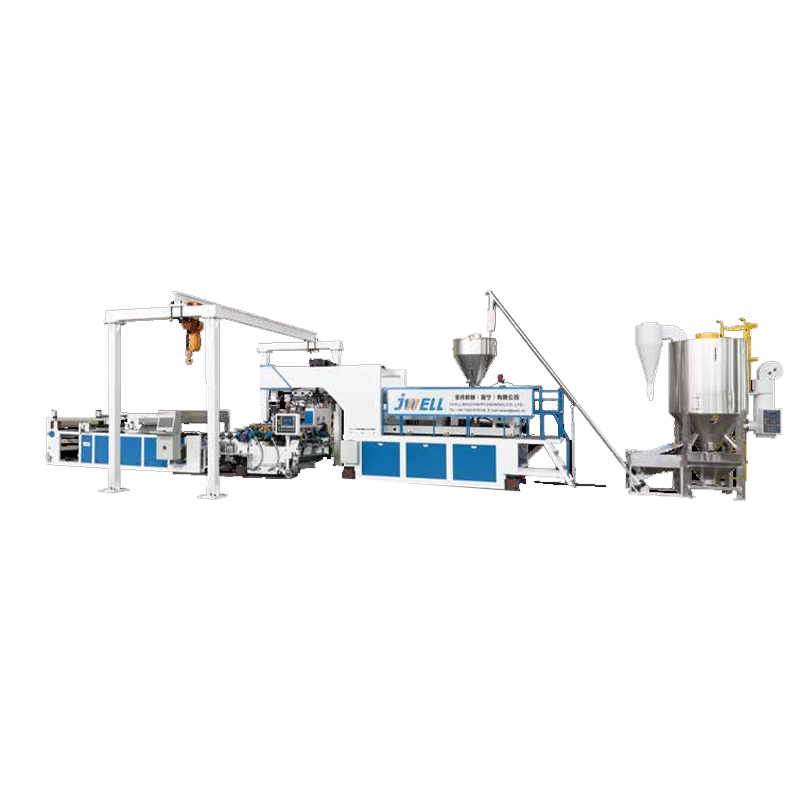
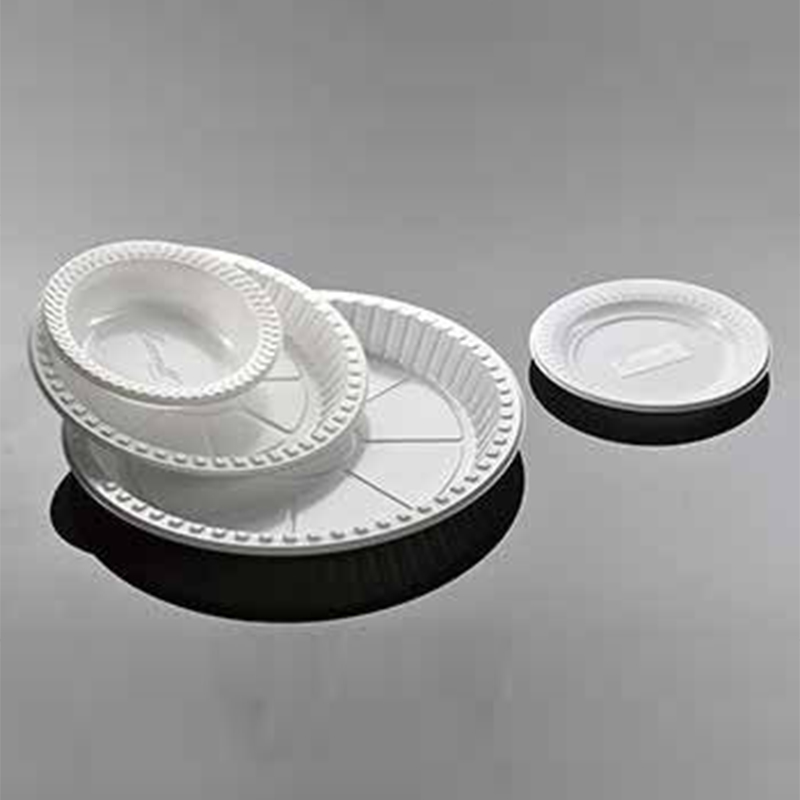
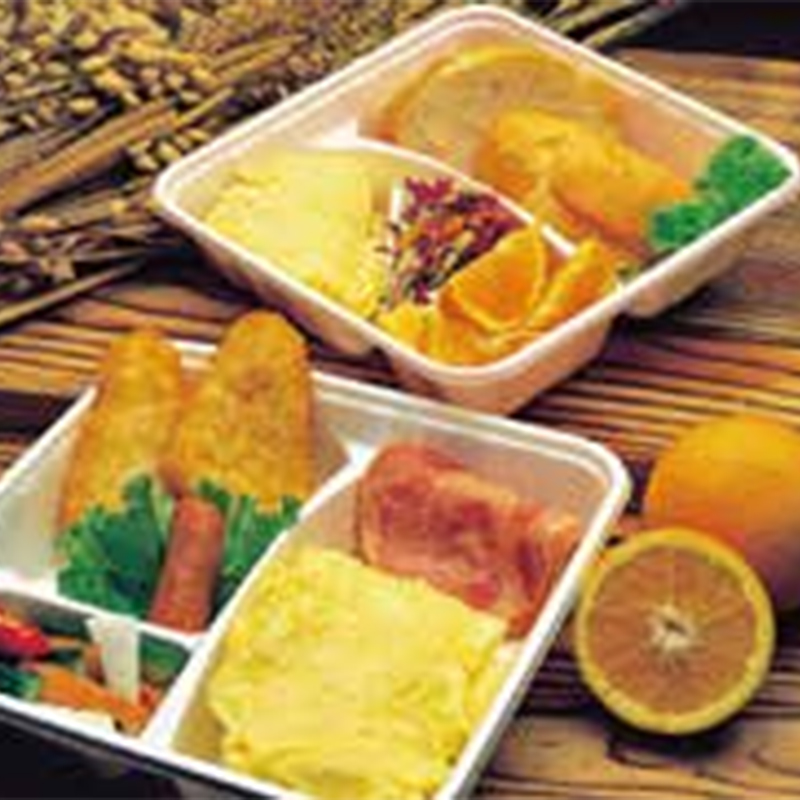
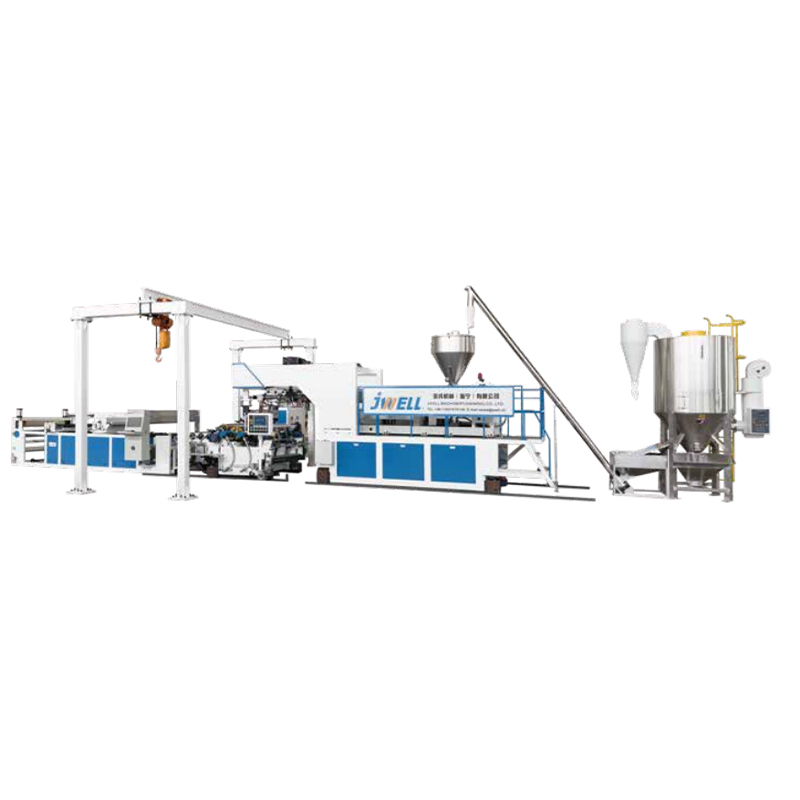
This series of PP/PS thermoforming sheet extrusion lines (JW5120/65-1000, JW5130/75-1000, JW5150/90-1000, JW585/65-1000, JW590-H High-Output, JW5100-H High-Output) is designed for continuous, high-efficiency production of polypropylene (PP) and polystyrene (PS) sheets.
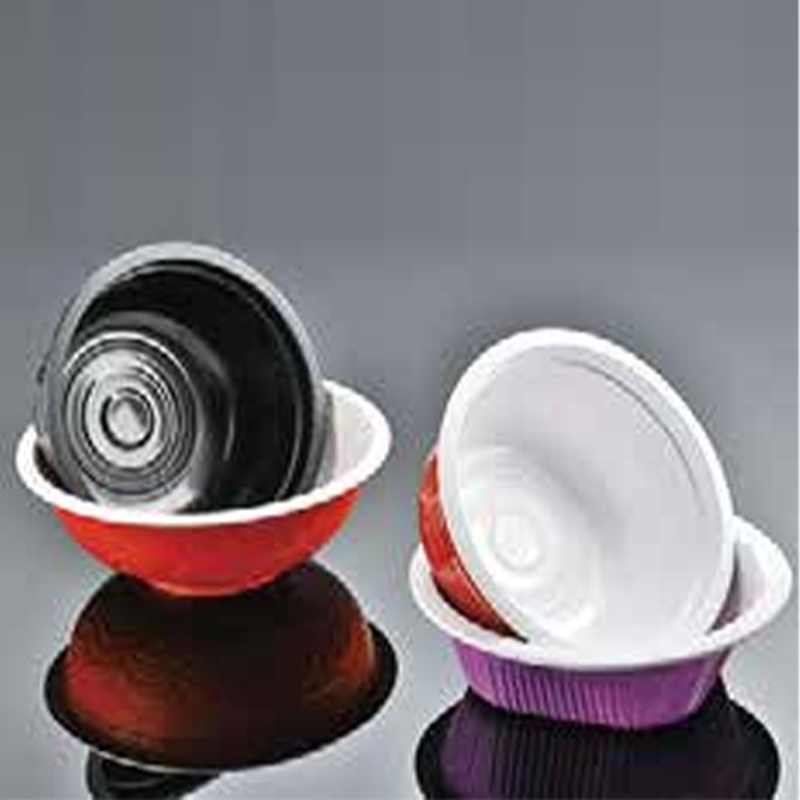
The PP and PS thermoforming sheets produced by our lines are widely used in food packaging, medical trays, disposable cups and lids, electronic component trays, and agricultural seedling trays. Below are specific examples corresponding to our models:
JW5120/65-1000 and JW5130/75-1000 – Suitable for thin-gauge PP/PS sheets (0.2–1.0 mm) used for transparent fruit containers, bakery boxes, and yogurt cups. One European customer used the JW5120 to process PS at 400 kg/h, producing 0.5 mm dessert cups at 800 mm width with zero surface defects.
JW5150/90-1000 – High-output line (700–850 kg/h) for thicker sheets (up to 2.0 mm). A Turkish thermoforming plant uses it to produce black PP sheets for automotive battery trays. The 800 mm width allows two rows of trays per sheet, reducing scrap by 12%.
JW585/65-1000 – Balanced medium-output model (550–700 kg/h), widely used for disposable cutlery and deli containers. A Polish customer continuously produces 0.3 mm PS sheets at 650 kg/h with thickness deviation below 1%.
JW590-H (High-Output) – Optimized for sheets of 0.2–2.1 mm, output 400–500 kg/h. A US packaging company uses it to produce high-clarity PP lids. The "H" design provides faster screw cooling and better melt uniformity.
JW5100-H (High-Output) – Narrower width (400–500 mm) but high speed (600–700 kg/h). Ideal for tube-based thermoforming of straws or small-diameter cups. An Indonesian customer uses it to produce 0.2 mm PS straw reel – the line runs 24/7 with minimal downtime.
All models can process PP and PS homopolymers, copolymers, and recycled blends (up to 30% regrind) without major adjustments.
Based on actual production data from over 20 installations, here are the standout benefits:
2.1 High output + low energy consumption
JW5150/90-1000 achieves 850 kg/h – 15–20% higher than comparable 90mm extruders on the market, thanks to an optimized screw design (L/D 33:1 with mixing section).
Specific energy consumption only 0.28–0.32 kWh/kg (verified by a Malaysian customer producing PP at 750 kg/h).
2.2 Precise width and thickness control
Standard 800 mm width (except JW5100-H: 400–500 mm) with automatic die lip adjustment. Thickness range 0.2 mm to 2.1 mm (JW590-H up to 2.1 mm) – switch from film to rigid sheet without hardware changes.
Real case: A Chilean customer produces 0.6 mm PS sheet with tolerance of ±0.008 mm over 800 mm width – meeting IKEA food-contact standards.
2.3 Fast material and color change
JW series features screw puller and vented barrel design. Switching from white PP to black PS takes less than 40 minutes (including purging). A South African former reported monthly material scrap savings of €2,000 compared to his old line.
2.4 Robust extruder configurations (tandem or single)
Models like JW5120/65-1000 use JW5120 + JW565 tandem configuration – primary extruder melts, secondary extruder cools/boosts. Eliminates melt fracture even at high speeds.
For JW590-H and JW5100-H, single high-torque extruder with grooved feed section handles high backpressure – ideal for low melt strength PS.
2.5 User-friendly HMI and remote support
Siemens PLC with 12-inch touchscreen. All process parameters (melt pressure, temperature profile, screw speed, draw tension) can be saved as recipes. Product changeover time <10 minutes.
Quality control and testing procedures
We follow a strict 5-step QC process for each line – from component manufacturing to final acceptance. Here’s what we do (and what you can expect during your factory acceptance test).
3.1 Raw material and component inspection
All screws and barrels are made of nitrided steel (38CrMoAlA), hardness >900 HV. Each screw is tested for straightness (≤0.05 mm/m) and surface roughness (Ra ≤0.4 μm).
Heating elements and thermocouples are calibrated using master probes (±1°C accuracy).
3.2 Online thickness and width monitoring
NDC or similar infrared gauge scans the sheet at 100 points per second. Data is fed back to the die bolts (automatic profile control). We guarantee:
Thickness tolerance: ±5% of target (e.g., 0.5 mm → ±0.025 mm)
Width tolerance: ±2 mm
For JW590-H, we add a laser width sensor because this model often runs at maximum thickness 2.1 mm, which is prone to edge bead.
3.3 Melt quality testing (MFR and gel count)
During trial runs, melt samples are taken every 2 hours to measure melt flow index (PP: target 2–8 g/10min at 230°C; PS: target 5–12 g/10min at 200°C).
Gel counter (optical scanner) detects unmelted particles >0.2 mm. Acceptable limit: <5 gels/m² for food-grade sheets. For medical applications, <1 gel/m² can be achieved.
3.4 Mechanical and thermal stability testing
The line runs continuously for 72 hours at maximum output (e.g., JW5150/90-1000 at 850 kg/h). We monitor:
Motor current fluctuation ≤5%
Melt pressure fluctuation ≤±1.5 bar
Sheet thickness (longitudinal) deviation ≤±3% over 500 m of roll length
3.5 Finished roll quality inspection
Each roll is checked for:
No fish eyes, streaks, or die lines (visual inspection under 45° light)
Consistent winding tension (no telescoping or wrinkles)Core inner diameter and slitting edge accuracy (±1 mm)
Real case: A German customer had rejected a previous supplier due to poor thickness control. During the FAT for our JW5130/75-1000, they witnessed a 500 kg production run of 0.4 mm PS sheet with deviation of only 0.008 mm – they signed off immediately.
|
Mode
|
Material
|
Extruder Specification
|
Products Width(mm)
|
Products Thickness(mm)
|
|
JWS120/65-1000
|
PP、PS
|
JWS120+JWS65
|
800
|
0.2-2.0
|
|
JWS130/75-1000
|
PP、PS
|
JWS130+JWS75
|
800
|
0.2-2.0
|
|
JWS150/90-1000
|
PP、PS
|
JWS150+JWS75
|
800
|
0.2-2.0
|
|
JWP85/65-1000
|
PP、PS
|
JWP85+JWS65
|
800
|
0.2-2.0
|
|
JWS90-H(High Yield)
|
PP、PS
|
JWS90
|
800
|
0.2-2.0
|
|
JWS100-H(High Yield)
|
PP、PS
|
JWS100
|
800
|
0.2-2.0
|
Q1: Which model should I choose for high-output PP sheet (1.0–1.5 mm thickness, 700 kg/h)?
A: Choose the JW5150/90-1000. It offers 700–850 kg/h capacity, 800 mm width, and handles sheet up to 2.0 mm thick. A Thai packaging company uses 1.2 mm PP sheet for reusable food trays, running continuously at 780 kg/h for 18 months without screw wear issues. If you only need 500 mm width, the JW5100-H (600–700 kg/h) is more cost-effective.
Q2: Can I use recycled PS (post-consumer) on the JW590-H?
A: Yes – but you need a screen changer. The JW590-H comes with a large screen changer (hydraulic, 400 mm² filtration area). For up to 30% regrind, use 80 mesh screens. For 100% recycled PS (e.g., from CD cases), we recommend adding a melt pump to stabilize output. A Mexican customer uses 100% recycled PS on a JW590-H to produce non-food-contact trays (2.0 mm) at 420 kg/h.
Q3: How often do the screw and barrel need replacement?
A: For PP (non-abrasive), expect 25,000–30,000 hours (about 5 years on two shifts). For PS (lower friction), up to 35,000 hours. For reinforced or filled materials (e.g., talc-filled PP), replace at 15,000 hours. We supply hardness test reports with spare parts. A Vietnamese customer ran a JW5120 with PP homopolymer for 28,000 hours – the screw was still within wear tolerance.
Q4: What is the difference between JW585/65-1000 and JW590-H? Their outputs seem similar (550–700 vs 400–500 kg/h)?
A: They serve different thickness needs:
JW585/65-1000 uses a tandem design (85mm + 65mm) – better for thin sheets (0.2–1.0 mm) because the second extruder removes bubbles and reduces orientation. Output: 550–700 kg/h.
JW590-H is a single 90mm high-torque extruder – optimized for thicker sheets (up to 2.1 mm) at moderate output (400–500 kg/h). It has a grooved feed section to push high-viscosity melts.
Example: A Brazilian customer tried to produce 1.8 mm PS on a JW585 – got melt fracture. Switched to JW590-H – perfect surface.
Q5: What is the typical power consumption of the JW5150/90-1000 at 750 kg/h?
A: Measured at our test center: Main motor (160 kW) + heating (45 kW) + downstream equipment (15 kW) = total power 220 kW. At 750 kg/h, that is 0.293 kWh/kg. By comparison, many competitors require 0.35–0.40 kWh/kg at the same output. At €0.12/kWh, annual electricity savings are about €15,000.
Q6: How do you control thickness across 800 mm width without an automatic die?
A: Even our basic model comes with a manual flex lip die (30 adjustment bolts). For automatic control, we offer an automatic profile system with thermal bolts (expand/contract via heating). On the JW5100-H, because the width is only 400–500 mm, a manual die with 20 bolts easily achieves ±0.01 mm – no automation needed.
Q7: What is the lead time? What documents are needed for CE certification?
A: Standard lead time: 60–75 days after deposit. We provide:
CE Declaration of Conformity (Machinery Directive 2006/42/EC)
Electrical schematics (Siemens)
Pressure vessel certificate for cooling rolls (PED 2014/68/EU)
Noise test report (typically 78–82 dB(A) at 1 meter)
A Swedish customer obtained full CE compliance for their JW5130 in 2023 – passed third-party inspection with no modifications.
Q8: Can I produce both solid and foam sheets on the same line?
A: For solid PP/PS only – this line has no foaming agent injection port. If you need foam sheet (e.g., PS foam sheet for food boxes), we offer separate tandem foam sheet lines with a cooling mixer. However, many customers produce microcellular foam sheet by adding chemical foaming agent (CFA) to the hopper – but you would need to replace the screw with a barrier-type screw. Contact us for retrofit kits.





Tel: +86-19579950928

E-mail: [email protected]

Company Address
No. 128 Qingfeng Road, Xieqiao Town, Haining City, Jiaxing City, Zhejiang Province

19579950928

 English